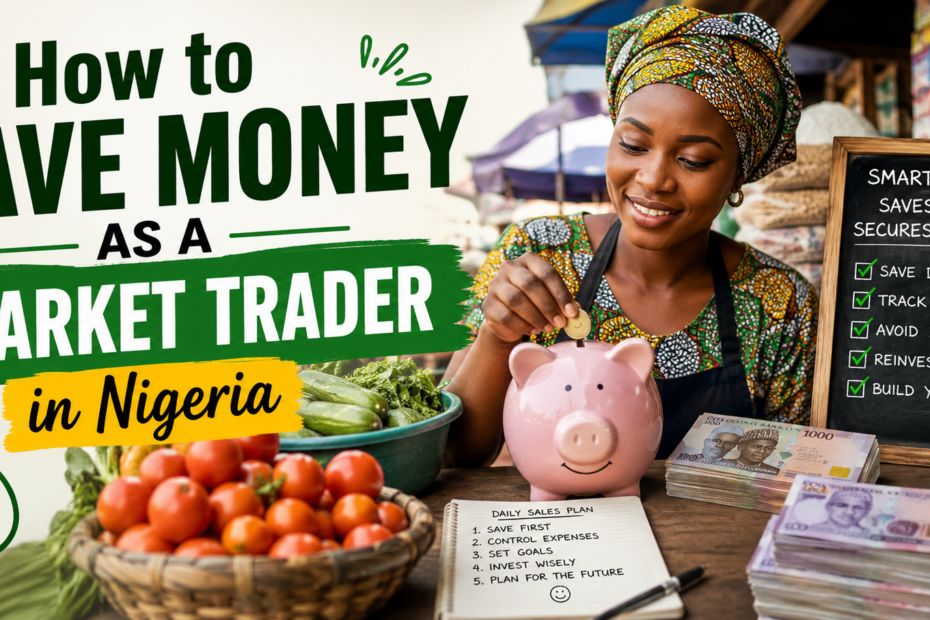
Practical saving strategies
1. Understanding the Reality of Market Trading Income
2. Separate Capital from Profit Immediately
One of the biggest mistakes market traders make in Nigeria is mixing their business capital with profit.
When this happens, the business slowly becomes weak because the money meant to restock goods is being spent on personal needs.
Over time, the trader is unable to buy enough stock, and sales begin to drop. This is one of the main reasons small businesses collapse even when they are making daily sales.
To avoid this, traders must learn to separate capital from profit immediately after each sale cycle. A simple method is to first set aside the original capital used for buying goods before touching any profit.
The capital should remain untouched and strictly used for restocking. Traders can also keep money in different places such as a cash box for daily operations, a separate savings wallet for profit, and a bank account for long-term storage. This discipline helps the business stay strong and grow steadily.
3. Daily Savings Habit (Even if Small)
Building a daily savings habit is one of the most effective ways for market traders in Nigeria to achieve financial stability, even when income is small or inconsistent.
The key is consistency rather than the amount. A trader can start by saving as little as ₦200 to ₦1,000 daily, depending on how much profit is made.
Over time, these small amounts accumulate into a meaningful sum that can support emergencies or business expansion.
One important rule to follow is “save before you spend,” meaning savings should be removed immediately after sales or profit is made, before any other expenses arise.
This prevents the temptation to spend everything. Many traders also benefit from daily contribution systems like ajo or esusu, where they save regularly through trusted groups.
These systems help enforce discipline and ensure money is not easily accessible for impulsive spending. With consistency, small daily savings can grow into financial strength over time.
4. Avoiding Common Money Leaks in the Market
Many market traders lose a significant portion of their earnings not because sales are low, but because of small, unnoticed money leaks that happen every day.
One common habit is spending on unplanned snacks and drinks throughout the day. While these expenses seem small, they add up quickly over time.
Another major issue is giving too much credit or unnecessary discounts to customers, which reduces actual cash flow and affects business stability.
Impulse restocking is also a problem—buying goods without proper planning or understanding what is already in stock often leads to wasted money on slow-moving items.
In addition, family withdrawals from business funds can seriously affect capital, especially when there is no clear separation between personal and business money.
These hidden spending habits may not feel harmful in the moment, but over time they reduce profit and weaken the business. Controlling them is essential for consistent savings and growth.
5. Using Ajo / Esusu the Smart Way
Ajo or esusu is one of the most trusted and practical saving systems among market traders in Nigeria, especially because it encourages discipline and consistency.
It works as a rotating savings system where a group of people contribute a fixed amount of money daily, weekly, or monthly, and each member takes turns receiving the total lump sum.
This method helps traders who find it difficult to save on their own by forcing regular contributions.
However, to use ajo effectively, it is very important to join only trusted and reliable groups to avoid scams or mismanagement of funds.
Many traders prefer groups that are well-known within their market or managed by respected leaders.
The major benefit of this system is discipline—because once you commit, you are expected to contribute consistently without excuses.
Over time, traders use their payout to expand their business, restock in bulk, or handle major expenses, making esusu a powerful tool for capital growth and financial stability.
6. Stock Management to Prevent Waste of Money
Stock management is one of the most important skills a market trader must learn to avoid wasting money and locking up capital in unsold goods.
A common mistake is overbuying slow-moving products simply because they seem cheap or because others are selling them.
When these goods do not sell quickly, the trader’s money becomes stuck in stock instead of being available for other profitable opportunities.
To avoid this, traders should learn how to track fast-selling versus slow-selling products. This can be done by observing daily sales patterns and keeping simple records of what sells quickly and what stays longer on the shelf.
Over time, this helps the trader make smarter buying decisions based on real demand.
Restocking should always be based on demand, not emotions or pressure from suppliers or other traders. Buying only what is needed ensures steady cash flow, reduces waste, and keeps the business flexible and profitable.
7. Keeping Business Records (Simple Daily Notes)
Keeping simple business records is one of the most powerful habits a market trader in Nigeria can develop, yet it is often ignored.
Many traders rely only on memory, which makes it difficult to know whether the business is truly profitable or not.
Writing daily sales in a small notebook is a simple way to stay organized. It helps the trader see exactly how much money comes in each day and how it is being used.
Another important method is tracking profit versus expenses. This means clearly separating money used for restocking, transport, food, and other costs from actual profit.
When this is done consistently, the trader can easily identify real earnings instead of guessing.
With proper records, it also becomes easier to know how much can be safely saved each week without affecting the business.
Even basic note-keeping builds discipline, improves financial awareness, and helps traders make better decisions that support long-term growth and stability.
8. Setting Weekly or Monthly Savings Goals
Separating personal money from business money is one of the most important financial habits a market trader must develop in Nigeria.
Many small businesses fail not because sales are low, but because the trader uses the same money for both personal and business needs.
When everything is kept in “one pocket,” it becomes difficult to track profit, restock properly, or grow the business. Over time, the business slowly loses strength without the owner realizing it.
A simple solution is to physically separate funds. Traders can use different envelopes, wallets, or even separate bank accounts to distinguish business money from personal expenses.
This makes it easier to control spending and protect business capital. Another effective method is paying yourself a fixed “salary” from the business profit. This ensures that personal needs are covered without interfering with business funds.
With this discipline, traders gain better financial control, reduce confusion, and create a stable foundation for long-term business growth.
10. Reducing Unnecessary Market Expenses
An emergency fund is very important for market traders in Nigeria because sales are not always consistent.
There are days when customers are plenty, and there are also “bad market days” when sales are extremely low or almost nothing is made.
Without backup money, traders may be forced to struggle, borrow, or even break their business capital just to survive these difficult periods.
To avoid this, traders should consistently save small amounts from their daily or weekly profit specifically for emergencies.
This money should not be touched except when sales are poor or unexpected expenses arise. Even small contributions build up over time and create a safety net that reduces financial pressure.
Having an emergency fund also helps traders avoid borrowing at high interest rates, which can further weaken their business.
Instead of going into debt during slow periods, they can rely on their saved funds. This creates stability, peace of mind, and long-term business security.
12. Reinvesting Wisely (Not Emotionally)
Using technology for saving has become a smart and modern way for market traders in Nigeria to manage money more effectively.
Even in busy market environments, digital tools can help enforce discipline and make saving easier and more consistent.
One useful option is mobile banking savings features offered by many Nigerian banks. These allow traders to set aside money directly from their accounts into savings, helping them avoid the temptation to spend everything at once.
Fintech apps also play a big role by allowing users to set daily or weekly saving targets. These apps automatically track progress and encourage consistency, even when income is irregular.
Another powerful method is alert-based discipline, such as auto deductions or scheduled transfers. With this, a fixed amount is automatically moved into savings whenever money enters the account.
This reduces emotional spending and ensures regular saving without effort. Overall, technology helps traders build strong financial habits and stay disciplined in a simple and practical way.
14. Mindset Shift: From Spending Trader to Growing Trader
Conclusion
Saving money as a market trader in Nigeria is not about how much you earn daily, but how wisely you manage what comes in.
In a fast-moving environment like Lagos, where prices change quickly and income is never guaranteed, discipline becomes your strongest financial tool.
Small daily actions—saving a little, separating capital from profit, avoiding wasteful spending, and reinvesting wisely—can completely transform your business over time.
It is important to understand that financial stability does not come from luck or higher sales alone, but from consistent habits built every day in the market.
Even in a tough economy, traders who learn to control their money will always stand stronger than those who only focus on making sales.
In Lagos, you don’t always need more money—you often just need a better money strategy. With patience, discipline, and consistency, every trader can move from surviving daily to building lasting financial growth.
Frequently Asked Questions
How to Make 5000 Naira Daily in Nigeria
Making ₦5,000 daily in Nigeria is possible, but it usually requires consistency, practical skills, and choosing opportunities that match your available time and capital. Instead of searching for quick money, focus on activities that can generate repeat income.
One practical option is small-scale trading. You can buy fast-moving items such as snacks, household products, phone accessories, or food items in bulk and sell with a profit margin. Many people start with low capital and grow gradually.
Freelancing is another route. Skills like writing, graphic design, video editing, social media management, and virtual assistance can generate daily earnings once clients become regular. Even basic digital services can become a reliable source of income.
You can also consider service-based work. Examples include laundry services, delivery assistance, tutoring, photography, hair services, or helping businesses manage online pages.
For students or workers, weekend businesses such as selling drinks, thrift items, or preparing homemade food can help achieve daily targets.
Another option is affiliate marketing or content creation, although these usually take time before producing steady income.
To reach ₦5,000 daily consistently, calculate backwards. For example, selling ten items with ₦500 profit each already meets the target. The key is creating a system instead of relying on luck. Start small, track results, reinvest profits, and improve gradually.
What Are the Top 3 Safest Investments?
Safe investments are generally designed to protect capital while producing steady returns. Although no investment is completely risk-free, some are considered more stable than others.
The first option is government-backed fixed-income investments. These are often preferred because they are structured to preserve money while generating predictable returns over time. They may not create explosive growth, but they provide stability.
The second option is high-yield savings or regulated savings platforms. Saving through trusted financial institutions allows money to grow gradually while remaining accessible. This approach works well for emergency funds and short-term goals.
The third option is diversified investment funds. Instead of putting all your money into one business or asset, these spread investments across multiple areas. Diversification reduces the effect of one poor-performing asset.
When choosing investments, consider your goal, time horizon, and risk tolerance. If you need the money within months, prioritize capital preservation. If your timeline is years, moderate growth options may work better.
Avoid investments promising unusually high returns in a short period. Many losses happen because people chase speed instead of sustainability.
A good rule is to build savings first, maintain an emergency fund, and only invest money you will not urgently need.
How to Save 1k in 30 Days?
Saving ₦1,000 in 30 days may seem small, but it is a practical way to build financial discipline and develop the habit of consistency.
Start by breaking the goal into smaller amounts. Saving about ₦35 daily will help you reach and slightly exceed ₦1,000 before the end of the month. Small daily targets feel easier than trying to save large amounts at once.
Separate your savings immediately after receiving money. Do not wait until all expenses are completed because most people spend first and save later. Even keeping the amount in a separate wallet, account, or savings app can help.
Reduce one unnecessary expense. For example, skip impulse snacks, limit unnecessary transport, reduce subscriptions, or avoid daily small purchases that accumulate over time.
Track your progress every week. Seeing your balance increase creates motivation and helps you stay accountable.
If daily saving is difficult, try a weekly approach. Saving ₦250 every week also gets you to the goal.
The bigger lesson is not the ₦1,000 itself but proving to yourself that you can control spending and build consistency. Once the habit becomes easier, increasing the target to ₦5,000, ₦10,000, or more becomes much more realistic.
What Can I Use 10,000 Naira to Invest In?
₦10,000 may not seem like much, but it can still be enough to start building income if used carefully. The goal at this level is usually learning and gradual growth rather than immediate wealth.
One option is micro trading. You can buy and resell small products with regular demand such as drinks, snacks, phone accessories, toiletries, or digital products.
Another option is skill investment. Use the money to learn a marketable skill, purchase internet data, subscribe to training, or buy simple tools needed to begin earning.
Food-related businesses can also work with small capital. Selling homemade snacks, beverages, or packaged items often requires limited startup funds.
Digital opportunities are another path. You can start content creation, affiliate marketing, or offer online services if you already possess a skill.
If you prefer lower effort, consider putting part of the money into savings and using the rest to start a small side business.
Avoid putting the entire ₦10,000 into risky schemes or promises of instant multiplication. Small capital grows better through repetition and reinvestment.
Treat your first ₦10,000 as training capital. The objective is not massive profit immediately but building experience, confidence, and habits that prepare you for larger opportunities.
How to Get 10,000 Monthly Income?
Generating ₦10,000 monthly income is achievable through small but consistent income sources. The amount becomes easier when divided into weekly or daily targets.
One simple approach is offering services. Skills such as tutoring, cleaning, graphic design, writing, social media support, or assisting local businesses can generate extra income monthly.
Selling products is another practical method. Even earning ₦500 profit daily gives around ₦15,000 monthly if maintained consistently.
Students and workers can also create side income through weekend activities. Examples include reselling items, helping with errands, managing online pages, or preparing food for sale.
Digital work can contribute as well. Freelancing, affiliate marketing, and simple online tasks may start slowly but can grow over time.
You can also combine multiple small income streams instead of depending on one source. For example, earning ₦4,000 from a service and ₦6,000 from sales achieves the target.
Keep expenses low while growing income. Many people increase earnings but spend at the same pace.
The most important factor is consistency. A small income earned every month is often more valuable than irregular large amounts. Build systems, improve skills, and reinvest profits to create long-term growth.
Where to Invest Money to Get Good Returns for Beginners?
If you are a beginner, the best investment is usually one that helps you grow money without taking risks you do not fully understand. Good returns should be balanced with safety and consistency.
One of the strongest places to start is automated savings and fixed-income investments. These help you build discipline while earning moderate returns. Another beginner-friendly option is diversified mutual funds because your money is spread across different assets instead of depending on one company or sector.
For Nigerians, a practical beginner approach could look like this:
- 50% → emergency savings
- 30% → regulated low-risk investments
- 20% → learning and trying growth opportunities
If you are interested in stocks, start small and think long term instead of chasing fast profit. Diversification and patience matter more than finding the “perfect” investment.
For many beginners, the best first investment is actually developing income skills while investing gradually.
How to Turn 10K into 100k Fast?
Turning ₦10,000 into ₦100,000 quickly is possible, but it usually happens through business growth or skill monetization, not traditional investing.
A safer approach is multiplying the money through cycles.
Examples:
- Buy and resell products with repeat demand.
- Offer services such as graphics, writing, editing, tutoring, or social media support.
- Start a micro food business.
- Use part of the money to learn a monetizable skill.
For example:
- Start with ₦10k inventory.
- Earn ₦3k–₦5k profit.
- Reinvest repeatedly.
After several cycles, growth compounds.
Be careful with promises like:
- “Double your money in 24 hours”
- Guaranteed crypto returns
- High-yield investment groups
- Referral schemes
Fast growth normally comes with high risk. Focus on speed through repetition and reinvestment, not gambling.
Can I Buy Stock on OPay?
As of now, OPay is mainly focused on payments, transfers, wallets, and related financial services rather than functioning as a full stock brokerage platform. Public information does not indicate that users can directly buy listed stocks inside OPay the same way dedicated investment platforms allow.
If your goal is buying stocks, look for platforms designed specifically for investing and verify regulation, fees, and available markets before funding an account.
Before buying any stock:
- Understand what company you are buying.
- Know fees and withdrawal rules.
- Avoid investing money needed for bills.
For beginners, learning first often matters more than opening an account immediately.
Which Is Better, Piggyvest or Cowrywise?
This depends on your goal.
For disciplined saving, many people lean toward PiggyVest because of its structured savings approach and withdrawal controls.
For investing and broader exposure to mutual funds and investment portfolios, many prefer Cowrywise because it is more investment-focused.
Simple rule:
- Choose PiggyVest if your challenge is saving consistently.
- Choose Cowrywise if your goal is building investments gradually.
A lot of people eventually use both—one for saving discipline and one for investing. Community discussions from Nigerian users often reflect this split in use cases.
What Is the Best Thing to Invest in Right Now in Nigeria?
There is no single “best” investment for everyone because the right choice depends on your timeline and income stability.
For many Nigerians today, a balanced approach often works better:
- Build an emergency fund first.
- Use regulated savings and fixed-income options for stability.
- Add diversified investments for long-term growth.
- Invest in skills that increase earning power.
If you only have a small amount of money, increasing your earning capacity can outperform chasing investment returns.
A simple beginner formula:
Earn → Save → Invest → Reinvest
That order reduces pressure and helps you stay consistent even when markets or income fluctuate.
What to Invest in to Make Money Fast With Little Money?
If your goal is to make money fast with little money, it helps to separate investing from income generation. Most real investments grow slowly. Fast results usually come from increasing cash flow.
One of the strongest options is investing in a small business cycle. For example, buying and reselling products with regular demand can turn a small amount into repeated profit. Food items, digital services, thrift products, accessories, and local supply opportunities often require lower starting capital.
Another option is skill-based investing. Spending ₦5,000–₦20,000 learning a practical skill and using the rest for internet, tools, or promotion can sometimes produce returns faster than traditional investments.
You can also explore regulated investment products, but expect moderate growth rather than quick multiplication.
A simple beginner formula:
- 40% → keep as backup cash
- 40% → use to create income
- 20% → invest for growth
Avoid:
- “Double your money” groups
- Guaranteed daily profit schemes
- Pressure to recruit people
- Investments with unclear regulation
Small money grows faster when reinvested consistently than when chasing shortcuts.
What Creates 90% of Millionaires?
You may have heard statements like “90% of millionaires are created through real estate” or similar versions. Those claims vary and are often oversimplified.
In reality, most wealth is usually built through combinations of:
- Owning businesses
- Long-term investing
- Compounding returns
- Consistent saving and reinvestment
- High-income skills
Business ownership is powerful because it allows income to scale beyond hours worked. Investing helps preserve and grow that income over time.
Many financially successful people also share similar habits:
- They spend less than they earn.
- They invest repeatedly.
- They avoid unnecessary debt.
- They stay focused for years.
The pattern is usually not one lucky investment—it is repeated decisions over a long period.
For beginners, a practical goal is not “becoming a millionaire fast.” It is learning how to:
earn → keep → grow → repeat.
That process tends to produce stronger long-term results than searching for one breakthrough.
Which Bank Is Best to Buy Shares in Nigeria?
There is no single “best bank” to buy shares in Nigeria because shares are normally purchased through licensed stockbrokers, not ordinary savings accounts. Some banks operate stockbroking subsidiaries that connect investors to the market.
Popular choices people often consider include:
These services provide access to buying and selling shares listed on the Nigerian market.
When choosing, compare:
- Regulatory status
- Ease of account opening
- Fees
- Research tools
- Customer support
For beginners, simplicity and trust usually matter more than finding the lowest fee.
Where Can I Invest My Money and Get Monthly Income?
If monthly income is the goal, look for investments designed for cash flow, not rapid appreciation.
Beginner-friendly categories include:
- Fixed-income products that may pay periodic returns
- Dividend-paying investments (returns can vary)
- Money market or income-focused funds
- Rental or business income if capital allows
Think of monthly income investing as building a machine that produces cash over time.
Example approach:
- Emergency fund first
- Stable monthly-income investments second
- Growth investments third
Remember that higher monthly payouts usually mean higher risk.
A good question to ask is:
“Do I want income now, or bigger growth later?”
Your answer changes the type of investment that fits best.
Where Can I Invest Money and Earn Daily?
Daily earnings sound attractive, but genuine investments rarely pay reliable daily returns.
If someone promises:
- fixed daily profit,
- guaranteed daily withdrawals,
- zero risk,
be cautious.
More realistic ways to create daily cash flow include:
- Running a small trading business
- Service-based work
- Short business cycles with reinvestment
- Interest-bearing products that accumulate value over time (even if they do not pay daily)
The closest thing to daily earning for most people is building an activity that produces income regularly rather than expecting an investment to pay every day.
A healthier mindset is:
daily effort → weekly income → monthly wealth
That approach is usually more sustainable than searching for daily investment payouts.