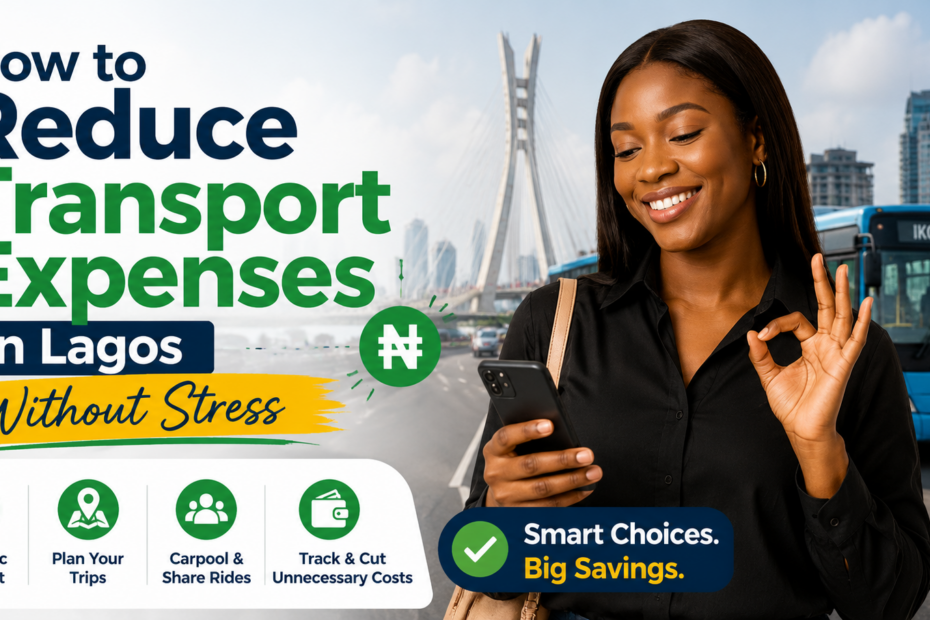
A short trip that used to be affordable now takes a bigger chunk of daily income. From Oshodi to Ikeja, Lekki to Ajah, and other busy routes, traffic alone can turn a simple journey into a long, tiring, and expensive adventure. Many commuters wake up early, spend hours in traffic, and still end up paying more than expected just to get home or work.
The frustration is real—transportation is no longer just about movement; it has become a major expense. This guide will show you simple, stress-free ways to cut transport costs in Lagos without suffering.
1. Plan Your Trips Before Leaving Home
One of the easiest ways to reduce transport expenses in Lagos is to plan your movement before stepping out. Many people spend more money simply because they make unplanned trips or go out multiple times in a day for things that could have been done in one journey.
When you move without a plan, you end up paying extra for short rides, repeated fares, and unnecessary delays in traffic.
A smarter approach is to combine errands into one trip. For example, instead of going out separately for shopping, visiting someone, and handling work-related tasks, you can organize everything into a single route. This reduces the number of times you pay transport fare and helps you save both money and energy.
It is also important to check traffic updates before leaving home. Tools like Google Maps can help you see real-time traffic conditions and choose better travel times or routes.
In addition, avoiding peak hours—early morning rush and evening gridlock—can make a big difference in both cost and stress levels, since fares are often higher and delays longer during those periods.
2. Use BRT and Government Transport Systems
If you want to reduce transport expenses in Lagos without adding more stress to your day, one of the smartest options is to use BRT and other government-supported transport systems whenever possible. While ride-hailing services and taxis offer convenience, their costs can quickly add up—especially for people who commute daily.
BRT buses are generally more affordable because they are designed for mass transportation, making them a better option for workers, students, and regular commuters trying to control monthly expenses. Instead of paying premium fares during busy hours, you can move across major parts of Lagos at a lower and more predictable cost.
Another advantage is that BRT routes tend to be safer and easier to plan around. Since they follow fixed routes and schedules, commuters often know what to expect compared to constantly negotiating transport prices or dealing with fare increases.
Dedicated BRT lanes also help reduce time lost in traffic. In a city where delays can turn a short journey into hours on the road, this can save both time and money.
Popular examples include:
- Oshodi–Abule Egba route – widely used by daily commuters moving across mainland Lagos.
- Ikorodu–TBS corridor – a popular option for reducing travel time into the central business area.
Making BRT part of your routine may not eliminate transport costs completely, but it can significantly reduce how much you spend over time while making daily movement more predictable.
3. Learn Cheaper Route Combinations
One transport habit that saves many Lagos residents money is learning how to combine different transport options instead of always choosing one direct route. In Lagos, convenience often comes at a higher price, especially when using ride-hailing services or taking direct vehicles during busy periods.
A practical way to reduce costs is by mixing transport modes. For example, you can take a keke or short local ride to a major bus stop, continue the journey with a bus or BRT, and then walk a short distance to your final destination. Small adjustments like this can significantly reduce daily transport spending without making movement difficult.
Another smart strategy is avoiding direct expensive routes when cheaper alternatives are available. Direct transport may save a little time, but the extra cost adds up over weeks and months.
For example, instead of booking an Uber from Ajah straight to Victoria Island every day, you could use a combination of bus and ferry services where available. Although it may require a little planning, the total cost can be lower while helping you avoid some road traffic.
The goal is not to make every trip longer—it is to become flexible and choose routes that balance cost, time, and convenience. Once you understand the transport patterns around your regular destinations, saving money becomes much easier.
4. Use Ferry Transport Where Possible
Many people think of road transport first when moving around Lagos, but water transport can be a smart alternative for reducing both travel stress and transport expenses. If your route connects to ferry services, it may be worth considering—especially during periods of heavy traffic.
One of the biggest advantages of ferry transport is speed. While roads can become heavily congested for hours, water routes often provide a smoother and more predictable journey. This can help commuters spend less time in transit and avoid the frustration of sitting in endless traffic.
Ferry transport can also be cost-effective depending on the route and frequency of travel. For people who commute regularly, the time saved may translate into lower daily spending on multiple transport connections and reduced transport fatigue.
Some commonly used examples include:
- Ikorodu ↔ CMS — a popular route for commuters traveling between the mainland and Lagos Island.
- Apapa ↔ Victoria Island — useful for reducing dependence on heavily congested road networks.
Water transport may not suit every destination, but if it connects with your daily route, combining ferry services with buses or short walks can create a cheaper and more efficient commuting routine in Lagos.
5. Walk Short Distances Instead of Taking Vehicles
One simple habit that can reduce transport expenses in Lagos is choosing to walk short distances instead of taking a vehicle every time. Many people spend money on trips that are only a few minutes away without realizing how much those small transport costs add up over time.
For example, taking a keke, bike, or short bus ride for a distance that could be covered in 5–15 minutes of walking may seem convenient in the moment, but repeated daily, those fares can become a noticeable part of your monthly expenses.
Walking short distances can help you cut unnecessary transport spending while giving you more flexibility in your movement. It also reduces the stress of waiting for vehicles during busy periods or dealing with sudden fare increases.
Beyond saving money, walking has added benefits for your health. Regular walking supports physical activity, improves energy levels, and can become an easy way to stay active without needing a gym membership.
Of course, safety and weather should always come first. Choose well-populated routes, avoid unsafe areas, and walk only when the distance is practical. Small decisions like this may not look significant at first, but over weeks and months, they can lead to meaningful savings.
6. Avoid Peak Hours (Very Important Section)
In Lagos, timing can greatly influence how much you spend on transportation. The same route that is affordable in a quiet period can become more expensive and stressful during peak hours. Understanding this pattern is one of the easiest ways to reduce transport expenses without changing your lifestyle too much.
During the morning rush, many commuters are heading to work at the same time. This high demand often leads to increased fares, longer waiting times, and overcrowded vehicles. Drivers and transport operators take advantage of the demand, and passengers end up paying more just to get moving on time.
The same situation happens in the evening. As people leave work and head home, transport fares can rise again due to heavy demand and traffic congestion. What should be a simple journey often turns into a stressful and costly experience.
A practical solution is to adjust your schedule where possible. Leaving home a bit earlier in the morning or returning slightly later in the evening can help you avoid the worst of the rush hours. Even a 30–60 minute difference can make transport cheaper, faster, and far less stressful.
By simply managing your timing, you not only save money but also enjoy a smoother and more comfortable commuting experience in Lagos.
7. Join Carpooling or Ride-Sharing Groups
Another effective way to reduce transport expenses in Lagos is by joining carpooling or ride-sharing arrangements. Instead of paying full fare for every trip, you can share transportation with colleagues, neighbors, or people going in the same direction.
For example, if you and a colleague work in the same area, you can take turns using a single ride or split the cost of an Uber or Bolt trip. This immediately reduces how much each person spends daily while still enjoying the comfort of a direct ride.
Carpooling also works well in office environments where employees live within similar routes. Many workplaces or informal groups already organize shared transport plans, especially for people commuting long distances. This helps everyone save money while reducing the stress of finding transport every morning.
In addition, WhatsApp communities and neighborhood groups have become common places where people connect for ride-sharing. You can easily find others heading your direction and agree on how to split fuel or ride costs fairly.
Beyond saving money, carpooling can also reduce stress since you are no longer handling all transport expenses alone. It encourages better planning, builds connections, and makes daily commuting more predictable in a busy city like Lagos.
8. Consider Living Close to Work (Long-Term Tip)
One of the most effective long-term ways to reduce transport expenses in Lagos is to live closer to your workplace or daily business location. While this may not be an immediate solution for everyone, it can have a huge impact on your monthly budget over time.
When you live far from work, you spend money every single day on transport—sometimes multiple times a day. These costs add up quickly, especially with rising fares, traffic delays, and occasional route changes. But when your home is close to your workplace, you can drastically reduce or even eliminate daily transport expenses.
At first, renting a place closer to work may seem more expensive, but it is important to look at the bigger picture. In many cases, the money saved on transport, time wasted in traffic, and daily stress can balance out the higher rent. You also gain extra time that can be used for rest, side work, or personal development.
Beyond money, living nearby improves your quality of life. You avoid long commutes, reduce fatigue, and have more control over your daily schedule. In a city like Lagos, where traffic can be unpredictable, proximity often becomes a smarter financial and lifestyle decision in the long run.
9. Budget Your Weekly Transport Expenses
One often overlooked way to reduce transport expenses in Lagos is to treat transportation like a real budgeted cost, not something you spend on randomly. When you don’t track it, transport money disappears quickly without you realizing how much you’re actually spending each week.
A simple but powerful method is to set a weekly transport limit. Decide how much you can afford to spend on movement in a week based on your income, then stick to it. This helps you become more intentional with every trip you make, instead of moving around without planning.
It is also important to track your daily spending. Even small fares like keke, short bus rides, or quick Bolt trips add up faster than most people think. Writing it down or using a simple notes app can help you see where your money is going and where you can cut back.
Another key habit is avoiding unnecessary “emergency trips” that are not truly urgent. Many people go out for things that could wait or be done in one combined trip, leading to avoidable transport costs.
When you start budgeting your transport like other major expenses, you gain more control over your money and reduce wasteful spending without changing your lifestyle drastically.
Conclusion
Reducing transport expenses in Lagos is not about drastic lifestyle changes—it is about small, smart adjustments that make daily movement easier and cheaper. From planning your trips ahead, using BRT and government transport systems, combining cheaper routes, and even walking short distances, every step you take adds up to real savings over time.
The truth is, smart planning will always beat daily struggle. When you understand how transport works in Lagos and make intentional choices, you spend less, stress less, and move more efficiently across the city. Even simple habits like avoiding peak hours or budgeting your weekly transport can make a noticeable difference.
Consistency is the key. The more you practice these strategies, the more natural they become—and the more money you save without even thinking about it.
In Lagos, you don’t always need more money—you often just need better movement strategy.
Frequently Asked Questions
What are ways you can reduce transportation expenses?
Reducing transportation expenses requires a combination of planning, discipline, and smart daily choices. One of the most effective ways is to reduce unnecessary movement.
Many people spend more money on transport simply because they make frequent trips that are not planned or essential. By grouping your activities—such as shopping, banking, or visiting friends—you can complete multiple tasks in a single journey instead of paying for transport multiple times.
Another important method is choosing cheaper transport options. In many cities like Lagos, transportation costs vary depending on the mode used. Public transport such as buses (danfo or BRT) is significantly cheaper than taxis or ride-hailing services.
Even though it may be less comfortable, it helps save a lot of money over time. Sharing rides with colleagues or neighbors going in the same direction is another effective cost-saving strategy.
Walking short distances instead of taking transport also helps reduce expenses. Many people overlook this, but walking not only saves money but also improves health.
Additionally, planning your routes carefully can reduce costs. Instead of taking indirect or congested routes that increase fare, choosing direct and less busy routes can make transportation more efficient.
Finally, budgeting for transport weekly or monthly helps control spending. When you set a limit, you become more conscious of how often you move around. Over time, these small adjustments combine to significantly reduce your overall transportation expenses without necessarily reducing your quality of life.
How to save money on transportation costs?
Saving money on transportation costs starts with intentional lifestyle adjustments and financial awareness. The first step is creating a transportation budget.
When you know how much you are allowed to spend daily or weekly, it becomes easier to avoid unnecessary trips or expensive transport options. Many people overspend simply because they do not track their movement expenses.
Another effective method is using public transportation systems whenever possible. In cities like Lagos, buses and shared transport are far more affordable than private taxis or ride-hailing apps.
Although they may require more patience, they significantly reduce daily commuting costs. For people working in offices or attending school, consistency in using the same route and transport type can help stabilize expenses.
Living closer to your workplace or school is another long-term solution. Even if rent is slightly higher in such locations, the money saved on daily transport often compensates for it. Remote work or hybrid jobs also reduce commuting costs drastically, allowing individuals to save more money monthly.
You can also reduce transport costs by avoiding peak-hour travel when fares are often higher due to demand and traffic delays. Additionally, carpooling or joining group transport arrangements helps split costs among multiple people, making it more affordable.
Ultimately, saving money on transportation is about discipline and planning. The goal is not to stop moving but to move smarter, reduce unnecessary trips, and choose cost-effective options consistently.
How to make transport cheaper?
Making transport cheaper involves both personal decisions and strategic lifestyle changes. One of the most effective ways is adopting shared transportation systems.
Instead of using private vehicles or ride-hailing services alone, sharing rides with others reduces the cost per person significantly. This is especially effective in urban environments where many people travel similar routes daily.
Another method is using affordable public transport systems. In many developing cities, government or private bus systems offer the lowest fares compared to other options. Although they may not be the most comfortable, they remain the most cost-efficient for daily commuting.
Planning your travel time also plays a role in making transport cheaper. Traveling during off-peak hours can sometimes reduce fares and helps avoid traffic congestion, which increases fuel and transport costs.
Additionally, reducing the number of trips you make each day directly lowers your transport expenses. Combining errands into a single outing is a practical approach.
For long-term savings, choosing accommodation close to your workplace or school is highly effective. This reduces daily dependency on transport and can sometimes eliminate it entirely for certain days. Another important factor is avoiding unnecessary luxury transport choices when a cheaper alternative exists.
Finally, technology can help reduce transport costs. Using navigation apps to find the shortest or least congested routes helps save both time and money. When combined, these strategies make transportation significantly more affordable without reducing mobility or productivity.
What are the solutions to traffic congestion in Lagos?
Traffic congestion in Lagos is a major challenge caused by high population density, limited road infrastructure, and heavy dependence on road transport. One of the most effective solutions is improving public transportation systems.
Expanding and modernizing buses, rail systems, and water transport can reduce the number of private vehicles on the road. When more people rely on efficient public transport, traffic naturally decreases.
Another solution is better traffic management and enforcement. Proper regulation of road usage, strict enforcement of traffic laws, and reduction of illegal parking or roadside trading can significantly improve traffic flow. Traffic officers also need better training and technology support to manage congestion more efficiently.
Infrastructure development is equally important. Expanding existing roads, constructing flyovers, and creating alternative routes can help reduce bottlenecks in high-traffic areas. However, infrastructure alone is not enough if population and vehicle usage continue to grow without control.
Encouraging flexible work arrangements can also reduce congestion. When companies adopt remote work or staggered working hours, fewer people are on the road at the same time. This spreads traffic flow across the day instead of concentrating it during rush hours.
Finally, promoting water transportation and rail systems in Lagos is a long-term solution. Since Lagos has coastal and lagoon areas, water transport can significantly reduce road pressure. If properly developed and made affordable, it can become a major alternative to road commuting.
In summary, solving Lagos traffic requires a combination of infrastructure, policy enforcement, and behavioral change from citizens.
Which method gives the least transportation cost?
The method that gives the least transportation cost is generally public transportation combined with walking for short distances. Public transport such as buses is usually the cheapest option because the cost is shared among many passengers. This significantly reduces the amount each individual pays per trip compared to private taxis or ride-hailing services.
Walking short distances is completely free and often underestimated. In many urban areas, people spend money on transport for distances they could easily walk. Over time, these small savings accumulate into a significant reduction in monthly transport expenses.
Another very low-cost method is carpooling or ride-sharing with colleagues, friends, or neighbors. When fuel or transport costs are shared, the burden becomes much lighter for everyone involved. This is especially useful for people working in the same area or living along the same route.
However, the absolute cheapest method depends on lifestyle. For someone living close to their workplace or school, walking or cycling may be the least expensive option overall. For others, combining public transport with minimal taxi usage provides the best balance between cost and convenience.
Ultimately, the lowest transportation cost method is not just one option but a combination of strategies: using public transport, reducing unnecessary travel, walking short distances, and sharing rides whenever possible. The key is consistency and discipline in choosing the most economical option available in every situation.
What are the 7 pillars of logistics?
The seven pillars of logistics represent the core elements that ensure goods and services move efficiently from producers to consumers. These pillars are essential for maintaining a smooth and cost-effective supply chain system.
The first pillar is transportation, which involves moving goods from one location to another using road, rail, air, or water. Without efficient transportation, logistics becomes slow and unreliable.
The second pillar is warehousing, which refers to storing goods safely before they are distributed. Warehousing ensures that products are available when needed and helps balance supply and demand.
The third pillar is inventory management, which focuses on controlling stock levels to avoid shortages or overstocking. Proper inventory management reduces waste and improves efficiency.
The fourth pillar is material handling, which involves the movement, protection, and storage of goods within warehouses or facilities. The fifth is packaging, which protects products during transport and makes handling easier and safer.
The sixth pillar is information management, which ensures that accurate data flows between suppliers, transporters, and customers for better decision-making.
The seventh pillar is customer service, which ensures that logistics systems meet customer expectations in terms of delivery time, product condition, and reliability. Together, these seven pillars work as a connected system that ensures goods move efficiently, safely, and cost-effectively across the supply chain.
What are the two methods to solve the transportation problem?
In operations research, the transportation problem focuses on finding the most efficient way to distribute goods from multiple suppliers to multiple destinations while minimizing cost. The two primary methods used to solve this problem are the North-West Corner Rule and the Least Cost Method.
The North-West Corner Rule is a simple initial solution technique. It starts from the top-left corner (north-west) of the transportation matrix and allocates supply to demand step by step until all requirements are satisfied. While it is easy to apply, it does not always produce the optimal solution because it does not consider transportation cost differences.
The Least Cost Method, on the other hand, is more efficient. It allocates goods starting from the cell with the lowest transportation cost in the matrix.
This method helps reduce overall cost from the beginning and usually provides a better initial solution than the North-West Corner Rule. However, it may still require further optimization using methods like MODI (Modified Distribution Method) or stepping stone techniques.
Both methods are important because they provide a starting solution that can be improved. In practice, logistics managers prefer cost-based approaches because they lead to more efficient and economical transportation plans.
What are the biggest problems in Lagos?
Lagos, being one of the fastest-growing cities in Africa, faces several major challenges that affect daily life and economic activities. One of the biggest problems is traffic congestion.
Due to high population density, limited road infrastructure, and heavy reliance on road transport, Lagos roads are often overcrowded, leading to long travel times and productivity loss.
Another major issue is inadequate infrastructure. Many roads, drainage systems, and public facilities are not sufficient for the growing population. This leads to flooding during heavy rains, road damage, and general urban stress. Housing is also a major concern, as the demand for accommodation far exceeds supply, leading to overcrowding and high rent prices.
Unemployment and underemployment are also significant challenges. While Lagos is an economic hub, job opportunities are not enough to match the growing labor force, leading many people to engage in informal or unstable work.
Additionally, waste management and environmental pollution remain serious problems. Improper disposal of waste contributes to blocked drainage systems and health risks. Security concerns in some areas also affect residents and businesses.
Despite these challenges, Lagos remains a vibrant city with strong economic potential. However, solving these problems requires long-term investment in infrastructure, better urban planning, and effective governance.
What are the 7 major modes of transportation?
The seven major modes of transportation describe the different ways goods and people move from one place to another. The first is road transport, which includes cars, buses, motorcycles, and trucks. It is the most common mode because it offers flexibility and door-to-door service.
The second is rail transport, which uses trains to move passengers and heavy goods over long distances. It is efficient for bulk transportation and reduces road congestion. The third is air transport, which is the fastest mode and is mainly used for long-distance travel and high-value or urgent goods.
The fourth is water transport, which includes ships, boats, and ferries. It is ideal for transporting large quantities of goods across seas and rivers at low cost. The fifth is pipeline transport, which is used for moving liquids and gases such as oil and natural gas through pipelines.
The sixth is ropeway or cable transport, often used in mountainous areas or tourist locations. It includes cable cars and gondolas. The seventh is multimodal transport, which combines two or more modes of transportation in a single logistics chain to improve efficiency and reduce costs.
Each mode has its advantages depending on cost, speed, distance, and type of goods being transported.
What are the 3 C’s of logistics?
The 3 C’s of logistics refer to Cost, Customer, and Convenience, which are the key principles guiding effective logistics management. The first “C,” Cost, focuses on minimizing transportation and operational expenses while maintaining efficiency.
Businesses aim to reduce costs without compromising service quality, as logistics expenses directly affect profitability.
The second “C,” Customer, emphasizes meeting customer expectations. In logistics, customer satisfaction is critical because timely delivery, product condition, and service reliability determine whether customers remain loyal. A strong logistics system ensures that goods arrive on time and in good condition.
The third “C,” Convenience, refers to how easy and accessible the logistics process is for both businesses and customers. This includes smooth ordering systems, flexible delivery options, and simple return processes. The more convenient the system, the more efficient the supply chain becomes.
Together, these three principles help businesses design logistics systems that are efficient, customer-friendly, and cost-effective. Balancing all three is essential because focusing on one without the others can lead to inefficiency or dissatisfaction.
What are the 5 D’s of logistics?
The 5 D’s of logistics are important principles that help organizations manage the movement of goods efficiently and effectively. They are Delivery, Demand, Destination, Duration, and Documentation. Each of these plays a major role in ensuring that supply chain operations run smoothly from start to finish.
Delivery refers to how goods are transported from the supplier to the customer. This includes the choice of transport mode, delivery speed, and reliability. Efficient delivery ensures that products arrive in good condition and on time, which directly affects customer satisfaction.
Demand focuses on understanding what customers need and when they need it. Accurate demand forecasting helps companies avoid overstocking or understocking, both of which can cause financial loss or service failure. Proper demand planning ensures that logistics operations are aligned with market needs.
Destination refers to the final location where goods are delivered. Logistics planning must consider distance, accessibility, and route efficiency to ensure smooth delivery. Poor destination planning can lead to delays and increased costs.
Duration is the time it takes for goods to move through the supply chain. Faster duration often means better customer satisfaction, but it must be balanced with cost efficiency.
Documentation involves all paperwork and digital records required in logistics, such as invoices, shipping documents, permits, and tracking information. Proper documentation ensures transparency, reduces legal issues, and improves coordination between all parties involved.
Together, the 5 D’s help logistics professionals maintain control, reduce errors, and improve overall efficiency in supply chain operations.
What are the 6 rules of logistics?
The 6 rules of logistics are commonly known as the right principles of logistics management, which ensure that goods are delivered efficiently and effectively. These rules are: Right product, Right quantity, Right condition, Right place, Right time, and Right cost.
The right product means delivering exactly what the customer ordered without mistakes or substitutions. This ensures customer satisfaction and trust in the supply chain system. The right quantity ensures that the correct number of items is delivered—neither too much nor too little—helping to avoid waste or shortages.
The right condition focuses on ensuring that goods arrive undamaged and in usable condition. Proper packaging, handling, and transportation methods are essential to maintain product quality throughout the logistics process.
The right place ensures that goods are delivered to the correct destination without errors. Even a small mistake in location can lead to delays, additional costs, and customer dissatisfaction.
The right time emphasizes timely delivery. Delivering too early or too late can affect customer needs, especially in industries like retail, healthcare, or manufacturing where timing is critical.
Finally, the right cost ensures that logistics operations are carried out in the most cost-effective way possible without compromising quality or service. Businesses must balance efficiency and affordability.
Together, these six rules form the foundation of effective logistics management and help organizations deliver value consistently.
What is the poorest part of Lagos?
Lagos is a highly diverse city with both wealthy neighborhoods and low-income communities spread across different areas. Instead of identifying a single “poorest part,” it is more accurate to describe certain areas as low-income or densely populated informal settlements where living conditions are more challenging due to overcrowding, limited infrastructure, and higher poverty levels.
Some of these communities are found in mainland Lagos areas such as parts of Mushin, Ajegunle, Agege, and some areas of Lagos Island like Makoko. These locations are known for high population density and limited access to modern housing and infrastructure.
However, it is important to understand that these areas are not defined solely by poverty; they are also vibrant communities with strong economic activity, small businesses, and hardworking residents.
Living conditions in such areas can include challenges like inadequate drainage, traffic congestion, limited access to clean water in some spots, and overcrowded housing. Despite this, many people in these communities engage in trading, transportation services, craftsmanship, and informal businesses that support Lagos’s economy.
It is also important to avoid labeling any part of Lagos as permanently “poorest,” because economic conditions can change over time due to development projects, urban renewal, and government interventions. Lagos is a city of contrast, where even low-income areas contribute significantly to its growth.
In summary, while some areas face more economic and infrastructural challenges than others, Lagos remains a mixed city where poverty and prosperity exist side by side.
What is the safest area in Lagos?
Safety in Lagos varies depending on location, time, and individual experience. Rather than declaring a single “safest area,” it is more accurate to highlight neighborhoods that are generally considered more secure, well-planned, and residential-friendly due to better infrastructure, security presence, and organized development.
Areas such as Ikeja, Victoria Island, Lekki, and Ikoyi are often regarded as relatively safer compared to many other parts of the city. These locations typically have better road networks, private security services, gated estates, and stronger police presence. They also host many businesses, embassies, and high-income residential estates, which contribute to increased security measures.
For example, Ikoyi and Victoria Island are known for high-end residential buildings, corporate offices, and strict access control in many estates. Lekki has rapidly developed into a modern residential and commercial hub with many gated communities. Ikeja, being the capital of Lagos State, has a mix of residential and commercial zones with relatively stable infrastructure and security systems.
However, safety in Lagos is not only determined by location but also by personal habits. Avoiding late-night movement in unfamiliar areas, using trusted transport services, and staying aware of surroundings significantly improve personal safety anywhere in the city.
It is also important to note that Lagos is a large and dynamic city, so even generally safe areas can experience occasional incidents. Therefore, safety depends on both environment and behavior rather than location alone.
What are the transportation options in Lagos?
Lagos has one of the most diverse transportation systems in Nigeria due to its large population and economic importance. The most common option is road transportation, which includes buses (danfo), minibuses, taxis, ride-hailing services like Uber and Bolt, and motorcycles (okada in permitted areas). Road transport is the most widely used but also the most affected by traffic congestion.
Another important option is the Bus Rapid Transit (BRT) system, which provides structured and relatively affordable bus services along major routes. BRT buses are more organized and offer a more predictable travel experience compared to regular buses.
Rail transport is also developing in Lagos. The Lagos Rail Mass Transit system, such as the Blue Line, is helping reduce road congestion by providing faster and more efficient movement across key corridors.
Water transportation is another growing option. Lagos, being a coastal city with lagoons, uses ferries and boats to connect mainland and island areas. This mode helps reduce pressure on roads and can save travel time in heavy traffic conditions.
In addition, private transport and ride-hailing services are widely used for convenience, especially among working-class residents and business professionals.
Overall, Lagos offers multiple transportation options, but road transport remains dominant. The future of mobility in the city is gradually shifting toward more integrated systems that combine rail, water, and road transport to reduce congestion and improve efficiency.
What is the golden triangle for logistics?
The golden triangle of logistics refers to the balance between three critical factors that determine the success of any logistics or supply chain system: Cost, Speed (Time), and Quality (Service level).
These three elements form a triangle because improving one often affects the others, and businesses must find a balance that works best for their operations and customers.
Cost represents the amount spent on transportation, storage, labor, fuel, and other logistics activities. Companies always aim to reduce cost, but lowering cost too much can affect service quality or delivery speed. For example, choosing the cheapest transport option may result in delays.
Speed (Time) refers to how quickly goods move from suppliers to customers. In modern logistics, fast delivery is very important because customers expect quick service. However, increasing speed often requires more resources, such as air transport or advanced technology, which increases cost.
Quality (Service level) focuses on delivering goods in good condition and ensuring customer satisfaction. Even if delivery is fast and cheap, poor handling or damaged goods reduce trust and customer loyalty.
The golden triangle shows that logistics is about balance, not perfection in one area. A business cannot maximize all three factors at the same time. For example, a company offering same-day delivery will likely face higher costs, while a cheaper system may take longer to deliver.
In practical logistics management, companies analyze customer expectations and market demands to decide where to focus—whether on reducing cost, increasing speed, or improving service quality. The golden triangle is therefore a strategic guide for making smart decisions in supply chain planning and transportation management.
What are the 4 types of logistics?
The four main types of logistics describe how goods and services move through different stages of the supply chain, from production to final delivery and even after consumption. These are inbound logistics, outbound logistics, reverse logistics, and third-party logistics (3PL).
Inbound logistics involves the movement of raw materials, components, and supplies from suppliers to manufacturers or production facilities. It focuses on procurement, transportation, and storage of materials needed for production. Efficient inbound logistics ensures that production is not delayed due to lack of materials.
Outbound logistics refers to the movement of finished products from manufacturers or warehouses to customers or retailers. This stage focuses on order fulfillment, distribution, and delivery. Outbound logistics is highly customer-focused because it directly affects delivery speed and satisfaction.
Reverse logistics deals with the movement of goods from customers back to the manufacturer or supplier. This includes returns, recycling, repair, refurbishment, or disposal. It is becoming increasingly important due to e-commerce growth and environmental sustainability concerns.
Third-party logistics (3PL) involves outsourcing logistics activities to external companies that specialize in transportation, warehousing, and distribution. Businesses use 3PL providers to reduce costs and improve efficiency by leveraging expert logistics services without managing everything internally.
Together, these four types of logistics cover the entire lifecycle of goods. From sourcing raw materials to delivering finished products and handling returns, each type plays a crucial role in ensuring an efficient and effective supply chain system.
What is the ABC method of logistics?
The ABC method of logistics is an inventory management technique used to classify items based on their importance, value, and usage rate. The term “ABC” stands for Always Better Control, and it helps businesses prioritize inventory control efforts to improve efficiency and reduce costs.
In this system, Category A items are the most valuable but usually represent a small percentage of total inventory. These items require strict control, frequent monitoring, and accurate forecasting because they contribute significantly to overall value. For example, expensive machinery parts or high-demand products may fall under this category.
Category B items are moderately important. They represent a middle ground in terms of value and quantity. These items require regular but not as strict control as A items. They are managed with balanced attention to ensure smooth operations without excessive monitoring.
Category C items are low-value items but usually make up the largest portion of inventory in terms of quantity. These include small or inexpensive goods such as office supplies or low-cost materials. Since their financial impact is low, they require minimal control compared to A and B items.
The ABC method helps logistics managers focus resources where they matter most. Instead of treating all inventory equally, businesses can allocate time, money, and attention based on importance. This improves efficiency, reduces waste, and ensures that critical items are always available when needed.
In summary, the ABC method is a practical and widely used tool in logistics and supply chain management that helps organizations maintain better control over inventory while optimizing operational costs.
What are the 7 rights of logistics?
The 7 rights of logistics are principles that ensure goods are delivered efficiently, accurately, and in a way that satisfies customer needs. These rights expand on the basic idea of delivering the right product to the right place but provide a more complete framework for modern logistics management.
The first is the right product, which means delivering exactly what the customer ordered without errors. The second is the right quantity, ensuring that the correct number of units is delivered to meet demand without shortages or excess.
The third is the right condition, which ensures that goods arrive undamaged and in usable form. Proper packaging and handling are essential to achieve this. The fourth is the right place, meaning goods must be delivered to the correct destination without mistakes in routing or addressing.
The fifth is the right time, which emphasizes timely delivery. Delivering too early or too late can negatively affect customer satisfaction and business operations. The sixth is the right customer, which ensures that goods are delivered to the correct recipient, avoiding misdelivery or confusion.
The seventh is the right cost, which focuses on delivering goods in the most cost-efficient way without reducing service quality. Businesses must balance affordability with performance.
Together, these seven rights form a complete framework for logistics excellence. They help organizations reduce errors, improve efficiency, and increase customer satisfaction by ensuring that every part of the delivery process is carefully managed.
What is the golden rule of logistics?
The golden rule of logistics is a guiding principle that emphasizes delivering the right product, in the right quantity, in the right condition, to the right place, at the right time, and at the right cost. It is essentially a simplified version of the “7 rights of logistics” and serves as the foundation for all logistics and supply chain operations.
This rule highlights that logistics is not just about moving goods but about ensuring accuracy, efficiency, and customer satisfaction at every stage. If any part of the rule is broken, the entire supply chain system can be affected. For example, delivering the right product but at the wrong time can still lead to customer dissatisfaction.
The golden rule also emphasizes balance. Companies must avoid focusing too much on one area while ignoring others. For instance, reducing cost too aggressively may affect delivery speed or product quality. Similarly, focusing only on speed may increase expenses significantly.
In practical application, logistics managers use this rule to evaluate performance and make decisions. It helps them design better transportation systems, improve warehouse operations, and ensure smooth communication across the supply chain.
Ultimately, the golden rule of logistics is about creating value through efficiency and reliability. It ensures that customers receive what they need, when they need it, and in the best possible condition, while businesses maintain cost control and operational effectiveness.