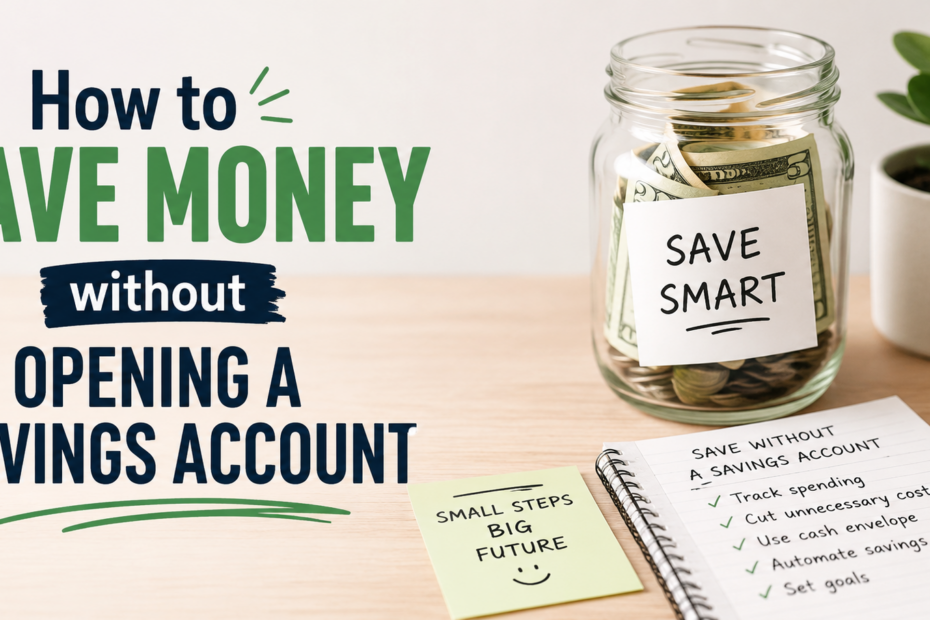
Many people earn money every day, yet still find it difficult to save anything meaningful at the end of the month. Bills, transport, food, and unexpected expenses often take priority, leaving little or nothing behind.
On top of that, not everyone feels comfortable using banks—some don’t trust financial institutions, while others prefer to avoid opening a savings account due to charges, distance, or personal reasons.
However, the truth is that saving money does not depend only on having a bank account. With the right discipline and simple systems, anyone can still build savings and improve their financial stability. It all comes down to how you manage what you already have, no matter how small it is.
In this guide, you’ll learn practical ways to save money safely without opening a savings account.
Why People Don’t Use Savings Accounts
Many people avoid using savings accounts for different personal and practical reasons, and most of them are understandable based on their daily experiences.
One of the biggest reasons is lack of trust in banks. Some individuals feel uncertain about how their money is managed or worry about unexpected issues with their accounts, even though banking systems are generally secure.
Another major factor is low or irregular income. When money comes in small or unpredictable amounts, people often feel there is nothing “extra” to save in a bank. Instead, they prefer to keep cash at hand for immediate needs like food, transport, and family responsibilities.
Fear of hidden charges also discourages many people. Some believe banks deduct fees that slowly reduce their balance over time, making them feel like they are losing money instead of saving it.
In addition, modern banking apps can make saving difficult for some users because of the temptation to withdraw easily. With just a few taps on a phone, saved money can quickly be spent, defeating the purpose of saving in the first place.
Finally, there are still areas where people have limited or no access to banking services. Distance to banks, lack of internet access, or poor financial inclusion can make it difficult for individuals to open or manage savings accounts.
All these reasons show why many people look for alternative ways to save money outside traditional banking systems.
Method 1: Cash Envelope System
One of the simplest and most effective ways to save money without opening a savings account is the cash envelope system. This method helps you control your spending by physically dividing your money into different categories before you start using it.
Here’s how it works: once you receive your income, you split it into labeled envelopes based on your expenses. For example, you can have envelopes for food, transport, rent, utilities, and savings.
Each envelope contains a fixed amount of money that is meant only for that purpose. This way, you already know how much you are allowed to spend in each area, which helps prevent overspending.
The most important part of this system is the “savings envelope.” From the beginning, you decide a specific amount to set aside and place it in this envelope. Treat it as money that is not meant for daily spending. You only touch it in very important situations or emergencies, and not for casual needs.
This method is powerful because it makes your money visible and easy to manage. Unlike digital banking, where money feels abstract, cash envelopes give you a clear picture of your financial limits. When an envelope is empty, you naturally stop spending in that category, which builds discipline over time.
Overall, the cash envelope system helps you stay organized, avoid unnecessary expenses, and consistently grow your savings without needing a bank account.
Method 2: “Hidden Savings” at Home
Another way to save money without opening a savings account is by using a safe and intentional home storage system, often called “hidden savings.” This method works best for people who prefer to keep physical cash but still want to build discipline over time.
The first option is to use a lock box or small safe container. This gives your money an extra layer of protection and reduces the temptation to spend it easily. Once you place money inside, make it a rule that it should only be opened for serious emergencies or planned financial goals.
If you don’t have a lock box, you can still save by storing money in a hard-to-reach or less obvious place in your home. The idea is not to hide it carelessly, but to make it inconvenient enough that you won’t be tempted to dip into it regularly.
Another helpful tip is to wrap and label your savings clearly, such as “long-term savings” or “future goal fund.” This simple act creates a mental barrier that discourages impulsive spending and reminds you that the money has a specific purpose.
However, safety is very important in this method. Always avoid obvious hiding places like under mattresses, drawers you use daily, or transparent containers. Choose a secure, discreet location that only you can easily access.
When used wisely, this method can help you steadily build savings while maintaining full control over your money.
Method 3: Mobile Wallet Savings (Without Bank Account Feel)
For people who want the convenience of saving money without the stress of traditional banking, mobile wallet savings can be a practical alternative. Even if you don’t want a formal savings account, many mobile money platforms allow you to store and manage funds digitally in a simple way.
The first step is to use mobile money apps or wallets that are available in your area. These platforms let you keep money safely on your phone, making it easier to separate savings from daily spending cash. It feels less formal than a bank account, but still gives you structure.
Next, you can improve your saving habit by setting automatic transfer rules. This means you decide in advance that a certain amount of money will be moved into your savings wallet regularly—daily, weekly, or monthly. Once this is set, you don’t have to think about it again, which helps reduce the temptation to spend.
The key mindset here is to treat your savings like “locked money.” Even though it is accessible on your phone, you should act as if it is not available for everyday use. Only access it when you have a clear financial goal or emergency.
This method is powerful because it combines discipline with convenience. It removes the physical risk of cash loss while still helping you build consistent savings habits over time.
Method 4: Daily/Weekly Savings Challenge
One of the easiest ways to build a savings habit is by turning it into a simple challenge. Instead of waiting for a large amount of money before you start saving, you focus on small, consistent contributions every day or week.
You can begin with something realistic like saving ₦100, ₦200, or ₦500 daily, depending on your income. If daily saving feels difficult, you can switch to a weekly plan where you set aside a fixed amount every week. The key is consistency, not the size of the amount.
This method works because small savings feel less stressful, yet they grow over time. For example, saving ₦200 daily may seem small, but over a month or a year, it becomes a meaningful amount that can support your goals or emergencies.
To stay motivated, it is important to track your progress. You can use a simple notebook, a savings chart, or even your phone notes to record how much you save each day or week. Watching your savings grow creates a sense of achievement and encourages you to keep going.
You can also make it more fun by setting personal goals, such as “30-day savings challenge” or “weekly consistency streak.” This turns saving money into a habit rather than a burden.
Overall, the daily or weekly savings challenge helps you stay disciplined, build financial confidence, and develop a strong saving culture over time.
Method 5: The “No-Spend Rule”
The “No-Spend Rule” is a simple but powerful discipline method that helps you control unnecessary expenses and increase your savings without needing a bank account. The idea is to intentionally choose certain days where you do not spend any money at all unless it is absolutely necessary.
You can start by selecting 1 to 3 days each week as your no-spend days. On these days, you avoid buying food outside, making impulse purchases, or spending on anything that is not urgent. The goal is to become more aware of your spending habits and reduce unnecessary financial leaks.
Instead of spending on those days, you simply save the money you would have used. For example, if you normally spend ₦1,000 on transport, snacks, or small items, you set that amount aside as savings for the day. Over time, these small saved amounts accumulate into something meaningful.
This method works because it trains your mind to delay unnecessary spending and focus only on essential needs. It also helps you realize how often money is spent on things that are not truly important.
To make it easier, you can plan your no-spend days in advance and prepare meals or necessities beforehand so you are not tempted to spend.
Overall, the “No-Spend Rule” builds strong financial discipline, reduces wasteful spending, and helps you grow your savings steadily with little effort.
Method 6: Convert Cash Into Assets
Another smart way to save money without opening a savings account is to convert your cash into useful assets instead of letting it sit idle or getting wasted on unnecessary spending. This method helps you protect your money by turning it into things that still hold value over time.
Instead of spending your money on impulse purchases, you can use it to buy small but valuable items that you will eventually need.
For example, you can stock up on food items, fuel, or airtime bundles in advance. This reduces the pressure of future spending and helps you indirectly “save” money by locking in value before prices increase or needs arise.
Another option is to invest in small trading goods or mini business items. This could be items you can resell later or use to generate income, such as snacks, provisions, or household essentials. Instead of spending money repeatedly, you turn it into something that can bring returns.
The key idea behind this method is to shift your mindset from spending to storing value. Cash left unused can easily disappear on unnecessary things, but when it is converted into assets, it becomes more intentional and harder to waste.
However, it is important to be careful and only buy assets you truly need or understand. Avoid overstocking or buying items just because they look attractive.
Overall, this method helps you protect your money, reduce wasteful spending, and build financial discipline by turning everyday expenses into long-term value.
Common Mistakes to Avoid
While saving money without a savings account is possible, many people struggle to see results because they fall into a few avoidable mistakes. Understanding these errors can help you stay consistent and protect your progress.
One common mistake is using savings for small emergencies or minor needs. Many people start saving well, but quickly dip into it whenever a small problem arises. Over time, this destroys the purpose of saving and makes it difficult to build financial stability.
Another issue is not having a clear savings goal. When you don’t know what you are saving for—whether it is emergency funds, business capital, or future plans—it becomes easier to lose motivation and spend the money carelessly.
A very common habit is mixing savings with spending money. When everything is kept in one place or not properly separated, it becomes difficult to track what is meant for savings and what is for daily expenses. This often leads to accidental spending of saved money.
Lastly, lack of discipline is one of the biggest challenges. Saving money requires consistency and self-control. Without discipline, even the best saving methods will fail because the habit is not strong enough to resist temptation.
Avoiding these mistakes will make your savings journey more effective, structured, and successful over time.
Tips to Stay Consistent
Staying consistent with saving money is often the hardest part, but it becomes easier when you follow simple and intentional habits. Without consistency, even the best saving methods will not produce meaningful results.
First, set a clear savings goal. When you know exactly what you are saving for—such as an emergency fund, business capital, or a personal project—it becomes easier to stay motivated. A clear goal gives your savings direction and purpose.
Next, make it a habit to track your savings weekly. Whether you use a notebook or your phone, recording your progress helps you see growth over time. This small action builds motivation and keeps you accountable.
It is also important to stay away from impulse spending. Many people lose their savings because of unplanned purchases. Before buying anything, ask yourself if it is necessary or if the money is better saved. This simple habit can protect your progress significantly.
Another helpful strategy is to involve a trusted accountability partner. This could be a friend, family member, or someone with similar financial goals. Sharing your progress with someone else adds responsibility and encourages you to stay committed.
Overall, consistency is what turns small savings into real financial growth. When you stay disciplined and focused, saving money becomes a natural habit rather than a struggle.
Conclusion
Saving money is not about how much you earn, but about how disciplined you are with what you already have. Many people believe they need a high income to start saving, but in reality, consistency matters more than income size.
The truth is, you can build wealth and financial stability even without a bank account, as long as you follow the right habits and stay committed to your goals. Simple methods like budgeting, setting aside cash, and avoiding unnecessary spending can make a big difference over time.
The most important step is to start. You don’t need a perfect plan or a large amount of money—just begin with what you have. Start small, stay consistent, and grow your savings step by step. Over time, those small actions will turn into strong financial habits and real progress.
Frequently Asked Questions
What are 7 ways to save money?
Saving money is one of the most important financial habits anyone can develop, especially in a world where expenses can easily exceed income if not properly managed. Below are 7 effective and practical ways to save money in a sustainable manner.
First, create a budget and stick to it. A budget helps you track your income and expenses, making it easier to identify unnecessary spending. Without a budget, money tends to “disappear” without clear direction.
Second, separate wants from needs. Needs are essential things like food, shelter, and transportation, while wants include luxury items or impulse purchases. Learning to prioritize needs helps reduce wasteful spending.
Third, set savings goals. When you have a clear target, such as emergency savings or business capital, you are more motivated to save consistently.
Fourth, avoid impulse buying. Many people spend money emotionally rather than logically. A simple rule is to wait 24 hours before purchasing non-essential items.
Fifth, reduce unnecessary subscriptions and habits. Small recurring expenses like unused data plans, streaming services, or frequent takeouts can accumulate into large amounts over time.
Sixth, automate your savings. If possible, set aside a fixed amount immediately after receiving income so you are not tempted to spend it.
Seventh, look for cheaper alternatives. This includes buying in bulk, comparing prices, or choosing affordable brands instead of expensive ones.
In summary, saving money is not about how much you earn, but how well you manage what you have. Consistency and discipline are the real keys to financial stability.
How to save 1k in 30 days?
Saving 1,000 units of currency in 30 days may seem small or large depending on your income level, but it is a very realistic and achievable financial goal when broken into simple daily actions. The key is consistency, discipline, and a clear plan.
First, divide the total amount by the number of days. Saving 1,000 in 30 days means you only need to save about 33–34 per day. This small breakdown makes the goal feel less overwhelming and more achievable.
Second, adopt a daily savings method. You can set aside the required amount every day immediately after receiving any money. This prevents accidental spending.
Third, use a physical savings box or envelope system if you do not have access to a bank. Keeping cash out of sight reduces temptation.
Fourth, cut one small daily expense. For example, reducing snacks, drinks, or unnecessary transport spending can easily cover your daily savings target.
Fifth, apply the “save before spending” rule. Instead of saving what is left, you save first before using money for anything else.
Sixth, track your progress daily. Monitoring your savings builds motivation and helps you stay consistent.
Seventh, increase your savings slightly on days you earn extra money. This will help you finish earlier than 30 days if done well.
In conclusion, saving 1,000 in 30 days is not about sacrifice but about awareness. Small, intentional actions every day lead to strong financial habits over time.
What are the 5 best ways to save money?
There are many methods to save money, but some strategies are more effective and widely used because they deliver consistent results. The 5 best ways to save money focus on discipline, planning, and smart financial behavior.
First is budgeting. Budgeting is the foundation of financial control. When you create a clear plan for your income and expenses, you are less likely to overspend. A good budget shows exactly how much you can save each month.
Second is automated savings. This method involves setting aside money automatically as soon as you receive income. It removes the temptation to spend first and save later, which rarely works for most people.
Third is cutting unnecessary expenses. Many people spend money on things they don’t really need, such as frequent eating out, unused subscriptions, or impulse shopping. Reducing these costs can significantly increase savings.
Fourth is goal-based saving. When you save with a purpose—like building an emergency fund, buying a phone, or starting a business—you are more focused and motivated to stay consistent.
Fifth is tracking your spending habits. You cannot manage what you do not measure. Keeping records of your daily or weekly spending helps you identify financial leaks and adjust accordingly.
In conclusion, saving money is not about restriction but about control. When you apply these five methods consistently, you gradually build financial stability and reduce financial stress.
How to easily start saving money?
Starting to save money can feel difficult at first, especially if you are not used to managing your finances. However, saving becomes easy when you start small and build consistent habits over time.
The first step is to understand your income and expenses clearly. Many people struggle financially because they do not know where their money goes. Writing down what you earn and what you spend gives you clarity.
Next, start with a small and realistic amount. You do not need to save a large percentage of your income immediately. Even saving a small fixed amount daily or weekly helps you build the habit. The goal is consistency, not perfection.
Another important step is to separate your savings from your spending money. This can be done using a different account, wallet, or even a physical container. When savings are kept separate, you are less likely to spend them accidentally.
Also, try to reduce unnecessary spending gradually. You don’t have to stop enjoying life, but you should identify areas where you spend impulsively, such as snacks, entertainment, or online shopping.
Setting a clear goal also makes saving easier. When you know why you are saving—whether for emergency needs, education, or business—you become more motivated.
Finally, track your progress regularly. Seeing your savings grow encourages you to continue.
In summary, starting to save money is about building discipline step by step. Small actions repeated daily will eventually lead to strong financial habits.
What is the 30 day rule to save money?
The 30-day rule is a simple but powerful financial strategy designed to help people control impulse spending and improve their saving habits. It works by delaying non-essential purchases for 30 days before making a decision.
Instead of buying something immediately when you feel the urge, you wait for 30 days. If after that period you still feel the item is necessary, you can then consider buying it.
The purpose of this rule is to reduce emotional spending. Many purchases are made based on excitement, peer pressure, or temporary desire rather than real need. By introducing a waiting period, you give yourself time to think logically about whether the purchase is truly important.
During the 30 days, you may realize that you no longer want the item or that your money is better used for something more valuable, such as savings, investments, or essential needs. This helps you build financial discipline over time.
Another benefit of the 30-day rule is that it encourages prioritization. Instead of spending on everything you want immediately, you begin to focus on long-term goals.
To apply it effectively, you can write down items you want to buy and revisit the list after 30 days. This makes your financial decisions more intentional.
In conclusion, the 30-day rule is not about denying yourself enjoyment but about creating control over your spending habits. It helps you save more money by reducing unnecessary and impulsive purchases.
How to save money really quickly?
Saving money quickly requires a combination of urgency, discipline, and aggressive financial control. Unlike long-term saving strategies, fast saving focuses on cutting expenses immediately and redirecting every available resource into savings.
The first step is to pause all non-essential spending. This means temporarily stopping things like entertainment subscriptions, eating out, online shopping, and impulse purchases. When the goal is speed, every unnecessary expense becomes a leak that slows progress.
Second, you should increase your saving rate drastically. Instead of saving a small percentage of income, aim to save 30%–70% if possible, depending on your situation. This may require lifestyle adjustments, such as cooking at home, using public transport, or reducing luxury habits.
Third, consider a short-term income boost. Selling unused items, doing freelance work, or small side hustles can significantly speed up savings.
Fourth, use the cash isolation method, where you separate saved money immediately after receiving income. This prevents accidental spending.
Fifth, set a very clear short-term target, such as saving within 7, 14, or 30 days. A tight deadline creates urgency and focus.
Finally, track your progress daily to stay motivated. The faster you see results, the more committed you become.
In summary, saving money quickly is not about comfort—it is about temporary sacrifice for long-term gain.
What is the 3 6 9 rule of money?
The 3-6-9 rule of money is a simple financial planning framework that helps individuals structure their savings and financial goals in stages. It is often used as a discipline model for managing income, expenses, and wealth growth over time.
While interpretations may vary, the most common version focuses on dividing financial responsibility into three phases: 3 months, 6 months, and 9 months.
The first stage, 3 months, represents emergency readiness. At this level, you should aim to save enough money to cover at least three months of essential expenses. This protects you from sudden financial shocks such as job loss, illness, or unexpected emergencies.
The second stage, 6 months, represents stability. Here, your financial cushion is expanded to cover half a year of living expenses. This level gives you more security and reduces financial stress, allowing you to make better long-term decisions without panic.
The third stage, 9 months, represents growth preparation. At this point, your savings are strong enough to support investment opportunities, business expansion, or major life decisions. It is also a stage where financial independence begins to take shape.
In summary, the 3-6-9 rule is not just about saving money—it is about building structured financial security step by step. It encourages discipline, long-term thinking, and gradual wealth building instead of living paycheck to paycheck.
How to save your money daily?
Saving money daily is one of the most effective ways to build strong financial habits because it turns saving into a routine rather than a burden. The first step is to set a fixed daily amount. This could be small, such as a percentage of your income or a specific amount you can comfortably set aside every day. The key is consistency, not size.
Second, use a daily savings container or system. This can be a physical savings box, envelope system, or digital wallet. Keeping your savings separate from spending money reduces temptation.
Third, apply the “save first” rule. Whenever you receive money, immediately remove your daily savings before spending anything else. This ensures saving becomes automatic behavior.
Fourth, reduce one small daily expense. For example, cutting back on snacks, transport, or unnecessary purchases can easily fund your daily savings goal.
Fifth, track your progress daily. Writing down or monitoring your savings helps you stay motivated and disciplined.
Sixth, stay consistent even with small amounts. Daily saving works through accumulation, not big one-time deposits.
In conclusion, saving money daily is about building discipline through repetition. Small actions done every day eventually lead to strong financial stability.
How to save money automatically?
Saving money automatically is one of the most powerful financial strategies because it removes human emotion from the saving process. Instead of relying on willpower, you create a system where saving happens without effort.
The first step is to set up automatic transfers if you use a bank or digital wallet. This means a fixed amount of money is moved to your savings account immediately after you receive income.
Second, adopt the pay-yourself-first principle. This means your savings are treated like a mandatory bill, not an optional action. Once income arrives, savings are deducted before any spending occurs.
Third, use separate accounts or wallets. Keeping savings in a different place from spending money reduces temptation and makes it harder to access impulsively.
Fourth, automate bill payments where possible. This prevents late fees and helps you plan your remaining budget more effectively.
Fifth, increase automation gradually. Start with a small percentage of income and increase it over time as your financial discipline improves.
In summary, automatic saving is effective because it removes decision-making from the process. Once set up, it ensures consistent growth of savings without constant effort or emotional struggle.
What is the most profitable way to save money?
The most profitable way to save money is not just about storing cash but about combining saving with smart financial growth strategies. Traditional saving alone keeps money safe, but it does not significantly increase its value over time. To make savings more profitable, you must focus on earning returns on your saved money.
One of the most effective methods is investment-based saving, where part of your savings is placed into income-generating opportunities such as businesses, low-risk investments, or skill development. Unlike idle savings, these options allow your money to grow.
Another approach is high-interest savings options, such as fixed deposits or savings platforms that offer returns. While not extremely high, they are safer than risky investments and still grow your money over time.
A third strategy is reinvesting profits. If your savings are used to start a small business or side hustle, the profits should be reinvested instead of being spent immediately. This compounds growth.
Fourth, reducing inflation impact is also important. Keeping all money idle reduces its value over time due to rising costs, so diversification is key.
In conclusion, the most profitable saving method is not just storing money but actively making it grow through smart financial decisions, discipline, and reinvestment.
How to grow money while saving?
Growing money while saving means combining discipline with smart financial decisions so that your savings do not just sit idle but also increase in value over time.
The first approach is to separate saving from investing. Instead of keeping all your money in one place, allocate a portion to safe savings and another portion to low-risk growth opportunities. This balance ensures both security and growth.
Second, consider interest-earning options such as savings accounts, fixed deposits, or trusted financial platforms that offer returns. While the growth may be gradual, it is safer than keeping cash unused.
Third, adopt a reinvestment mindset. If your savings generate any profit—whether from a small business, side hustle, or investment—reinvest a portion instead of spending it. This creates compounding growth over time.
Fourth, build a skill-based income stream. Skills such as writing, design, trading small goods, or freelancing can turn saved money into active capital that produces more income.
Fifth, avoid keeping all savings in cash. Inflation reduces the value of money over time, so diversification is important.
In conclusion, growing money while saving is about making your money work for you. Even small, consistent growth strategies can turn simple savings into long-term financial strength.
Where to save money for beginners?
For beginners, the best place to save money depends on safety, accessibility, and discipline. The first and most common option is a bank savings account. This is secure, easy to use, and helps beginners build the habit of saving regularly. It also protects money from loss or theft.
Second, beginners can use mobile money or digital wallets. These platforms often allow quick deposits and withdrawals, making it easy to track savings and stay consistent.
Third, a separate savings account is highly recommended. Keeping savings separate from daily spending money reduces the temptation to withdraw unnecessarily.
Fourth, beginners can use a budgeting or savings app that tracks income and expenses. These tools help you understand your financial habits and improve discipline.
Fifth, for those who struggle with self-control, a fixed deposit or locked savings plan is useful. This prevents early withdrawal and forces long-term saving.
Finally, some beginners start with a physical savings box to build discipline before moving to digital systems.
In summary, beginners should focus on safe, simple, and accessible saving options that help build consistency before exploring advanced financial tools.
How do you force yourself to save money?
Forcing yourself to save money is less about motivation and more about building systems that remove temptation. The first step is to treat savings like a mandatory bill. Just like rent or electricity, savings should be deducted immediately after income is received.
Second, use automatic savings tools if available. Automation removes the need for decision-making, which is where most people fail.
Third, create financial barriers to spending. This can include keeping money in a separate account, using a locked savings system, or giving a trusted person control over part of your savings.
Fourth, set clear and emotional goals. When you attach savings to a strong reason—such as escaping debt, starting a business, or achieving independence—you are more likely to stay disciplined.
Fifth, use the delay rule for purchases. Forcing a 24–30 day waiting period reduces impulse spending significantly.
Sixth, track your progress daily or weekly. Seeing your savings grow creates psychological motivation that reinforces discipline.
In conclusion, forcing yourself to save money is about creating structure, not relying on willpower. When systems are strong, saving becomes automatic behavior instead of a struggle.
How to save money without touching it?
Saving money without touching it requires strong financial separation and discipline systems that make savings inaccessible for daily use. The first method is to use a locked savings account or fixed deposit where withdrawals are restricted for a specific period. This prevents emotional spending.
Second, open a separate savings account with no debit card access. If you cannot easily access the money, you are less likely to spend it.
Third, adopt the “out of sight, out of mind” principle. When savings are not visible in your main spending account, temptation reduces significantly.
Fourth, automate transfers so that money moves directly into savings immediately after income arrives. This ensures you never “see” the money as available for spending.
Fifth, avoid linking savings accounts to mobile apps or debit cards used for daily transactions.
Sixth, mentally treat savings as “already spent” money for your future self. This mindset shift helps reduce withdrawal temptation.
In summary, not touching your savings requires removing both physical and psychological access. The harder it is to reach the money, the easier it is to keep it.
How to save 1k in 3 months?
Saving 1,000 in 3 months is a realistic goal when broken down into small, manageable steps. First, divide the total amount by the number of days in 3 months (about 90 days). This means you only need to save around 11–12 per day, which makes the goal very achievable.
Second, set a daily or weekly savings plan. Consistency is more important than the amount, so even small daily savings build up over time.
Third, reduce one small unnecessary expense. For example, cutting snacks, drinks, or minor impulse purchases can easily cover your savings target.
Fourth, use a dedicated savings container or account. Keeping savings separate ensures you do not accidentally spend them.
Fifth, apply the save-first rule. Always set aside your savings before spending on anything else.
Sixth, increase savings slightly whenever you receive extra income, such as gifts or side earnings.
Seventh, track your progress weekly to stay motivated.
In conclusion, saving 1,000 in 3 months is not difficult; it only requires discipline, consistency, and small daily sacrifices that add up over time.