Many Nigerians find it difficult to save money, even when they genuinely want to. The rising cost of living has made basic needs like food, fuel, electricity, and transportation more expensive than ever.
For people earning fixed salaries or running small businesses, income often disappears before the month ends. Many Nigerians also deal with irregular income, especially freelancers, traders, and side hustlers who do not earn the same amount every week.
Another major challenge is impulse spending. Small daily expenses on mobile data, online shopping, eating out, and unnecessary subscriptions quietly drain income without people noticing. Most savings plans also fail because they are too strict, unrealistic, or designed without considering Nigeria’s current economic situation.
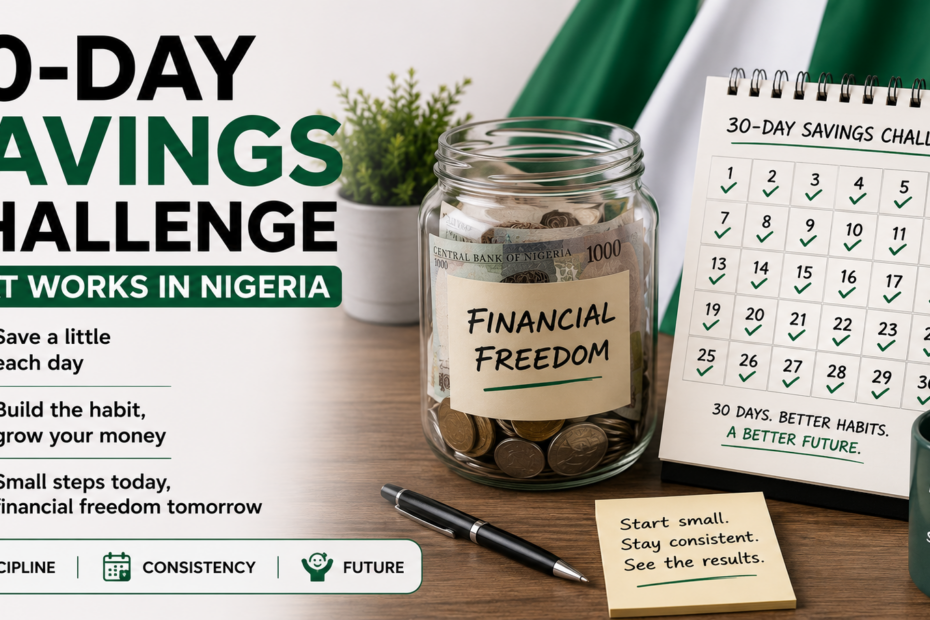
That is why this 30-day savings challenge works differently. It is simple, practical, and designed for everyday Nigerians. Instead of forcing extreme sacrifices, the challenge helps you build a consistent savings habit gradually, no matter your income level.
What a 30-day savings challenge means
A 30-day savings challenge is a simple and structured way to save money consistently over a period of one month. Instead of trying to save a huge amount at once, the challenge focuses on setting aside small amounts of money daily or weekly.
The idea is to make saving feel easier, more realistic, and less stressful for people with different income levels.
The challenge can follow different patterns. Some people save a fixed amount every day, while others gradually increase the amount as the days go by.
For example, someone may start with ₦200 on the first day and continue building the habit throughout the month. The focus is not necessarily on how much you save, but on creating consistency.
One reason this challenge works well is because it encourages discipline. Many people fail to save because they only save when they have extra money left.
The 30-day challenge changes that mindset by making saving a daily habit. Over time, this habit improves financial control, reduces unnecessary spending, and helps people become more intentional with money management.
Why this challenge works specifically in Nigeria
The 30-day savings challenge works well in Nigeria because it is flexible and realistic for the average person. Unlike complicated savings plans that require large deposits, this challenge allows people to start small.
Even saving between ₦100 and ₦1,000 daily can make a noticeable difference after 30 days. The small amounts reduce pressure and make it easier for people to stay committed.
Another reason the challenge is effective is that it suits different income levels and lifestyles. Students can participate using pocket money, salary earners can save from their monthly income, and business owners or side hustlers can save from daily profits. It does not require a high-paying job before someone can begin building a savings habit.
The challenge is also practical during months when income is unstable. In Nigeria, many people do not earn the same amount consistently because of delayed salaries, fluctuating business sales, or unexpected expenses. Since the challenge is flexible, people can adjust the amount they save without completely stopping the habit.
Most importantly, it helps build discipline in a largely cash-based economy where spending is often impulsive. When people intentionally save a small amount every day, they become more conscious of unnecessary expenses and better at managing money over time.
Different versions of the 30-day savings challenge
There is no single way to do a 30-day savings challenge. The best method is the one that matches your income pattern and lifestyle. Below are some practical versions Nigerians can choose from depending on their financial situation.
Fixed Daily Saving Plan
This is one of the easiest methods to follow. You choose a specific amount and save it every single day for 30 days. For example, saving ₦500 daily means you will have ₦15,000 at the end of the challenge. The fixed structure makes it simple because you already know how much to save each day.
This option works well for salary earners, students, and people with predictable income.
Incremental Savings Plan
In this method, the amount increases gradually every day. You may start with ₦100 on Day 1, ₦200 on Day 2, ₦300 on Day 3, and continue increasing daily until the end of the month. This approach is good for people who want to challenge themselves gradually while building stronger saving discipline.
It can also make saving feel more engaging and less repetitive.
Weekly Bulk Saving Plan
Not everyone earns money daily, which is why this method works for freelancers, business owners, and contract workers. Instead of saving every day, you save once every 7 days. For example, you can decide to save ₦5,000 or ₦10,000 every weekend throughout the 30 days.
This reduces pressure while still helping you stay consistent.
Income Percentage Savings Plan
This method is ideal for people with unstable income. Instead of saving a fixed amount, you save a percentage of whatever you earn. For example, you may decide to save 10% to 20% of your daily or weekly income. If you make more money, you save more. If you earn less, your savings amount adjusts naturally.
This approach is flexible and realistic for traders, freelancers, and side hustlers whose income changes regularly.
Step-by-step guide to start the challenge
Starting a 30-day savings challenge becomes easier when you follow a simple plan. The goal is to make the process practical and sustainable, not stressful. Here are the basic steps to begin successfully.
Choose Your Savings Goal
The first step is deciding what you want to achieve at the end of the 30 days. Your target should be realistic based on your income and expenses.
For example, you may aim to save ₦15,000, ₦30,000, or even ₦50,000 within the month. Having a clear goal gives you motivation and helps you stay focused throughout the challenge.
Pick a Realistic Daily Amount
After setting your target, decide how much you can comfortably save daily or weekly. Avoid choosing an amount that will make survival difficult before the month ends. Even small amounts like ₦200, ₦500, or ₦1,000 daily can add up over time. The most important thing is consistency.
Open a Separate Savings Account or Use a Fintech App
Keeping your savings separate from your regular spending money reduces temptation. You can use a dedicated bank account or trusted fintech savings apps that allow you to lock funds temporarily. This creates discipline and helps you avoid spending the money impulsively.
Set Daily Reminders
Many people forget to save because they get busy or distracted by daily activities. Setting a phone alarm or reminder can help you stay consistent. Choose a specific time each day, such as morning or evening, to transfer your savings immediately.
Track Your Daily Progress
Monitoring your progress keeps you motivated and accountable. You can use a notebook, spreadsheet, or savings tracker app to record how much you save each day. Seeing your progress grow over time can encourage you to complete the full 30-day challenge successfully.
Best ways to avoid failing the challenge
Many people start a 30-day savings challenge with excitement but struggle to finish it because of a few common mistakes. Understanding these mistakes—and how to avoid them—can make the difference between success and failure.
Not Tracking Expenses
One major reason people fail is that they don’t know where their money is going. Without tracking expenses, small daily spending on food, transport, data, and impulse purchases quietly eats into savings. Before they realize it, there is nothing left to save.
Solution:
Use a simple budget notebook or a budgeting app to record daily spending. When you track your money, you become more aware and intentional with your choices.
Mixing Savings with Spending Money
Another common mistake is keeping savings in the same account as everyday spending money. This makes it very easy to “borrow” from savings without noticing.
Solution:
Open a separate savings account or use a fintech app where your savings are locked or not easily accessible. Treat it as untouchable money unless there is a real emergency.
Peer Pressure and Lifestyle Spending
In Nigeria, social pressure can easily affect spending habits. Outings with friends, unplanned hangouts, and trying to “keep up” with others can quickly destroy a savings plan.
Solution:
Be intentional about your lifestyle during the challenge. You don’t have to isolate yourself, but reduce unnecessary spending and learn to say no to unplanned expenses.
No Clear Goal
Many people fail because they are saving without a clear purpose. When there is no goal, motivation drops quickly and saving feels meaningless.
Solution:
Set a clear target before starting—whether it is ₦15,000, ₦50,000, or emergency savings. A defined goal gives direction and keeps you committed throughout the 30 days.
Tools Nigerians can use for savings
There are several practical tools Nigerians can use to successfully complete a 30-day savings challenge. The key is choosing tools that make saving easier, more disciplined, and less tempting to withdraw from.
Bank Savings Accounts
Traditional bank savings accounts are still a reliable option. Most Nigerian banks allow you to open savings accounts with low minimum balance and provide debit cards for easy access.
However, for a savings challenge, it is better to avoid using the same account you spend from daily. Keeping a separate account strictly for savings helps reduce temptation and builds discipline.
Fintech Savings Apps
Fintech apps have made saving more structured and automated, especially for young Nigerians and people with irregular income.
- PiggyVest is one of the most popular savings platforms in Nigeria. It allows users to automate daily, weekly, or monthly savings and even lock funds for a fixed period to prevent early withdrawal.
Official site: PiggyVest - Cowrywise helps users save and invest automatically with flexible or fixed plans. It is useful for people who want both discipline and long-term growth.
Official site: Cowrywise - Kuda offers built-in savings “vaults” where users can set aside money, lock it, and earn interest over time. This makes it easier to separate spending money from savings.
Official site: Kuda
These platforms reduce the temptation to spend because they automate the saving process and make withdrawals less immediate.
Airtime and Data Discipline Tricks
Another powerful but often ignored savings tool is controlling daily mobile spending. Many Nigerians lose a significant amount of money on airtime, data subscriptions, and unnecessary app usage.
Simple discipline strategies include:
- Setting a weekly data budget instead of buying randomly
- Using Wi-Fi when available to reduce mobile data costs
- Turning off auto-renewal for subscriptions
- Avoiding unnecessary social media browsing that consumes data and encourages impulse spending
When managed properly, these small adjustments free up extra money that can be redirected into savings consistently throughout the 30-day challenge.
Realistic savings examples
After completing the 30-day savings challenge, the most important step is not to stop, but to decide what to do with the money and the habit you have built. This is where real financial progress begins.
Reinvest Savings Into a Small Business
One smart option is to use part of your savings to start or support a small business. In Nigeria, even small capital can go into buying goods to resell, starting a food business, or funding a side hustle like phone accessories, thrift fashion, or mini importation. The goal is to let your money start generating more money instead of sitting idle.
Continue the Challenge for 60 or 90 Days
If you were able to complete 30 days successfully, you can extend the challenge to 60 or 90 days. This helps you build stronger financial discipline and accumulate a larger amount over time. The longer you stay consistent, the more powerful your savings habit becomes.
Build an Emergency Fund
Another important step is to turn your savings into an emergency fund. This is money set aside for unexpected situations like medical bills, job loss, or urgent family needs. Having this fund reduces financial stress and prevents you from going into debt when emergencies happen.
Start Investing Small Amounts
Once you are comfortable saving, the next level is investing. You don’t need large capital to start. You can begin with small amounts in low-risk investment options such as money market funds or trusted fintech investment platforms. The key is to let your money grow over time while you continue to save consistently.
Conclusion
At the end of the day, successful saving is not really about how much you earn, but how well you manage what you already have. Many people with high income still struggle financially because they lack discipline, while others with small income build strong financial stability through consistent saving habits.
The 30-day savings challenge proves that small, consistent actions can create real results over time. Even modest daily savings, when done with discipline, can grow into meaningful amounts that improve your financial situation. What truly matters is not the size of the money you start with, but your ability to stay committed.
Over time, this discipline builds financial control, reduces stress, and moves you closer to financial freedom. Small savings may look insignificant today, but with consistency, they become the foundation of long-term wealth and stability.
Frequently Asked Questions
What can I use 10,000 naira to invest in?
₦10,000 may look small, but in Nigeria it is enough to start several low-capital and realistic investment paths if used wisely. The key is to focus on small, scalable businesses or skill-based investments rather than trying to chase quick unrealistic profits.
One of the best ways to invest ₦10,000 is reselling products. You can buy fast-moving goods like phone accessories (earphones, chargers, screen guards), perfumes, or small fashion items like caps and socks from wholesale markets or online vendors. With good marketing on WhatsApp, Facebook, or TikTok, you can double or triple your money over time.
Another strong option is food-related micro-businesses. You can start selling snacks like puff-puff, buns, roasted groundnuts, or sachet water at busy locations like schools, bus stops, or offices. Food sells daily, so your cash flow is faster compared to many other businesses.
You can also invest in digital skills learning. Use part of the ₦10,000 to buy data and take a short online course in areas like graphic design, copywriting, or social media management. These skills can later earn you ₦5,000–₦20,000 per job, making the initial money grow indirectly.
Lastly, consider agriculture mini-investments, such as poultry feed contribution or buying small livestock feeds if you partner with someone raising chickens or snails.
The most important rule is to avoid spending all ₦10,000 on consumption or luxury. Instead, focus on something that can bring it back with profit. Consistency, patience, and reinvestment are what turn small money into big capital.
Which is the biggest challenge to saving money?
The biggest challenge to saving money is not low income—it is lack of financial discipline and impulse control. Many people assume that once they earn more, saving will become easier, but in reality, spending habits usually grow alongside income. This is known as “lifestyle inflation.”
One major problem is unplanned spending. Without a clear budget, money disappears on transport, food, data subscriptions, and emotional purchases like clothes or gadgets. These small expenses accumulate and reduce the ability to save anything meaningful.
Another challenge is peer and social pressure. In Nigeria, social expectations can be strong. People feel the need to “belong” by spending on outings, parties, fashion, and unnecessary upgrades. This pressure often pushes individuals to spend money they should have saved.
Also, many people struggle with lack of financial goals. When there is no clear reason to save—like building an emergency fund, starting a business, or paying future school fees—saving feels meaningless. Without purpose, money is easily spent.
Another hidden issue is poor income structure, especially for people who earn irregular income. When money comes in randomly, it becomes difficult to allocate savings consistently.
The real solution is not just earning more but building systems: budgeting, automatic savings, separating accounts, and setting clear financial goals. Once saving becomes a habit rather than a decision, the challenge reduces significantly. Discipline beats income when it comes to long-term financial stability.
What is the 30-day rule to save money?
The 30-day rule is a simple but powerful money habit designed to stop impulse buying and improve saving discipline. It works by introducing a waiting period before you make any non-essential purchase.
Here’s how it works: whenever you want to buy something that is not a basic need—such as clothes, gadgets, shoes, or luxury items—you do not buy it immediately. Instead, you wait for 30 days. During this time, you observe whether you still truly need or want the item.
In most cases, after 30 days, the emotional desire to buy reduces or disappears completely. This helps you avoid spending money on temporary emotions or pressure-driven decisions.
The rule is especially useful in today’s world where social media constantly triggers spending habits. You may see something online and feel like you must buy it immediately. The 30-day rule interrupts that impulse and gives your logical thinking time to take control.
Another benefit is that it helps you prioritize your financial goals. Instead of spending ₦10,000 or ₦50,000 on unnecessary items, you can redirect that money into savings, investments, or business opportunities.
To apply it effectively, you can write down the item you want, its price, and the date you first wanted it. If after 30 days you still feel it is important and financially responsible, then you can buy it. But if not, you save the money instead.
Over time, this habit builds strong financial discipline and significantly increases your ability to save money without feeling deprived.
How to turn 10k into 100k fast?
Turning ₦10,000 into ₦100,000 is possible, but it is important to be realistic: it requires strategy, effort, time, and consistency—not luck or gambling. Any approach that promises instant multiplication is usually risky or unsustainable.
One practical method is reselling high-demand items. Start by buying small but fast-selling goods like phone accessories, thrift fashion items (okrika), perfumes, or beauty products. Reinvest every profit instead of spending it. With strong marketing on WhatsApp and social media, you can scale gradually from ₦10,000 to ₦100,000.
Another method is service-based micro business. For example, use the ₦10,000 to print flyers, promote a skill, or buy data to start offering services like graphic design, typing, CV writing, or social media management. Even if you don’t have the skill yet, you can learn quickly online and start small. One or two clients can grow your capital fast.
You can also consider event or weekend hustle services, such as drink retailing at parties, small catering support, or assisting vendors during busy events. These opportunities can multiply capital quickly when done consistently.
However, the most important principle is reinvestment discipline. Many people fail because they take out profits early instead of growing the capital base. If you consistently reinvest and scale demand, ₦10,000 can grow step-by-step.
Avoid gambling, forex shortcuts without knowledge, or “doubling schemes.” They are the fastest way to lose money instead of growing it.
The truth is that turning ₦10k to ₦100k is not magic—it is business growth through smart reinvestment and consistency.
How to make 1k per day?
Making ₦1,000 per day in Nigeria is realistic if you focus on small daily income skills or micro-businesses that generate quick cash flow. The key is consistency and choosing activities that have daily demand.
One of the easiest ways is buying and reselling small goods. You can sell items like sachet water, snacks, groundnuts, sweets, or drinks in busy areas. Even a small margin of ₦100–₦200 per item can quickly reach ₦1,000 daily if you have steady customers.
Another option is offering simple services. This includes tasks like laundry help, house cleaning, phone charging services, or assisting traders in markets. These jobs may seem small, but they provide daily income when you build trust in your environment.
You can also earn ₦1,000 per day through digital micro gigs, such as writing simple content, managing social media pages, or doing small online tasks. With a smartphone and data, platforms and local clients can provide steady work.
Another practical method is food vending. Selling breakfast items like bread, akara, puff-puff, or noodles in the morning can easily generate ₦1,000 or more daily profit depending on location.
However, the most important factor is location and consistency. Even the best idea will fail if placed in a poor location or done irregularly. High-traffic areas like schools, bus stops, and markets increase your chances of daily sales.
In summary, making ₦1,000 per day is not about big capital—it is about small, repeated actions that meet everyday needs.
What is the 52 week money challenge?
The 52-week money challenge is a simple savings plan designed to help people build the habit of saving consistently over one year. It is popular because it starts small and gradually increases, making it easier for people with low or irregular income to participate.
The basic idea is that you save money every week for 52 weeks (which is one full year). In the traditional version, you start by saving ₦100 in the first week, ₦200 in the second week, ₦300 in the third week, and you continue increasing by ₦100 each week until the 52nd week. By the end of the year, your final weekly savings will be ₦5,200.
If you follow this exact pattern, the total amount saved at the end of 52 weeks is ₦100 + ₦200 + ₦300 … up to ₦5,200, which adds up to a significant lump sum. The beauty of the challenge is that it does not feel heavy at the beginning because the amounts are small, but it builds discipline over time.
There is also a reverse version where you start with the highest amount (₦5,200) in week one and gradually reduce it each week. This helps people who have more money at the beginning of the year but want easier savings later.
The challenge teaches consistency, patience, and financial discipline. It is not about how much you earn but how regularly you save. Many people use it to build emergency funds, start small businesses, or prepare for year-end expenses like rent or school fees.
How to save money and never go broke?
To save money and avoid going broke, you need more than just income—you need a strong financial system and discipline. Many people earn well but still struggle financially because they lack structure in how they manage money.
The first key principle is pay yourself first. This means that as soon as you receive money, you immediately set aside a portion for savings before spending anything. Even if it is just 10%, consistency matters more than amount.
Second, you must create a budget system. Divide your money into categories such as needs (food, transport, rent), savings, investments, and personal wants. Without a budget, money tends to disappear on unplanned spending.
Another important strategy is separating accounts or wallets. If possible, keep savings in a different bank account or digital wallet that is not easily accessible. This reduces temptation to spend it.
You also need to control lifestyle inflation. As income increases, many people immediately upgrade their lifestyle—better clothes, more expensive food, and unnecessary spending. To avoid going broke, your spending should not grow as fast as your income.
Another key habit is building an emergency fund. This is money set aside for unexpected situations like illness, job loss, or urgent repairs. It protects you from borrowing or selling assets during emergencies.
Finally, always aim to earn more while saving more. Saving alone is not enough if income is too low. Combine savings discipline with skill development or side hustles.
In summary, never going broke is not luck—it is structure, discipline, and consistency in financial decisions.
How to do the 100 day money saving challenge?
The 100-day money saving challenge is a short-term financial discipline plan designed to help you build strong saving habits in just over three months. Unlike yearly challenges, this one is more intense and requires daily commitment.
There are different ways to structure it, but one of the most common methods is saving a fixed amount every day for 100 days. For example, you might decide to save ₦500 or ₦1,000 daily, depending on your income. By the end of 100 days, you will have ₦50,000 or ₦100,000 respectively.
Another approach is the incremental method, where you increase your savings slightly each day or week. For instance, you start with ₦100 on day one, ₦200 on day two, and continue increasing gradually. This method builds momentum and discipline over time.
To succeed in the challenge, you need clear planning. First, decide your daily savings target based on your income. Second, choose a safe place to store your money, such as a dedicated savings account or a digital wallet. Third, automate or set reminders so you don’t forget.
One of the biggest benefits of the 100-day challenge is that it trains your mind to treat saving as a daily habit rather than an occasional action. It also helps you build funds quickly for a specific goal, such as starting a business, paying rent, or investing in skills.
However, discipline is the biggest requirement. Missing days or withdrawing early reduces the effectiveness of the challenge. The goal is not just the money but the habit you build.
How much can 10K grow in 5 years?
How much ₦10,000 can grow in 5 years depends entirely on how it is used. If the money is simply kept idle, it does not grow at all—in fact, inflation may reduce its value over time. But if it is invested properly, it can multiply significantly.
If you put ₦10,000 in a basic savings account with low interest (around 5% yearly in Nigeria), after 5 years it may only grow slightly, possibly around ₦12,500 to ₦13,000. This shows that traditional savings alone is not enough for wealth growth.
However, if you invest in a small business or resale system, the growth potential is much higher. For example, if you consistently reinvest profits from buying and selling goods, ₦10,000 could grow to ₦100,000 or more within 5 years depending on how disciplined and active you are.
If you invest in skills development, the return can be even greater. Turning ₦10,000 into learning digital skills like graphic design, copywriting, or social media management can lead to monthly earnings. Over 5 years, this can translate into hundreds of thousands or even millions in total income.
In a more aggressive scenario, if you consistently reinvest at a monthly growth rate of even 10–15%, compounding can significantly increase the value over time. Small consistent growth beats inactivity.
The key lesson is that money does not grow by itself—what you do with it determines the outcome. ₦10,000 can either remain ₦10,000 or become a stepping stone to financial stability depending on decisions, consistency, and reinvestment habits.
What is the 15 * 15 * 15 rule?
The 15 * 15 * 15 rule is a financial planning concept often used in investment and wealth-building discussions, especially in long-term savings strategies like mutual funds or systematic investment plans (SIPs). It is designed to show how small, consistent investments can grow into large wealth over time.
The rule generally means investing ₦15,000 monthly for 15 years at an average return of 15% annually. While the exact currency may vary depending on the country, the principle remains the same: consistent investment, long time horizon, and compound growth.
The power of this rule lies in compounding. Compounding means that your money earns returns, and those returns also earn additional returns over time. The longer the duration, the more powerful the growth becomes.
For example, if someone consistently invests ₦15,000 every month for 15 years, the total amount contributed is ₦2,700,000. However, with a 15% annual return (which is considered high but possible in certain investment markets), the final value can grow significantly beyond the actual amount invested due to compounding effects.
The lesson behind the 15 * 15 * 15 rule is not just the numbers—it is discipline. Many people fail financially not because they don’t earn enough, but because they don’t invest consistently over a long period.
It teaches three key principles: invest regularly, stay patient for many years, and allow compounding to do the heavy lifting. Over time, small disciplined investments can grow into serious wealth.