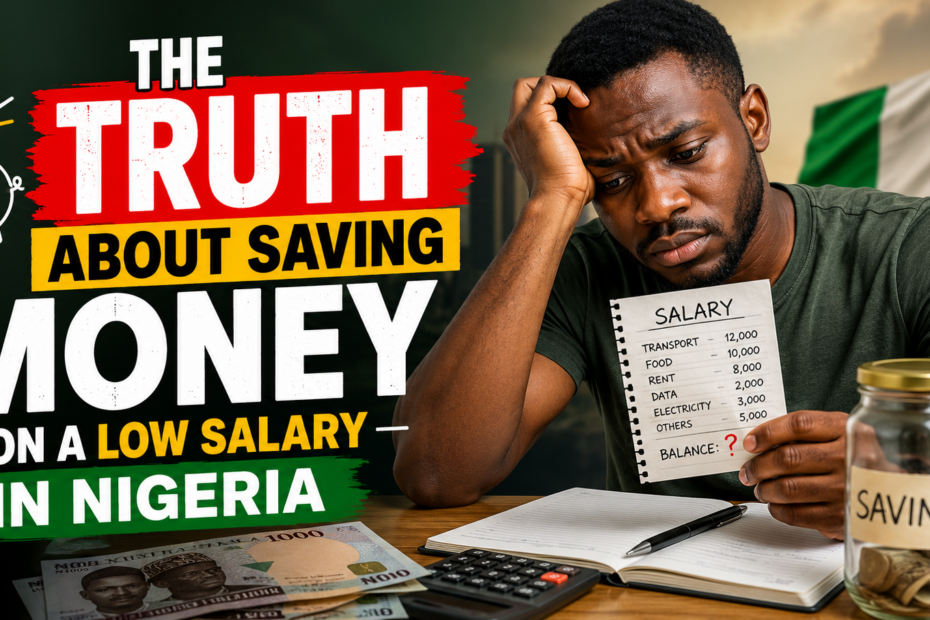
Saving money on a low salary in Nigeria can feel almost impossible, especially when the cost of food, transportation, rent, electricity, data, and other daily needs keeps increasing.
For many workers, salary finishes before the month ends, leaving little or nothing to keep aside. This is why many people believe that saving is only for those who earn big money.
However, the truth is that saving money on a low salary in Nigeria is not always about having plenty left after spending. It is often about learning how to manage the little income available, reduce unnecessary expenses, and build a consistent saving habit.
Living on a low income can be stressful, particularly when there are family responsibilities, unexpected emergencies, debt, and pressure to maintain a certain lifestyle.
Still, even small savings can make a meaningful difference over time. Saving ₦500, ₦1,000, or ₦2,000 regularly may not look like much at first, but it can gradually become an emergency fund, business capital, school-fee support, or money for an important personal goal.
This article explains the truth about saving money on a low salary in Nigeria. It will show why saving can be difficult, the common mistakes that keep people broke, and practical ways to save without making life unnecessarily hard.
The goal is not to pretend that everyone can save large amounts every month. The goal is to help you take control of your money, start with what you have, and build a stronger financial future step by step.
Why Saving on a Low Salary Feels Difficult in Nigeria
Saving money on a low salary in Nigeria can be very difficult because the cost of living continues to rise while many people’s income remains the same.
Basic needs such as food, rent, transportation, electricity, cooking gas, data, school fees, and healthcare can consume most of a person’s monthly salary.
In some cases, workers receive their salary and already know that it will not be enough to cover all their expenses until the next payday. When income is small and daily needs are many, saving money can feel like an impossible task.
One major reason many Nigerians struggle to save is the high cost of transportation. Workers who travel daily to work may spend a large part of their income on buses, motorcycles, fuel, or ride-hailing services.
This becomes even more challenging for people living far from their workplace. By the time transport money, food, and other daily expenses are removed from salary, there may be very little left to save.
Family responsibilities also make saving difficult for many people. Some workers support their parents, younger siblings, spouse, children, relatives, or friends.
Even when a person earns a small salary, they may still be expected to contribute money for food, school fees, medical bills, ceremonies, rent, or emergencies. These responsibilities are real and important, but they can make it hard to focus on personal savings.
Debt is another serious reason why many low-income earners cannot save. Some people borrow money before the end of the month because their salary does not cover their needs.
When the next salary enters, a large part of it goes into repaying loans, borrowing from friends, salary advances, or digital loan apps. This cycle can continue for months and make saving almost impossible.
There are also spending habits that quietly reduce the money people could save. Impulsive buying, betting, frequent eating outside, expensive data subscriptions, unnecessary online shopping, and spending money to impress others can quickly drain a small salary.
Trying to maintain a lifestyle that does not match income can create pressure to spend on clothes, phones, parties, outings, and other things that are not urgent.
However, it is important to understand that struggling to save does not always mean a person is lazy or financially irresponsible. Sometimes, the salary is simply too small compared to the cost of surviving in Nigeria.
This is why people need to be realistic about their financial situation. Saving may start with very small amounts, but building the habit of managing money carefully can still help someone become more financially stable over time.
The Importance of Saving Small Amounts
Many people believe they cannot save money because their salary is too small. They may tell themselves that they will start saving when they begin earning ₦500,000 or more every month.
However, waiting for a bigger salary before building a saving habit can delay financial progress for many years. The truth is that saving does not always begin with a large amount of money. It begins with the decision to keep something aside regularly, no matter how small the amount may be.
A person earning a low salary can start by saving ₦500, ₦1,000, or ₦2,000 every week. Although these amounts may look small, they can become meaningful over time when saved consistently.
For example, saving ₦1,000 every week can become ₦4,000 in a month and ₦48,000 in one year. That money may not solve every financial problem, but it can provide support during difficult moments and reduce the need to borrow from friends, family members, or loan apps.
Small savings are especially important because emergencies can happen at any time. A person may suddenly need money for transport, medical treatment, food, phone repairs, electricity, school needs, or urgent family responsibilities.
Without savings, even a small emergency can become a serious problem. Many people are forced to borrow money because they do not have anything kept aside for unexpected expenses. Saving small amounts regularly can help create a simple emergency fund that gives a person more financial confidence.
Saving little by little also helps people develop discipline. When someone learns to keep aside a small amount every week or every month, they are building a habit that can grow as their income increases.
The person may begin with ₦500 weekly today, but later increase it to ₦2,000, ₦5,000, or more when their financial situation improves. The most important thing is not the size of the first savings; it is the consistency of the habit.
Small savings can also help reduce financial stress. Knowing that there is even a small amount of money available for emergencies can make a person feel more secure.
Instead of panicking whenever an unexpected expense appears, they can use part of their savings and avoid entering unnecessary debt. Over time, this simple habit can help a low-income earner become more financially stable and better prepared for the future.
Practical Ways to Save Money on a Low Salary in Nigeria
Saving money on a low salary in Nigeria requires planning, discipline, and realistic choices. It may not be easy to save a large amount every month, but small changes in daily spending can create room for savings.
The goal is not to suffer or deny yourself every basic need. Instead, it is to become more intentional with your money and reduce spending that does not truly add value to your life.
One practical way to save is by creating a simple monthly budget immediately after receiving your salary. Write down your total income and list your most important expenses, such as rent, food, transport, electricity, data, school fees, and family responsibilities.
This will help you see where your money is going and prevent you from spending without a plan. A budget does not have to be complicated. Even writing your expenses in a notebook or using the notes section of your phone can help you manage your money better.
It is also important to separate needs from wants. Needs are things you cannot do without, such as food, transport, rent, medicine, and electricity.
Wants are things that may be enjoyable but are not urgent, such as buying new clothes when you already have enough, eating at expensive restaurants, upgrading your phone unnecessarily, or spending money on entertainment every weekend. When income is low, reducing unnecessary wants can make it easier to save something small.
Cooking at home is another effective way to reduce expenses. Buying food outside every day can quietly consume a large part of a worker’s salary.
Preparing meals at home and taking food to work can help reduce daily spending. Where possible, buying food items such as rice, beans, garri, noodles, cooking oil, and other household items in bulk may also help you save money compared to buying small quantities every day. However, it is important to buy only what you can afford and what you will actually use.
Reducing unnecessary subscriptions can also create extra money for savings. Some people spend more than they realise on data plans, streaming services, gaming subscriptions, airtime, betting, and other monthly payments.
Review these expenses and remove the ones that are not important. Even if you save only ₦1,000 or ₦2,000 from cancelled subscriptions, that money can be added to your savings.
Avoiding debt for non-essential things is another important habit. Borrowing money to buy clothes, attend parties, upgrade gadgets, or impress people can create financial pressure later.
Before borrowing, ask yourself whether the item is truly necessary and whether you can repay the money without suffering.
Debt should not become the normal way of surviving every month, especially when it is used for things that do not improve your income or solve an urgent problem.
Tracking daily expenses can also help you identify money leaks. Many people spend small amounts every day without noticing how much it becomes at the end of the month.
Transport, snacks, drinks, data, airtime, betting, and impulse purchases may look small individually, but they can add up quickly. By writing down what you spend each day, you can identify areas where you need to cut back and redirect that money into savings.
One of the best saving methods for low-income earners is called “pay yourself first.” This means that immediately after receiving your salary, you remove a small amount for savings before spending on anything else.
Instead of waiting until the end of the month to see what is left, treat your savings like an important bill that must be paid.
It may be ₦2,000, ₦5,000, or even less, depending on your income. The amount may be small, but the habit can protect you from spending everything and help you build financial discipline over time.
Saving on a low salary may require sacrifice, but it does not mean life must become miserable.
By budgeting, reducing unnecessary spending, avoiding debt, and saving immediately after payday, you can gradually build a stronger financial foundation. The most important thing is to start with what you have and remain consistent, even when the amount feels small.
Emergency Savings and Financial Safety
Emergency savings are one of the most important forms of financial protection, especially for people earning a low salary in Nigeria.
Life can change suddenly, and unexpected expenses can appear when a person is least prepared. A medical issue, transport problem, phone repair, electricity bill, family emergency, job delay, rent pressure, or urgent school expense can quickly create financial stress.
When there is no money kept aside, even a small problem can become a serious burden.
For low-income earners, emergency savings are important because there may not be many people available to provide financial support when problems arise. Without savings, a person may be forced to borrow money from friends, relatives, colleagues, or loan apps.
In some cases, they may sell personal items, delay important bills, or go without basic needs until the next salary arrives. These situations can create shame, stress, and more debt, especially when the person is already struggling to survive on a small income.
Having emergency savings does not mean that a person will never face financial problems. However, it can make difficult situations easier to manage.
For example, if a person suddenly needs money for hospital treatment, transport to work, food, or a family emergency, even a small amount saved can reduce panic.
Instead of borrowing immediately, they may be able to use part of their emergency fund and avoid entering a debt cycle.
Building an emergency fund does not have to happen overnight. A person can start with a simple target of ₦20,000. This may seem small, but it can still be useful during an urgent situation.
Once that amount is reached, the next target can be ₦50,000. Over time, the person can continue increasing the fund as their income improves or as they find ways to reduce expenses. The goal is to build financial safety gradually, not to pressure yourself into saving an unrealistic amount.
It is also helpful to keep emergency savings separate from money meant for daily spending. If possible, place it in a different bank account, savings wallet, or trusted savings platform that is not too easy to withdraw from every day.
This can reduce the temptation to spend the money on non-essential things. However, the savings should still be accessible when a real emergency happens.
Emergency savings should be used for urgent and necessary situations, not for parties, new clothes, betting, expensive outings, or things that can wait.
Before using the money, ask yourself whether the expense is truly urgent and whether it would create a serious problem if you did not pay for it immediately. This simple habit can help protect your savings and make it available when you genuinely need it.
For someone earning a low salary, an emergency fund may start slowly, but it can bring peace of mind and financial confidence.
Saving ₦500, ₦1,000, or ₦2,000 regularly may not feel impressive at first, but it can become a source of support when life becomes difficult. The aim is not to have perfect finances immediately. The aim is to become less dependent on borrowing and more prepared for unexpected challenges.
The Need to Increase Your Income
Budgeting and reducing unnecessary spending are important, but they cannot solve every financial problem when a person’s salary is very low.
In Nigeria, the cost of food, transportation, rent, electricity, data, and other basic needs can rise faster than many people’s income.
This means that even someone who is careful with money may still struggle to save if their salary is not enough to meet their essential needs. In such situations, increasing income can be one of the most practical ways to create more room for savings.
A side hustle does not have to mean working every hour of the day or living without rest. The purpose is to create an additional source of income that can reduce financial pressure and support important goals.
Even a small extra income can help a person save more, pay off debt, handle emergencies, or invest in a better opportunity. For example, someone who earns an extra ₦10,000, ₦20,000, or ₦50,000 monthly may decide to use part of it for savings instead of depending only on their salary.
There are many side hustle opportunities that Nigerians can explore depending on their skills, location, available time, and starting capital.
A person with digital skills may consider freelancing, content writing, graphic design, social media management, virtual assistance, online tutoring, or website services.
Someone who enjoys teaching can offer private lessons to students, help children with schoolwork, or teach practical skills such as computer use, baking, makeup, sewing, or language lessons.
People who prefer selling physical products can consider phone accessories, thrift clothes, beauty products, food items, snacks, drinks, household items, or small online businesses.
A person can start by selling to friends, neighbours, colleagues, church members, or customers through WhatsApp, Facebook, Instagram, or other social media platforms.
Small food businesses such as selling snacks, pastries, cooked meals, drinks, or packaged food can also provide extra income when managed carefully.
Practical skills can also create valuable income opportunities. Tailoring, hairdressing, barbing, baking, makeup, photography, delivery services, cleaning services, and repairs can become profitable side businesses.
These types of work may require training, tools, or small capital, but they can grow over time when customers are treated well and the income is managed properly.
The best side hustle is usually one that matches your existing skills, available time, and financial capacity. It is better to start small with something you understand than to borrow money for a business you have not researched.
Before starting, consider the cost of materials, transport, marketing, customer demand, and the amount of profit you can realistically make.
When extra income begins to come in, it is important not to spend all of it immediately. A good approach is to divide the money between personal needs, business growth, debt repayment, and savings.
For example, part of the profit can be used to buy more stock or improve the service, while another part can go directly into an emergency fund. This can help the side hustle become a long-term source of financial support instead of temporary spending money.
Increasing income may not happen overnight, but it can gradually improve a person’s financial situation. Budgeting helps you control the money you already earn, while a side hustle can help you create more money to manage. When both habits work together, saving becomes more realistic and financial stability becomes easier to achieve.
Common Mistakes That Prevent People From Saving
Many people want to save money, but certain habits make it difficult to keep savings consistently. These mistakes may look small at first, but over time, they can prevent a person from building an emergency fund, paying important bills comfortably, or reaching bigger financial goals.
Understanding these mistakes can help low-income earners in Nigeria make better decisions with their money.
Saving Only When There Is Money Left
One common mistake is waiting until the end of the month before trying to save. For many people, there is usually little or nothing left after paying for food, transport, data, electricity, family needs, and other expenses.
When saving is treated as something to do only after spending, it often does not happen. A better approach is to save immediately after receiving salary or income. Even if it is ₦500, ₦1,000, ₦2,000, or ₦5,000, removing it first can help build the habit of saving consistently.
Spending Money to Impress Other People
Some people spend money they cannot afford because they want to look successful in front of friends, colleagues, neighbours, or people on social media.
They may buy expensive clothes, change phones too often, attend costly events, or spend heavily on outings simply to avoid looking poor.
This type of spending can create unnecessary financial pressure. It is better to live according to your income and focus on personal financial progress instead of trying to impress people who may not support you during an emergency.
Borrowing for Fashion and Entertainment
Borrowing money for urgent needs may sometimes happen, but borrowing for fashion, parties, betting, expensive outings, or entertainment can damage a person’s finances.
When the next salary enters, part of it goes into repaying the debt, leaving less money for food, transport, bills, and savings.
Before borrowing, it is important to ask whether the item or activity is truly necessary. If it is not urgent, it may be wiser to wait until you can afford it without debt.
Keeping Savings Where It Is Too Easy to Withdraw
Another mistake is keeping savings in the same account used for daily spending. When money is easily available, it can be tempting to withdraw it for small wants, snacks, online shopping, outings, or other non-essential expenses.
Over time, the savings may disappear without the person noticing. It can help to keep savings in a separate bank account, savings wallet, cooperative account, or another secure place that is not used for daily transactions. The money should still be available for real emergencies, but it should not be too easy to spend carelessly.
Saving Without a Clear Goal
Saving can feel difficult when there is no clear reason for doing it. A person may save for a few weeks and later spend the money because they do not have a specific target.
Having a clear savings goal can make it easier to stay disciplined. For example, someone may be saving for rent, school fees, business capital, a new phone, land, an emergency fund, or a professional course.
When people know what they are saving for, they are more likely to avoid unnecessary spending and remain focused.
Saving money becomes easier when it is connected to a clear purpose and supported by good financial habits. Avoiding these common mistakes can help a person protect their income, reduce debt, and gradually build a stronger financial future.
Conclusion: Saving on a Low Salary Is Still Possible
Saving money on a low salary in Nigeria may not be easy, especially when the cost of food, transport, rent, electricity, data, and family responsibilities keeps increasing.
Many people are doing their best to survive from one salary to another, so it is important to be realistic about the challenges involved. However, earning a small income does not mean that saving is completely impossible.
It simply means that saving may need to start small, grow gradually, and be supported by careful financial decisions.
The goal is not to save a huge amount of money overnight or compare your progress with people who earn more than you do.
The goal is to develop discipline, reduce unnecessary spending, avoid debt for non-essential things, and keep a small amount aside whenever you can. Saving ₦500, ₦1,000, or ₦2,000 regularly may not look impressive at first, but it can become useful money over time.
It can help you handle emergencies, reduce borrowing, pay for important needs, or support a future business idea.
Building financial security is a gradual process. Start by creating a simple budget, identifying the expenses that drain your money, and choosing a realistic amount to save after each salary or income payment.
If your income is too small to meet your needs, look for safe and practical ways to increase your earnings through a side hustle, skill, or small business. The more intentional you become with your money, the easier it will be to make progress.
Remember that saving is not only about the amount of money you keep; it is also about building a habit that protects your future.
Every small amount saved is a step away from unnecessary debt and a step closer to financial peace. Start with what you have, remain consistent, and allow your savings to grow one small decision at a time.
Frequently Asked Questions
How to Save Money Fast on a Low Income in Nigeria
Saving money on a low income in Nigeria can feel difficult because food, transport, rent, data, electricity, and other daily needs take a large part of salary.
However, saving is still possible when you start with a realistic plan instead of waiting until you earn a bigger income. The fastest way to save is to treat savings as an important bill.
Once you receive your salary or income, remove a small amount immediately before spending on other things.
Even if you earn ₦50,000, ₦70,000, or ₦100,000 monthly, begin with an amount you can maintain. Saving ₦2,000, ₦5,000, or ₦10,000 every month may look small, but consistency is more important than saving a large amount once and stopping later.
Keep the money in a separate bank account, savings wallet, cooperative account, or trusted investment platform where it will not be too easy to withdraw.
Reducing unnecessary spending can also help you save faster. Review your weekly expenses and identify money that goes into impulse buying, expensive food, unnecessary subscriptions, betting, frequent outings, or buying items because other people are buying them.
You do not have to live an unhappy life, but you need to separate needs from wants. Cooking more meals at home, buying food items in bulk, using public transport when possible, and planning purchases before going to the market can protect your money.
How to Save on a Low Salary
A low salary requires a simple budget. Divide your income into important needs, savings, debt repayment, and personal spending.
For example, if you earn ₦70,000 monthly, you can decide to save ₦5,000 first, use a fixed amount for transport and food, then control the remaining money carefully. Avoid spending without knowing where your money is going.
Nigeria’s national minimum wage is currently ₦70,000 per month, although many informal workers and employees of small businesses may still earn below this amount.
There are also discussions about reviewing the wage because rising living costs have reduced its value. (Trading Economics) This makes personal budgeting and additional income especially important.
How to Earn ₦5,000 Per Day in Nigeria
Earning ₦5,000 daily is possible, but it usually requires a skill, a small business, a service, or consistent online work.
You can sell snacks, food, thrift clothes, phone accessories, provisions, perfumes, drinks, or household items. A person who makes ₦1,000 profit from five customers has reached the ₦5,000 target.
You can also offer services such as graphic design, writing, social media management, hair styling, barbing, laundry, delivery assistance, tutoring, photography, phone repairs, or printing services.
Online opportunities such as freelance writing, virtual assistance, affiliate marketing, content creation, and selling digital products can also grow into daily income, but they require patience and learning.
How to Save ₦100,000 in Two Years
Saving ₦100,000 in two years is very achievable because two years is twenty-four months. You only need to save about ₦4,200 every month to reach the goal.
To make it easier, target ₦5,000 monthly. At the end of twenty-four months, you will have ₦120,000, giving you an extra ₦20,000 above your target.
The key is to make the saving automatic and avoid touching it for emergencies that are not truly urgent. If you earn extra money from a side hustle, gifts, bonuses, or small jobs, add part of it to the savings.
A low salary may slow down your progress, but discipline, controlled spending, and extra income can help you build financial security gradually.
How to Save Money as a Small Salary Earner
Saving money as a small salary earner can be challenging, especially in Nigeria, where the cost of food, transportation, rent, electricity, and other essential expenses continues to rise.
However, the amount you earn does not completely determine your ability to save. What matters most is how you manage your income and develop consistent financial habits.
The first step is to create a simple monthly budget. Write down your income and list your essential expenses such as rent, feeding, transportation, utility bills, and communication.
Once you know where your money goes, it becomes easier to identify areas where you can reduce unnecessary spending. Even small daily expenses, such as buying snacks, drinks, or making impulse purchases, can consume a significant portion of your salary over time.
Another effective strategy is to save immediately after receiving your salary. Instead of waiting to see what remains at the end of the month, transfer a fixed amount into a separate savings account as soon as you are paid.
Even if you can only save ₦2,000, ₦5,000, or ₦10,000 monthly, consistency will help you build a healthy savings habit.
You should also look for opportunities to increase your income. A side hustle such as freelancing, online selling, tutoring, tailoring, baking, graphic design, or content writing can provide additional money that can be saved or invested.
Increasing your income while controlling your expenses is one of the fastest ways to improve your financial situation.
Avoid unnecessary debt whenever possible. Borrowing money for non-essential items often creates additional financial pressure and reduces your ability to save.
Instead, focus on living within your means and setting realistic financial goals. Saving may seem slow at first, but every small amount saved consistently brings you closer to financial security.
What Is a Normal Salary in Nigeria?
There is no single salary that can be described as the “normal” salary in Nigeria because earnings vary widely depending on factors such as industry, location, education, experience, and employer.
Someone working in a multinational company may earn several hundred thousand naira each month, while another person working in a small private business may earn far less.
The official national minimum wage in Nigeria is currently ₦70,000 per month, following the approval of a new minimum wage in 2024.
However, not every employer pays this amount, particularly in the informal sector and some small businesses.
Many workers still earn below the official minimum wage, while professionals in sectors such as banking, oil and gas, telecommunications, technology, medicine, and engineering often earn significantly higher salaries.
For many office jobs in urban areas, monthly salaries commonly range from around ₦100,000 to ₦300,000, depending on the role and level of experience.
Senior professionals and managers can earn much more, while entry-level workers and support staff may earn closer to the minimum wage.
Rather than comparing your salary with others, it is more useful to evaluate whether your income can comfortably cover your living expenses, allow you to save regularly, and help you achieve your long-term financial goals.
Which Job Is the Lowest Salary?
The jobs with the lowest salaries in Nigeria are typically found in the informal sector or entry-level positions that require little or no formal education.
These roles often include domestic workers, cleaners, security guards employed by small firms, shop attendants, casual labourers, farm workers, restaurant assistants, and some sales attendants.
The exact salary depends on the employer, the location, and the nature of the work. Workers in rural communities may earn less than those performing similar jobs in major cities like Lagos or Abuja.
Likewise, employees of large organisations generally receive better pay and benefits than those working for small businesses.
It is important to remember that every job provides valuable experience and can serve as a stepping stone to better opportunities.
Many successful professionals started in low-paying positions before improving their skills, gaining experience, and advancing their careers.
Investing in education, vocational training, digital skills, or professional certifications can significantly increase earning potential over time.
How Much Tax Is Deducted from a ₦300,000 Salary in Nigeria?
The amount of tax deducted from a ₦300,000 monthly salary depends on several factors under Nigeria’s Pay As You Earn (PAYE) system.
These factors include your annual income, the Consolidated Relief Allowance (CRA), pension contributions, National Housing Fund deductions (if applicable), and any other approved reliefs.
Because of these variables, there is no single fixed tax amount for everyone earning ₦300,000 per month. Two employees with the same salary may pay different amounts depending on their deductions and employment benefits.
In many cases, after applying the required reliefs and graduated tax bands, the monthly PAYE deduction may fall roughly within the range of ₦15,000 to ₦30,000, although the actual figure can be lower or higher depending on your specific circumstances and payroll structure.
Your employer’s payroll department calculates and remits this tax to the relevant state tax authority in accordance with Nigerian tax laws.
If you want to know your exact PAYE deduction, you should review your monthly payslip or use a reliable Nigerian PAYE calculator that takes all statutory deductions into account.
Is ₦50,000 a Lot of Money?
Whether ₦50,000 is considered a lot of money depends on the situation and the purpose for which it is being used. For some people, especially students or individuals living in rural areas with relatively low expenses, ₦50,000 can cover essential needs for several weeks.
For others living in major cities like Lagos, Abuja, or Port Harcourt, where rent, transportation, and food are more expensive, ₦50,000 may only cover a small portion of monthly expenses.
As a monthly salary, ₦50,000 is generally considered low in today’s economic environment because inflation has significantly increased the cost of living.
It can be difficult to comfortably meet basic needs, save money, and handle unexpected expenses on this amount alone, particularly for someone supporting a family.
However, as extra income, emergency savings, or startup capital for a small business, ₦50,000 can still be very useful.
It can help purchase inventory for a small trading business, invest in learning a new skill, buy tools for a side hustle, or serve as the foundation for building a savings habit.
Ultimately, the value of ₦50,000 depends less on the amount itself and more on how wisely it is managed. Careful budgeting, prioritising essential expenses, and using the money for productive purposes can make it go much further than spending it impulsively.