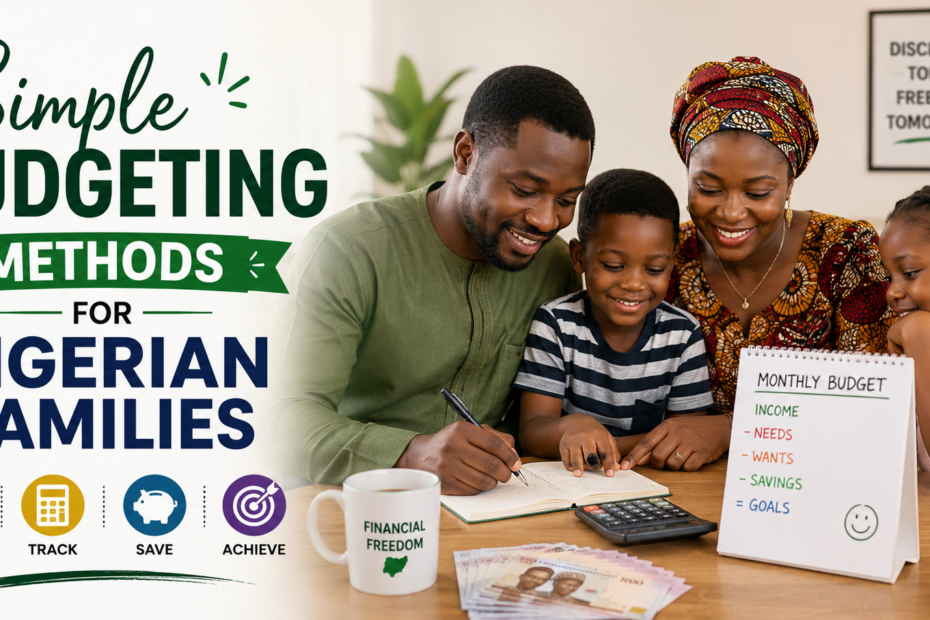
In many Nigerian homes today, managing money has become increasingly difficult due to rising food prices, fuel costs, school fees, and rent. Families are often forced to stretch limited or unstable incomes just to meet basic needs, leaving little or nothing for savings or emergencies.
Without a clear plan for spending, many people find that their money “disappears” before the end of the month, even when they feel they have tried their best.
This is why budgeting is no longer optional but necessary for financial survival and stability. It helps families understand where their money is going and how to manage it wisely. Budgeting is not about restriction—it is about control.
What is budgeting (in simple terms)?
Budgeting simply means planning how you will spend your money before you actually receive or use it. In other words, it is telling your money where to go instead of wondering where it went after it has been spent.
When you budget, you are taking control of your income by assigning specific amounts to different needs such as food, rent, transportation, school fees, savings, and other daily expenses. This helps you live within your means and avoid unnecessary spending that can lead to debt or financial stress.
Budgeting is important because it gives structure to your finances. Without it, it is easy to spend money on things that are not really important and later struggle when essential needs come up. It also helps you prepare for emergencies and future goals instead of living from hand to mouth.
For example, if a family earns ₦150,000 monthly, budgeting helps them decide in advance how much should go to food, rent, transport, school fees, and savings. Instead of spending randomly, they allocate money properly so every important area is covered. This way, they are less likely to run out of money before the month ends.
In simple terms, budgeting is not about limiting your life—it is about organizing your money so it works for you instead of against you.
The 50/30/20 Rule (Adapted for Nigerian Families)
The 50/30/20 rule is a simple budgeting method that helps families divide their income into three clear categories so money is easier to manage. It is widely used because it is easy to understand and apply, even for beginners who have never done budgeting before.
Under this rule, 50% of your income goes to needs, which are essential expenses you cannot avoid. These include food, rent, transportation, and school fees. These are the basic things required for daily living, and they must always come first in any budget.
Next, 30% is allocated to wants, which are things that improve comfort and lifestyle but are not absolutely necessary. This includes mobile data, entertainment, eating out, subscriptions, and leisure activities. These expenses are important for balance, but they should never exceed what you can afford.
Finally, 20% is set aside for savings or emergency funds. This portion is very important because it helps you prepare for unexpected situations like medical bills, job loss, or urgent repairs. It also helps you work toward long-term goals such as starting a business or building a house.
However, in Nigeria’s current economic situation, many families find the standard 50/30/20 rule difficult to follow strictly. Due to high living costs, some households may need to adjust it to 60/30/10 or even 70/20/10, where a larger portion goes to needs and less is left for savings.
The key is not the exact percentage, but consistency in planning and discipline in spending.
Envelope System (Cash Budgeting Method)
The envelope system is a simple and practical budgeting method that helps families control their spending by using cash only. It works by dividing your monthly income into different physical or labeled envelopes, with each envelope assigned to a specific expense category such as food, transport, school fees, rent, and savings.
Once you receive your income, you separate the money immediately based on your planned budget. For example, you may put a fixed amount into the “Food” envelope, another into “Transport,” another into “School Fees,” and so on.
Each envelope is used only for its specific purpose, meaning you cannot use money meant for transport to buy food or spend savings on entertainment.
The key rule of this method is simple: once an envelope is empty, you stop spending in that category until the next income arrives. This helps you avoid overspending and forces you to stick to your financial plan.
The envelope system is especially effective for families who use cash for most of their daily expenses, which is common in Nigeria. It creates discipline, reduces impulse buying, and makes it very clear where your money is going. Instead of guessing or overspending, you can physically see how much is left in each category.
In simple terms, the envelope system turns budgeting into a visual and controlled process, helping families manage money more responsibly and avoid financial stress.
Weekly Budgeting Method (Very Useful in Nigeria)
The weekly budgeting method is a practical way for families in Nigeria to manage their money more effectively, especially in a situation where prices of goods and services change frequently and income is not always stable or consistent.
Unlike monthly budgeting, which can feel overwhelming or unrealistic for some households, weekly budgeting breaks financial planning into smaller, more manageable parts.
This method works well because food prices, transport fares, and other daily expenses can rise unexpectedly. Also, many people earn income at different times, such as weekly wages, daily earnings, or irregular business profits. Because of this, planning money on a monthly basis may not always reflect real-life situations.
The process is simple and easy to follow. Every Sunday, you sit down and plan how your money will be spent for the next seven days. You focus only on immediate needs such as food, transport, and essential bills for that week. Instead of thinking about the entire month, you concentrate on what is required to survive and stay comfortable for the next few days.
At the end of each week, you review your spending and adjust your plan based on actual needs and unexpected expenses. This helps you stay flexible and avoid running out of money before the next income arrives.
In summary, weekly budgeting helps Nigerian families stay realistic, flexible, and more in control of their daily finances in an unpredictable economy.
Priority-First Budgeting (Needs Before Wants)
Priority-first budgeting is a simple financial method that helps families focus on what truly matters before spending money on less important things. It is based on the idea that not all expenses are equal, and some must be taken care of before others.
In this method, the first priority is always basic needs. These include food, rent, transportation, school fees, and other essential household bills. These are the expenses that keep the family stable and functioning, so they must always come first when planning how to use income.
After taking care of needs, the next category is wants or luxuries. These are things that improve comfort or enjoyment but are not necessary for survival. Examples include subscriptions like Netflix, social outings, parties, new clothes, and shopping for non-essential items.
While these things are fine to enjoy, they should only be considered after all important responsibilities have been covered.
For example, school fees must never be treated as optional spending. A family should not spend money on entertainment or luxury items while ignoring educational needs, because education is a long-term investment in the future.
Priority-first budgeting helps families avoid unnecessary financial stress by ensuring that essential needs are never neglected. It also teaches discipline and responsibility in spending decisions.
By following this method, families can live more peacefully knowing that their most important obligations are always taken care of first before any extra spending is considered.
Saving Even With Low Income
Saving money is possible even when income is small, and it is one of the most important habits for financial stability. Many families believe they must earn a lot before they can save, but the truth is that successful saving starts with consistency, not amount.
The best way to begin is to start small. You can save as little as ₦500 to ₦1,000 daily or weekly, depending on what you can afford. The key is not the size of the money, but the discipline of doing it regularly. Over time, these small amounts add up and become useful for emergencies or future plans.
To make saving easier, you can use simple tools like piggy banks (kolo) or modern bank savings apps. These help you separate savings from your daily spending money so you are less tempted to use it. Digital savings platforms also allow automatic deductions, which makes saving even more consistent.
Another powerful mindset is to treat savings like a “bill you must pay.” Just like rent, food, or transport, savings should be a fixed responsibility in your budget. Once you receive income, you set aside your savings first before spending on anything else. This helps you prioritize your future and avoid spending everything at once.
In summary, saving on a low income is not about how much you earn, but about building the habit of setting something aside regularly, no matter how small.
Common Budgeting Mistakes Nigerian Families Make
Many Nigerian families struggle with money not because they do not earn enough, but because of poor financial habits and avoidable budgeting mistakes. Understanding these mistakes is the first step toward better money management.
1. Spending before planning
One of the biggest mistakes is spending money immediately after receiving it without any plan. When there is no budget in place, it becomes easy to overspend on non-essentials and run out of money quickly.
2. No record of expenses
Many families do not track how their money is spent. Without keeping records, it becomes difficult to know where the money is going, which leads to confusion and poor financial control.
3. Relying on one income source
Depending on a single source of income is risky, especially in an unstable economy. If that income stops, the entire family becomes financially vulnerable.
4. Not saving for emergencies
A lot of families fail to set aside money for unexpected situations like illness, job loss, or urgent repairs. This often leads to borrowing and debt when emergencies arise.
5. Emotional spending (weddings, parties, peer pressure)
Spending based on emotions or social pressure is also common. Many people overspend during weddings, parties, or to “keep up” with others, even when it affects their financial stability.
Avoiding these mistakes can help families gain better control over their finances and build a more secure financial future.
Practical Tips to Make Budgeting Work
Budgeting only works when it is applied consistently in daily life. Many families understand budgeting in theory but struggle to practice it. These practical tips can help make budgeting more effective and easier to follow.
1. Write expenses down (not in your head)
Always record your income and spending in a notebook or phone. When everything is written down, it becomes easier to see where your money is going and identify unnecessary expenses.
2. Use budgeting apps or notebooks
You can use simple budgeting apps or even a basic notebook to track daily expenses. The goal is to stay organized and aware of your financial situation at all times.
3. Shop in bulk from markets like Mile 12 or local wholesalers
Buying in bulk is often cheaper than buying in small quantities. Markets like Mile 12 and other local wholesale markets in Nigeria can help families save money on food and household items.
4. Avoid impulse buying
Do not buy things just because you feel like it or because they are on display. Always ask yourself if the item is truly needed before spending money.
5. Cook at home more often
Eating out frequently can be expensive. Cooking at home helps reduce food costs and gives you better control over your budget.
When these simple habits are practiced consistently, budgeting becomes easier and more effective, helping families save money and reduce financial stress.
Conclusion
Budgeting is not poverty—it is discipline. It is not about how much money you have, but how well you manage what comes in. Many families struggle financially not because their income is too small, but because there is no proper plan guiding their spending and saving habits.
Even a small income can grow and provide stability when it is managed with proper planning and consistency. When every naira is given a purpose, it becomes easier to avoid waste, reduce debt, and build savings over time.
Financial stability does not happen overnight; it starts with small daily decisions such as tracking expenses, prioritizing needs, and saving consistently, no matter how little. These small actions, when repeated, create strong financial habits that lead to long-term security.
In the end, success with money is not about earning more alone, but about managing what you already have wisely.
“A well-planned ₦50,000 is better than an unmanaged ₦200,000.”
Frequently Asked Questions
What is the 3 6 9 rule of money?
The “3 6 9 rule of money” is not a universally fixed financial law, but rather a flexible personal finance concept that is often used by financial coaches, content creators, and budgeting educators to help people structure their money habits in a disciplined way. Because different people interpret it differently, it is important to understand it as a guiding principle rather than a strict formula.
One common interpretation of the 3-6-9 rule focuses on time-based financial stability planning. In this version, “3” represents having at least 3 months of emergency savings to handle unexpected expenses such as job loss, illness, or urgent repairs. The “6” represents planning your financial goals within a 6-month cycle, encouraging short-term discipline such as paying off debt, saving for school fees, or building a small business fund. The “9” is often linked to longer-term financial growth habits, such as building investments, developing multiple income streams, or planning for major life goals over a 9-month to multi-year horizon.
Another interpretation presents the rule as a mindset system. Here, “3” encourages identifying 3 core income sources or financial priorities. “6” focuses on maintaining 6 disciplined money habits such as saving, budgeting, tracking expenses, avoiding unnecessary debt, investing small amounts regularly, and setting financial goals. The “9” emphasizes consistency over time—building wealth gradually through repeated actions over 9 months or more.
Although it may sound structured, the 3 6 9 rule is not an official banking or economic system. Instead, it is a motivational framework that helps individuals think in stages: survival (3), stability (6), and growth (9). When applied correctly, it encourages better financial planning, especially for beginners who need simple structure to manage their money wisely.
What is the simplest budgeting method?
The simplest budgeting method is widely considered to be the “pay-yourself-first” method combined with basic percentage splitting or even the envelope system, depending on a person’s lifestyle and income consistency.
However, for most beginners, the easiest and most practical approach is the 50/30/20 rule, because it removes complexity while still giving structure.
In the 50/30/20 method, your income is divided into three simple categories. About 50% goes to needs—these are essential expenses like rent, food, transportation, electricity, and basic bills. These are things you cannot avoid in daily living.
Then 30% goes to wants, which include entertainment, eating out, shopping for non-essential items, subscriptions, or leisure activities. Finally, 20% is allocated to savings or debt repayment, helping you build financial security over time.
Another very simple method is the envelope system, which is especially useful in cash-based economies like Nigeria. In this system, you divide physical cash into labeled envelopes such as “food,” “transport,” “rent,” and “savings.” Once an envelope is empty, you stop spending in that category until the next income arrives. This method helps control overspending because it creates a visible limit.
The simplest budgeting method is not necessarily about advanced calculations but about clarity and discipline. A beginner only needs to know three things: how much they earn, how much they must spend, and how much they should save. Once these three areas are clear, financial control becomes easier.
Ultimately, the best budgeting method is the one a person can consistently follow. Simplicity wins over complexity. If a budget is too complicated, it will likely be abandoned. But a simple system like 50/30/20 or envelope budgeting builds strong habits that gradually improve financial stability and reduce money stress.
How to make a monthly budget in Nigeria?
Creating a monthly budget in Nigeria requires a realistic understanding of income, rising living costs, and essential expenses that vary depending on location, family size, and lifestyle.
The first step is to clearly identify your total monthly income. This may include salary, business profit, side hustle income, or any additional earnings. It is important to use a realistic average if income is irregular, especially for self-employed individuals.
Next, list all essential expenses. In Nigeria, common necessities include rent, food, transportation, electricity (including generator fuel or inverter maintenance), data subscriptions, school fees, and family support.
Because inflation can fluctuate, it is wise to estimate slightly higher than previous months to avoid shortfalls. For example, transportation costs may increase unexpectedly due to fuel price changes.
After listing essentials, include secondary expenses such as clothing, entertainment, gifting, and personal care. These are not urgent but still part of normal living. Then, allocate a portion for savings, even if it is small. In Nigeria’s economic environment, saving may feel difficult, but consistency matters more than amount.
A practical structure many Nigerians use is dividing income into percentages: 50–60% for needs, 20–30% for wants and lifestyle, and 10–20% for savings or investment. However, this can be adjusted depending on income level and responsibilities.
Tracking is also very important. Write everything down in a notebook or use budgeting apps to monitor spending daily or weekly. Many people lose control of their budget simply because they do not track expenses.
Finally, review your budget at the end of each month. Compare planned expenses with actual spending. This helps you identify waste, adjust priorities, and improve the next month’s plan. A good monthly budget in Nigeria is not perfect—it is flexible, realistic, and focused on financial survival and gradual growth.
What are the 9 components of a family budget?
A complete family budget is built on several key components that help ensure financial stability, proper planning, and reduced financial stress. The 9 components of a family budget cover all major areas of household income and expenses, allowing families to manage money effectively and avoid unnecessary debt.
- Income: This includes all sources of money coming into the family such as salaries, business income, freelance earnings, or side hustles. It is the foundation of every budget.
- Housing (Rent or Mortgage): This covers rent payments or home loans. It is usually the largest monthly expense for most families.
- Food and Groceries: This includes daily meals, supermarket shopping, and household consumables.
- Transportation: Costs for commuting, fuel, vehicle maintenance, public transport, or ride-hailing services.
- Utilities: Electricity, water, gas, internet, and phone bills fall under this category.
- Education: School fees, textbooks, uniforms, and other educational expenses for children or dependents.
- Savings and Investments: Money set aside for emergencies, future goals, or wealth-building opportunities.
- Healthcare: Medical bills, insurance, medications, and routine health checks.
- Personal and Miscellaneous Expenses: Clothing, entertainment, gifts, subscriptions, and unexpected costs.
Each component plays a vital role in maintaining financial balance. A strong family budget ensures that income is distributed properly across all areas without overspending in one category while neglecting another. For example, failing to plan for healthcare or education can create financial pressure later.
By organizing money into these 9 components, families can clearly see where their income is going and make better financial decisions. It also helps reduce conflicts about money because spending becomes planned instead of random.
Ultimately, a well-structured family budget is not just about controlling expenses—it is about building financial stability and long-term security for everyone in the household.
How to create a simple budget for beginners?
Creating a simple budget for beginners starts with understanding one basic principle: you cannot manage what you do not measure. The first step is to calculate your total monthly income. This includes salary, side income, or any consistent money you receive. Beginners should avoid guessing and instead use actual figures to stay realistic.
The second step is to list your essential expenses. These are the things you must spend on to survive, such as food, rent, transport, utilities, and basic personal needs. Writing these down helps you see exactly where your money goes every month.
Next, subtract your essential expenses from your income. Whatever remains is your discretionary money. This is where beginners often make mistakes by spending without planning. Instead, divide this remaining amount into two parts: savings and non-essential spending. Even saving a small amount is important because it builds discipline.
A very simple structure beginners can follow is the 3-step rule: earn, spend wisely, and save something every time you earn. Unlike complex budgeting systems, this method focuses on consistency rather than perfection.
Beginners should also track their spending daily or weekly. This can be done using a notebook, spreadsheet, or mobile app. Tracking helps identify unnecessary expenses such as impulse buying, frequent eating out, or unplanned transport costs.
Finally, review your budget at the end of each month. Ask yourself what worked, what didn’t, and what can be improved. A simple budget is not meant to restrict life but to give control over money. Over time, beginners who stay consistent with budgeting develop stronger financial discipline, reduced stress, and better saving habits.
What are the five most common budgeting methods?
There are several budgeting methods people use around the world, but five stand out as the most common because they are simple, practical, and adaptable to different income levels and lifestyles.
These methods are the 50/30/20 rule, zero-based budgeting, envelope system, pay-yourself-first method, and incremental (or line-item) budgeting.
The 50/30/20 rule divides income into three categories: 50% for needs, 30% for wants, and 20% for savings or debt repayment. It is popular because it is easy to understand and does not require complex calculations.
The zero-based budgeting method assigns every single unit of income a specific job. At the end of the budget, income minus expenses equals zero. This does not mean spending everything, but rather ensuring every naira is allocated intentionally, including savings.
The envelope system is a cash-based method where money is divided into labeled envelopes such as food, transport, and rent. Once an envelope is empty, spending stops in that category. It is very effective for controlling overspending.
The pay-yourself-first method prioritizes savings before anything else. As soon as income arrives, a portion is set aside for savings or investment before paying bills or spending on needs and wants.
Finally, incremental or line-item budgeting is commonly used in households and businesses. It involves tracking past expenses and adjusting them slightly each month based on changes in income or cost of living.
Each of these methods works differently depending on personality and financial discipline. Some people prefer structure like zero-based budgeting, while others prefer flexibility like the 50/30/20 rule. The key is consistency and choosing a method that fits your lifestyle.
What are the 7 steps in good budgeting?
Good budgeting follows a structured process that helps individuals or families take control of their income and expenses. The 7 steps in good budgeting provide a clear roadmap for financial planning and stability.
The first step is identifying your total income. This includes salary, business profits, side hustle income, and any regular financial inflow. Without knowing your exact income, budgeting becomes guesswork.
The second step is listing all expenses. This includes fixed expenses like rent and school fees, and variable expenses like food, transport, and utilities.
The third step is categorizing expenses into needs, wants, savings, and debt repayment. This helps you understand priority spending versus optional spending.
The fourth step is setting financial goals. These can be short-term goals like paying bills on time, or long-term goals like buying a house or building savings.
The fifth step is creating a spending plan. Here, you assign specific amounts to each category based on your income and priorities.
The sixth step is tracking your spending regularly. This ensures you do not overspend in any category and helps you stay disciplined throughout the month.
The seventh and final step is reviewing and adjusting your budget at the end of each month. This allows you to identify mistakes, reduce unnecessary spending, and improve future budgeting accuracy.
When these 7 steps are followed consistently, budgeting becomes more than just a financial task—it becomes a lifestyle that builds financial control, reduces stress, and improves long-term financial security.
How do you make a zero-based budget for a home?
A zero-based budget is a financial system where every income is assigned a specific purpose until nothing is left unallocated. For a home, this method is very effective because it gives full control over household spending and prevents waste. The idea is simple: income minus expenses equals zero, but every naira is planned.
To begin, the first step is to calculate your total household income. This includes salaries, business income, freelance earnings, and any other consistent money coming into the home. It is important to use realistic figures, not estimated or hopeful income.
The second step is to list all household expenses. These include rent, food, transportation, electricity, school fees, water, internet, and other daily needs. In a home setting, you should also include occasional expenses like medical bills, clothing, and repairs.
Next, you assign every naira of income to a category. For example, if rent takes a large portion, you allocate it first. Then you distribute the rest among food, transport, savings, debt repayment, and entertainment until every naira is assigned.
After allocation, the budget should mathematically reach zero. This does not mean you have no money left physically, but that every unit of money has a job.
The fourth step is tracking spending throughout the month. This ensures that each category is followed strictly and no category is overspent.
Finally, at the end of the month, you review and adjust the next month’s budget based on real-life spending patterns.
A zero-based budget helps families avoid financial confusion, reduce unnecessary spending, and build discipline because every expense is intentional and planned.
What are the 7 types of budgeting?
Budgeting can be approached in different ways depending on goals, organization style, and financial complexity. The 7 types of budgeting are commonly used in households, businesses, and personal finance management.
The first type is incremental budgeting, where the current budget is based on the previous period’s budget with small adjustments. It is simple and widely used.
The second is zero-based budgeting, where every expense must be justified from scratch each time. Nothing is carried over automatically.
The third is activity-based budgeting, which focuses on the cost of activities required to produce goods or services. It is often used in business environments.
The fourth is value proposition budgeting, where spending is based on whether each cost adds value to the individual or organization.
The fifth is flexible budgeting, which adjusts based on changes in income or activity levels. This is useful for people with irregular income like freelancers or business owners.
The sixth is cash flow budgeting, which focuses on tracking when money comes in and goes out, ensuring liquidity and avoiding shortages.
The seventh is surplus budgeting, where income is planned in a way that ensures leftover funds (surplus) after all essential expenses, encouraging savings and investment.
Each type serves a different purpose. For example, zero-based budgeting is strict and detailed, while flexible budgeting is more adaptable. Choosing the right type depends on financial discipline, income stability, and personal goals. Understanding these 7 types helps individuals and families choose a system that fits their financial lifestyle and improves money management efficiency.
What is the budgeting app for Nigeria?
In Nigeria, several budgeting apps are designed to help individuals manage money, track expenses, save automatically, and build financial discipline. These apps are especially useful because they simplify budgeting in a fast-changing economic environment where expenses can fluctuate.
One of the most popular apps is PiggyVest, which helps users save money automatically, lock funds, and invest. It is widely trusted for disciplined savings and goal-based financial planning.
Another strong option is Cowrywise, which offers automated savings plans, mutual fund investments, and goal tracking features. It is designed for both beginners and advanced savers.
For everyday banking and budgeting, Kuda Bank is very popular. It provides spending insights, free transfers, budgeting tools, and expense tracking within a mobile banking system.
Similarly, OPay is widely used for payments, transfers, and financial management. It also helps users monitor spending patterns.
Another option is Carbon, which offers budgeting tools, loans, and expense tracking features.
These apps help Nigerians manage money more effectively by providing real-time tracking, automated savings, and clear financial summaries. Choosing the right app depends on personal needs—whether the focus is saving, spending control, investing, or full digital banking.
What are the 5 basics to any budget?
Every successful budget is built on a few fundamental principles that do not change regardless of income level, location, or lifestyle. The five basics to any budget are income, expenses, savings, financial goals, and tracking/control. These elements form the foundation of financial stability and help individuals or families manage money effectively.
The first basic is income, which refers to all the money coming in. This may include salary, business profit, freelance work, allowances, or any regular cash inflow. Without a clear understanding of income, budgeting becomes guesswork. You must always know exactly how much money you are working with.
The second basic is expenses, which include everything you spend money on. Expenses are usually divided into fixed costs like rent and school fees, and variable costs like food, transport, and entertainment. Knowing your expenses helps you avoid overspending.
The third basic is savings. A budget without savings is incomplete. Savings act as financial protection for emergencies such as illness, job loss, or urgent repairs. Even a small amount saved consistently builds financial strength over time.
The fourth basic is financial goals. These give your budget direction. Goals can be short-term, such as paying bills on time, or long-term, such as buying land or building a business. Goals help you stay disciplined.
The fifth basic is tracking and control. A budget only works when spending is monitored regularly. Tracking ensures you stay within limits and adjust when necessary.
Together, these five basics create a strong financial system. When applied consistently, they help individuals avoid debt, reduce stress, and build long-term financial stability regardless of income size.
How to budget for a family?
Budgeting for a family requires planning, communication, and discipline because multiple people depend on a single financial system.
The first step is to determine the total household income, including salaries, business earnings, side hustles, and any additional income sources. This gives a clear picture of what the family can realistically spend each month.
Next, list all family expenses. These typically include rent, food, transportation, electricity, school fees, healthcare, clothing, and utilities. In many families, especially in Nigeria, expenses can fluctuate due to inflation, so it is important to estimate slightly higher than previous months.
After listing expenses, categorize them into needs, wants, and savings. Needs are essential survival costs, wants are lifestyle choices like entertainment, and savings are for emergencies and future goals. This helps prioritize spending.
The fourth step is to set family financial goals. These could include building an emergency fund, paying off debt, saving for a house, or funding education. Goals help keep the family focused and reduce unnecessary spending.
Next, create a monthly spending plan. Assign specific amounts to each category based on income. Every family member should understand the plan to avoid misunderstandings.
Then, implement regular tracking. This means monitoring expenses weekly or daily to ensure the budget is followed.
Finally, hold a monthly family review meeting. This helps identify problems, adjust spending, and improve the next month’s budget.
Family budgeting works best when everyone is involved. It builds financial discipline, reduces conflict, and ensures that money is used effectively for both present needs and future stability.
How do I budget with no income?
Budgeting with no income may sound impossible, but it is actually an important financial survival strategy. When there is no income, the goal of budgeting changes from spending and saving to preserving resources, prioritizing needs, and planning recovery.
The first step is to assess what resources are available. This may include savings, support from family or friends, or emergency funds. You must calculate exactly how much money you currently have, even if it is small.
Next, you should list only essential expenses. In a no-income situation, non-essential spending must be eliminated completely. Essentials include food, basic shelter, transportation for urgent needs, and critical health expenses.
The third step is to create a survival budget, not a regular budget. This means dividing available funds strictly based on priority. For example, food and shelter come first, followed by basic communication or transport if necessary. Entertainment and luxury spending must be paused.
The fourth step is to reduce all unnecessary costs. This may include moving to cheaper accommodation, reducing food costs, or using minimal electricity and data.
The fifth step is to focus on income recovery strategies. Budgeting without income is temporary, so efforts should be made to find work, start a small business, sell unused items, or explore freelance opportunities.
It is also important to track spending carefully so that available funds last as long as possible.
In summary, budgeting with no income is about survival, not growth. It requires strict discipline, prioritization, and urgent action to restore income as quickly as possible while protecting essential needs.
What are the first 5 things you should list in a budget?
When creating a budget, especially for beginners or families, the order in which expenses are listed is very important. The first five things you should list in a budget are the most essential financial categories that determine survival, stability, and financial planning.
The first item is income. Before listing any expense, you must clearly state how much money is coming in. Without income, budgeting cannot be accurate. This includes salary, business profit, and any side earnings.
The second item is housing cost. This includes rent or mortgage payments. Housing is usually the largest and most important fixed expense, so it must be prioritized early in the budget.
The third item is food and groceries. Food is a daily necessity, and its cost must be carefully planned to avoid overspending or shortages.
The fourth item is transportation. This includes commuting costs, fuel, public transport fares, or vehicle maintenance. Without transportation planning, other areas of life can be disrupted.
The fifth item is utilities and basic bills, such as electricity, water, internet, and phone services. These are essential for communication, work, and daily living.
Once these five key items are listed, you can then move to secondary expenses like entertainment, clothing, savings, and debt repayment. Starting with the most important categories ensures that survival needs are covered first before lifestyle spending.
This structured approach helps individuals and families avoid financial imbalance and ensures that critical needs are always prioritized in every budgeting cycle.
Which type of budget is best for a family?
The best type of budget for a family depends on income stability, financial discipline, and lifestyle needs, but generally, the zero-based budget and the 50/30/20 method are considered the most effective for most families.
The zero-based budget is highly effective because it assigns every unit of income a specific purpose. In this system, income minus expenses equals zero. Every naira is planned, including savings and debt repayment.
This method gives families full control over their money and reduces wasteful spending. It is especially useful for families who want strict financial discipline and detailed tracking.
The 50/30/20 rule is another excellent option for families who prefer simplicity. It divides income into 50% for needs, 30% for wants, and 20% for savings or debt repayment. This method is easier to follow and helps maintain balance between survival, lifestyle, and future planning.
For families with irregular income, a flexible budget may be better. This type adjusts spending based on monthly earnings, making it suitable for business owners or freelancers.
However, many financial experts recommend combining methods—for example, using zero-based budgeting for fixed expenses and the 50/30/20 rule for general planning.
Ultimately, the best family budget is one that is simple, realistic, and consistently followed. A budget that is too complicated will fail, while a simple but disciplined system builds long-term financial stability, reduces stress, and helps families achieve both short-term needs and long-term financial goals.