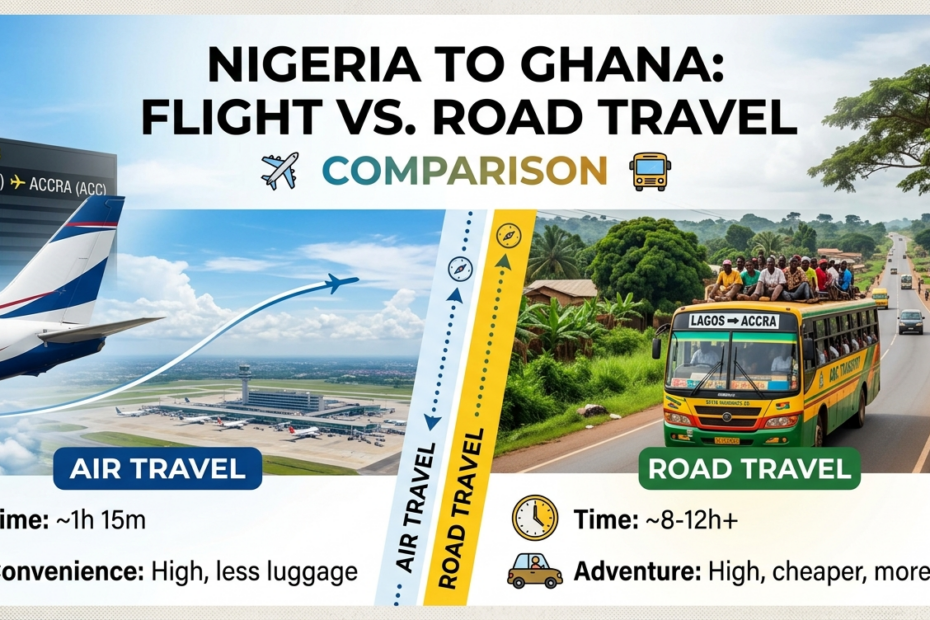
Planning a trip from Nigeria to Ghana? You might be wondering whether flying or traveling by road is the best option. With multiple choices available, it can be challenging to decide which mode of travel saves you time, reduces costs, and ensures a comfortable journey.
In this Nigeria to Ghana travel comparison, we break down everything you need to know—from travel time and expenses to comfort and safety—so you can make an informed decision for your next adventure.
Travel Time: Flight vs Road from Nigeria to Ghana
When planning your trip from Nigeria to Ghana, understanding the travel time for each option is essential. Here’s a clear comparison:
By Flight:
-
Average flight duration: 1.5 to 2 hours from Lagos or Abuja to Accra.
-
Additional time: Airport check-in (1–2 hours), security checks, and boarding.
-
Minimal delays if you choose direct flights.
By Road:
-
Approximate driving time: 12 to 18 hours depending on your starting point in Nigeria and traffic conditions.
-
Factors affecting travel time:
-
Traffic congestion in major cities like Lagos or Accra.
-
Border clearance delays at the Nigeria-Ghana border.
-
Rest stops for food, fuel, and bathroom breaks.
-
-
Driving overnight may reduce traffic delays but can be tiring.
Quick Takeaway:
Flights are significantly faster, making them ideal for travelers who value time. Road travel, while longer, allows flexibility in stops and sightseeing along the route.
Cost Comparison: Flight vs Road from Nigeria to Ghana
By Flight (e.g., Lagos → Accra):
-
One‑way economy ticket: typically ₦150,000 – ₦190,000 in 2025.
-
Round‑trip fares: around ₦290,000 – ₦370,000.
-
Additional costs: baggage fees, airport transfers, travel insurance, lounge access (optional).
By Road (Bus or Private Car):
-
Bus one‑way ticket (Lagos → Accra) with reputable operators: ₦45,000 – ₦80,000 in 2025.
-
Private car/drive‑yourself: fuel, tolls, border formalities—expect ₦100,000 – ₦160,000+ depending on vehicle, stops, and number of passengers.
-
Hidden/extra costs: border fees, permits, possible overnight stays, meals on the route.
Updated Cost Comparison Table:
| Mode of Travel | Typical Cost (One‑Way) | Additional Expenses | Estimate Total |
|---|---|---|---|
| Flight | ₦150,000 – ₦190,000 | Baggage fees, airport transfers | ₦160,000 – ₦200,000+ |
| Bus (road) | ₦45,000 – ₦80,000 | Snacks, rest stops, border processing | ₦50,000 – ₦85,000 |
| Private car/drive | ₦100,000 – ₦160,000+ | Fuel, tolls, permits, overnight stay possible | ₦110,000 – ₦170,000+ |
Quick Takeaway:
If you prioritise speed and comfort, flying is the faster and more convenient (though more expensive) option. Road travel remains significantly cheaper per person, especially by bus, but involves longer journey time and more variables such as stops, delays, and border checks.
Comfort and Convenience: Flight vs Road from Nigeria to Ghana
When choosing how to travel from Nigeria to Ghana, comfort and convenience are key factors that can make a big difference in your journey.
By Flight:
-
Legroom & Seating: Economy class seats are generally comfortable, though legroom can vary by airline. Premium or business class offers extra space and amenities.
-
Amenities: In-flight services often include refreshments, snacks, entertainment (on some airlines), and climate-controlled cabins.
-
Stress Level: Minimal travel stress as flights are fast and smooth. Airport security checks may add minor delays, but the overall journey is quicker.
-
Flexibility: Limited by flight schedules, but multiple daily flights are available on popular routes like Lagos to Accra.
By Road:
-
Legroom & Seating: Bus seats vary—premium buses offer reclining seats, air-conditioning, and sometimes Wi-Fi, while regular buses can be cramped. Private cars offer personal space but may be tiring for long drives.
-
Breaks & Stops: Road trips require periodic stops for fuel, meals, and bathroom breaks, which can increase total travel time but allow for stretching and sightseeing.
-
Stress Level: Longer travel time and border procedures can make road travel more tiring. Drivers may experience fatigue, and navigating traffic or poor roads adds to stress.
-
Flexibility: Highly flexible—you can choose departure times, stop locations, and pace of travel, making it ideal for sightseeing or carrying extra luggage.
Quick Takeaway:
Flights provide a fast, relatively stress-free, and comfortable experience, ideal for travelers prioritizing convenience. Road travel offers flexibility and adventure but can be tiring and less predictable, especially on long journeys.
Safety Considerations for the Nigeria → Ghana Journey: Flight vs Road
When weighing your travel options for a trip from Nigeria to Ghana, safety is a major factor. Here’s a detailed look at the risks and comparisons between travelling by road and by air.
Road Travel Risks
-
Road accidents are common in both Ghana and Nigeria. In Ghana, for example, between January and June 2025 there were about 1,504 fatalities from some 7,289 crashes.
-
In Nigeria, the first quarter of 2025 recorded 2,650 crashes and 1,591 fatalities.
-
Other road‑travel hazards include:
-
Driver fatigue and long hours behind the wheel (especially for bus or private‑car trips).
-
Poor road infrastructure: potholes, unmarked lanes, poor lighting.
-
Security checkpoints, fake or unauthorised stops, robbery risks. Tourists driving in Ghana are advised to be wary of fake checkpoints.
-
Border crossings can complicate the journey: vehicle checks, paperwork, delays—all add stress and risk of encountering problematic situations.
-
-
Takeaway for road travel: While it offers flexibility and visibility, the risk factor is higher in terms of accidents, fatigue, and security issues relative to many air travel routes.
Air Travel Safety
-
Flying remains one of the safest modes of transport globally. According to the International Air Transport Association (IATA) data, the fatality‑risk ratio was about 0.11 per one million flights in 2022.
-
In Nigeria, at least one carrier, Air Peace, achieved its sixth consecutive IOSA (Operational Safety Audit) certification by IATA, placing it “on par” with established global carriers.
-
While air travel is very safe, it’s not entirely free of issues (delays, minor incidents, etc.). But major accidents are exceedingly rare compared with road travel.
-
Takeaway for air travel: If you prioritise safety and speed, flying is the safer option when comparing a route like Nigeria → Ghana.
Comparative Summary
| Mode | Key Risks | Relative Safety Level |
|---|---|---|
| Road Travel | Accidents, fatigue, poor infrastructure, security/robbery risks | Higher risk |
| Air Travel | Very low accident rates; mostly minor operational issues | Much lower risk |
Practical Advice
-
If you opt for road travel: choose reputable transportation companies, avoid driving at night if possible, ensure your vehicle is well‑maintained, and be aware of security risks en route.
-
If you opt for flying: pick airlines with recognised safety certifications, arrive at the airport early, and ensure your travel insurance covers any eventualities.
Environmental Impact: Flight vs Road from Nigeria to Ghana
In today’s travel planning, many travelers consider the environmental impact of their journey. Here’s how flights and road travel compare:
By Flight:
-
Airplanes emit a significant amount of CO₂ per passenger per kilometer. A short-haul flight from Lagos to Accra generates roughly 0.2–0.3 tonnes of CO₂ per passenger.
-
Flights have a larger carbon footprint than road travel per passenger, especially for solo travelers or short distances.
-
However, airlines are gradually adopting more fuel-efficient planes and carbon-offset programs.
By Road:
-
Traveling by bus or shared car significantly reduces per-passenger emissions compared to flying.
-
A private car emits more CO₂ than a bus but can still be lower than a flight if multiple passengers share the ride.
-
Road trips allow travelers to combine trips or carry more luggage without additional emissions, increasing efficiency.
Quick Takeaway:
For eco-conscious travelers, road travel—especially by bus or shared vehicle—tends to be more environmentally friendly than flying. Flights are faster but come with a larger carbon footprint, which is an important consideration for sustainable travel.
Tips for Travelers: Nigeria to Ghana
Planning your journey from Nigeria to Ghana can be smoother with the right tips. Here’s what you need to know about airlines, road travel, and travel documents.
Best Airlines for Nigeria → Ghana
-
Air Peace: Popular for Lagos to Accra, reliable schedules, and good safety record.
-
Arik Air: Offers multiple daily flights from Lagos and Abuja to Accra.
-
ASky Airlines & Africa World Airlines: Other options for competitive fares and convenient schedules.
-
Tips: Book in advance to get better rates, check baggage policies, and arrive at the airport at least 2 hours before departure.
Recommended Bus Companies or Driving Tips
-
Bus Operators: Peace Mass Transit, ABC Transport, and Modern Coast offer Lagos–Accra routes with varying levels of comfort.
-
Driving Tips:
-
Ensure your vehicle is in good condition, including brakes, tires, and lights.
-
Avoid driving at night, especially on unfamiliar roads.
-
Plan your route, including rest stops and fuel stations.
-
Be cautious at security checkpoints and carry valid ID and vehicle documents.
-
Consider traveling in groups for safety when using a private car.
-
Documents and Border Requirements
-
Passport: Valid passport is required for entry into Ghana.
-
Visa: Nigerian citizens do not require a visa for stays up to 90 days.
-
Yellow Fever Vaccination Certificate: Mandatory for all travelers entering Ghana.
-
COVID-19/Health Requirements: Check current guidelines before traveling.
-
Vehicle Documents (for road travelers): Vehicle registration, insurance, and temporary import permits if applicable.
Quick Takeaway:
Planning ahead is key. Whether flying or traveling by road, choosing reputable operators, carrying the correct documents, and following safety guidelines will make your Nigeria to Ghana trip more comfortable, safe, and stress-free.
Conclusion & Recommendation: Flight vs Road Travel from Nigeria to Ghana
Choosing the best way to travel from Nigeria to Ghana depends on your priorities:
-
If you value time and convenience, flying is the fastest, most comfortable, and safest option.
-
If budget is your priority, traveling by road—whether by bus or private car—offers significant savings, flexibility, and the opportunity for a scenic journey.
Ultimately, both options have their pros and cons. By considering travel time, cost, comfort, safety, and even environmental impact, you can make the choice that best fits your needs.
Engagement Tip:
Have you traveled from Nigeria to Ghana by road or flight? Share your experience in the comments and let other travelers know what worked best for you!
Frequently Asked Questions
Can I use my NIN to travel to Ghana?
No, the National Identification Number (NIN) issued by Nigeria cannot be used as a travel document for international travel, including trips to Ghana.
The NIN serves as a national identity verification tool within Nigeria, primarily used for accessing government services, opening bank accounts, obtaining SIM cards, and other domestic purposes. While it is an important identification document, it does not replace internationally recognized travel documents.
To travel to Ghana, Nigerian citizens are required to carry a valid passport. This is the internationally recognized document that confirms your identity and nationality. A Nigerian passport ensures that you can pass through border control checkpoints legally and comply with Ghanaian immigration laws.
When planning your trip, ensure that your passport is valid for at least six months beyond your intended date of entry into Ghana, as this is a common requirement for entry into many countries.
It is also important to note that using only the NIN for travel could result in denial of entry at the Ghanaian border. Immigration officials require a formal passport to record your arrival, departure, and for verification purposes.
While the NIN is crucial for identification at home, the international travel framework recognizes passports, visas, and other travel-specific documents as valid proof of identity.
In summary, the NIN is not sufficient for international travel. For Nigerian citizens intending to visit Ghana, the passport is mandatory, and it is essential to carry it along with other relevant travel documents to ensure smooth passage through customs and immigration checkpoints. Planning ahead by checking passport validity and ensuring compliance with entry requirements can help avoid travel disruptions.
Can someone travel from Nigeria to Ghana by road?
Yes, it is entirely possible to travel from Nigeria to Ghana by road, and many travelers choose this option for reasons such as flexibility, cost savings, or the opportunity to experience local scenery.
The journey by road allows passengers to stop at various towns along the way, enjoy local cuisine, and interact with communities across Nigeria and into Ghana.
Traveling by road typically involves using either a bus service, a private car, or a combination of both. Bus services are widely available from major Nigerian cities such as Lagos, Ibadan, and Abuja, with reputable operators offering comfortable buses that provide reclining seats, air conditioning, and sometimes Wi-Fi.
These buses usually follow well-established routes and make scheduled stops for food, fuel, and restroom breaks. Travelers should choose recognized and experienced transport operators to ensure safety and reliability during the journey.
Driving a private car is another option, though it requires careful planning. Travelers must consider factors such as fuel, road conditions, border crossing procedures, and overnight stops if the journey is too long for a single day.
Driving allows for complete flexibility, enabling travelers to adjust departure times and routes according to their preferences. However, private drivers should be aware of potential security concerns, road quality, and fatigue during long stretches.
The journey by road usually takes around 12 to 18 hours depending on starting location, traffic conditions, and border crossing delays. It is essential for travelers to carry all necessary travel documents, including a passport, yellow fever vaccination certificate, and vehicle papers if driving. Road travel can be an enriching experience, but preparation, caution, and awareness of travel conditions are key to a smooth journey.
What documents are required to travel from Nigeria to Ghana?
Traveling from Nigeria to Ghana requires several essential documents to ensure smooth passage through borders and compliance with legal regulations. The most important document is a valid Nigerian passport, which serves as proof of identity and citizenship. Passports must generally be valid for at least six months beyond the intended date of entry into Ghana.
In addition to a passport, travelers must provide a yellow fever vaccination certificate, commonly referred to as the “yellow card.” Ghana, like many countries in West Africa, requires proof of vaccination against yellow fever as a measure to protect public health. Without this certificate, entry may be denied or quarantine procedures may be enforced.
Other required documents include proof of accommodation or travel plans. Immigration authorities may ask for hotel reservations or a letter from a host in Ghana to verify the purpose and duration of your stay. Travelers should also carry sufficient funds to cover their stay, as proof of financial means may be requested.
For those traveling by road with a private vehicle, additional documentation is necessary, including the vehicle registration papers, proof of insurance, and temporary import permits if required. Border officials may also check for valid driver’s licenses, especially if the vehicle will be driven across the border by the traveler.
It is also advisable to carry copies of identification, travel insurance, and emergency contact information. Preparing all required documents in advance ensures a smooth travel experience and reduces the likelihood of delays at checkpoints or border crossings.
Which African country is the cheapest to visit from Nigeria?
The cheapest African country to visit from Nigeria depends on several factors, including distance, transportation costs, accommodation rates, and the cost of living in the destination country.
Among the popular destinations for Nigerian travelers, Ghana is often considered one of the most affordable options. Its proximity to Nigeria reduces travel expenses, whether traveling by air or road, and local prices for food, transport, and accommodation are generally reasonable.
Other affordable destinations include Benin Republic, which borders Nigeria to the west. Road travel is easy and inexpensive, with minimal visa requirements and lower living costs. Similarly, Togo offers affordable travel options and short transit times, making it a budget-friendly destination for weekend trips or short holidays.
Costs vary based on the mode of travel. Traveling by road is generally cheaper than flying, especially when using buses or shared transport. Accommodation options in these countries range from budget hostels to affordable hotels, reducing overall travel costs. Food and entertainment are also comparatively inexpensive, allowing travelers to enjoy local culture without overspending.
Travelers looking for a balance between affordability and a fulfilling travel experience should consider factors such as seasonal costs, local transport availability, and currency exchange rates. Planning ahead and booking in advance can further reduce expenses, making these neighboring African countries ideal for budget-conscious travelers from Nigeria.
Do I need a yellow card to travel to Ghana from Nigeria?
Yes, a yellow card, which is an official yellow fever vaccination certificate, is mandatory for all travelers entering Ghana from Nigeria.
Yellow fever is a viral disease that poses serious health risks, and many West African countries, including Ghana, enforce vaccination requirements to prevent its spread. The certificate serves as proof that the traveler has received the vaccine and is protected against the disease.
Without a yellow card, travelers may be denied entry at the Ghanaian border. In some cases, authorities may enforce quarantine measures until proof of vaccination is presented.
It is therefore critical to receive the yellow fever vaccine well in advance of travel, as some countries require the vaccination to have been administered at least 10 days before entry.
The yellow card is recognized internationally and must be carried alongside other travel documents, such as a valid passport and visa if required. Health authorities and border officials use this certificate to verify compliance with public health regulations and to ensure the safety of both travelers and the local population.
In addition to the yellow card, travelers are encouraged to follow other health precautions, such as carrying mosquito repellents, wearing protective clothing, and staying updated on any travel health advisories issued by the Ghana Health Service or the Nigerian Ministry of Health.
Which economy is better Ghana or Nigeria?
Comparing the economies of Ghana and Nigeria depends on what factors you are looking at because both countries have different strengths and challenges.
Nigeria has the larger economy overall. It has a much bigger population, larger oil and gas reserves, and a broader market size. Nigeria’s GDP remains significantly higher than Ghana’s, making it one of the largest economies in Africa.
However, having a larger economy does not always mean a better standard of living. Ghana is often viewed as having a more stable economic environment in areas like inflation management, governance consistency, and ease of doing business. In recent years, Ghana has made progress in reducing inflation and stabilizing its economy after facing debt and currency challenges.
Nigeria, on the other hand, has greater economic potential because of its population size, natural resources, tech sector growth, and industrial opportunities. But it also faces major challenges such as inflation, currency instability, unemployment, and infrastructure gaps.
In simple terms:
- Nigeria has the bigger and more powerful economy
- Ghana is often seen as more stable and easier for daily living/business management
So the “better” economy depends on perspective:
- For market size and opportunity → Nigeria
- For relative stability and ease of living → Ghana
Which month is the cheapest to fly to Accra, Ghana?
The cheapest months to fly from Nigeria to Accra are usually January, February, March, and September. Travel demand is lower during these periods, so airlines often reduce ticket prices to attract passengers.
Several flight tracking platforms and travel reports show that:
- January and February are among the cheapest months after the holiday rush
- March can also offer affordable fares
- September is another low-demand period with lower ticket prices
By contrast, flights become much more expensive during:
- June to August (summer travel period)
- December holidays
- Easter periods
Another important factor is booking time. Travelers usually get cheaper prices when they:
- Book 4–8 weeks early
- Fly on weekdays instead of weekends
- Avoid holiday seasons
Morning flights and direct flights from Lagos to Accra are often the most cost-effective combination.
How much is a plane ticket from Nigeria to Ghana?
The price of a flight ticket from Nigeria to Ghana depends on:
- Departure city (Lagos or Abuja)
- Time of booking
- Airline
- Travel season
For the common Lagos to Accra route, one-way economy tickets typically range between ₦200,000 and ₦500,000+ depending on demand. During peak holiday periods, prices may rise above ₦700,000.
Some recent fare estimates show:
- Low-demand season: around ₦200k–₦435k
- Regular season: around ₦280k–₦540k
- Peak season: ₦435k–₦800k+
Flights are usually direct and take approximately 1 hour from Lagos to Accra. Popular airlines on the route include Air Peace and Africa World Airlines.
Prices change frequently, so travelers often save money by:
- Booking early
- Traveling during low seasons
- Comparing airlines before payment
Why are Nigerians moving to Ghana?
Many Nigerians move to Ghana for a combination of economic, educational, business, and lifestyle reasons.
One major reason is the perception that Ghana offers a calmer and more stable environment compared to some parts of Nigeria. Many people see Ghana as less stressful, with more organized urban systems and relatively lower levels of congestion and insecurity in some areas.
Another reason is education. Ghana has become a popular destination for Nigerian students because some universities offer stable academic calendars with fewer strikes or disruptions.
Business opportunities also attract Nigerians. Ghana’s location within West Africa makes it suitable for trade, hospitality, and small business operations. Some entrepreneurs prefer Ghana because of what they perceive as easier business processes and more predictable regulations.
Lifestyle and quality of life are also important factors. Some Nigerians believe Ghana offers:
- Cleaner urban environments
- Less traffic compared to Lagos
- More relaxed pace of life
However, it is important to note that migration goes both ways. Many Ghanaians also move to Nigeria because Nigeria has a larger economy and more business opportunities overall.
So Nigerians move to Ghana mainly for:
- Stability
- Education
- Lifestyle
- Business environment
- Personal preference
How much money do you need per day in Ghana?
The amount of money you need per day in Ghana depends on your lifestyle, accommodation type, and travel purpose.
For a budget traveler, daily expenses can range between $30 and $60 USD per day. This may cover:
- Basic accommodation
- Local transportation
- Affordable meals
- Small personal expenses
For a mid-range lifestyle, you may need around $80 to $150 USD daily, especially if staying in hotels, using ride-hailing services, and eating in restaurants regularly.
Luxury travelers or business visitors may spend much more depending on accommodation and entertainment choices.
In major cities like Accra, costs are generally higher than smaller towns. Accommodation and transportation are usually the biggest expenses.
Some travelers on Reddit and travel forums even mention that parts of Accra can feel expensive compared to expectations, especially for flights, hotels, and imported goods.
To reduce costs:
- Use local transport when possible
- Eat local meals
- Book accommodation early
- Avoid peak tourist seasons
Overall, Ghana can be affordable or expensive depending on how you choose to travel and live.
What is the biggest issue in Ghana?
Ghana faces several national challenges, but one of the biggest issues affecting the country in recent years has been economic pressure, especially related to inflation, unemployment, and public debt.
Like many developing economies, Ghana has experienced rising costs of living, currency depreciation, and high prices for goods and services. Inflation affects transportation, food, housing, and business operations, making daily life more difficult for many citizens. Economic reforms and debt restructuring efforts have also placed pressure on households and businesses.
Another major challenge is youth unemployment. Many young graduates struggle to find stable jobs, especially in formal sectors. This has increased interest in entrepreneurship, migration, and digital work opportunities.
Infrastructure gaps also remain an issue in some areas, particularly regarding roads, drainage systems, healthcare access, and electricity reliability outside major cities.
In addition, illegal mining activities, commonly referred to as “galamsey,” have become a significant environmental concern. These activities affect water bodies, farmland, and local ecosystems, creating long-term environmental risks.
Despite these challenges, Ghana is still widely viewed as one of the more politically stable countries in West Africa, with democratic continuity and relative social stability.
So while Ghana’s biggest issue is often linked to economic hardship and unemployment, the country continues to work toward reforms and long-term development.
Is Ghana welcoming to African Americans?
Yes, Ghana is widely regarded as one of the most welcoming African countries for African Americans. Ghana has actively promoted cultural and historical connections with the African diaspora for many years.
One major reason is the country’s historical relationship with the transatlantic slave trade. Ghana hosts important heritage sites such as Cape Coast Castle and Elmina Castle, which are deeply connected to African American history. Many visitors travel there to reconnect with ancestral roots and learn more about African heritage.
Ghana also gained global attention through initiatives like the “Year of Return” campaign launched in 2019, which encouraged people of African descent around the world to visit and reconnect with Africa. This initiative attracted many African Americans, celebrities, entrepreneurs, and investors.
In everyday life, many African Americans report feeling welcomed by locals, especially in cities like Accra. The country is known for its hospitality, peaceful atmosphere, and relatively stable political environment.
However, like any country, experiences can vary depending on expectations, location, and personal interactions. Cultural differences still exist, and visitors may need time to adjust to local customs and systems.
Overall, Ghana has built a strong reputation as a friendly and culturally welcoming destination for African Americans interested in tourism, heritage, relocation, or business opportunities.
What is the hottest month in Ghana?
The hottest months in Ghana are usually March and April. During this period, temperatures rise significantly across many parts of the country, especially in northern regions and inland cities.
In the capital city, Accra, temperatures during March and April often range between 30°C and 35°C (86°F to 95°F), although it can feel hotter because of humidity. Northern areas of Ghana may experience even higher temperatures.
The heat during these months is partly influenced by the transition between the dry season and the rainy season. Dry winds, strong sunshine, and lower rainfall contribute to warmer daytime conditions.
The northern regions of Ghana generally experience hotter weather than coastal areas because they are farther from the cooling influence of the Atlantic Ocean.
Even though March and April are usually the hottest months, Ghana has a tropical climate, meaning warm weather exists throughout most of the year.
Travelers visiting during this period are often advised to:
- Stay hydrated
- Wear light clothing
- Avoid prolonged sun exposure during midday
- Use sunscreen and cooling methods where possible
How much does a ticket to Ghana cost?
The cost of a ticket to Ghana depends on:
- Your departure country or city
- Time of booking
- Airline
- Travel season
For travelers flying from Nigeria to Accra, economy class tickets usually range between ₦200,000 and ₦500,000 or more depending on demand and booking period. During holidays and peak seasons, prices can rise significantly.
Flights from Lagos to Accra are among the most common and typically take about one hour. Ticket prices are usually cheaper when:
- Booked several weeks early
- Traveled during low-demand months
- Scheduled on weekdays instead of weekends
For travelers coming from Europe or North America, ticket prices are much higher and vary widely depending on airline routes and stopovers.
Budget airlines, promotional offers, and travel comparison websites can help reduce costs.
Overall, there is no fixed ticket price to Ghana because airfare changes regularly based on season and demand.
Do I need a visa to visit Accra?
Whether you need a visa to visit Accra depends on your nationality and travel purpose.
For Nigerian citizens, Ghana is part of the Economic Community of West African States (ECOWAS), which allows visa-free movement among member countries. This means Nigerians generally do not need a visa for short visits to Ghana. Instead, travelers usually need:
- A valid international passport
- Proof of return travel (sometimes requested)
- Vaccination documents, especially Yellow Fever card
However, immigration requirements can change, so travelers should always confirm current entry rules before departure.
For citizens of countries outside ECOWAS, a visa may be required depending on bilateral agreements with Ghana.
Even when visas are not required, visitors must still comply with immigration checks and entry conditions at the airport or border.
So, for many West African travelers—especially Nigerians—a visa is generally not required for short visits to Accra under ECOWAS travel arrangements.