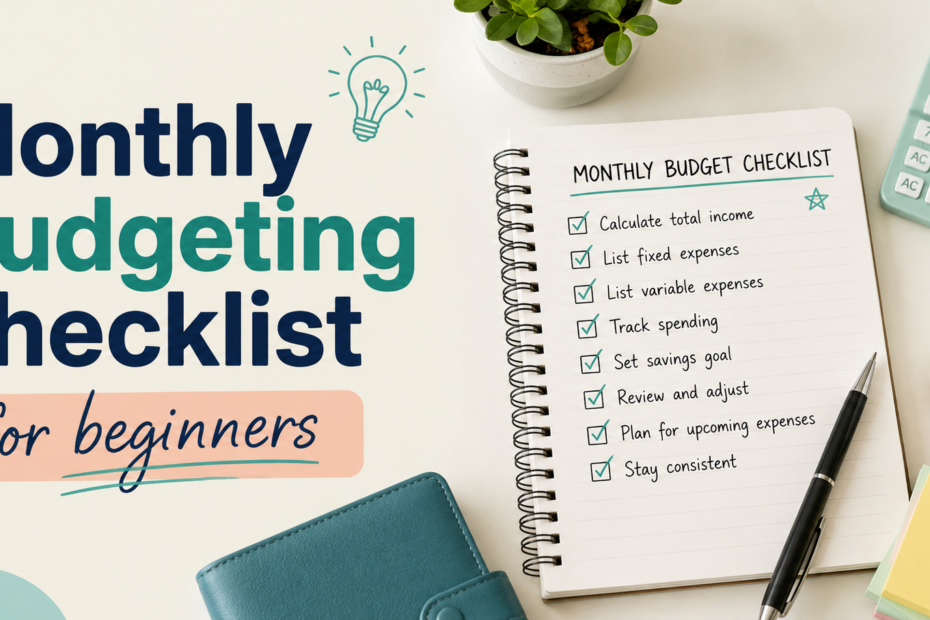
Managing money for the first time can feel confusing, especially when expenses seem to appear faster than income.
Many beginners struggle not because they earn too little, but because they do not have a clear plan for how their money should be used each month. This is where a monthly budgeting checklist becomes valuable.
A monthly budget is more than writing numbers on paper—it is a practical system that helps you understand your income, control spending, prepare for unexpected expenses, and work toward your financial goals.
Whether you are earning your first salary, running a small business, or simply trying to improve your financial habits, creating a structured monthly budget can help you make smarter decisions with your money.
This monthly budgeting checklist for beginners will walk you through the essential steps needed to organize your finances, reduce unnecessary spending, build consistent saving habits, and create a budget you can actually maintain long term.
Understanding the Purpose of a Monthly Budget
A monthly budget is a simple financial plan that helps you decide how your money will be earned, spent, and saved during a specific month.
It gives you a clear picture of your income and expenses so you can make better financial decisions instead of spending without direction.
For beginners, budgeting may seem restrictive at first, but its real purpose is to create control and financial clarity.
When you create a monthly budget, you become more aware of where your money goes each month.
This makes it easier to track income, manage regular expenses, and identify unnecessary spending habits that reduce financial progress.
A budget also helps prevent overspending and lowers the chances of relying on loans or accumulating debt to cover everyday costs.
Another major benefit of budgeting is reduced financial stress. Knowing that your bills, savings, and essential expenses are already planned creates peace of mind and confidence.
Rather than wondering where your money disappeared to, a monthly budget helps you stay organized and in control of your financial future.
Listing and Tracking All Sources of Income
The foundation of every successful monthly budget starts with understanding exactly how much money comes in each month.
Before planning expenses or setting savings goals, beginners should identify and track every source of income they receive.
This includes not only a monthly salary but also side hustles, freelance projects, business profits, commissions, rental income, or any occasional earnings.
One of the most common budgeting mistakes beginners make is creating a budget based only on their main salary while ignoring additional income streams.
This can result in unrealistic spending plans, missed savings opportunities, or confusion about actual financial performance. A complete income picture allows you to create a budget that reflects reality rather than assumptions.
Tracking income also helps reveal patterns in earnings, especially for people whose income changes from month to month.
Recording all incoming money makes it easier to plan expenses wisely, avoid overspending, and set achievable financial goals.
When you have full visibility into your income, every spending decision becomes more intentional and financially informed.
Categorizing Monthly Expenses Clearly
After identifying all sources of income, the next step in creating an effective monthly budget is organizing your expenses into clear categories.
Categorizing expenses helps beginners understand exactly where their money goes each month and prevents spending from becoming confusing or unmanageable.
Instead of viewing all expenses as one large amount, breaking them into sections creates better financial awareness and control.
Start by grouping expenses into major categories such as housing, food, transportation, utilities, debt payments, savings, and personal spending.
Housing may include rent and accommodation costs, while food covers groceries and eating out.
Transportation includes fuel, public transport, or vehicle maintenance, while personal spending can include entertainment, shopping, and other lifestyle expenses.
It is also important to separate expenses into fixed and variable categories. Fixed expenses are costs that stay relatively the same each month, such as rent or loan repayments.
Variable expenses change depending on habits and choices, such as food, entertainment, and shopping.
Understanding this difference helps beginners identify which expenses can be adjusted and where unnecessary spending may be reducing financial progress.
Setting Realistic Spending Limits for Each Category
Once your monthly expenses have been grouped into categories, the next step is assigning realistic spending limits to each one. This is where budgeting moves from awareness into action.
Setting limits helps create discipline and ensures your money is distributed intentionally instead of being spent impulsively throughout the month.
For beginners, spending limits should always be based on actual income rather than expectations or ideal situations.
A common mistake is creating a budget that looks perfect on paper but does not match real financial habits or earnings.
For example, setting an extremely low food budget or unrealistic savings target may lead to frustration and abandoning the budget entirely.
A more effective approach is to start with achievable limits that fit your current lifestyle and gradually improve over time.
Small adjustments are usually easier to maintain than sudden financial restrictions. At the same time, your budget should remain flexible because expenses can change from month to month.
The goal is not perfection but creating a structure that helps you spend intentionally, stay consistent, and build better financial habits over time.
Prioritizing Savings and Emergency Funds
A strong monthly budget is not complete without prioritizing savings, and this step should never be treated as optional.
One of the most important principles in personal finance is “paying yourself first,” which means setting aside a portion of your income for savings before spending on wants or non-essential expenses.
This habit ensures that your financial future is being protected even while you handle your daily needs.
Emergency funds are a key part of this savings structure. Life is unpredictable, and unexpected expenses such as medical bills, sudden job loss, home repairs, or urgent family needs can appear without warning.
Without savings, these situations often force people into debt or financial stress. However, having an emergency fund provides a safety net that keeps your finances stable during difficult times.
For beginners, it is important to understand that savings do not have to be large at the start. Even small, consistent contributions each month can gradually build a strong financial cushion.
Over time, these small efforts grow into meaningful financial security, giving you peace of mind and greater control over your financial life.
Reviewing and Adjusting the Budget Monthly
A monthly budget is not something you create once and forget; it is a living plan that should be reviewed and adjusted regularly.
As income, lifestyle, and financial goals change, your budget must also evolve to remain effective. This is why reviewing your budget at the end of every month is a crucial habit for beginners.
At the end of each month, take time to compare your actual spending with your planned budget.
This helps you clearly see which areas you stayed on track and where you overspent or underestimated costs. It also reveals patterns in your financial behavior that may not be obvious during daily spending.
Adjusting your budget is just as important as creating it. If certain categories consistently run over budget, you may need to reallocate funds or reduce spending in other areas.
On the other hand, if you manage to spend less than planned, you can increase savings or improve financial goals.
This regular review process builds strong financial awareness over time. It teaches discipline, improves decision-making, and helps beginners gradually gain full control over their money.
Conclusion
Creating a successful monthly budget does not require financial expertise or a high income.
It starts with understanding where your money comes from, planning how it will be spent, and making intentional decisions each month.
A budgeting checklist gives beginners a simple structure that turns financial goals into practical daily habits.
Remember that budgeting is not about limiting your life—it is about giving your money a purpose. Some months may not go exactly as planned, and adjustments will be necessary.
What matters most is consistency and the willingness to keep improving your financial decisions over time.
Start with small changes, review your progress every month, and stay committed to your plan. Over time, those simple budgeting habits can lead to greater financial confidence, reduced stress, and long-term financial stability.
Frequently Asked Questions
How to Prepare a Simple Monthly Budget?
A simple monthly budget is built on clarity, consistency, and honesty about your income and spending habits.
The first step is to calculate your total monthly income, which includes salary, side hustle earnings, freelance payments, or any other regular inflow of money.
Once you have a clear figure, the next step is to list all your essential expenses. These are the non-negotiable costs such as rent, feeding, transportation, utilities, and debt repayment.
After identifying essentials, you should also include your variable expenses, which are costs that change monthly such as entertainment, shopping, and eating out.
The third step is to allocate your income into categories so that every naira has a purpose. A commonly used approach is to ensure that spending does not exceed income while prioritizing needs over wants.
It is also important to set aside a portion for savings, even if it is small at first, because consistency matters more than the amount.
Many people fail at budgeting because they forget to plan for unexpected expenses, so an emergency category should always be included.
After setting the budget, the next stage is tracking your spending throughout the month. This helps you stay aware of where your money is going and prevents overspending.
At the end of the month, you should review your budget to see what worked and what didn’t. Adjustments are normal and necessary because income and expenses often change.
A simple monthly budget is not about restriction but about control, helping you make intentional financial decisions and avoid unnecessary debt.
What are 20 Examples of Expenses?
Expenses refer to the different ways money leaves your hands in daily life, and they can be grouped into essential, lifestyle, and occasional costs.
Common examples of expenses include rent or house payment, electricity bills, water bills, internet subscription, and transportation costs such as fuel or public transit fares.
These are usually fixed or recurring and form the backbone of most monthly budgets.
Other important examples include food and groceries, school fees, healthcare costs, and medication.
Debt repayments such as loans, credit payments, or borrowed money repayments also count as major expenses that must be prioritized to avoid financial penalties.
Clothing and personal care items like haircuts, toiletries, and grooming products are also regular spending categories.
Lifestyle-related expenses include entertainment such as movies, subscriptions, streaming services, and social outings.
Eating out, ordering food, and buying snacks are also common spending habits that add up over time. Communication expenses such as airtime, mobile data, and phone repairs are also part of everyday financial outflow.
Additional examples include insurance payments, savings contributions, gifts, donations, and emergency spending for unexpected situations like repairs or medical emergencies.
Business-related costs such as equipment, stock purchases, or marketing expenses can also fall under this category for entrepreneurs.
Even small purchases like drinks, accessories, or impulse buys are considered expenses because they reduce available income.
Understanding all these examples helps individuals gain awareness of where money goes.
When people track these expenses carefully, they can identify unnecessary spending, reduce waste, and improve financial discipline. This awareness is the foundation of effective budgeting and long-term financial stability.
What are the 7 Steps in Good Budgeting?
Good budgeting follows a structured process that helps individuals manage money effectively and avoid financial stress. The first step is identifying your total income.
This includes all reliable sources of money, whether it is salary, freelance work, or business profit. Without knowing your exact income, it is impossible to build a realistic budget.
The second step is listing all fixed expenses. These are consistent monthly costs such as rent, loans, school fees, and subscriptions. After that, you move to variable expenses, which change frequently, including food, transportation, and entertainment.
Separating these categories helps you understand which costs are flexible and which are not.
The third step is setting financial goals. These goals may include saving for emergencies, paying off debt, or building investment funds. Goals give direction to your budget and help you stay motivated.
The fourth step is allocating your income into spending categories. This ensures that every portion of your money is assigned a purpose before you spend it.
The fifth step is prioritizing needs over wants. This is important because it helps prevent unnecessary spending and ensures that essential needs are always covered first.
The sixth step is tracking your expenses daily or weekly. Monitoring your spending helps you stay within limits and avoid surprises at the end of the month.
The final step is reviewing and adjusting your budget regularly. Life changes such as income increases, job loss, or new responsibilities can affect your financial plan.
A good budget is flexible and adapts to these changes. By following these seven steps consistently, anyone can develop strong financial discipline and long-term stability.
What are the 5 Basics to Any Budget?
Every effective budget is built on five fundamental elements that guide how money is managed. The first basic is income, which represents all the money coming in.
Understanding your income clearly is essential because it determines the limit of your spending and saving capacity. Without accurate income tracking, budgeting becomes unrealistic.
The second basic is expenses. These include all money going out, such as rent, food, transport, and utilities.
Categorizing expenses helps you understand where your money is being used and identify areas where you can reduce unnecessary spending. Expenses must always be compared with income to ensure balance.
The third basic is savings. A strong budget always includes a savings plan, even if the amount is small.
Savings act as financial security and help you handle emergencies without borrowing money. Over time, savings also support long-term goals such as buying assets or starting a business.
The fourth basic is financial goals. These give direction to your budget and help you stay focused. Goals can be short-term, like saving for a gadget, or long-term, like building an emergency fund or investing. Without goals, budgeting becomes less meaningful and harder to maintain.
The fifth basic is tracking and control. This involves monitoring your spending and adjusting your behavior when necessary.
Tracking ensures that you do not overspend and helps you stay accountable. Control also means making conscious decisions instead of impulsive purchases.
When these five basics are combined, they create a strong financial structure that supports stability, discipline, and growth.
A budget is not just about limiting spending but about managing money in a way that aligns with your priorities.
What are the Top 3 Biggest Expenses?
The top three biggest expenses for most individuals and households typically take the largest portion of monthly income and greatly influence financial stability.
The first major expense is housing, which includes rent, mortgage payments, and sometimes utility-related housing costs.
Housing is often the largest because shelter is a basic human need, and in many cities, rent prices consume a significant portion of income.
Poor housing planning can quickly lead to financial stress, especially when it exceeds a reasonable percentage of earnings.
The second biggest expense is transportation. This includes fuel, vehicle maintenance, car payments, public transport fares, and sometimes ride-hailing services.
Transportation costs can become very high depending on distance to work, fuel prices, and frequency of travel. For many people, daily commuting is unavoidable, making this a consistent and necessary expense.
The third major expense is food. Food expenses include groceries, cooking supplies, eating out, and snacks.
While food is essential, it is also one of the areas where spending can easily become uncontrolled due to lifestyle habits like frequent dining out or impulse purchases. Proper planning and meal preparation can significantly reduce this cost.
These three categories are considered the biggest because they are essential for survival and daily functioning.
Together, they often consume the majority of a person’s income, leaving limited room for savings if not properly managed.
Understanding and controlling these expenses is the foundation of financial stability and effective budgeting.
What are the 7 Types of Cost?
The concept of cost can be understood in several ways depending on how money is spent and what purpose it serves.
One common type is fixed cost, which remains constant every month, such as rent or loan repayments. These costs do not change easily and must be paid regardless of income fluctuations.
Another type is variable cost, which changes depending on usage or consumption, such as food, transport, or electricity bills. These costs are flexible and often fluctuate monthly.
A third type is direct cost, which is directly linked to producing goods or services, especially in business. For individuals, this can include the exact cost of buying a product or service.
Indirect cost refers to expenses that are not directly tied to production but still necessary, such as maintenance or administrative costs.
There is also opportunity cost, which represents what you give up when choosing one option over another, such as spending money instead of saving it.
Another important type is operating cost, which includes daily expenses required to run a household or business, such as utilities and supplies.
Lastly, there is sunk cost, which refers to money already spent that cannot be recovered, regardless of future decisions.
Understanding these seven types of cost helps individuals and businesses make better financial decisions and avoid wasteful spending. It also improves budgeting accuracy and long-term financial planning.
What is the Best Budgeting Method?
The best budgeting method depends on personal income style, discipline level, and financial goals, but one of the most effective and widely recommended approaches is the 50/30/20 rule.
This method divides income into three clear categories: 50% for needs, 30% for wants, and 20% for savings or debt repayment. It is popular because it is simple, flexible, and easy to maintain even for beginners.
Another strong method is zero-based budgeting, where every unit of income is assigned a specific purpose so that income minus expenses equals zero.
This method is very detailed and helps prevent wasteful spending because every naira is accounted for.
Envelope budgeting is also effective, especially for people who prefer cash control. It involves dividing money into physical or digital envelopes for different spending categories.
The best method is ultimately the one that helps you stay consistent. If you prefer simplicity, the 50/30/20 rule may work best. If you want strict control, zero-based budgeting is more suitable.
What matters most is discipline, tracking expenses, and regularly reviewing your budget. A good budgeting method is not about complexity but about sustainability and personal financial awareness.
What are 5 Key Points to Personal Budgeting?
Personal budgeting is built on several important principles that help individuals manage money effectively. The first key point is knowing your income clearly.
Without understanding how much money comes in, it is impossible to plan spending realistically. This includes salary, side income, and any additional earnings.
The second key point is tracking expenses. Every spending category, from rent to small daily purchases, should be monitored.
This helps identify spending habits and reduce unnecessary costs. The third key point is prioritizing needs over wants.
Essential expenses like food, housing, and transport should always come first before luxury or entertainment spending.
The fourth key point is setting financial goals. These goals may include saving for emergencies, paying debts, or building investments.
Goals provide direction and motivation for better financial discipline. The fifth key point is consistency and review. A budget is not a one-time activity but a continuous process that requires monthly review and adjustment.
Together, these five points form the foundation of strong personal financial management. When applied correctly, they help individuals avoid debt, build savings, and achieve long-term financial stability.
What are the Biggest Expenses for Most People?
The biggest expenses for most individuals typically fall into essential living categories that take up the majority of monthly income.
The first major expense is housing, which includes rent, mortgage payments, or accommodation-related costs.
This is usually the largest expense because shelter is a basic necessity, and in many urban areas, it consumes a significant portion of earnings.
The second biggest expense is transportation. This includes fuel, public transport fares, vehicle maintenance, or ride services.
Transportation is essential for work, education, and daily activities, making it a consistent and unavoidable cost for most people.
The third major expense is food. This includes groceries, cooking supplies, dining out, and snacks.
Food is a daily necessity, but it can also become a major spending area when not properly managed. Poor food planning often leads to overspending.
Other significant expenses include healthcare, utilities, and debt repayments. These costs may not always be as large as the top three but still have a strong impact on financial stability.
Together, these expenses shape most people’s financial structure and determine how much they can save or invest each month.
Proper management of these areas is essential for achieving financial balance and avoiding financial stress.
What are the Five Personal Expenses?
Personal expenses refer to the money spent on individual needs, lifestyle, and daily living activities.
The first common type is housing expense, which includes rent, home maintenance, and utility bills like electricity and water. This is usually a fixed and essential cost for almost everyone.
The second type is food expense, which covers groceries, meals, snacks, and beverages. This category is essential but can vary depending on eating habits and lifestyle choices.
The third type is transportation expense, which includes commuting costs such as fuel, public transport fares, ride-hailing services, and vehicle maintenance.
The fourth personal expense is healthcare, which includes medical bills, medications, health insurance, and routine checkups.
Health expenses are important because they ensure physical well-being and financial protection against emergencies.
The fifth type is personal lifestyle expenses, which include clothing, grooming, entertainment, subscriptions, and social activities.
These five personal expenses represent the core areas where individuals spend most of their income. Understanding them helps in creating a realistic budget that balances needs and wants.
Proper management of these expenses ensures financial stability, reduces unnecessary debt, and allows for consistent saving and long-term financial growth.