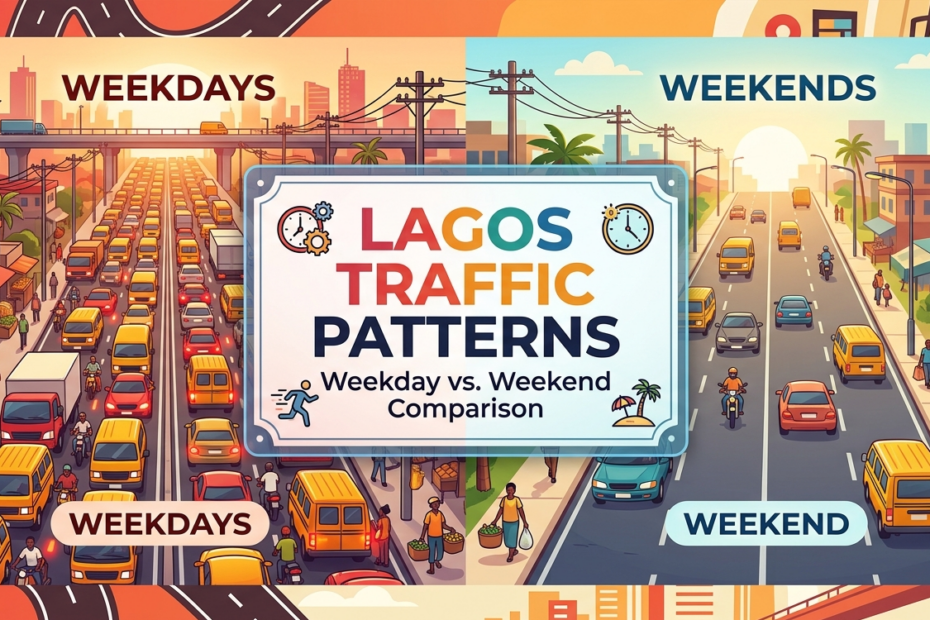
Lagos, Nigeria’s largest city, is a bustling commercial hub with millions of daily commuters. Its traffic patterns are among the most complex in Africa, influenced by population density, urban planning, and the daily movement of residents. Understanding the differences between weekday and weekend traffic can save you time, reduce stress, and make commuting more efficient.
Weekdays are characterized by predictable yet heavy congestion, especially during rush hours.
Weekends show a different traffic behavior. Congestion is often less predictable and driven more by leisure activities.
Lagos traffic patterns differ significantly between weekdays and weekends. While weekdays are dominated by work-related congestion, weekends reflect leisure and social movement. Understanding these patterns can help residents, commuters, and visitors plan effectively, save time, and reduce the stress associated with Lagos roads.
What is the average traffic speed in Lagos?
The average traffic speed in Lagos varies significantly depending on the area, time of day, and traffic conditions. During peak hours, such as morning and evening rush hours, the average speed can drop to as low as 10 to 15 kilometers per hour on heavily congested roads like the Third Mainland Bridge, Lekki-Epe Expressway, and Ikorodu Road.
In less congested areas or during off-peak hours, speeds can range between 30 and 50 kilometers per hour. Factors influencing these speeds include the volume of vehicles, frequent stop-and-go traffic caused by traffic lights, roadblocks, accidents, and informal street trading.
Poor road conditions, including potholes and unplanned construction, also contribute to slower travel times. Public transportation vehicles such as danfos and buses often stop irregularly to pick up passengers, further slowing traffic flow.
Motorcycle riders (okadas) can maneuver more freely, but they are also a source of unpredictability, which slows overall traffic speed for other vehicles. Traffic management initiatives, including dedicated BRT lanes, one-way systems, and controlled intersections, have helped marginally improve average speeds in some areas, but the high population density and rapid urbanization continue to place enormous pressure on the city’s road network.
Consequently, traveling even short distances in Lagos can take significantly longer than in cities with less congestion, highlighting the importance of planning and using traffic apps to navigate efficiently.
Why does Lagos have so much traffic?
Lagos experiences heavy traffic due to a combination of urban, economic, and infrastructural factors. The city is the commercial hub of Nigeria, hosting millions of workers, traders, students, and visitors daily, which creates a massive demand for transportation.
The road infrastructure has not kept pace with the city’s rapid population growth, leading to insufficient lanes, narrow streets, and bottlenecks in critical areas. Unregulated urban development and high-density residential settlements often result in vehicles crowding onto limited roadways.
Additionally, the public transportation system is underdeveloped and unable to accommodate the commuting needs of the population, forcing more people to rely on private cars, commercial buses, and motorcycles.
Other contributing factors include traffic violations, poor enforcement of traffic laws, street trading that blocks roads, and frequent road accidents. Seasonal issues like flooding during the rainy season exacerbate traffic problems by reducing the number of usable roads.
Finally, the presence of construction projects, both for roads and buildings, interrupts normal traffic flow. Together, these factors make Lagos a city where congestion is a daily reality and traffic management remains a significant challenge for urban planners and authorities.
Is Lagos a LIC or NEE?
Lagos is classified as a Newly Emerging Economy (NEE). While Nigeria as a whole is considered a developing country, Lagos is a major economic center that demonstrates many characteristics of an emerging economy.
The city is the largest commercial and financial hub in Nigeria, contributing a substantial portion of the national GDP. It hosts major industries, multinational corporations, financial institutions, and a thriving informal economy, reflecting rapid economic growth and urbanization.
Lagos also shows infrastructural development with modern roads, bridges, ports, and international airports, although challenges such as inadequate public transportation and traffic congestion remain.
Unlike Low-Income Countries (LICs), Lagos exhibits significant industrialization, urbanization, and investment potential, which are typical indicators of an emerging economy.
The city continues to attract domestic and foreign investment, driving both population growth and urban expansion. Its status as an NEE highlights its economic potential while also underscoring the need for improved infrastructure, governance, and urban planning to manage rapid growth sustainably.
What is the biggest problem in Lagos?
One of the biggest problems in Lagos is traffic congestion, which affects almost every aspect of daily life. The city’s roads are heavily congested due to population density, inadequate infrastructure, and a high number of vehicles relative to road capacity.
This congestion results in long travel times, increased fuel consumption, environmental pollution, and heightened stress for commuters. Related problems include poor public transportation, chaotic urban planning, and weak enforcement of traffic laws.
Other major challenges in Lagos include flooding, housing shortages, inadequate waste management, and energy supply issues. Rapid population growth strains existing infrastructure, creating pressure on healthcare, education, and basic services.
Security and informal settlements also contribute to urban challenges, making sustainable development difficult. While traffic is the most visible and daily-encountered issue, it is interconnected with other structural problems, meaning comprehensive urban planning, investment in infrastructure, and policy reforms are necessary to address the city’s most pressing challenges effectively.
How is traffic managed in Lagos?
Traffic management in Lagos is handled through a combination of government agencies, infrastructure projects, and traffic regulations. The primary agency responsible is the Lagos State Traffic Management Authority (LASTMA), which enforces traffic laws, directs vehicles, and addresses congestion on major roads.
The city also employs the use of traffic lights, one-way systems, and designated lanes to control the flow of vehicles. Bus Rapid Transit (BRT) lanes have been introduced on key routes to provide dedicated corridors for buses, reducing congestion for other road users.
Road construction and maintenance projects are periodically undertaken to improve infrastructure, although they can temporarily worsen traffic. Surveillance through cameras and traffic monitoring centers helps authorities detect accidents or blockages quickly.
Additionally, public awareness campaigns encourage compliance with traffic rules and road safety. Despite these measures, the effectiveness of traffic management is often hampered by high vehicle volumes, poor road conditions, unregulated street trading, and inconsistent enforcement.
As a result, commuters are advised to combine official traffic guidance with personal planning strategies, such as using alternative routes, checking real-time traffic updates, and traveling during off-peak hours, to navigate the city more efficiently.