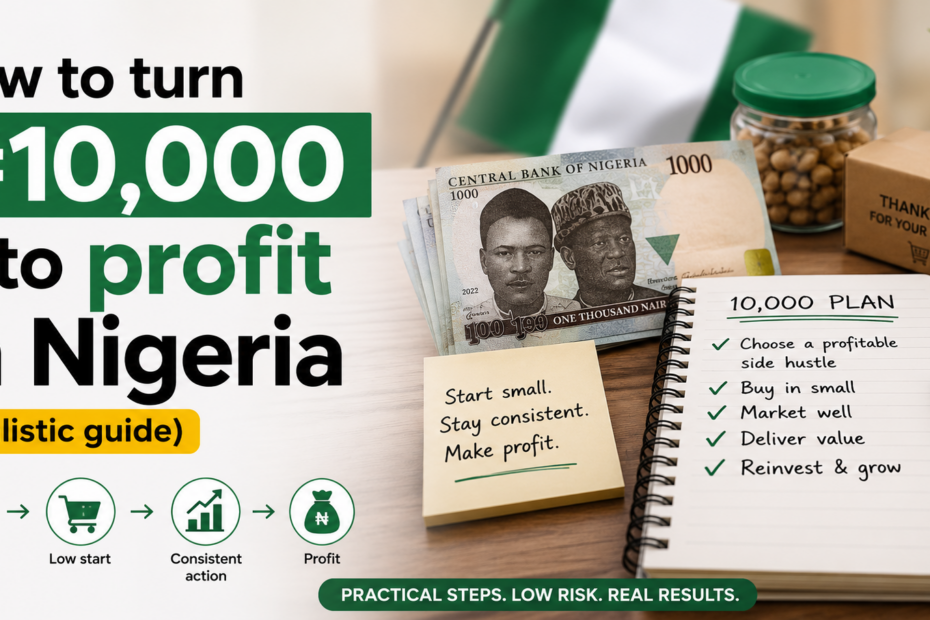
₦10,000 often feels like an amount that is too small to do anything meaningful with, especially in a tough economy like Nigeria’s. Many people assume that real business or investment requires large capital, but that mindset is what keeps most people stuck.
The truth is, ₦10,000 will not make you rich overnight, and it is not meant to. However, it can absolutely be the beginning of something bigger if used correctly.
What matters most is not the size of the money, but how you use it. When you combine the right small-scale opportunity with consistency and basic skill, that ₦10,000 can start generating steady cash flow. Over time, that small profit can be reinvested and grown.
₦10,000 is not a limitation—it is a launchpad.
Mindset Shift
Before you even think about how to turn ₦10,000 into profit, the first thing that must change is your mindset. The biggest mistake most beginners make is expecting “big money” immediately from small capital. That expectation usually leads to disappointment or falling for scams that promise to double money quickly.
The smarter approach is to think in stages: reinvest → grow → scale. Your first ₦10,000 is not the final result; it is the starting cycle. You buy something small, sell it for a profit, then reinvest both your capital and profit back into the next round. That is how real businesses grow.
Avoid anything that looks like “quick doubling” schemes—they almost always end in loss. Instead, focus on real value creation.
The key principle is simple: profit comes from buying low, selling value, and solving real problems people already have.
Best Small Business Ideas with ₦10,000 in Nigeria
A. Food Resale Business
This is one of the fastest ways to start making daily cash flow with low capital because food is a basic necessity—people buy it every day.
With ₦10,000, you can start small by focusing on fast-moving items like Indomie, eggs, bread, sachet water, and sachet drinks. The strategy is simple: buy in bulk at a cheaper price from local markets or wholesalers, then resell in smaller units at a profit.
For example, instead of selling a full crate of eggs, you can break it down and sell per piece. The same applies to bread and drinks—buy at wholesale price and sell retail.
Your main target customers are students, office workers, and neighbors who need quick and affordable meals or snacks. If you position yourself in a busy area like a student hostel or residential street, you can make daily sales consistently.
The key advantage of this business is fast turnover—money comes back quickly, allowing you to reinvest and restock frequently.
B. Phone Accessories Reselling
Phone accessories are always in demand because almost everyone owns a mobile phone. With ₦10,000, you don’t need to stock many items at once. Start small with just 2–3 fast-moving products like earpods, chargers, and screen guards.
The strategy here is simple: buy cheap from wholesale markets (like computer villages or online suppliers) and resell at a higher price. Your profit may look small per item, but it adds up quickly with volume.
To sell faster, focus on places where people frequently need these items—offices, campuses, bus stops, and social media platforms like WhatsApp and Instagram. Consistency and trust matter more than location at the beginning.
C. Mini Importation / Online Reselling
This involves buying cheap products in bulk from wholesalers or foreign suppliers (often through agents) and reselling them locally at a higher price.
With ₦10,000, you may start with very low-cost items like gadgets, fashion accessories, or small household items. The goal is to test what sells fast before scaling.
You can market your products using WhatsApp status, Instagram pages, and Jiji listings. Good product photos and clear pricing can make a big difference in sales.
This model works best when you focus on trending, low-cost items people already want.
D. POS / Airtime + Data Reselling (Micro-Level)
This is one of the most practical low-capital businesses in Nigeria today. With ₦10,000, you may not own a full POS machine yet, but you can start as an agent under an existing POS operator or fintech partner.
Your role is to help people withdraw cash, buy airtime, or purchase data bundles, and you earn a small commission on every transaction.
It works best in busy areas like student environments, markets, and residential communities where people need quick cash access and mobile services.
The key to growing here is high traffic and trust, because the more transactions you handle, the more daily income you generate.
E. Recharge Card Printing / Data Vending
This is a simple but effective small business that still works in many parts of Nigeria. With low capital, you can start selling recharge pins and mobile data bundles either manually or through small digital platforms.
You don’t need a physical shop at the beginning—you can operate from home and sell via WhatsApp, street customers, or small retail shops around you.
It works especially well in busy residential areas, campuses, and neighborhoods where people frequently need quick airtime and data without going to big shops.
The advantage is flexibility and low risk, but success depends on speed, availability, and customer trust.
Digital Ways to Turn ₦10,000 into Profit
A. Learn a Skill + Offer Services
One of the smartest ways to grow ₦10,000 is to invest it into a digital skill that can generate long-term income. Instead of spending everything on physical goods, you use part of it to learn and position yourself for service-based earnings.
Skills like copywriting, graphics design (using Canva), and social media management are highly in demand in Nigeria because businesses constantly need content and online visibility.
Your ₦10,000 can be used strategically for:
- Buying affordable data to learn online consistently
- Enrolling in a short mini-course or YouTube-based training
- Creating a basic brand identity (simple logo, WhatsApp business setup, or small ads to reach first clients)
Once you learn even the basics, you can start offering services to small businesses, vendors, and startups. The key advantage here is that your skill becomes the real asset, not the ₦10,000.
B. Affiliate Marketing
Affiliate marketing is a digital system where you promote other people’s products and earn a commission when someone buys through your link.
With ₦10,000, you don’t need to buy products. Instead, you focus on promotion and traffic generation using platforms like WhatsApp, Instagram, Facebook, or TikTok.
Your money can be used for:
- Data to stay consistently online and active
- Boosting posts or running small targeted ads
- Creating simple content (designs, short videos, or promotional posts)
The main idea is simple: you sell without owning inventory. You just connect buyers to products and earn per sale.
This model works best when you focus on trust, consistency, and choosing products people already want (like gadgets, skincare, fashion, or digital services).
Common Mistakes People Make
Many people don’t fail because the idea is bad—they fail because of how they approach it. With a small capital like ₦10,000, discipline and patience matter more than the business itself.
1. Trying Too Many Businesses at Once
One of the fastest ways to lose money is jumping between multiple ideas. Today it’s food resale, tomorrow it’s phone accessories, next week it’s affiliate marketing.
This creates confusion, scattered focus, and zero real progress. Small capital needs focus, not variety. One clear idea executed properly will always outperform five half-started ones.
2. Expecting Overnight Profit
Many beginners expect immediate success after a few days. When they don’t see fast results, they quit or switch ideas.
In reality, small businesses grow gradually. The first few days or weeks are about learning the market, understanding customers, and building consistency—not getting rich quickly.
3. Spending Profit Instead of Reinvesting
Another major mistake is treating every small profit as personal income. Once ₦500 or ₦1,000 comes in, it is quickly spent.
This breaks the growth cycle. Without reinvestment, the business never scales. Profit should first build the business before it builds lifestyle.
4. Copying Without Understanding Demand
Copying what others are doing without understanding your own market is risky. Just because a business works for someone else doesn’t mean it will work for you.
Location, customers, pricing, and timing all matter. Always ask: “Who is my customer and what problem am I solving?”
Successful business with small capital is not about luck—it is about focus, patience, reinvestment, and understanding real demand.
Realistic Profit Expectation
It is important to be honest here so expectations stay realistic. ₦10,000 is a starting capital, not a shortcut to wealth. If you apply the right strategy, choose a good business model, and stay consistent, it can grow—but not instantly or magically.
In a short business cycle, ₦10,000 can realistically grow into about ₦15,000 to ₦30,000, depending on the type of business, demand in your area, and how disciplined you are with reinvestment. Some people may grow faster, while others may grow slower—it is not the same for everyone.
What truly determines your result is not just the idea itself, but consistency, location, customer demand, and how well you manage your profit. If you reinvest properly and avoid wasteful spending, your capital keeps multiplying gradually over time.
The key takeaway is simple: small money can grow, but only when you treat it like a system, not a one-time hustle.