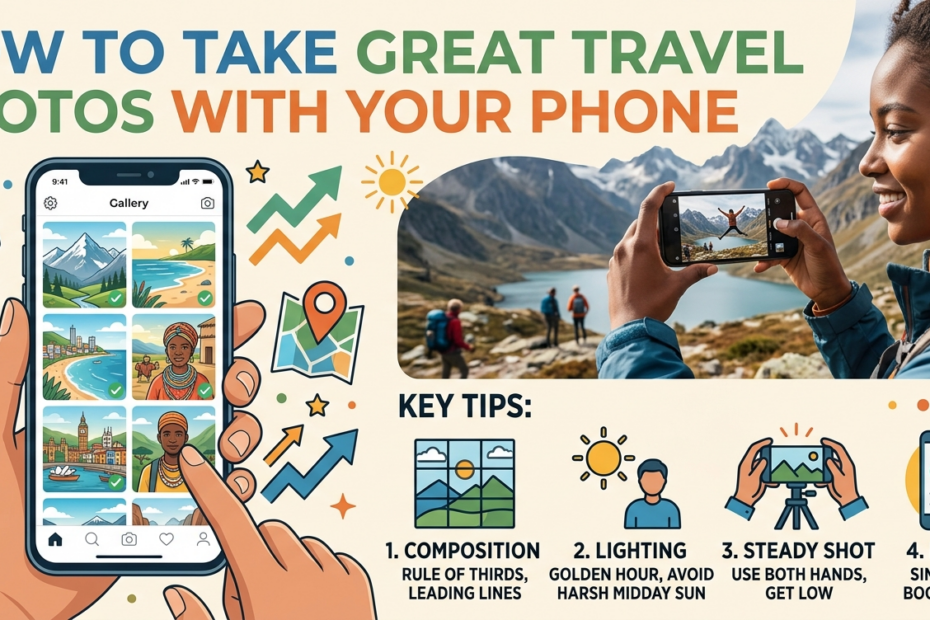
Gone are the days when you needed a bulky camera to capture your travel adventures. Today’s smartphones have evolved into powerful travel cameras, capable of taking breathtaking photos that rival professional gear.
Whether you’re wandering through city streets or hiking up mountain trails, your phone is always within reach — lightweight, convenient, and ready to capture every unforgettable moment.
Learning how to take great travel photos with your phone helps you turn ordinary snapshots into stunning visual stories you’ll be proud to share instantly on social media or keep as cherished memories. By the end of this guide, you’ll know exactly how to make the most of your mobile camera and create travel photos that truly stand out.
Choose the Right Phone and Settings
When it comes to taking great travel photos, your phone’s camera quality matters — but megapixels aren’t everything. What truly makes a difference is the lens quality, image stabilization, and HDR (High Dynamic Range) performance. These features help you capture sharper, more balanced shots, even in challenging lighting conditions.
Before your next trip, take a few minutes to explore your phone’s camera settings. Turn on gridlines to improve composition, use Pro or Manual mode to control exposure and focus, and if your phone allows it, shoot in RAW format for higher-quality editing later. Small adjustments like these can dramatically improve the clarity and detail of your travel photos.
Here’s a quick comparison of popular smartphones and their key photography features:
| Smartphone | Lens Quality | Image Stabilization | HDR Performance | RAW Support |
|---|---|---|---|---|
| iPhone 15 Pro | Excellent triple-lens system | Advanced optical stabilization | Smart HDR 5 | ✅ Yes |
| Samsung Galaxy S24 Ultra | High-resolution quad-lens | Super Steady Mode | Adaptive HDR | ✅ Yes |
| Google Pixel 8 Pro | Superb AI image processing | Optical + digital stabilization | HDR+ enhanced | ✅ Yes |
| OnePlus 12 | Hasselblad-tuned lens | Optical stabilization | HDR 10+ | ✅ Yes |
Choosing a phone with these camera strengths ensures you can capture every destination in vivid detail — from glowing sunsets to dimly lit city streets.
Master Lighting and Composition
Lighting can make or break your travel photos. The best photographers know that understanding light is the secret to capturing breathtaking images. For the most flattering results, try shooting during the golden hour — the short window just after sunrise or before sunset. During this time, the sunlight is soft, warm, and adds a magical glow to landscapes, portraits, and city scenes.
When the sun is high and harsh, avoid direct light that causes deep shadows. Instead, look for natural reflectors like light-colored walls, water surfaces, or sand to bounce light gently onto your subject. This technique helps balance exposure and gives your photos a professional finish.
Composition is just as important as lighting. Turn on your camera’s gridlines and use the rule of thirds to position your subject slightly off-center for a more dynamic shot. Experiment with leading lines — roads, bridges, or rivers — to draw the viewer’s eye into the photo. You can also use framing elements like doorways, windows, or trees to add depth and context to your scene.
For example:
-
A traveler framed between two palm trees at sunset.
-
A winding road leading toward a mountain range.
-
Reflections on calm water during the golden hour.
By mastering light and composition, you’ll transform simple phone shots into stunning travel photographs that capture the mood and magic of every destination.
Capture Emotion and Story
The most memorable travel photos don’t just showcase landscapes — they tell a story. Including people, movement, and local life in your shots brings energy and authenticity to your travel photography. A photo of a bustling market, a child playing by the river, or a street musician in action can convey the true essence of a destination far better than a static landmark.
To make your photos stand out, look for unique angles. Shoot from above, get close to your subject, or use reflections creatively. Candid moments often capture genuine emotions, so avoid over-posing your subjects. Sometimes the best shot is when someone is laughing, walking, or simply interacting naturally with their environment.
By focusing on storytelling, your travel photos will resonate with viewers — whether on social media, in a travel blog, or in your personal collection — and turn ordinary scenes into unforgettable memories.
Edit Smartly (Without Overdoing It)
Even the best travel photos can benefit from a little post-processing — but the key is to edit smartly without overdoing it. Overly filtered or over-saturated images can look artificial, so focus on subtle adjustments that enhance the natural beauty of your shots.
Some of the best mobile editing apps include:
-
Snapseed – Great for selective adjustments, healing spots, and fine-tuning colors.
-
Lightroom Mobile – Offers advanced controls for exposure, color grading, and RAW editing.
-
VSCO – Ideal for stylish presets and subtle film-like effects.
Start with the basics:
-
Brightness & Contrast: Adjust to bring out details without washing out colors.
-
Color Balance: Correct white balance or tweak tones to make skies and landscapes pop.
-
Sharpening: Enhance details carefully; too much can create an unnatural look.
For a clear visual impact, try a before-and-after comparison:
-
Original: Slightly dull sky, underexposed foreground.
-
Edited: Brighter exposure, enhanced contrast, and vivid but natural colors.
By mastering simple edits, you can make your travel photos truly stand out while keeping them authentic and visually appealing.
Bonus: Social Media and Sharing Tips
Once you’ve captured and edited stunning travel photos with your phone, the next step is sharing them effectively. For social media, consistency is key. Using a consistent set of filters or editing style helps establish your personal or brand identity, making your feed visually cohesive and instantly recognizable.
Engaging captions are just as important as the image itself. Tell a story, share a fun anecdote, or provide travel tips related to the photo. Captions that evoke emotion or curiosity encourage more interaction, boosting your post’s reach and engagement.
Different platforms have unique requirements:
-
Instagram: Optimize images for 1080px width, use relevant hashtags, and post at peak engagement times.
-
Pinterest: Vertical images perform best; add keyword-rich descriptions for discoverability.
-
Google Photos: Organize albums and add locations to make it easier to revisit or share memories.
By combining thoughtful editing with strategic sharing, your travel photos won’t just stay in your gallery — they’ll inspire, engage, and reach a wider audience online.
Conclusion
Taking great travel photos with your phone is all about combining the right tools, smart techniques, and a creative eye. Remember to choose a phone with strong camera features, master lighting and composition, capture authentic moments, and edit your shots thoughtfully. Don’t forget to share your photos strategically on social media to reach a wider audience and tell your travel story.
Now it’s your turn — grab your phone, experiment with new angles, lighting, and editing styles, and start capturing the magic of your next adventure. Share your best mobile travel photo tips in the comments and inspire fellow travelers to elevate their photography game.
Frequently Asked Questions
How to take good travel photos with phone?
Taking good travel photos with your phone is all about understanding your device’s capabilities and learning how to work with light, composition, and storytelling. First, make sure your phone camera settings are optimized.
Turn on gridlines to help with framing, use HDR for scenes with contrasting light, and shoot in RAW if your phone allows it for better post-editing flexibility. While megapixels are often advertised, lens quality, sensor size, and image stabilization play a much bigger role in producing sharp and detailed photos.
Lighting is the most critical factor in mobile photography. Natural light is often the best; aim for early mornings or late afternoons when the sunlight is soft, known as the golden hour.
Avoid harsh midday light that can create unflattering shadows. If shooting indoors or in shaded areas, use reflective surfaces to bounce light or adjust your exposure settings manually to ensure clarity.
Composition can transform ordinary snapshots into captivating photos. Techniques such as the rule of thirds, leading lines, and framing add depth and guide the viewer’s eye through your image.
Experiment with different angles, perspectives, and heights to make your photos more interesting. Including people, local culture, or movement adds narrative and emotion to your shots, making them more memorable than just static landscapes.
Editing is also crucial. Mobile apps like Snapseed, Lightroom Mobile, and VSCO allow you to enhance your photos subtly. Adjust brightness, contrast, saturation, and sharpness, but avoid over-editing. Before-and-after comparisons can help you identify which adjustments improve the photo without making it look unnatural.
Finally, practice storytelling. Think of each photo as a part of your travel narrative. Capture moments that reflect the atmosphere, emotion, and uniqueness of the place you are visiting.
By combining the right camera techniques, creative composition, thoughtful lighting, and subtle editing, your phone can produce travel photos that rival professional cameras. Consistency and practice will help you develop your unique style, making your travel photography more compelling and visually appealing.
What is the 20 60 20 rule in photography?
The 20 60 20 rule in photography is a compositional guideline that helps photographers create balanced and visually appealing images by dividing the frame into proportions that guide the placement of subjects and elements.
According to this rule, roughly 20% of the frame should be allocated to the foreground, 60% to the middle ground, and 20% to the background. This structure creates depth, perspective, and a natural flow for the viewer’s eye.
The foreground typically includes objects that lead the viewer into the scene. It could be a pathway, a tree branch, or an object that adds context and interest. The middle ground, which occupies the largest portion of the frame, usually contains the main subject of the photograph, such as a person, building, or landmark.
This is where the viewer’s attention is naturally drawn, so it should be clear, focused, and compelling. The background, making up the remaining 20%, adds context without distracting from the main subject. It can include scenery, sky, or distant objects that contribute to the story of the photo.
Using the 20 60 20 rule ensures that photos are not flat or monotonous. It introduces layers and depth, making the image feel more immersive. The rule is particularly useful in travel and landscape photography, where there are multiple elements competing for attention. By structuring the frame this way, photographers can maintain balance, highlight the subject, and create a sense of proportion and harmony.
Although it is a guideline, not a strict rule, the 20 60 20 principle helps beginners and experienced photographers alike think more intentionally about composition. It encourages observing the scene carefully and arranging elements to produce a pleasing visual flow.
When combined with other techniques, such as leading lines, the rule can elevate the quality and impact of any photograph, making it more engaging and professional.
What are the 7 C’s of photography?
The 7 C’s of photography are fundamental principles that guide photographers in creating visually appealing and technically strong images. These principles focus on key aspects such as clarity, composition, and color, which collectively improve the quality and impact of a photograph. The 7 C’s include Clarity, Composition, Contrast, Color, Creativity, Cropping, and Control of lighting.
Clarity ensures that the subject of the photograph is sharp and well-defined, avoiding blur unless intentionally used for artistic effect. Composition refers to the arrangement of elements within the frame to create balance, visual interest, and harmony.
Techniques like the rule of thirds, leading lines, and framing fall under this category. Contrast helps separate subjects from their background, providing visual emphasis and depth through light, dark, and color differences.
Color is an essential element in photography that influences mood and aesthetics. Understanding complementary, analogous, or contrasting color schemes can enhance the visual appeal of images.
Creativity encourages thinking beyond standard shots, experimenting with angles, perspectives, and ideas to make photos unique. Cropping is the art of eliminating distractions or unnecessary elements from the frame, highlighting the subject effectively. Finally, Control of lighting emphasizes understanding natural and artificial light, its direction, and intensity to achieve the desired atmosphere and clarity.
Mastering the 7 C’s enables photographers to consistently produce strong, professional-quality images. These principles apply to all types of photography, including travel, portrait, and landscape photography, and help create photos that are not only technically sound but also emotionally engaging and visually striking.
How to take amazing travel photos?
Taking amazing travel photos requires more than just pointing your camera at a destination. It involves preparation, understanding light, creative composition, and storytelling to capture moments that truly reflect the essence of a place.
Start by researching your location to identify iconic landmarks, hidden gems, and unique perspectives. Knowing when and where to shoot helps you take advantage of optimal lighting conditions, such as the golden hour, which enhances color, shadow, and mood.
Use your camera or phone effectively. Experiment with angles, perspectives, and distances to find fresh ways to present familiar sights. Incorporating foreground, middle ground, and background elements adds depth and context.
Include local culture, people, and activities to tell a story, making your images more engaging and memorable. Movement, candid interactions, and spontaneous moments often make the most compelling travel photographs.
Lighting and weather play a significant role in creating amazing photos. Avoid harsh sunlight unless you can use shadows creatively. Soft, diffused light works well for landscapes and portraits alike. Reflections, rain, or fog can add mood and atmosphere, providing unique shots that stand out.
Post-processing is equally important. Subtle adjustments to exposure, contrast, saturation, and sharpness enhance your photo without making it look artificial. Editing apps like Snapseed or Lightroom Mobile allow you to refine your images on the go. Consistency in editing style also helps maintain a visually cohesive travel feed.
Finally, focus on storytelling. Each photo should convey a sense of place, emotion, or experience. By combining technical skills with creativity and narrative, you can transform ordinary travel snapshots into breathtaking, unforgettable images that inspire and captivate viewers.
How to be photogenic and look good in every photo?
Being photogenic is less about genetics and more about understanding how to present yourself effectively in front of the camera. Posture is critical: stand tall, elongate your neck slightly, and avoid slouching to appear confident and natural.
Relax your shoulders and avoid stiff poses, as tension often shows in photographs. Angle your body slightly rather than facing the camera straight on; a three-quarter pose tends to be flattering for most body types.
Facial expressions are equally important. A natural, relaxed smile or soft expression usually looks better than a forced grin. Practice subtle expressions in the mirror to understand which angles highlight your features.
Learning to tilt your chin slightly downward or upward depending on your face shape can also improve your appearance. Lighting plays a huge role; natural light from windows or during golden hours produces soft, flattering effects, while harsh overhead lighting can exaggerate shadows and lines.
Camera positioning matters too. Shooting slightly above eye level can slim the face and reduce the appearance of double chins, while avoiding low angles that can distort features. Using props, movement, or candid gestures often results in more natural and attractive photos compared to static poses.
Clothing and color choices contribute to your photogenic appearance. Wear colors that complement your skin tone and avoid overly busy patterns that distract from your face. Confidence and comfort in what you wear directly affect how you appear in photos.
Finally, practice is essential. Experiment with different poses, angles, lighting, and expressions to discover what works best for you. Over time, you will develop an understanding of your photogenic strengths, enabling you to consistently look good in photos while maintaining a natural and authentic presence.
Frequently Asked Questions
How to take good travel photos with phone?
Taking great travel photos with your phone is less about having the best camera and more about how you see and capture the moment. Modern smartphones are powerful—you just need to use them intentionally.
Start with lighting. Natural light is your best friend. Shoot during early morning or late afternoon (golden hour) for soft, warm tones. Avoid harsh midday sunlight when possible.
Next, focus on composition. Use the rule of thirds—place your subject slightly off-center instead of in the middle. Most phone cameras have a grid you can turn on to help with this.
Pay attention to angles and perspective. Don’t just shoot at eye level. Try low angles, high angles, or side views to make your photos more interesting.
Keep your lens clean. This sounds simple, but a dirty lens can ruin photo quality.
Use HDR mode when shooting landscapes or scenes with both bright and dark areas. It balances exposure and captures more detail.
Finally, avoid excessive zoom. Instead, move closer to your subject to maintain image quality.
In summary, great travel photos come from good lighting, composition, angles, and attention to detail—not just camera quality.
What are the 7 tips for taking good photographs?
Here are 7 essential tips that can instantly improve your photography:
- Use good lighting – Natural light produces the best results.
- Follow the rule of thirds – Avoid placing your subject in the center.
- Keep your camera steady – Prevent blurry images.
- Focus on your subject – Tap to focus when using a phone camera.
- Simplify your background – Avoid distractions behind your subject.
- Experiment with angles – Different perspectives create unique shots.
- Edit lightly – Adjust brightness, contrast, and color without overdoing it.
These simple tips can make a big difference, even if you’re using a smartphone.
What is the 20-60-20 rule in photography?
The 20-60-20 rule in photography is a creative guideline that helps you capture a balanced variety of shots, especially when traveling or creating content.
- 20% wide shots – These capture the environment or full scene (landscapes, city views).
- 60% medium shots – These focus on the main subject with some background context.
- 20% close-up shots – These highlight details like textures, objects, or facial expressions.
This rule ensures your photo collection is not repetitive. Instead of taking only one type of shot, you create a mix that tells a complete visual story.
In summary, the 20-60-20 rule helps you capture a balanced set of images—wide, medium, and close-up—for better storytelling.
How do I set my phone camera to take good pictures?
To get the best results from your phone camera, you need to adjust a few simple settings and habits.
First, turn on the grid lines to help with composition (rule of thirds).
Second, use HDR mode for scenes with uneven lighting, such as bright skies and darker foregrounds.
Third, set your camera to the highest resolution available in settings to capture more detail.
Fourth, use tap-to-focus and adjust exposure. On most phones, you can tap the screen and slide up or down to control brightness.
Fifth, avoid using digital zoom. Instead, move physically closer to your subject.
Sixth, use portrait mode for people to create a blurred background effect.
Finally, keep your camera steady or use a tripod when possible to avoid blur.
In summary, the best phone camera setup involves grid lines, HDR, proper focus, high resolution, and steady shooting.
How to be photogenic and look good in every photo?
Being photogenic is not about looks—it is about angles, confidence, and practice.
First, find your best angle. Most people look better when their face is slightly turned instead of facing the camera directly.
Second, use good posture. Stand or sit straight, relax your shoulders, and avoid stiffness.
Third, pay attention to lighting. Face natural light instead of standing with light behind you.
Fourth, practice a natural smile. Forced expressions often look awkward, so think of something that makes you genuinely happy.
Fifth, slightly tilt your chin down or to the side to avoid awkward angles.
Sixth, relax and be comfortable. Confidence shows in photos more than anything else.
Finally, take multiple shots. The best photos often come after a few attempts.
In summary, being photogenic comes from angles, lighting, posture, and confidence—not perfection.
How to avoid blurry phone pictures?
Blurry photos usually come from motion, poor focus, or low light—but all of these can be fixed with simple habits.
First, keep your phone steady. Use both hands and hold your elbows close to your body. If possible, lean against a wall or use a stable surface. Even slight hand movement can cause blur.
Second, tap to focus before taking the shot. Your phone won’t always choose the right focus point automatically, so tapping ensures your subject is sharp.
Third, improve your lighting conditions. Low light forces your camera to use slower shutter speeds, which increases blur. Shoot in bright natural light whenever possible.
Fourth, avoid using digital zoom. Zooming reduces quality and exaggerates blur. Instead, move physically closer to your subject.
Fifth, clean your camera lens. A smudged lens can make photos look soft or blurry.
Finally, use burst mode when capturing moving subjects. You can choose the sharpest shot afterward.
In summary, steady hands, proper focus, good lighting, and clean lenses are the keys to sharp photos.
Why is my face not photogenic?
The idea of being “not photogenic” is often misunderstood. In most cases, it’s not your face—it’s angles, lighting, and camera distortion.
Cameras, especially phone cameras, can distort facial features depending on distance and lens type. For example, holding the camera too close can make your nose look bigger or your face uneven.
Lighting also plays a major role. Poor lighting creates harsh shadows, making features look less flattering. Natural light, especially from the front, improves appearance instantly.
Angles matter too. Facing the camera directly is not always the most flattering position. Slightly turning your face or adjusting your chin can make a big difference.
Another factor is expression. Many people look different in photos because they feel tense or unnatural. Relaxing your face and practicing expressions helps a lot.
Finally, confidence affects how you appear. When you feel comfortable, it shows in your photos.
In summary, “not photogenic” is usually about technique, not appearance—improving lighting, angles, and comfort can change everything.
What are the 5 C’s of photography?
The 5 C’s of photography are guiding principles that help you take better, more intentional photos:
- Composition – How elements are arranged in your photo (rule of thirds, framing, balance).
- Clarity – Sharpness and focus of your image.
- Color – Use of colors to create mood and visual appeal.
- Contrast – Difference between light and dark areas, which adds depth.
- Creativity – Your unique style, perspective, and storytelling approach.
These five elements work together to create visually appealing and meaningful photos.
In summary, the 5 C’s help you think beyond just taking a picture and focus on creating a strong image.
What are the 10 rules of photography?
While photography is creative, there are basic rules that help beginners take better photos:
- Use the rule of thirds
- Focus on good lighting
- Keep your camera steady
- Simplify the background
- Use leading lines to guide the eye
- Try different angles and perspectives
- Pay attention to framing
- Capture emotion or story
- Avoid over-editing your photos
- Practice consistently
These rules are guidelines, not strict laws. Once you understand them, you can break them creatively.
In summary, these rules improve composition, clarity, and storytelling in your photos.
How to take good photos with phone for beginners?
If you’re just starting, you don’t need expensive gear—your phone is enough if you use it well.
First, use natural light. Stand facing the light instead of having it behind you.
Second, turn on grid lines and use the rule of thirds for better composition.
Third, tap to focus on your subject before taking the photo.
Fourth, keep your shots simple. Avoid cluttered backgrounds that distract from your subject.
Fifth, experiment with angles. Don’t take all photos from eye level—try different perspectives.
Sixth, avoid using too many filters. Instead, make small edits like adjusting brightness and contrast.
Finally, practice regularly. The more photos you take, the better your eye for good shots becomes.
In summary, beginners can take great phone photos by focusing on lighting, composition, focus, and practice.
Does my camera show my true face?
Not exactly. A camera does not perfectly represent how you look in real life. Several factors—like lens type, distance, lighting, and angles—affect how your face appears in photos.
Phone cameras often use wide-angle lenses, which can distort facial features, especially when the camera is too close. This can make parts of your face (like your nose) appear larger or slightly different from how people see you in person.
Another reason is mirroring. You are used to seeing your face in a mirror, which is reversed. When you see a photo (non-mirrored), it can look unfamiliar even if it’s accurate.
Lighting also plays a huge role. Harsh lighting can create shadows and exaggerate features, while soft natural light makes faces look more balanced.
In summary, your camera shows a version of your face, but not always your “true” appearance due to lens distortion, lighting, and perspective.
Why is 12MP better than 48MP?
A higher megapixel number does not always mean better photo quality. In many cases, 12MP can produce better images than 48MP because of how sensors work.
With 48MP cameras, the pixels are smaller because more pixels are packed into the same space. Smaller pixels capture less light, which can reduce image quality, especially in low-light conditions.
On the other hand, 12MP cameras often have larger pixels, which capture more light. This leads to:
- Better low-light performance
- Less noise (graininess)
- Sharper and clearer images
Many 48MP cameras also use pixel binning, which combines multiple pixels into one to produce a better 12MP image anyway.
In summary, image quality depends more on sensor size and light capture than megapixel count, which is why 12MP can sometimes be better than 48MP.
How do you unblur your phone camera?
If your phone camera is producing blurry images, the issue is usually fixable with a few simple steps.
First, clean your camera lens. Dirt, fingerprints, or smudges can reduce sharpness.
Second, check your focus. Tap on the subject before taking the picture to ensure proper focus.
Third, improve lighting. Low light often causes blur because the camera uses slower shutter speeds.
Fourth, restart your camera app or phone. Sometimes software glitches affect image quality.
Fifth, check for camera settings like resolution and ensure they are set to the highest quality.
If the problem continues, it could be a hardware issue, such as a damaged lens or autofocus problem, which may require repair.
In summary, cleaning the lens, focusing correctly, improving lighting, and checking settings usually fix blurry camera issues.
How to get sharp indoor photos?
Indoor photography can be challenging because of limited light, but you can still get sharp photos with the right approach.
First, increase available light. Open windows or turn on multiple light sources to brighten the room.
Second, hold your phone very steady or use a tripod. Low light increases the risk of motion blur.
Third, use night mode or low-light mode if your phone has it. These modes are designed for indoor conditions.
Fourth, tap to focus on your subject and adjust exposure manually if needed.
Fifth, avoid using flash unless necessary. Flash can create harsh shadows and unnatural tones.
Sixth, lower your movement. Ask your subject to stay still while taking the shot.
In summary, good lighting, stability, and proper focus are key to sharp indoor photos.
Why does my phone camera not focus when I zoom in?
When you zoom in on your phone, you are often using digital zoom, which crops and enlarges the image instead of using true optical zoom. This reduces image quality and makes focusing more difficult.
Zooming in also reduces the amount of light reaching the sensor, which can make autofocus slower or less accurate.
Another reason is that at higher zoom levels, even small hand movements become more noticeable, making the image appear out of focus.
Some phones have limited autofocus capability when zoomed in, especially in low light or when the subject is too close.
To fix this:
- Avoid excessive zoom
- Move closer to your subject instead
- Ensure good lighting
- Tap to focus manually
In summary, zoom reduces image quality and affects autofocus, which is why your camera struggles to focus when zoomed in.