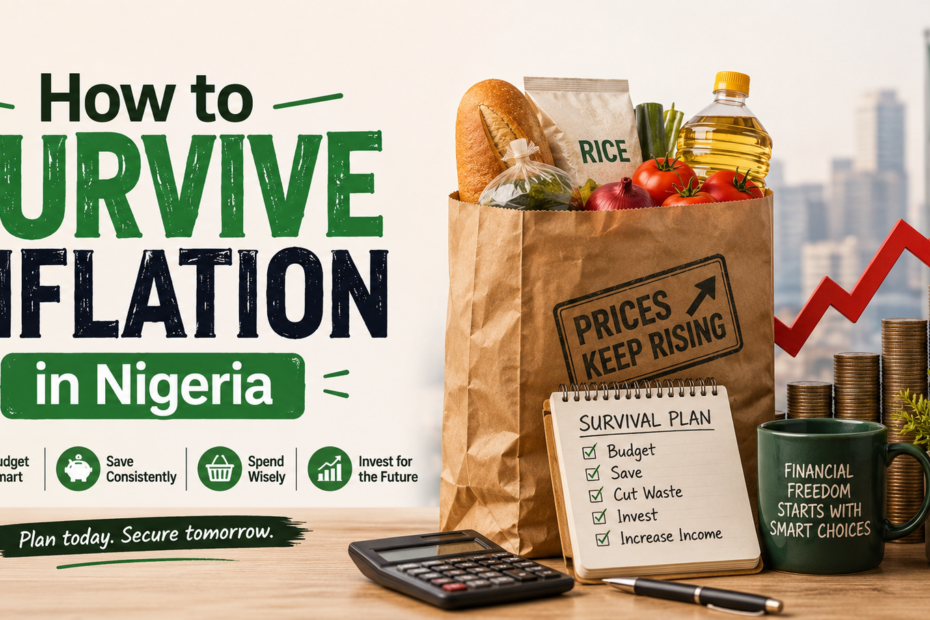
1. Personal Budgeting Strategies
2. Smart Food Survival Tips
3. Multiple Income Streams
In today’s Nigeria, depending on only one salary is no longer a safe financial strategy. With rising inflation and unstable economic conditions, many people are discovering that a single source of income is not enough to meet daily needs. This is why building multiple income streams has become essential for survival.
One of the most common options is side hustles. Many Nigerians are now engaging in small businesses such as POS operations, petty trading, food sales, and phone accessories. These businesses can start small but provide steady daily income that helps reduce financial pressure.
Another growing opportunity is digital income. With a smartphone and internet connection, people can earn through writing, content creation, social media management, blogging, and affiliate marketing. These online opportunities may take time to grow, but they can become strong long-term income sources.
Small-scale farming and reselling goods are also practical options. Farming crops or raising animals on a small scale can provide both food and income, while buying and reselling products like clothes, shoes, or groceries can generate quick profit.
The truth is simple: relying on one income in today’s economy is risky. The more income streams you have, the more financially stable and prepared you become against inflation and unexpected expenses.
4. Saving in an Inflation Economy
Saving money during inflation in Nigeria may seem difficult, but it is still very possible with the right discipline and approach. Even when prices are rising, the habit of saving remains one of the most important financial survival skills.
One effective method is saving in small daily or weekly amounts. Instead of waiting to save large sums, you can adopt a ₦500–₦2,000 daily or weekly saving system. Over time, these small contributions add up and create a meaningful financial cushion for emergencies or future needs.
Another trusted method widely used in Nigeria is cooperative savings, commonly known as ajo or esusu. This system allows individuals to contribute money regularly and take turns receiving a lump sum. It helps people stay committed to saving while also accessing larger amounts when needed.
It is also important to avoid keeping all your money in cash. Cash loses value quickly during inflation and can easily be spent without planning. Using bank accounts or secure savings platforms helps protect your money and makes saving more structured.
You may also consider low-risk savings platforms that offer interest, helping your money grow gradually over time.
The most important lesson is this: saving is not about how much you earn, but about discipline. Even small, consistent savings can make a big difference in an inflation-driven economy.
5. Cutting Unnecessary Expenses
8. Mental Survival During Inflation
When people talk about inflation, they often focus only on money, but the mental and emotional impact is just as important. In Nigeria today, rising prices can cause stress, anxiety, and constant worry about how to meet daily needs. That is why mental survival is a key part of financial survival.
One important step is learning how to manage stress and anxiety. Instead of constantly worrying about what you cannot control, it helps to focus on what you can change, such as budgeting better, reducing expenses, or finding extra income sources. Staying calm allows you to think more clearly and make better financial decisions.
It is also important to avoid financial depression. Many people become discouraged when money is tight, but giving up only makes the situation worse. Understanding that inflation affects almost everyone can help you feel less alone and more motivated to adapt.
Staying motivated even when money is low is very important. Small progress, such as saving a little or earning extra income, should be celebrated because it builds confidence over time.
Community support and family cooperation also play a big role. Sharing responsibilities, pooling resources, and supporting one another can reduce pressure on individuals.
In the end, surviving inflation is not just about money—it is also about maintaining a strong, positive, and adaptable mindset.
9. Common Mistakes Nigerians Make
Bonus
10 Things Nigerians Must Stop Doing If They Want to Survive Inflation This Year
Inflation is not only about rising prices—it is also about habits that quietly drain your money. If you want to survive the current economic situation in Nigeria, here are 10 things you must stop doing immediately:
- Stop waiting for salary increase before adjusting your lifestyle
Inflation is already happening, so waiting will only make things worse. - Stop unnecessary spending on luxury and non-essential items
Focus on needs, not wants. - Stop eating out frequently when you can cook at home
Home cooking is far cheaper and more sustainable. - Stop ignoring small daily expenses
Little spending like data, snacks, and transport adds up quickly. - Stop relying on one source of income
One income is too risky in today’s economy. - Stop borrowing money for lifestyle or show-off purposes
Debt should be for emergencies or productive use only. - Stop impulse buying without planning
Always think before you spend. - Stop keeping all your money idle in cash
Inflation reduces the value of cash over time. - Stop refusing to learn new skills or side hustles
Extra income can make a big difference. - Stop trying to impress people while struggling financially
Financial survival is more important than social approval.
Frequently Asked Questions
How to beat inflation in Nigeria?
Beating inflation in Nigeria is not about eliminating it completely at a personal level, but about positioning your income, spending, and investments in a way that reduces its impact on your lifestyle and savings.
Inflation simply means that the value of money reduces over time, so what ₦10,000 can buy today may not be what it can buy tomorrow. To beat it, the first step is to increase your income streams.
Relying on a single salary or business profit is risky in an inflationary economy. Many Nigerians are now combining jobs, side hustles, freelancing, small trading, and digital skills like graphic design, copywriting, and social media management to stay ahead.
Another powerful strategy is smart budgeting. You need to track your expenses carefully and cut unnecessary spending. Focus on needs rather than wants, especially during periods when food, transport, and rent prices are rising rapidly. Bulk buying essential goods when prices are slightly lower can also help reduce long-term costs.
Most importantly, you must learn to store value, not just save money. Keeping cash idle in a bank account without interest growth will make you lose purchasing power. Instead, consider assets or investments that grow over time, such as agriculture-related businesses, dollar-based investments, or high-demand small businesses.
Finally, financial education is key. People who understand inflation tend to make better decisions about money. Learning how markets behave and adapting quickly gives you an advantage. In summary, beating inflation in Nigeria requires increasing income, controlling expenses, and moving money into value-preserving assets.
How to survive during high inflation?
Surviving during high inflation in Nigeria requires discipline, flexibility, and smart financial adjustments. When prices of goods and services rise rapidly, your money loses value faster, meaning your normal lifestyle can become more expensive even if your income remains the same.
The first survival strategy is prioritizing essential needs. You must focus your spending on food, shelter, transportation, and healthcare while reducing luxury or non-essential expenses such as expensive gadgets, frequent outings, or impulse shopping.
Another important survival tactic is adapting your lifestyle quickly. For example, instead of always relying on bought food, cooking at home in larger quantities can significantly reduce costs. Transport costs can also be managed by planning movements better or using more affordable alternatives when possible.
It is also crucial to create additional income streams. During inflation, depending on one income source is very risky. Many people in Nigeria survive by doing small side businesses such as reselling goods, offering services, or engaging in online work. Even small extra income can help absorb price increases.
Another key strategy is cooperative living or community support. Families and friends often share resources, bulk-buy items together, or support each other financially during tough periods. This reduces individual pressure.
Finally, emotional discipline matters. Inflation creates panic and financial stress, but panic leads to poor decisions like borrowing at high interest or spending recklessly.
Staying calm and planning weekly or monthly budgets helps you stay in control. In essence, survival during high inflation depends on reducing waste, increasing income, and making intentional financial decisions.
What is the best thing to invest in right now in Nigeria?
The best investment in Nigeria right now depends on capital size, risk tolerance, and financial goals, but some sectors consistently perform better during inflationary periods. One of the strongest options is agriculture.
Food demand never stops, and in Nigeria, inflation often increases food prices significantly. Investing in crops like cassava, maize, rice, poultry, or fish farming can generate steady returns. Even small-scale agribusiness like vegetable farming or livestock trading can be profitable.
Another strong area is small-scale trading and fast-moving consumer goods (FMCG). Products like rice, cooking oil, beverages, and toiletries are always in demand. Buying in bulk and reselling in smaller units allows investors to benefit from price increases over time.
Digital skills and online businesses are also becoming powerful investments. Learning skills like web design, social media management, affiliate marketing, or digital product creation can generate income in both local and international currencies, which helps protect against naira depreciation.
Real estate is another long-term option, especially land acquisition. Land tends to appreciate over time, especially in growing areas around cities like Lagos, Abuja, and Port Harcourt. However, it requires careful verification to avoid fraud.
Finally, dollar-linked or foreign currency assets are often used as a hedge against inflation. While access may vary, some Nigerians invest through global platforms, diaspora opportunities, or export-related businesses.
In conclusion, the best investment right now is not one single option but a combination of agriculture, trading, digital skills, and value-preserving assets that can grow with inflation rather than lose value.
How can we control inflation in Nigeria?
Controlling inflation in Nigeria is a complex economic challenge that requires coordinated action from both the government and financial institutions.
Inflation is often caused by multiple factors such as high production costs, weak currency value, supply chain issues, insecurity affecting agriculture, and excessive money supply in circulation. To control it effectively, Nigeria must address both demand-side and supply-side issues.
On the supply side, boosting local production is essential. When Nigeria produces more of what it consumes, especially food and manufactured goods, dependence on imports reduces. This helps stabilize prices.
Investing heavily in agriculture, improving rural security, and supporting farmers with subsidies, modern equipment, and access to credit can significantly increase food supply and reduce inflation pressure.
Another important factor is improving infrastructure. Poor roads, unreliable electricity, and high transportation costs increase the price of goods. When logistics become cheaper and more efficient, the cost of goods in markets reduces.
On the monetary side, the Central Bank must carefully manage money supply and interest rates. Printing too much money or uncontrolled lending can worsen inflation. Stable fiscal policies and better coordination between government spending and revenue collection are also important.
Reducing import dependency by supporting local industries is another major solution. Encouraging manufacturing within Nigeria reduces exposure to foreign exchange shocks.
Finally, fighting corruption and improving governance helps ensure that economic policies actually reach the people. When funds meant for development are properly used, inflationary pressures reduce over time. In summary, controlling inflation requires production growth, stable monetary policy, infrastructure development, and strong governance.
Where to put your money during high inflation?
During high inflation, the main goal is not just to save money but to preserve and grow its value. Keeping cash idle is risky because inflation reduces purchasing power over time.
One of the safest places to put money is in real assets. This includes land, property, and productive equipment. Land, in particular, tends to appreciate in value, especially in developing areas, making it a strong long-term hedge.
Another good option is agriculture-related investments. Since food prices rise during inflation, investing in farming, food processing, or agro-trading can help your money grow alongside rising prices. Even small investments in poultry or crop farming can provide consistent returns.
Businesses that deal in fast-moving goods are also a good place to store money. Items like food products, household essentials, and retail trading often maintain value because demand remains stable even during economic hardship.
Foreign currency exposure is another strategy. Holding part of your money in stable currencies like the US dollar can protect you from naira depreciation. This can be done through legal investment platforms, savings instruments, or international business opportunities.
Skills are also a form of investment. Spending money on learning digital skills, certifications, or business training can yield long-term returns because it increases earning capacity.
Finally, diversified investment is key. Instead of putting all your money in one place, spread it across assets such as business, agriculture, savings instruments, and skill development. This reduces risk and increases stability during inflation.
What is the 7 3 2 rule?
The 7-3-2 rule is a simple personal finance guideline used to help people structure their money for stability, growth, and long-term security.
Although different financial educators may interpret it slightly differently, in most contexts it refers to dividing your income into three major parts: 70% for living expenses, 30% for financial growth, and within the growth portion, focusing on compounding strategies that build wealth over time. The idea behind the rule is to prevent overspending while still ensuring that money is consistently working for your future.
In a high-inflation economy like Nigeria, this rule becomes even more important because unmanaged spending quickly erodes savings. The 70% portion typically covers necessities such as food, transportation, rent, and essential bills.
The 30% portion is where financial discipline becomes powerful. It is often split further into savings, investments, and emergency funds. Some financial coaches break it down further into smaller “steps” like saving first, investing second, and reinvesting profits, which is where the “7-3-2” interpretation sometimes expands.
The major advantage of this rule is structure. Many people struggle financially not because they earn too little, but because they lack a system for managing income. When money is allocated in advance, emotional spending reduces, and financial goals become more achievable.
In Nigeria today, where inflation reduces purchasing power quickly, the 7-3-2 rule encourages people to prioritize survival while still building wealth. It pushes individuals to avoid lifestyle inflation, create emergency buffers, and consistently invest in income-generating assets.
In summary, it is not just a budgeting formula—it is a discipline framework that helps individuals stay financially stable while preparing for the future.
What to buy to keep up with inflation?
To keep up with inflation, the key principle is to buy or invest in things that increase in value or maintain strong demand over time. In Nigeria, where prices of goods rise frequently, simply saving cash is not enough. Instead, people must focus on assets and products that act as a hedge against currency depreciation.
One of the most reliable things to buy is food-related commodities in bulk. Items such as rice, beans, oil, and canned goods tend to increase in price over time, so buying in bulk when prices are slightly lower helps preserve value. Some traders even resell these goods later for profit.
Another strong category is land or real estate. Land in growing areas of cities like Lagos and Abuja often appreciates over time due to urban expansion. Even small plots can become significantly more valuable within a few years.
Foreign currency is also a common hedge. Holding part of your money in stable currencies like the US dollar helps protect against naira devaluation. While access may vary, many people use legal exchange platforms or international savings tools for this purpose.
Durable productive assets are another smart option. This includes equipment used for business, farming tools, or transport-related assets like motorcycles or vehicles used for ride services. These assets can generate income while holding value.
Finally, investing in skills is extremely important. Buying education—such as digital marketing, tech skills, or business training—helps you earn more money in the future, which is one of the strongest ways to beat inflation.
In summary, to keep up with inflation, you should focus on real assets, essential goods, foreign currency exposure, and income-generating skills rather than holding idle cash.
What is the 4 rule for inflation?
The “4 rule” is often confused with different financial concepts, but in most personal finance discussions, it is closely related to the “4% rule,” which is used in retirement planning rather than inflation directly. However, in the context of inflation, it can still be explained in a practical way as a guideline for managing money growth and withdrawal.
The 4% rule suggests that if you have a large investment portfolio, you can safely withdraw about 4% of it annually without running out of money too quickly. The assumption behind this rule is that your investments will grow over time at a rate that outpaces inflation.
However, during high inflation periods, like what is experienced in Nigeria, this rule becomes more challenging because inflation reduces the real value of money faster than in stable economies.
To adapt the concept to inflation management, the idea becomes: your money should grow at least 4% above inflation to maintain purchasing power. For example, if inflation is 20%, your investments should ideally return 24% or more annually to stay ahead.
In practical terms for Nigerians, this means relying on low-yield savings accounts is not enough. Instead, investments must be placed in higher-growth opportunities such as businesses, agriculture, or dollar-based assets.
Institutions like the Central Bank of Nigeria influence inflation through monetary policy, but individuals must protect themselves by choosing investments that outperform inflation.
In summary, while the original 4% rule is about safe withdrawal in retirement, in inflation contexts it represents the minimum growth buffer needed to preserve wealth. In high-inflation environments, you must aim higher than 4% to truly stay ahead financially.
What are ways to fight inflation?
Fighting inflation requires action at both the government level and individual level. At the national level, inflation is typically controlled through monetary policy, fiscal discipline, and improved productivity. In Nigeria, one of the key institutions involved is the Central Bank of Nigeria, which manages interest rates and money supply to stabilize the economy.
One major way to fight inflation is increasing local production. When a country produces more of its food, goods, and services, it reduces dependence on imports and stabilizes prices. Agriculture plays a key role here because food inflation is one of the biggest drivers of overall inflation in Nigeria.
Another method is improving infrastructure. Poor roads, unreliable electricity, and high transport costs increase the price of goods. By improving logistics and energy supply, the cost of production and distribution decreases, helping to stabilize prices.
Monetary discipline is also critical. When too much money is circulating in the economy without corresponding production, inflation rises. Central banks manage this by adjusting interest rates and controlling liquidity.
At the individual level, people fight inflation by adjusting their financial behavior. This includes reducing unnecessary spending, investing in assets that appreciate, and diversifying income sources. Businesses also adjust by increasing efficiency and reducing waste.
Finally, stable governance and reduced corruption are important. When public funds are properly managed, resources are better used for development, which helps control inflation in the long term.
In summary, inflation is fought through a combination of production growth, monetary control, infrastructure development, and disciplined financial behavior both at national and personal levels.
What is the main cause of inflation in Nigeria?
The main cause of inflation in Nigeria is a combination of supply shortages, currency depreciation, and high production costs. Unlike a single-factor problem, inflation in Nigeria is driven by multiple interconnected economic challenges that reinforce each other over time.
One of the biggest causes is low domestic production. Nigeria relies heavily on imports for many goods, including fuel, machinery, and even food items in some cases. When production is insufficient locally, demand exceeds supply, causing prices to rise.
Another major cause is the weakening of the naira. When the currency loses value, imported goods become more expensive. Since Nigeria imports a significant portion of its goods, any depreciation in the exchange rate quickly translates into higher prices for consumers.
High transportation and energy costs also contribute significantly. Poor infrastructure, expensive fuel, and unreliable electricity increase the cost of producing and distributing goods. These costs are eventually passed on to consumers, raising inflation.
Food inflation is another major driver. Insecurity in farming regions, climate challenges, and supply chain disruptions reduce agricultural output, leading to higher food prices.
Monetary factors also play a role. When money supply grows faster than economic output, inflation rises. Policy decisions by institutions like the Central Bank of Nigeria influence this balance.
In summary, the main cause of inflation in Nigeria is structural—rooted in low production, currency weakness, high costs, and supply chain inefficiencies. These factors combine to continuously push prices upward over time.