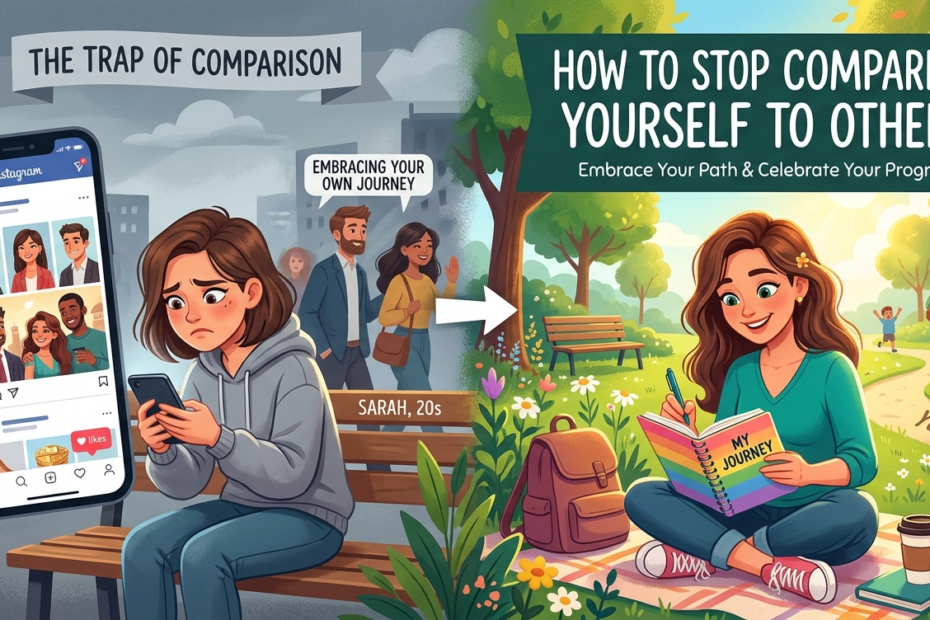
Comparing yourself to others is a challenge almost everyone faces, especially in today’s world of social media and constant online updates. It’s easy to look at someone else’s success, lifestyle, or achievements and feel like you’re falling behind.
This habit can quietly chip away at your self-esteem, increase stress, and even lead to anxiety. The more you focus on what others have, the less you appreciate your own journey and accomplishments.
If you want to stop comparing yourself to others and live a more fulfilling life, it’s essential to understand why these comparisons happen and adopt practical strategies to shift your mindset.
In this post, we’ll explore actionable steps you can take to embrace your uniqueness, build self-confidence, and focus on your personal growth instead of measuring yourself against others.
The Psychology Behind Comparison
Comparing yourself to others often starts with the mind’s natural tendency to evaluate where we stand. Psychologically, this habit is rooted in self-doubt and the desire for validation. When we feel uncertain about our abilities or achievements, it’s easy to measure our worth against others.
Social media plays a huge role in amplifying these feelings. Seeing curated images of someone’s success, lifestyle, or milestones can create unrealistic standards. For example, scrolling through a friend’s travel photos or career achievements might make you feel inadequate, even if your own accomplishments are significant.
Societal pressure also contributes. From a young age, we’re taught to compare ourselves to peers—grades, popularity, looks, or career paths. These comparisons can create anxiety, stress, and a constant feeling of falling short.
Recognizing why you compare yourself is the first step toward breaking the cycle. Once you understand the triggers—like social media, self-doubt, and societal expectations—you can start implementing strategies to stop comparing yourself and focus on your personal growth.
Practical Ways to Stop Comparing Yourself
Breaking the habit of comparing yourself to others takes conscious effort and consistent practice. The good news is that small, intentional steps can help you shift your mindset and focus on your own growth. Here are some practical strategies to help you stop comparing yourself and start embracing your unique journey:
1. Focus on Your Own Progress
Instead of measuring yourself against others, track your personal achievements. Create a journal or list of accomplishments—big or small—and review it regularly. By focusing on your own progress, you acknowledge growth over competition. Remember, your journey is unique, and your milestones don’t need to match anyone else’s.
2. Limit Social Media Exposure
Social media often triggers feelings of inadequacy. Set boundaries to avoid constant comparison:
-
Unfollow accounts that make you feel negative about yourself.
-
Limit scrolling time daily.
-
Focus on content that inspires and educates rather than fuels envy.
Reducing exposure to curated online highlights can help you avoid self-comparison and reclaim your mental space.
3. Practice Gratitude Daily
Gratitude shifts your attention from what you lack to what you already have. Try journaling three things you’re thankful for every day. This simple habit strengthens self-awareness and makes it easier to appreciate your accomplishments without comparing them to others.
4. Celebrate Others Without Judging Yourself
Admiring someone else’s success doesn’t have to diminish your own. Practice healthy admiration by:
-
Congratulating friends and colleagues sincerely.
-
Learning from others’ achievements instead of feeling threatened.
-
Using inspiration from others as motivation to grow personally.
This mindset encourages a supportive environment and reduces negative self-comparison.
5. Set Personal Goals
Define your own standards of success and prioritize personal growth. Focus on measurable, realistic goals that reflect your values and aspirations. By aiming to improve yourself rather than compete with others, you cultivate long-term confidence and fulfillment.
Quick Tips to Avoid Self-Comparison:
-
Replace negative self-talk with affirmations.
-
Spend more time on hobbies and passions that bring joy.
-
Reflect regularly on your progress, not others’.
-
Surround yourself with supportive, uplifting people.
Implementing these strategies consistently can transform the way you perceive yourself and others. By focusing on personal growth, practicing gratitude, and setting boundaries, you can stop comparing yourself and enjoy a more fulfilling, confident life.
Mindset Shifts for Long-Term Change
Stopping the habit of comparing yourself to others isn’t just about changing behaviors—it requires a shift in mindset. One of the most powerful changes you can make is adopting self-compassion.
Treat yourself with the same kindness and understanding that you would offer a friend. Replace negative self-talk with positive affirmations, reminding yourself of your strengths and achievements.
It’s also crucial to recognize that everyone’s journey is unique. Comparing your path to someone else’s ignores the different circumstances, experiences, and challenges that shape each person’s life. Embrace your individuality and focus on personal growth rather than measuring yourself against others.
Finally, define success by your own standards. When you set goals and evaluate progress based on your values and aspirations, you cultivate lasting confidence and satisfaction. By internalizing these mindset shifts, you can avoid self-comparison, reduce stress, and live a more fulfilling, authentic life.
Conclusion
Comparing yourself to others is a common struggle, but it doesn’t have to control your life. By understanding why you compare yourself, focusing on your own progress, limiting social media exposure, practicing gratitude, celebrating others without judgment, and setting personal goals, you can break the cycle of self-comparison.
Adopting long-term mindset shifts—such as self-compassion, positive self-talk, and defining success on your own terms—further strengthens your confidence and peace of mind. When you stop measuring yourself against others, you free up mental energy to focus on your growth, productivity, and overall wellbeing.
Start today by keeping a gratitude journal, tracking your achievements, or setting personal goals that align with your values. Small, consistent steps can transform the way you see yourself and help you live a more fulfilling, authentic life.
Frequently Asked Questions
How do I actually stop comparing myself to others?
Stopping comparison is not something that happens overnight—it is a habit you gradually replace with healthier thinking patterns. The first step is to understand that comparison usually comes from focusing on other people’s “highlight reel” while ignoring your own full journey. People naturally show their best moments, not their struggles.
A practical way to reduce comparison is to shift focus from others to personal progress. Instead of asking, “Why are they ahead of me?” ask, “Am I better than I was last month?” This simple change moves your attention from competition to growth.
Another important step is limiting exposure to triggers, especially social media. If certain accounts make you feel inadequate, reduce your time on them or unfollow them. You are not obligated to consume content that harms your mindset.
You also need to define your own success clearly. When you don’t have personal goals, you will constantly measure yourself using other people’s lives, which is unfair and inaccurate.
Practicing gratitude also helps. When you regularly reflect on what is going well in your life—skills, relationships, progress—you reduce the mental space for comparison.
Finally, remember that everyone has a different timeline. Comparing your beginning to someone else’s middle or end is never a fair comparison.
In summary, stopping comparison requires awareness, mindset shifts, reduced triggers, and consistent focus on your personal growth.
What causes people to compare themselves to others?
People compare themselves to others because of both psychological and environmental factors. One major cause is human nature and social instinct. Humans are naturally wired to observe others to understand where they stand in a group. This was useful for survival, but in modern life, it often creates insecurity.
Another cause is low self-esteem or lack of self-confidence. When someone is unsure of their own value, they tend to measure themselves against others to find validation or direction.
Social media also plays a big role. Platforms often show edited versions of people’s lives—success, beauty, wealth—without showing struggles. This creates unrealistic comparisons.
Lack of personal goals is another major cause. When you don’t have clear direction, you automatically use other people as a reference point for success.
Upbringing and environment can also influence comparison habits. People raised in highly competitive environments may develop a constant need to measure themselves against others.
Lastly, fear of failure can lead to comparison. Instead of focusing on personal progress, people look at others to judge whether they are “doing enough.”
In summary, comparison is driven by psychology, environment, self-esteem, and modern digital influence.
How to stop overthinking and comparing?
Overthinking and comparison often work together, creating a cycle of anxiety and self-doubt. Breaking this cycle requires intentional mental habits.
The first step is to become aware of when you are overthinking. Many people do it automatically without realizing it. Once you notice it, you can interrupt the pattern.
Next, focus on facts instead of assumptions. Overthinking often involves imagining worst-case scenarios or false conclusions. Ask yourself, “Is this a fact or just a thought?”
To reduce comparison, limit exposure to triggers such as social media or environments that make you feel inadequate. What you consume affects your thoughts.
Another powerful method is keeping yourself busy with meaningful activities. When your mind is occupied with productive tasks, there is less room for unnecessary thinking.
You should also practice mindfulness or grounding techniques, such as deep breathing or focusing on your current environment. This helps bring your mind back to the present moment.
Finally, develop a habit of self-reflection based on progress, not comparison. Track your own improvement instead of measuring yourself against others.
In summary, stopping overthinking and comparison requires awareness, focus on reality, reduced triggers, and consistent mental discipline.
Where in the Bible does it say to stop comparing yourself to others?
The Bible does not always use the exact phrase “stop comparing yourself,” but it strongly teaches against comparison and encourages contentment, humility, and focusing on your own purpose.
One of the most commonly referenced passages is Galatians 6:4-5, which says that each person should examine their own actions without comparing themselves to others, because each person is responsible for their own life.
Another relevant verse is 2 Corinthians 10:12, which warns against comparing ourselves with others, stating that those who do so lack understanding.
Romans 12:6 also emphasizes that everyone has different gifts according to grace, meaning people are not meant to be the same or measured equally.
Additionally, Philippians 4:11-12 teaches contentment in every situation, whether in abundance or need, focusing on inner peace rather than comparison.
In summary, the Bible encourages believers to focus on their own path, be content, and avoid unhealthy comparison because everyone has a unique purpose and journey.
Is comparison a mental illness?
Comparison itself is not classified as a mental illness. It is a natural human behavior that almost everyone experiences at some level. However, when comparison becomes excessive or constant, it can contribute to mental health challenges.
Healthy comparison can sometimes be useful. For example, it can motivate self-improvement or help you set goals. But unhealthy comparison happens when a person constantly feels inferior, anxious, or unhappy because of others’ success.
Excessive comparison is often linked to issues like low self-esteem, anxiety, depression, and social media addiction, but it is not a standalone mental disorder.
The danger of chronic comparison is that it can distort self-perception. A person may begin to believe they are not good enough, even when they are progressing in reality.
Mental health professionals often encourage reducing comparison habits through techniques like gratitude, self-awareness, cognitive restructuring, and limiting exposure to triggers.
In summary, comparison is not a mental illness, but when it becomes excessive, it can negatively affect mental health and emotional well-being if not managed properly.
How do I build self-confidence?
Building self-confidence is a gradual process that comes from repeated positive experiences, self-awareness, and taking action despite fear. It is not something you are born with; it is something you develop through practice and mindset shifts.
The first step is self-awareness. You need to understand your strengths, weaknesses, and values. When you know what you are good at, you stop depending on external validation to feel valuable.
Next is skill development. Confidence grows naturally when you are competent. The more you practice a skill—whether speaking, working, or learning—the more confident you become in that area.
Another key step is taking action despite fear. Confidence does not come before action; it comes after action. Every time you do something you are afraid of, your brain learns that you can handle it.
You should also challenge negative self-talk. Thoughts like “I can’t do this” weaken confidence. Replacing them with realistic thoughts like “I can learn this” builds mental strength.
Finally, track small wins. Every small achievement builds self-trust. Over time, these small wins accumulate into strong confidence.
In summary, self-confidence is built through awareness, skill, action, mindset, and consistency.
What is the root cause of comparison?
The root cause of comparison is deeply connected to human psychology and self-evaluation. Humans naturally compare themselves to others to understand their place in society. This is known as social comparison behavior, and it has existed for survival and social belonging reasons.
One major root cause is lack of self-identity or clarity. When people do not clearly understand their own goals or values, they use others as a reference point for success.
Another cause is low self-esteem. When someone does not feel confident internally, they rely on external validation or comparison to measure their worth.
Social media exposure also intensifies comparison. People are constantly exposed to curated versions of others’ lives, which can create unrealistic standards.
Cultural and environmental pressure also plays a role. In highly competitive environments, people are often measured against peers from a young age.
In summary, comparison comes from a combination of psychological wiring, self-doubt, lack of clarity, and external influences.
What are 5 examples of compare?
Comparison happens in many everyday situations, often without people realizing it. Here are five common examples:
- Academic comparison
Students comparing grades, intelligence, or performance in school or exams. - Financial comparison
People comparing salaries, income, or material wealth such as cars, houses, or lifestyle. - Physical appearance comparison
Comparing body shape, beauty, fashion, or overall appearance with others. - Career comparison
Comparing job positions, promotions, achievements, or professional success. - Social media comparison
Comparing likes, followers, lifestyle posts, and online popularity with others.
These examples show how comparison can appear in education, money, appearance, career, and digital life. While sometimes motivating, constant comparison can also lead to dissatisfaction if not managed properly.
What does comparison do to the brain?
Comparison affects the brain by activating emotional and reward-related systems, especially areas linked to self-evaluation and social perception. When people compare themselves to others, the brain processes it as a form of social judgment.
One key effect is the activation of the amygdala, the part of the brain responsible for emotional responses like anxiety and stress. Negative comparisons can trigger feelings of insecurity or inadequacy.
The brain’s reward system, particularly dopamine pathways, also plays a role. When someone sees another person’s success, it can create feelings of reward or frustration depending on how the comparison is interpreted.
Comparison can also affect self-perception circuits in the prefrontal cortex, influencing how people judge their own worth and abilities.
Over time, frequent negative comparison can lead to increased stress, reduced self-esteem, and overthinking patterns. However, positive comparison (used as inspiration) can motivate improvement and goal-setting.
In summary, comparison influences emotional processing, self-evaluation, and motivation systems in the brain, which is why it strongly affects mood and confidence.
What is the psychological term for comparing yourself to others?
The psychological term for comparing yourself to others is “social comparison.” This concept was developed by psychologist Leon Festinger in 1954 through Social Comparison Theory.
Social comparison theory explains that people evaluate their own abilities, achievements, and worth by comparing themselves to others. It is a natural human behavior used to understand where we stand socially and personally.
There are two main types of social comparison:
- Upward comparison – comparing yourself to people who are better or more successful. This can inspire growth but may also lead to feelings of inadequacy if overdone.
- Downward comparison – comparing yourself to people who are less successful or struggling. This can temporarily boost self-esteem but may reduce motivation if relied on too much.
While social comparison is normal, excessive or unhealthy comparison can negatively affect mental health, self-esteem, and confidence.
In summary, the psychological term is social comparison, and it is a natural but powerful mental process that influences how people see themselves in relation to others.