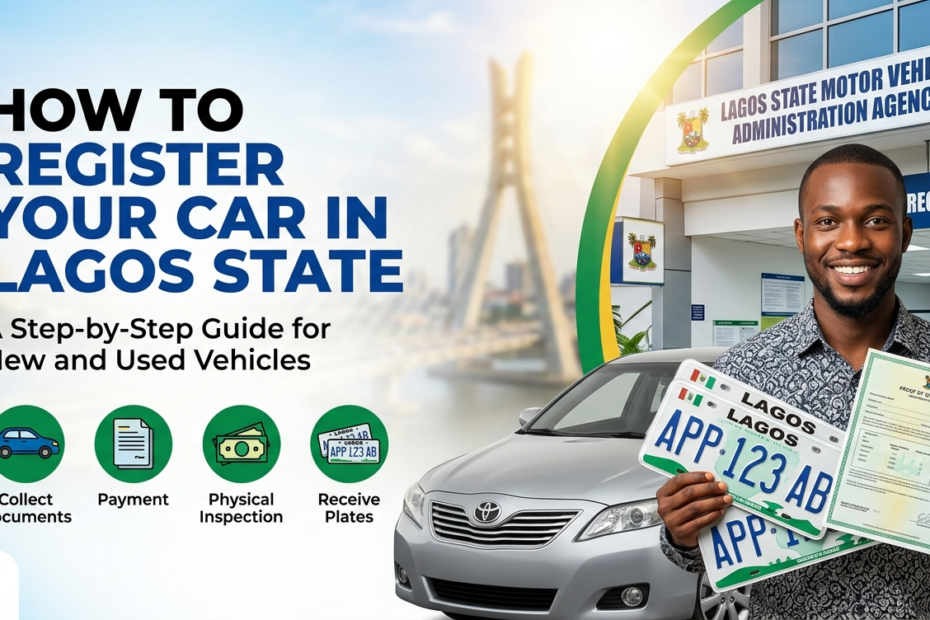
Registering your car in Lagos State is not just a legal requirement—it is essential for ensuring your vehicle is recognized and protected under the law. Whether you’ve just purchased a brand-new car or imported a vehicle, proper registration guarantees that your ownership is officially documented.
Beyond legality, registration plays a crucial role in promoting safety on the roads, as registered vehicles are traceable and accountable in case of accidents or traffic violations.
By completing the registration process, you not only comply with Lagos State regulations but also gain peace of mind knowing your vehicle is fully recognized by the authorities.
Who Can Register a Vehicle in Lagos State
In Lagos State, vehicle registration is open to anyone who meets the official eligibility requirements. Understanding who can register a vehicle will help ensure a smooth process.
1. Residents of Lagos State
Only individuals who reside in Lagos State or have a valid Lagos State address can register their vehicles locally. Proof of residence, such as a utility bill, tenancy agreement, or Lagos State ID, is typically required during the registration process.
2. Owners of New Cars
If you purchase a brand-new car—whether from an authorized dealer or manufacturer—you are eligible to register it immediately. The process ensures your vehicle has a valid number plate and registration certificate, confirming your legal ownership.
3. Imported or Used Vehicles
Imported vehicles and pre-owned cars can also be registered in Lagos State. However, additional documents, such as a customs clearance certificate and inspection report, may be required. Imported vehicles must comply with Lagos State regulations and road safety standards before registration can be completed.
By understanding eligibility, residents can prepare the necessary documents in advance and avoid delays during the registration process.
Documents Required for Car Registration in Lagos
To successfully register your vehicle in Lagos State, you need to provide certain essential documents. Having these ready in advance will help you avoid delays and ensure a smooth registration process.
1. Vehicle Purchase Receipt
This serves as proof of ownership and shows that the vehicle was legally acquired. It can be an invoice from the dealer, a sales receipt, or a bill of sale.
2. Proof of Identity
You must provide a valid form of identification, such as a driver’s license, national ID card, or international passport. This helps the Lagos State Vehicle Licensing Authority verify the owner’s identity.
3. Proof of Address
A recent utility bill, tenancy agreement, or any official document showing your Lagos State address is required. This confirms that you are eligible to register a vehicle in the state.
4. Vehicle Inspection Report / VIN Verification
Your vehicle may need to undergo an inspection to verify its Vehicle Identification Number (VIN) and ensure it meets road safety standards. This is especially important for imported or used vehicles.
By ensuring all these documents are complete and valid, you increase the chances of a fast and hassle-free registration.
Step-by-Step Lagos Car Registration Process
Registering your car in Lagos State is straightforward when you follow the correct steps. Here’s a simple guide to help you complete the process efficiently:
Step 1: Obtain the Vehicle Invoice and Customs Documents (if imported)
If your vehicle is imported, you must have a valid customs clearance certificate. For locally purchased cars, keep the sales invoice ready. These documents prove legal ownership and are essential for registration.
Step 2: Visit the Lagos State Vehicle Inspection Office
Before registration, your vehicle may need to undergo inspection to verify its Vehicle Identification Number (VIN) and ensure it meets road safety standards. This step is mandatory for both new and imported vehicles.
Step 3: Complete Application Forms
At the registration office, you will be required to fill out the official vehicle registration forms. Provide accurate information to avoid delays or rejection of your application.
Step 4: Pay Registration Fees
Lagos State requires the payment of registration fees, which vary depending on vehicle type and age. Make sure to confirm the current fee schedule at the official Lagos State DMV website or office.
Step 5: Collect Your Registration Certificate and Number Plates
Once your application and payment are processed, you will receive your vehicle registration certificate and number plates. Display your number plates correctly to comply with Lagos State road regulations.
Following these steps carefully ensures a smooth registration process and keeps your vehicle fully compliant with Lagos State laws.
Fees and Charges for Vehicle Registration in Lagos State
When registering a vehicle in Lagos State, you’ll need to budget for various fees. These typically include the registration fee, number‑plate issuance, vehicle inspection/road‑worthiness, and any administrative or customs‑related costs.
Typical Fees to Expect
-
The standard number plate for a private vehicle in Lagos is around ₦18,750.
-
Number‑plates for special or customized vehicles range between ₦37,000 and ₦210,000, depending on the category.
-
Road‑worthiness certificate renewal for private cars is typically between ₦5,000 and ₦12,000.
-
The base registration and administrative fees vary by vehicle type and engine capacity, with a general range of ₦45,000 for standard saloon cars (including plate, licence, and inspection).
Important Notes & Tips
-
Fees vary depending on vehicle type (private car, commercial vehicle, bus, etc.), engine capacity, whether the vehicle is imported or locally purchased, and whether it’s a first-time registration or renewal.
-
The fee structure may change at any time as directed by the Lagos State government, so always verify the latest rates with the official agency before payment.
-
Always make payments through official channels to avoid unofficial charges.
Suggested Blog Text
The cost to register your vehicle in Lagos State depends on the type and size of your vehicle, whether it’s new or imported, and whether you’re obtaining standard or customized number-plates. For example, a standard number plate for a private car typically costs about ₦18,750, while customized plates may run into ₦200,000+. The registration package (including inspection, number-plate issuance, certificate, and licence) can range from around ₦45,000 and higher for larger vehicles or commercial types. Renewal of the road-worthiness certificate may incur around ₦5,000 to ₦12,000 for typical private vehicles. Since fees are subject to revision by the state government, it’s important to confirm the latest rates before proceeding.
Tips for a Smooth Car Registration in Lagos
Registering your car in Lagos State can be a straightforward process if you follow a few practical tips:
1. Avoid Peak Hours
Visiting the registration office during peak hours can result in long waiting times. Try to schedule your visit early in the morning or on less busy days to save time.
2. Ensure All Documents Are Correct
Double-check that all your documents—vehicle invoice, proof of identity, proof of address, and inspection report—are complete and accurate. Missing or incorrect documents can delay the registration process.
3. Check Online Portals (If Available)
Some registration services or fee payments can be completed online. Checking the official Lagos State vehicle registration portal in advance can help you understand requirements, make payments, and even book appointments, reducing time spent at the office.
Following these tips increases the likelihood of a smooth, hassle-free registration experience and keeps your vehicle compliant with Lagos State regulations.
Common Mistakes to Avoid When Registering Your Car in Lagos
Registering your car in Lagos State can be simple, but several common mistakes can lead to delays, fines, or even legal issues. Being aware of these pitfalls will help ensure a smooth process:
1. Incomplete Documentation
Submitting registration forms without all the required documents is one of the most frequent causes of delays. Always double-check that you have your vehicle invoice, proof of identity, proof of address, and inspection report before visiting the registration office.
2. Late Registration Penalties
Failing to register your vehicle within the legally required time frame can result in fines or penalties. Ensure you complete the registration process promptly after purchasing or importing a vehicle to avoid unnecessary costs.
3. Using Fake or Altered Papers
Using forged or altered documents is illegal and can lead to severe legal consequences, including vehicle confiscation. Always use authentic documents issued by recognized authorities to stay compliant with Lagos State laws.
By avoiding these mistakes, you can save time, money, and stress while ensuring your vehicle is fully compliant with Lagos State regulations.
Conclusion
Timely registration of your car in Lagos State is essential for legal compliance, road safety, and official recognition of ownership. Completing the process promptly ensures that you avoid fines, enjoy peace of mind, and have full access to all legal protections as a vehicle owner.
Always follow the official guidelines and requirements set by Lagos State authorities. By preparing your documents in advance, adhering to the proper steps, and avoiding common mistakes, you can make the registration process smooth, efficient, and stress-free. Registering your car correctly is not just a legal obligation—it’s a smart step toward responsible vehicle ownership in Lagos State.
Frequently Asked Questions
How long can you drive an unregistered car in Nigeria?
Driving an unregistered car in Nigeria is against the law, as all vehicles operating on public roads must be registered with the appropriate government agency, usually the Federal Road Safety Corps (FRSC) and the State Vehicle Licensing Office.
However, there are specific provisions that allow a temporary use of an unregistered vehicle under certain conditions. When a person buys a new or imported vehicle, the law allows for the use of a temporary vehicle tag or dealer’s permit, which is usually valid for a maximum of 30 days.
During this period, the vehicle owner is expected to complete all registration processes including the issuance of number plates, proof of ownership, and roadworthiness certificate.
If you drive a completely unregistered car (one without any temporary tag or government-issued permit), it is considered a serious traffic violation. The Nigerian law, under the Road Traffic Act and FRSC regulations, empowers law enforcement agencies to impound such vehicles immediately.
The owner may also face fines, penalties, and in some cases, prosecution. The reason for this strict regulation is to ensure that all vehicles on the road can be identified, taxed, and monitored for safety and security purposes.
Driving unregistered vehicles also poses risks, especially in cases of accidents or theft, because unregistered cars are difficult to trace and may invalidate your insurance coverage.
In major cities like Lagos, Abuja, and Port Harcourt, the enforcement of this law is particularly strict. Vehicle owners are encouraged to begin the registration process immediately after purchase and avoid unnecessary delays.
In summary, you can only drive an unregistered car in Nigeria if you have a temporary vehicle tag, valid for no longer than 30 days. After that period, the vehicle must be fully registered before it can legally operate on public roads.
How much is road worthiness in Lagos?
The cost of obtaining a roadworthiness certificate in Lagos State varies depending on the type and category of the vehicle. Generally, the fee ranges from ₦1,000 to ₦10,000, but additional costs may apply depending on the inspection station, vehicle condition, and whether it’s a renewal or a new application.
For private cars, the standard roadworthiness fee is typically around ₦3,000 to ₦5,000, while commercial vehicles, trucks, or buses may pay up to ₦10,000 or more due to stricter safety inspections.
The roadworthiness test is conducted by the Vehicle Inspection Service (VIS) in Lagos, and it ensures that vehicles meet the minimum safety and environmental standards required to operate on public roads.
During the inspection, key components such as brakes, tires, lights, emissions, steering, and suspension are checked. If the vehicle passes, a roadworthiness certificate is issued, valid for 12 months. However, if the vehicle fails, the owner must repair the identified faults and return for re-inspection before certification can be granted.
In addition to the inspection fee, vehicle owners may also pay for related services such as booking, renewal of documents, or mechanical corrections, which can raise the total cost slightly.
Payment can be made online through the Lagos State e-Tax or VIS portal, or directly at approved testing centers. It is important to note that driving without a valid roadworthiness certificate is an offense, and offenders can be fined or have their vehicles impounded by FRSC or state traffic authorities.
Therefore, maintaining a valid roadworthiness certificate is both a legal requirement and a safety necessity for all drivers in Lagos
How long does car registration take in Nigeria?
Car registration in Nigeria typically takes between two days and two weeks, depending on the state, the type of vehicle, and whether all documents are ready and verified. In Lagos and Abuja, where digital processes are more advanced, vehicle registration can be completed within three to five working days if there are no document discrepancies. However, in some states or during busy periods, it can extend to about two weeks.
The process involves several steps: submission of required documents (such as the purchase receipt, valid ID, insurance, Customs duty papers for imported vehicles, and proof of address), verification by the Motor Vehicle Licensing Office, inspection by the Vehicle Inspection Service (VIS), payment of applicable fees, and issuance of the number plate and registration documents. Each of these steps must be completed sequentially.
Delays often occur when there are issues with Customs verification (especially for imported cars), incorrect paperwork, or backlog at the registration centers. Using the Lagos MVAA online system or the FRSC registration portal can significantly speed up the process, as some steps can be completed electronically. Once registration is completed, the owner receives the vehicle license, proof of ownership certificate, roadworthiness certificate, and number plates.
It’s important to note that driving before completing registration is only allowed if the driver possesses a temporary permit, valid for 30 days. Therefore, vehicle owners are encouraged to begin registration immediately after purchase to avoid penalties or impoundment. With proper documentation and prompt processing, full registration in Nigeria should not exceed two weeks.
How long can a car be unregistered before it needs a roadworthy act?
A car in Nigeria technically requires a roadworthiness certificate only after it is registered for operation on public roads. Therefore, an unregistered car that has never been driven or used does not immediately require a roadworthiness certificate until registration is initiated. However, once the car is ready to be put on the road — even temporarily — it must undergo a roadworthiness inspection and obtain the necessary certificate.
If a vehicle remains unregistered for a long time, such as several months or years, it is not legally permitted for road use, and therefore does not need a valid roadworthiness certificate during that inactive period. However, before it can be registered or reactivated for use, the vehicle must first pass the Vehicle Inspection Service (VIS) test to ensure it meets safety standards.
In summary, the roadworthiness requirement is tied to the car’s registration and active use status. Once the vehicle is set to be used publicly, even if previously unregistered, it must immediately obtain a roadworthiness certificate — no matter how long it has been unused or unregistered.
Can I drive around without registration?
Driving around without registration in Nigeria is considered illegal under the Road Traffic Act and the Federal Road Safety Corps (FRSC) regulations. Every vehicle operating on public roads must be registered with the relevant authorities, and a valid registration plate must be displayed at all times.
The law provides that once a vehicle is purchased, whether new or imported, the owner has a grace period of 30 days during which a temporary permit can be used while full registration is being processed. Beyond that grace period, driving without registration attracts penalties, including fines, vehicle impoundment, and possible prosecution.
The registration process serves several important purposes — it helps identify vehicle ownership, ensures road safety compliance, and facilitates law enforcement. Unregistered vehicles are often associated with criminal activities because they cannot be easily traced.
Therefore, the FRSC and state Vehicle Inspection Services (VIS) closely monitor unregistered vehicles. In most Nigerian cities like Lagos, Abuja, and Port Harcourt, officers conduct regular checks to ensure that all cars have valid registration numbers and accompanying documents such as proof of ownership, insurance, and roadworthiness certificates.
If you drive without registration and are stopped by traffic officers, the car can be seized immediately until proper documentation is provided. In addition, driving without valid registration can nullify your insurance coverage, meaning that in the event of an accident, you will not be entitled to any compensation.
The process of registering a car in Nigeria is not overly complicated — it involves paying prescribed fees, presenting necessary documents, and undergoing inspections to ensure the vehicle meets safety standards.
Because of the legal and financial risks involved, it is always advisable to start and complete your registration as soon as you purchase your vehicle. The bottom line is simple: you cannot legally drive around without registration unless you have a valid temporary permit, and even that has a strict expiration period.
What does JJJ mean in Lagos plate number?
In Nigerian number plate systems, the “JJJ” seen in Lagos plate numbers does not have a personalized meaning but follows a systematic code pattern used by the Federal Road Safety Corps (FRSC) to organize vehicle registration. The number plate format across Nigeria is standardized as ABC 123 DE, where:
-
The first three letters (ABC) represent a unique serial code generated by the FRSC.
-
The three digits (123) are random numeric identifiers.
-
The final two letters (DE) denote the state and licensing location — for example, “LA” stands for Lagos.
Therefore, in a Lagos plate number such as JJJ 345 LA, the “JJJ” portion is simply part of the serial sequence assigned by the FRSC to distinguish one vehicle from another. It does not refer to any name, abbreviation, or personal identity. The coding system progresses alphabetically; when one series is exhausted (e.g., JJJ 999 LA), it moves to the next available sequence, such as JJK, JJL, and so forth.
However, some people mistakenly believe that “JJJ” might stand for something specific to Lagos, but it doesn’t. The significance lies only in the administrative organization of vehicle registration. In Lagos, the plate codes end with “LA,” while other states have their own endings — for instance, “AB” for Abuja, “EK” for Ekiti, and “KN” for Kano.
In summary, “JJJ” in Lagos plate numbers is merely a randomized serial prefix generated as part of the FRSC’s national vehicle numbering system. It helps ensure that every car registered in Lagos has a unique and traceable identity.
What is the meaning of ABC in plate number?
In the Nigerian vehicle registration format ABC 123 DE, the first three letters — in this case “ABC” — are unique serial codes assigned to individual vehicles by the FRSC. These letters are not abbreviations or location identifiers; rather, they are randomly generated to differentiate one vehicle’s registration from another within the same state.
The system works sequentially. For example, after all combinations starting with “ABC” are exhausted (such as ABC 001 LA to ABC 999 LA), the next series, “ABD,” “ABE,” and so on, are introduced. This ensures that no two vehicles have the same number plate within a state at any time.
Unlike the last two letters (like “LA” for Lagos or “KN” for Kano), which indicate the state and licensing authority, the first three letters simply serve as vehicle identification codes. However, some people request customized or personalized plates, where the “ABC” portion can represent initials, company names, or special phrases. Such personalized plates attract higher fees — sometimes up to ₦150,000–₦250,000 depending on the customization level.
Therefore, “ABC” in a Nigerian plate number does not have a literal meaning unless specially chosen by the owner. In standard registration, it is part of a systematic alphanumeric coding structure that ensures every vehicle has a distinct and traceable identity nationwide.
How much is JTB tax?
The Joint Tax Board (JTB) tax in Nigeria refers to the personal income tax and related levies that are coordinated under the Joint Tax Board, a federal body responsible for harmonizing tax administration across states.
It is not a specific flat-rate fee like vehicle registration costs, but rather a tax identification and compliance system used to ensure that individuals and businesses pay the correct amount of taxes to the government.
Every vehicle owner, business operator, or working individual in Nigeria must have a JTB Tax Identification Number (TIN), which serves as proof of tax registration.
Obtaining a JTB TIN itself is free of charge, but the taxes associated with it vary based on your income, occupation, or business category. For vehicle-related transactions (like car registration or change of ownership), proof of tax payment or TIN verification is required before documents are processed.
When people refer to “JTB tax,” they often mean the annual personal income tax or business tax verified through the Joint Tax Board’s system. The actual amount depends on whether you are:
-
An employee (PAYE system): The tax rate ranges from 7% to 24% of annual income, depending on earnings.
-
A self-employed person or business owner: Taxes are assessed based on declared income, and rates can range from ₦5,000 to ₦50,000 annually for small traders under presumptive tax, to much higher amounts for larger businesses.
-
A vehicle owner using the TIN for registration: You may be asked to present evidence of the previous year’s tax clearance, which varies according to your income bracket and tax office records.
For example, in Lagos, when processing vehicle registration or change of ownership, the MVAA often requires a Tax Clearance Certificate (TCC) issued by the Lagos State Internal Revenue Service (LIRS) but validated by the Joint Tax Board’s online system.
The Joint Tax Board does not directly collect money; instead, it coordinates between federal and state tax authorities to maintain a centralized tax database. Payment is made to your respective State Internal Revenue Service (SIRS).
In essence, there is no fixed amount called “JTB tax.” Rather, it refers to the tax compliance system managed by the Joint Tax Board. The actual payable amount depends on your income or business size, usually verified through your Tax Identification Number (TIN).
For most individuals engaged in vehicle registration or documentation, the relevant cost of tax verification or clearance usually falls between ₦5,000 and ₦15,000, depending on the state and the type of service being processed.
What is the newest car registration?
The newest car registration process in Nigeria, as of 2026, is a fully digitalized and centralized system implemented by the Federal Road Safety Corps (FRSC) in collaboration with the Joint Tax Board (JTB) and the Motor Vehicle Administration Agencies (MVAA) across all states.
This modernized process ensures transparency, faster processing, and accurate record-keeping through an online database that links every vehicle to its owner via the National Vehicle Identification Scheme (NVIS).
Under the new registration system, every new or imported vehicle must first undergo Customs verification to confirm duty payment. Once the vehicle’s clearance is validated, the next step involves vehicle inspection by the Vehicle Inspection Service (VIS), which issues a roadworthiness certificate if the car meets safety standards.
Afterward, the vehicle owner submits the required documents—proof of ownership, valid ID, purchase receipt, insurance, and Customs papers—to the nearest MVAA or FRSC office.
The newest update to the car registration system introduced digital number plates and smart vehicle records, allowing real-time tracking and verification of vehicles nationwide.
Vehicle owners can now complete much of the process online, including payment of registration fees, tax verification through the JTB portal, and submission of documents for pre-approval. Once approved, the physical number plate and documents (such as proof of ownership and registration certificate) can be collected at designated centers.
Another notable improvement is the integration of biometric verification to prevent fraud and duplicate registrations. The system ensures that every car in Nigeria has a unique digital identity that can be instantly verified by law enforcement officers using handheld devices.
In summary, the newest car registration process in Nigeria is faster, more secure, and largely online-driven. It links vehicle ownership, insurance, tax compliance, and safety certification under one national database — enhancing accountability, efficiency, and road safety.
Can I renew my road worthiness online?
Yes, you can renew your roadworthiness certificate online in Nigeria through the Vehicle Inspection Service (VIS) and Motor Vehicle Administration Agency (MVAA) online portals, particularly in digitally advanced states such as Lagos, Abuja, Ogun, and Rivers. The online renewal process was designed to simplify what used to be a lengthy and manual procedure, allowing vehicle owners to renew their certificates conveniently from anywhere.
To renew your roadworthiness certificate online, you must first visit the official Lagos State Vehicle Inspection Service portal (or your state’s equivalent website). There, you enter your vehicle registration number and other details to retrieve your previous records.
The system automatically checks your vehicle status and generates an invoice for payment. Payments can be made online via debit card or through authorized bank partners. Once the payment is confirmed, the system provides a booking date for inspection if required.
If your vehicle is less than a year old or has previously passed inspection recently, the renewal might not require a physical check. However, older vehicles or those flagged for reinspection must undergo a quick physical test at an authorized VIS center before the certificate is renewed. Once the inspection is cleared, the digital roadworthiness certificate can be downloaded or printed directly from the online portal.
The entire online renewal process typically takes between 24 and 72 hours, depending on the vehicle’s inspection status and payment confirmation. The certificate remains valid for 12 months and must be renewed annually to maintain legal compliance.
This online system was introduced to reduce paperwork, improve transparency, and eliminate corruption in the inspection and certification process. Moreover, the digital certificate can be verified in real time by FRSC officers during road checks.
In conclusion, renewing your roadworthiness certificate online is not only possible but also encouraged. It’s convenient, secure, and faster than the manual process, ensuring that every compliant driver remains legally certified to use public roads.
What will happen if your vehicle is not registered?
If your vehicle is not registered in Nigeria, it cannot be legally driven on public roads, and doing so exposes you to serious legal, financial, and security consequences.
Under the Nigerian Road Traffic Act and FRSC regulations, every motor vehicle must be registered before use. Driving an unregistered vehicle can lead to immediate seizure, heavy fines, and even arrest.
The first consequence of not registering your vehicle is impoundment. The FRSC, Vehicle Inspection Officers (VIO), or state traffic enforcement agencies like LASTMA (in Lagos) have the authority to detain any unregistered vehicle found on the road. To recover the vehicle, the owner must pay all registration fees, penalties, and sometimes impound charges before release.
Secondly, unregistered vehicles are considered untraceable. This poses a major risk in the event of theft, accident, or involvement in criminal activities. Law enforcement relies on the national vehicle database to identify and trace registered vehicles, so an unregistered car remains invisible to the system.
Driving without registration also invalidates your vehicle insurance, meaning you cannot make claims in case of an accident. Insurance companies require valid registration documents as part of their policy terms, and without them, your coverage is null and void.
From a legal standpoint, driving an unregistered car can attract fines of up to ₦50,000 or more, depending on the offense and state. Repeat offenders may face court prosecution, especially if the vehicle is linked to a violation or road accident.
In essence, failure to register your vehicle not only violates the law but also exposes you to unnecessary risks and expenses. Registration ensures accountability, safety, and protection. Every car owner in Nigeria is therefore advised to register their vehicle immediately after purchase or importation to avoid severe penalties.
How do I check proof of ownership?
Checking your vehicle’s proof of ownership in Nigeria can now be done both physically and online, thanks to digital systems developed by the Motor Vehicle Administration Agency (MVAA) and the Federal Road Safety Corps (FRSC). This allows car owners, buyers, and law enforcement officers to verify a vehicle’s ownership status quickly and accurately.
To check the proof of ownership online, you can visit the Lagos MVAA online portal or the National Vehicle Identification System (NVIS) website.
On these platforms, you simply input the vehicle registration number or proof of ownership certificate number, and the system will display the details of the registered owner, including the chassis number, vehicle type, make, and year of registration. This verification ensures that the car truly belongs to the person claiming ownership and helps prevent fraud during vehicle transactions.
Alternatively, you can visit a Motor Vehicle Licensing Office or the Vehicle Inspection Service (VIS) office in your state to request a verification. You’ll need to present a valid ID, the vehicle’s registration details, and possibly an application form for verification.
For people purchasing used cars, checking the proof of ownership is particularly important to avoid buying stolen or cloned vehicles. In such cases, it’s recommended to cross-check with the Nigeria Police Central Motor Registry (CMR), which maintains an official record of all vehicles in the country.
In states like Lagos, the online verification service operates 24/7, and results are usually displayed instantly. This digital access has significantly reduced cases of vehicle fraud and illegal sales.
In conclusion, checking proof of ownership in Nigeria is easy and can be done online through the MVAA or NVIS portals, or manually at designated vehicle licensing offices. Always verify before making any vehicle purchase or ownership transfer to ensure the car is legally registered and free from encumbrances.
Which plate number is AAA in Lagos?
The plate number series “AAA” in Lagos State represents the first sequence of the standardized vehicle registration system introduced by the Federal Road Safety Corps (FRSC) under the National Vehicle Identification Scheme (NVIS).
The format of a Nigerian vehicle plate number is ABC 123 DE, where the first three letters (e.g., AAA) form a serial code, the three digits are unique identifiers, and the last two letters denote the state and licensing area (e.g., LA for Lagos).
In Lagos, the plate number AAA series was the starting code for the first batch of vehicles registered when the new reflective license plate system was introduced around 2011. For example, a plate like AAA 101 LA would have been among the earliest registrations under the modern numbering structure. The “AAA” sequence indicates the beginning of a new registration cycle, with subsequent vehicles following “AAB,” “AAC,” “AAD,” and so on as more cars were registered.
It’s important to note that “AAA” itself doesn’t have any personal or geographical meaning — it is part of the sequential coding system designed to uniquely identify every vehicle within the state. Once a series (like “AAA”) is exhausted — after reaching “AAA 999 LA” — the FRSC automatically transitions to the next available code.
However, in some rare cases, certain “AAA” plates may appear on official government vehicles or older cars that were among the first to register under the reflective plate system. Because the series was the initial code, plates beginning with “AAA” are often seen as symbols of early adoption or administrative priority when the modern registration process began.
In summary, “AAA” in Lagos plate numbers signifies the first batch in the state’s vehicle numbering sequence under the standardized FRSC system. It doesn’t represent a person, organization, or region but rather marks the starting point of the current registration series.
What is the meaning of KRD in Lagos plate number?
The letters “KRD” in a Lagos State number plate represent a specific licensing district or local government area within Lagos. Each area in Lagos has its own unique code assigned by the Motor Vehicle Administration Agency (MVAA) to identify where a vehicle was registered. In this case, “KRD” stands for Ikorodu Local Government Area.
Lagos State, being Nigeria’s most populated and commercially active region, uses different plate suffixes to organize vehicle registrations by geographical zones. For example:
-
EKY – Ikeja (the state capital)
-
AAA – Statewide initial code
-
KJA – Ojo / Alimosho axis
-
SMK – Surulere / Mushin
-
FKJ – Ifako-Ijaiye
-
KRD – Ikorodu
Thus, any vehicle bearing a plate such as ABC 123 KRD was registered in the Ikorodu MVAA office. This coding system allows easy identification of a car’s registration origin, aiding traffic management and law enforcement.
The “KRD” code helps officials quickly verify where a vehicle was first registered, especially in cases involving ownership disputes, vehicle theft, or administrative updates. It also helps balance registration workloads across multiple licensing offices within the state.
While many people believe that these suffixes indicate personal or private meanings, they are actually administrative designations. The last two or three letters at the end of every Nigerian number plate always signify the state and specific registration zone.
In conclusion, “KRD” in a Lagos plate number simply means the vehicle was registered in the Ikorodu Local Government Area, one of the major registration districts recognized by the MVAA and FRSC. It has no personal meaning but serves as an important part of Nigeria’s structured vehicle identification system.
Can 3 million buy a car in Nigeria?
Yes, ₦3 million can buy a car in Nigeria, although the type, brand, and condition of the vehicle will depend on whether you are purchasing a new, foreign-used (Tokunbo), or locally used car.
With inflation, import duties, and rising exchange rates, ₦3 million is considered a moderate budget, suitable mainly for reliable used vehicles rather than brand-new ones.
If you’re considering a foreign-used (Tokunbo) car, ₦3 million can get you:
-
A Toyota Corolla (2007–2011)
-
A Honda Accord (2006–2010)
-
A Toyota Camry (2005–2008)
-
A Lexus RX300 or RX330 (2004–2006)
-
A Nissan Altima or Sentra (2009–2012)
These vehicles are dependable, fuel-efficient, and have readily available spare parts in Nigeria.
For locally used cars, your ₦3 million budget stretches further. You can find newer models like:
-
Toyota Corolla (2013–2015)
-
Hyundai Elantra (2014–2016)
-
Kia Rio (2016–2018)
-
Honda City or Civic (2013–2016)
However, the prices depend heavily on mileage, maintenance history, and physical condition. If you buy locally, ensure you verify the car’s documents — including Customs papers, proof of ownership, and roadworthiness certificate — to avoid legal issues.
Brand-new vehicles from dealerships in 2026 typically start from ₦15 million upward, so ₦3 million would not be sufficient for a new car. Nonetheless, for first-time buyers or people seeking affordable personal transport, ₦3 million remains a reasonable budget for a quality used vehicle in Nigeria.
In conclusion, ₦3 million can definitely buy a car in Nigeria — primarily a well-maintained used one. With proper inspection, verification, and negotiation, it’s possible to get a reliable, fuel-efficient vehicle that offers long-term value for the price.