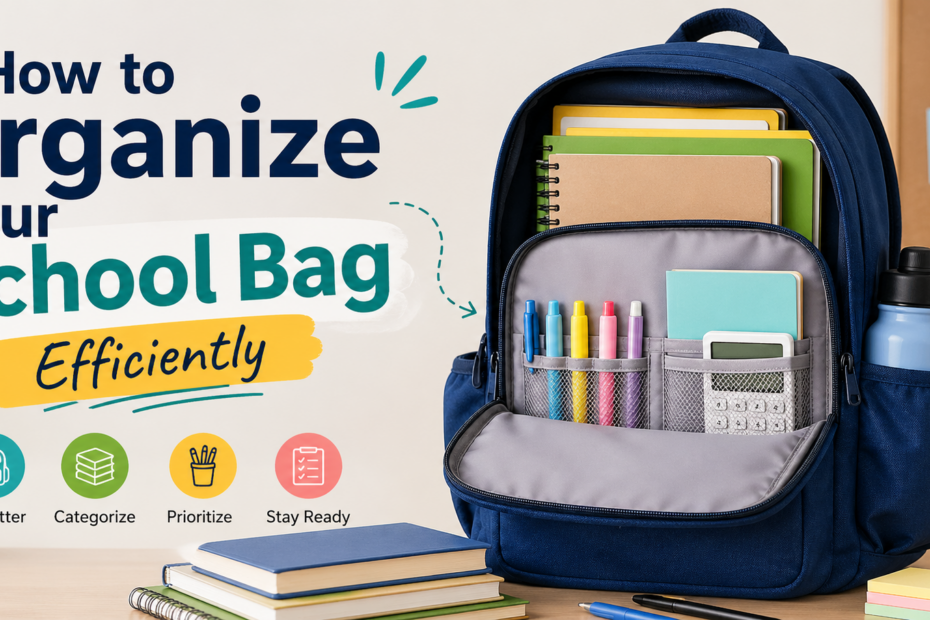
Carrying a school bag can feel like a daily challenge for many students. From lost pens and misplaced notebooks to crumpled papers at the bottom of the bag, it’s easy for things to get messy and disorganized.
These small frustrations can waste valuable time, cause unnecessary stress, and even make it harder to focus on studies. Learning how to organize your school bag efficiently can make your daily routine much smoother, ensuring that every essential item is in its proper place.
A well-organized bag not only saves time but also protects your books, gadgets, and stationery from damage. By adopting a few smart habits and packing strategies, students can enjoy a hassle-free school day and feel more in control of their study materials.
Choose the Right Bag
Choosing the right school bag is the first step toward effective school bag organization. A bag that is too small may force you to cram your books and supplies, while an oversized bag can become heavy and cumbersome. The ideal school bag should be comfortable, durable, and equipped with multiple compartments to help keep your items neatly separated.
Look for bags that have dedicated sections for textbooks, notebooks, stationery, gadgets, and even water bottles. This separation prevents items from getting damaged and makes it easier to locate what you need quickly. Some bags even include padded compartments for laptops or tablets, which is especially useful for students who carry electronic devices.
Investing in the best school bag for students isn’t just about style—it’s about functionality. A well-designed bag supports better posture, distributes weight evenly, and allows you to maintain an organized routine.
By choosing a bag that suits your daily needs, you lay the foundation for a clutter-free and stress-free school experience, making school bag organization a much simpler task.
Pack Strategically
Once you have the right bag, packing it strategically is key to maintaining an organized and efficient school bag. Proper placement of items not only keeps your belongings safe but also reduces strain on your back and makes it easier to find essentials quickly.
Here are some practical tips for packing your bag efficiently:
-
Place heavy items near the back: Books, laptops, and large binders should be positioned closest to your back. This helps balance the weight and prevents your bag from tipping backward.
-
Keep frequently used items on top: Notebooks, pens, water bottles, and your timetable should be easily accessible. This prevents constant digging through your bag during classes.
-
Use separate compartments: Assign smaller pockets or pouches for pencils, chargers, snacks, and other small essentials. This prevents clutter and keeps items from getting lost or damaged.
-
Organize by subject or priority: Consider grouping books and supplies by the order of your classes, making it faster to retrieve what you need.
-
Secure fragile items: Use padded compartments or wrap delicate gadgets to protect them from accidental bumps or drops.
By following these strategies, students can save time, reduce stress, and maintain a tidy school bag every day. A well-packed bag ensures that everything has its place, making school bag organization simpler and more effective.
Use Organizers & Pouches
Using organizers and pouches is a simple yet highly effective way to keep your school bag tidy and functional. Small pouches can be used to separate stationery, chargers, snacks, or even personal items like makeup, ensuring that nothing gets lost or mixed up with other belongings.
Opting for mesh or transparent pouches is especially helpful, as it allows you to see the contents at a glance. This makes it easy to grab what you need without digging through your bag and disturbing other items.
For example, a clear pencil pouch keeps your pens, erasers, and highlighters neatly contained and visible, while a small pouch for chargers prevents tangled cords and lost adapters.
Bag organizers are another excellent investment for students who carry multiple items. Multi-compartment organizers or divider inserts help create specific sections for different essentials, making school bag organization faster and more efficient. By using these practical tools, students can save time, protect their belongings, and maintain a clutter-free school bag every day.
Declutter Regularly
Regularly decluttering your school bag is essential for keeping it organized and functional. Over time, bags can accumulate old papers, broken pens, empty snack wrappers, and other unnecessary items that make it harder to find what you really need. By making it a habit to declutter your school bag weekly, you can maintain a tidy, stress-free space for your essentials.
A practical way to stay consistent is to establish a “bag cleaning day” routine. Choose one day each week—such as Sunday evening—to empty your bag completely.
Sort items into what you need, what can be stored elsewhere, and what should be thrown away. Check your pencil case, lunchbox, and any small compartments for forgotten items that can add clutter over time.
Not only does this routine help keep your school bag tidy, but it also protects your books, gadgets, and stationery from unnecessary damage. Decluttering regularly is a simple yet powerful step in school bag organization that saves time, reduces stress, and ensures that your bag is always ready for the week ahead.
Extra Tips for Efficient Organization
Beyond the basics of packing and using organizers, a few extra tips can take your school bag organization to the next level. One effective method is to color-code your notebooks and folders by subject. For example, math can be blue, science green, and English red. This visual system makes it easier to grab the right materials quickly, especially during busy school days.
Using folders for loose papers is another smart strategy. Instead of letting handouts, assignments, or notes pile up at the bottom of your bag, keep them sorted in labeled folders. This not only protects your documents but also streamlines your study routine.
Consider keeping a mini emergency kit in your bag. Items like hand sanitizer, tissues, a small snack, or a spare pen can save you from minor inconveniences during the day.
Finally, be aware of common mistakes in school bag organization. Overstuffing the bag, not using compartments, or ignoring weekly decluttering can quickly lead to mess and stress. By avoiding these pitfalls and applying these extra tips, students can maintain a neat, accessible, and fully organized school bag every day.
Conclusion
In summary, organizing your school bag efficiently starts with choosing the right bag, packing strategically, using organizers and pouches, and decluttering regularly.
Adding extra tips like color-coding notebooks, using folders, and keeping a mini emergency kit can further simplify your daily routine. By following these strategies, students can save time, reduce stress, and protect their belongings while maintaining a tidy and functional bag.
Start organizing your school bag efficiently today and see how much easier your school days become! With consistent habits, a well-arranged bag can transform your school experience into a smooth, stress-free routine.
Frequently Asked Questions
How do I arrange my school bag?
Arranging your school bag properly is about balancing weight, improving access, and keeping items organized so you don’t waste time searching during school hours. A well-arranged bag also protects your books and reduces strain on your back.
Start by emptying your bag completely. This helps you see everything you have and remove unnecessary items like old papers or broken stationery. Many students carry extra weight without realizing it, which makes the bag harder to manage.
Next, organize items by importance and frequency of use. Place the most frequently used items—like notebooks for current classes, timetable, pens, and calculator—in easy-to-reach compartments. These should go in the front or top section of your bag.
Heavier items such as textbooks should be placed closest to your back. This helps balance weight and prevents the bag from pulling backward, which can cause discomfort.
Smaller items like stationery, chargers, or keys should be stored in pouches or side pockets so they don’t get lost. Keeping similar items together makes it easier to find things quickly.
You should also keep a daily essentials section, which includes items you always need: writing materials, assignment books, and a water bottle.
Finally, make it a habit to reorganize your bag every day or at least once a week. This prevents clutter from building up and keeps your bag efficient.
In summary, a well-arranged school bag is structured by importance, weight distribution, and accessibility, making your school day smoother and more organized.
How to organize a 7 way bag?
A “7-way bag” (often a school or multipurpose backpack with multiple compartments) is designed for structured organization. To organize it effectively, you need to assign a clear purpose to each section so every item has a designated place.
Start with the main compartment. This is usually the largest space and should hold your heavy items like textbooks and exercise books. Place them vertically and close to the back panel to maintain balance and reduce strain.
The second compartment can be used for notebooks and lighter academic materials. This keeps them separate from heavier books and makes them easier to access during class.
The third compartment, often a front pocket, is ideal for stationery such as pens, pencils, erasers, rulers, and markers. Using a pencil case inside this section helps keep everything neat.
The fourth compartment is useful for personal items like a phone charger, wallet, hand sanitizer, or small accessories. Keeping these separate avoids mixing them with school materials.
The fifth section, often a side pocket, should hold a water bottle. This prevents leaks from damaging books and ensures easy access.
The sixth compartment can be used for lunch or snacks, ideally stored in a separate container to avoid spills.
The seventh compartment can be reserved for miscellaneous items like keys, ID cards, or emergency essentials.
The key to organizing a 7-way bag is consistency—always returning items to their assigned sections. This prevents clutter and saves time during busy school days.
What are the 7 types of bags?
Bags come in many forms, each designed for a specific purpose. The “7 types of bags” commonly refer to the most widely used categories in daily life.
The first type is the backpack, commonly used by students and travelers. It is worn on the back and is ideal for carrying books, laptops, and everyday essentials.
The second type is the handbag, often used for personal items such as wallets, cosmetics, and small accessories. It is usually carried by hand or over the shoulder.
The third type is the tote bag, which is simple, open, and spacious. It is commonly used for shopping, casual outings, or carrying lightweight items.
The fourth type is the messenger bag, which is worn across the body. It is popular among students and professionals who carry documents or laptops.
The fifth type is the duffel bag, a cylindrical bag used for travel or sports. It is flexible and can hold clothing, shoes, and gear.
The sixth type is the laptop bag, designed specifically to protect and carry laptops along with chargers and accessories.
The seventh type is the suitcase or travel bag, used for longer trips. It has wheels and compartments for organized packing of clothes and travel essentials.
Each bag type serves a different purpose, and choosing the right one depends on lifestyle, activity, and convenience.
What are 5 things you carry to school?
Most students carry a set of essential items to school that support learning, organization, and daily comfort. While the exact items may vary depending on school requirements, there are five common essentials.
The first and most important item is textbooks and notebooks. These contain lessons, assignments, and classwork, making them the core academic materials for any school day.
The second item is writing materials, such as pens, pencils, erasers, and rulers. Without these, it becomes difficult to complete tasks, take notes, or participate in class activities.
The third essential is a school bag or backpack, which helps organize and carry all your materials safely and comfortably.
The fourth item is a water bottle. Staying hydrated during school hours is important for concentration, energy, and overall health.
The fifth item is usually a lunch box or snacks, which provide energy during breaks and help students stay focused throughout the day.
Some students may also carry additional items like a calculator, device (tablet or laptop), or personal hygiene items, depending on school rules and personal needs.
In summary, the five basic school essentials are books, writing tools, a bag, water, and food, all of which support a productive school day.
What are the 5 steps of organizing?
Organizing is a skill that helps you manage time, space, and resources efficiently. The process can be broken down into five simple steps that can be applied to schoolwork, home tasks, or personal planning.
The first step is sorting. This involves separating items based on category or purpose. For example, in a school bag, you would separate books, stationery, and personal items.
The second step is decluttering. This means removing unnecessary or unused items. Getting rid of old papers or broken stationery helps reduce confusion and creates more space.
The third step is assigning a place. Every item should have a specific location. When everything has a home, it becomes easier to find and return items.
The fourth step is storing properly. This involves placing items in a structured way so they are easy to access and protected from damage. For example, keeping heavy books at the bottom of a bag.
The fifth step is maintaining the system. Organization is not a one-time task; it requires regular upkeep. Reviewing and rearranging items daily or weekly ensures the system continues to work effectively.
In summary, the five steps of organizing are sorting, decluttering, assigning, storing, and maintaining, and they help create order in both academic and personal life.
What is the 5 4 3 2 1 packing rule?
The 5-4-3-2-1 packing rule is a simple travel organization method that helps people pack efficiently without overpacking. It is mainly used for short trips, but the idea behind it can also help students or anyone trying to organize belongings in a structured way.
In its basic form, the rule suggests packing:
- 5 tops
- 4 bottoms
- 3 pairs of shoes or footwear options
- 2 accessories or outerwear items (like jackets, belts, or hoodies)
- 1 set of essentials (toiletries or special items depending on the trip)
The goal is not strict numbers but balance and minimalism. It helps you avoid carrying unnecessary items while still having enough variety for different situations. For example, instead of packing many similar clothes, you choose versatile pieces that can be mixed and matched.
This method works because it encourages planning outfits in advance. Each top can match multiple bottoms, reducing the need for excess clothing. It also helps you think practically about what you will actually use rather than packing “just in case” items.
Even though it is originally a travel rule, the same thinking can be applied to school organization—reducing clutter, choosing essentials, and keeping things simple.
In summary, the 5-4-3-2-1 rule is a structured packing strategy that promotes simplicity, organization, and smart decision-making when choosing what to carry.
What should a 13 year old girl have in her school bag?
A 13-year-old student’s school bag should be organized to support learning, comfort, and daily school needs without becoming too heavy or cluttered. The goal is to carry only what is necessary and age-appropriate for school life.
First, she should have core academic materials, such as textbooks, exercise books, and notebooks for each subject. These are essential for lessons, homework, and class activities.
Second, writing materials are important. This includes pens, pencils, erasers, sharpeners, a ruler, and possibly colored pens or markers for assignments and projects.
Third, a pencil case or stationery pouch helps keep all writing tools organized in one place, making them easier to find during class.
Fourth, a water bottle is essential for staying hydrated throughout the school day, which helps with focus and energy.
Fifth, a lunch box or snacks can help maintain energy levels, especially during long school hours.
Sixth, a planner or small notebook can be useful for writing assignments, deadlines, and reminders. This helps build organization habits early.
Seventh, some personal items like hand sanitizer, tissues, or sanitary products (if needed) can be included for hygiene and comfort.
Finally, depending on the school, she may also carry a school ID card, library card, or bus pass.
The most important principle is balance—her bag should not be overloaded. A well-packed school bag should be light enough to carry comfortably while still containing everything needed for a productive school day.
How to bag items correctly?
Bagging items correctly is about organizing, protecting, and balancing weight so that your bag is easy to carry and everything inside is easy to find. Whether it is a school bag, travel bag, or everyday backpack, the same principles apply.
Start by sorting your items. Group them into categories such as books, stationery, personal items, food, and electronics. This helps you see what you actually need to carry.
Next, place heavy items first and closest to your back. In a backpack, heavier objects like textbooks should sit near the back panel. This improves balance and reduces strain on your shoulders.
Then, add medium-weight items, such as notebooks or folders, in the middle section. These help stabilize the bag without making it too heavy at the front.
After that, place light and frequently used items in easy-to-reach pockets. Items like pens, keys, or small accessories should be stored in front compartments so you don’t waste time searching.
Use small pouches or cases for loose items. This prevents clutter and keeps things like chargers, earphones, or stationery organized.
Finally, ensure even weight distribution. A bag that is unevenly packed can cause discomfort and back strain.
In summary, correct bagging is about sorting items, placing heavy items properly, using compartments wisely, and maintaining balance for comfort and efficiency.
What are the 5 biggest packing mistakes to avoid?
Packing mistakes are very common, especially for students and travelers, and they often lead to unnecessary stress, heavy bags, or disorganization. Avoiding these mistakes can make your daily routine much smoother.
The first mistake is overpacking. Many people carry more items than they actually need “just in case.” This makes bags heavy and harder to manage. It is better to pack only essentials and plan ahead.
The second mistake is poor weight distribution. Placing all heavy items in one part of the bag can cause discomfort and back strain. Heavy items should always be placed closest to the back for balance.
The third mistake is not organizing items into categories. Mixing books, snacks, and stationery together makes it difficult to find things quickly. Using compartments or pouches helps avoid this confusion.
The fourth mistake is forgetting essentials. While some people overpack, others forget important items like notebooks, chargers, or water bottles. A simple checklist can prevent this.
The fifth mistake is not maintaining the bag regularly. Many students only organize their bags once in a while, leading to clutter buildup. Regular cleaning and rechecking help keep everything in order.
In summary, the five biggest packing mistakes are overpacking, poor weight balance, lack of organization, forgetting essentials, and not maintaining the bag regularly.
How to make your school bag look better?
Making your school bag look better is not just about style—it is also about keeping it clean, organized, and well-maintained. A neat-looking bag reflects good habits and makes school life more comfortable.
Start with cleaning your bag regularly. Remove old papers, trash, and unnecessary items. A clean bag instantly looks more organized and visually appealing.
Next, focus on proper organization inside the bag. When everything has a place—books in one section, stationery in another—the bag not only functions better but also looks neater when opened.
Using pouches or organizers can improve appearance and structure. Matching pencil cases or storage bags make the inside look more coordinated.
The outside of the bag also matters. Avoid overloading it with unnecessary keychains or decorations. A simple, clean design often looks more stylish than a cluttered one.
You can also improve appearance by choosing a well-designed backpack with good color and structure. Neutral or solid colors often look more professional and timeless.
Finally, take care of straps, zippers, and shape. A bag that is properly packed (not bulging or sagging) always looks better than one that is overstuffed or messy.
In summary, a better-looking school bag comes from cleanliness, organization, simple design choices, and proper packing habits.