Skip to content
Home ยป How to Learn Faster Using Active Recall

How to Learn Faster Using Active Recall

    Struggling to retain everything you study can be frustrating, especially when exams or deadlines are looming. Many students spend hours rereading notes or highlighting textbooks, yet find that the information slips away as soon as they stop studying.

    The key to breaking this cycle is learning faster using active recall, a scientifically proven technique that trains your brain to retrieve information instead of just passively absorbing it.

    By actively testing yourself on what youโ€™ve learned, you strengthen memory pathways, improve understanding, and retain knowledge for the long term.

    Whether youโ€™re preparing for school exams, professional certifications, or simply want to learn more efficiently, active recall offers a practical and highly effective approach to mastering information faster than traditional study methods.

    What is Active Recall?

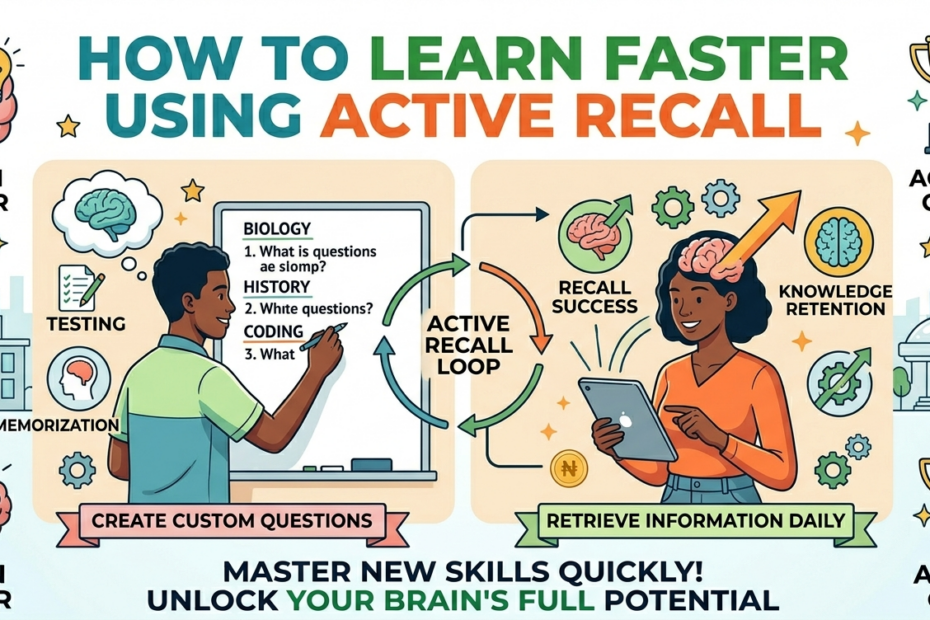
    Active recall is a study technique that involves actively retrieving information from your memory rather than passively reviewing it. In simple terms, it means testing yourself on what youโ€™ve learned instead of just rereading notes or textbooks. For example, after studying a chapter, you might close your book and try to write down or explain the key concepts from memory.

    The science behind active recall is rooted in how our brains form and strengthen neural connections. Each time you successfully retrieve information, you reinforce these pathways, making it easier to remember the material in the future.

    This process is far more effective for long-term memory retention than passive methods like highlighting or rereading, which often create a false sense of familiarity without actually improving recall.

    Incorporating active recall into your study routine is one of the most efficient learning strategies available. It not only boosts memory retention but also improves focus, understanding, and problem-solving skills, making it a cornerstone technique for anyone looking to learn faster and smarter.

    Benefits of Learning Faster Using Active Recall

    Active recall is more than just a study techniqueโ€”itโ€™s a powerful tool that can transform the way you learn. Here are some of the key benefits:

    • Improved Memory Retention: Actively retrieving information strengthens neural connections, making it easier to recall knowledge long-term compared to passive study methods.

    • Faster Study Sessions: By focusing on what you donโ€™t know rather than rereading material you already understand, you can study more efficiently and save time.

    • Better Understanding and Application: Active recall encourages deeper engagement with the material, helping you grasp concepts fully and apply them in real-life or exam scenarios.

    • Reduced Exam Stress: Confidence grows when you consistently test yourself and see improvement. This reduces anxiety and helps you perform better under pressure.

    Incorporating active recall into your study routine turns learning into an interactive process. Itโ€™s a proven learning strategy that not only improves memory retention but also enhances focus, understanding, and overall academic performance. By practicing active recall regularly, you can learn faster and retain more, making your study sessions both effective and efficient.

    How to Use Active Recall Effectively

    Learning faster using active recall isnโ€™t just about testing yourself randomlyโ€”it works best with structured strategies. Here are some proven methods to apply active recall effectively:

    1. Flashcards

    Create question-and-answer flashcards for key concepts. Digital tools like Anki or Quizlet can make this process easier by automatically organizing cards for review. Regularly testing yourself with flashcards forces your brain to retrieve information, strengthening memory retention over time.

    2. Practice Tests

    Simulate real exam conditions by taking practice tests. This method not only helps you identify gaps in your knowledge but also trains your brain to recall information under pressure. The more you practice, the more confident and efficient you become.

    3. Teach Someone Else

    Explaining concepts to a friend, family member, or even yourself reinforces understanding. Teaching forces your brain to organize information logically and recall details actively, making it easier to retain complex material.

    4. Spaced Repetition

    Combine active recall with spaced repetition for maximum results. Review information at increasing intervalsโ€”after one day, three days, a week, and so on. This spacing strengthens memory retention and prevents forgetting.

    5. Summarization

    After reading a chapter or completing a study session, close your notes and summarize the main points from memory. This simple exercise challenges your brain to retrieve information and identify areas that need more focus.

    By consistently applying these active recall strategies, you can significantly boost learning efficiency, improve memory retention, and reduce study time. Integrating these techniques into your daily routine is one of the most effective learning strategies for students, professionals, and lifelong learners alike.

    Common Mistakes to Avoid

    While active recall is a highly effective learning strategy, certain mistakes can reduce its effectiveness.

    • Passive Studying Instead of Active Recall: Simply rereading notes or highlighting text gives a false sense of understanding. Without actively retrieving information, memory retention remains low.

    • Overloading Sessions Without Breaks: Cramming large amounts of information in one sitting can overwhelm your brain. Short, focused sessions with breaks improve concentration and long-term recall.

    • Ignoring Spaced Repetition Principles: Reviewing information only once or irregularly diminishes the benefits of active recall. Spaced repetition ensures that knowledge is reinforced over time, preventing forgetting.

    Avoiding these common pitfalls will help you maximize the benefits of active recall, making your study sessions more efficient, focused, and productive.

    Conclusion

    Learning faster using active recall is a proven strategy that boosts memory retention, improves understanding, and makes study sessions more efficient.

    By incorporating techniques like flashcards, practice tests, teaching others, spaced repetition, and summarization, you can transform the way you learn and retain information.

    Start applying active recall in your daily study routine today to see tangible results. Have you tried active recall before? Share your experience in the comments and let others learn from your tips.

    Frequently Asked Questions

    How to memorize using active recall?

    Active recall is one of the most effective study techniques because it forces your brain to retrieve information instead of just rereading it. This strengthens memory and improves long-term retention.

    To use active recall, first study a topic briefly, then close your book or notes. After that, try to recall everything you just learned without looking. You can write it down or say it out loud.

    Next, check your notes to see what you missed. This step is important because it helps you identify gaps in your knowledge.

    Then repeat the process multiple times. Each cycle strengthens your memory pathways.

    See also  How to transition from side hustle to part-time income using online platforms

    You can also use questions instead of passive reading. For example, turn headings into questions like โ€œWhat is photosynthesis?โ€ and answer it from memory.

    Flashcards are another powerful tool for active recall because they force you to test yourself repeatedly.

    The key idea is simple: if your brain struggles to remember something, it learns it better next time.

    In summary, active recall works by testing yourself repeatedly instead of rereading, which significantly improves memory strength.

    What is the 7 3 2 1 study method?

    The 7-3-2-1 study method is a structured revision technique designed to improve memory retention through spaced repetition.

    • 7 minutes โ€“ First exposure: you study a topic for understanding.
    • 3 minutes โ€“ Quick recall: you close your notes and try to remember key points.
    • 2 minutes โ€“ Reinforcement: you review only what you forgot or got wrong.
    • 1 minute โ€“ Final summary: you quickly summarize everything in your own words.

    This method works because it combines learning, recall, correction, and summary in a short cycle, which strengthens memory faster than passive reading.

    It is especially useful for exam preparation, memorizing definitions, and understanding key concepts quickly.

    In summary, the 7-3-2-1 method improves learning by forcing repeated recall and quick revision in a structured time cycle.

    How to memorize 2x faster?

    To memorize faster, you need to focus on techniques that improve how your brain stores and retrieves information.

    First, use active recall instead of rereading. Testing yourself forces stronger memory formation.

    Second, apply spaced repetition, which means reviewing information at increasing intervals instead of cramming.

    Third, use visualization and association. Linking new information to images or familiar ideas helps the brain remember faster.

    Fourth, break information into small chunks. The brain remembers small pieces better than large blocks of information.

    Fifth, teach what you learn. Explaining a topic out loud makes your brain process it more deeply.

    Finally, avoid distractions and study in focused sessions using methods like the Pomodoro technique.

    In summary, faster memorization comes from active recall, repetition, visualization, and focused learningโ€”not just reading repeatedly.

    How can I improve my recall speed?

    Improving recall speed means training your brain to retrieve information quickly and accurately under pressure.

    First, practice daily active recall. The more you test your memory, the faster your brain becomes at retrieving information.

    Second, use frequent repetition with spacing. Revisiting information at intervals strengthens neural connections.

    Third, reduce reliance on passive reading. Instead of re-reading notes, try to recall them from memory first.

    Fourth, use cue-based learning. Create triggers like keywords, diagrams, or questions that help your brain access information quickly.

    Fifth, improve focus and attention. A distracted brain stores weaker memories, making recall slower.

    Finally, practice under timed conditions, especially when preparing for exams. This trains your brain to retrieve information faster under pressure.

    In summary, recall speed improves through repetition, testing, focus, and structured learning techniques.

    What is the 2/3, 5/7 study method?

    The 2/3, 5/7 study method is a spaced learning technique that improves memory by reviewing information at increasing time intervals.

    In this method:

    • You first study a topic and revise it after 2โ€“3 days
    • Then you review it again after 5โ€“7 days

    The idea is based on how memory works. The brain forgets information over time unless it is reinforced. By revisiting the material at these intervals, you strengthen long-term memory retention.

    This method is useful for exam preparation, language learning, and any subject that requires memorization.

    It works best when combined with active recall, meaning you should test yourself during each review instead of just rereading notes.

    In summary, the 2/3, 5/7 method improves memory by spacing out revisions so the brain strengthens long-term retention instead of forgetting information quickly.

    What is the 3 words test for memory?

    The 3 words test for memory is a simple cognitive exercise used to check and improve short-term memory and recall ability. In this method, a person is given three unrelated words, such as โ€œapple, chair, river,โ€ and asked to remember them.

    After a short distraction or delay (for example, counting backwards or answering a question), the person must recall the three words without looking.

    This test is commonly used in psychology and basic memory screening because it measures how well the brain can encode, store, and retrieve information quickly.

    To use it for studying, you can turn it into a learning tool by:

    • Writing 3 keywords from a topic
    • Studying them briefly
    • Then trying to recall them after a few minutes

    It helps train your brain to focus and improve recall speed over time.

    In summary, the 3 words test is a simple memory exercise that strengthens short-term recall and attention.

    What is the 2 7 30 trick for remembering?

    The 2-7-30 trick is a spaced repetition technique used to improve long-term memory retention.

    It works like this:

    • Review the material after 2 days
    • Review again after 7 days
    • Review again after 30 days

    This method is based on how the brain forgets information over time. Each review helps โ€œresetโ€ the forgetting curve, making the memory stronger and more permanent.

    Instead of cramming, this technique spreads learning over time, which makes recall easier and faster.

    It is especially useful for exams, language learning, and memorizing large topics.

    In summary, the 2-7-30 trick improves memory by reviewing information at strategic intervals to strengthen long-term retention.

    What are the top 5 study techniques?

    Effective studying is not about how long you study, but how well you learn. The top 5 study techniques are:

    1. Active Recall
      Testing yourself instead of rereading notes. This forces your brain to retrieve information, strengthening memory.
    2. Spaced Repetition
      Reviewing material at increasing time intervals (e.g., 2 days, 7 days, 30 days).
    3. Pomodoro Technique
      Studying in focused intervals (25โ€“50 minutes) with short breaks to improve concentration.
    4. Feynman Technique
      Explaining what you learned in simple words as if teaching someone else.
    5. Mind Mapping
      Using diagrams to visually connect ideas and improve understanding.

    These methods work because they engage the brain actively instead of passive reading.

    In summary, the best study techniques combine testing, repetition, focus, explanation, and visualization.

    How to use 100% of your brain while studying?

    The idea of using 100% of your brain at once is a myth. In reality, humans already use all parts of the brain, but not all at the same time. The goal is not โ€œ100% usageโ€ but efficient brain performance.

    To study effectively, you should:

    • Use active learning methods like testing yourself instead of rereading
    • Avoid multitasking, because it reduces focus and memory strength
    • Study in a distraction-free environment
    • Get enough sleep, because memory consolidation happens during rest
    • Eat properly and stay hydrated to support brain function
    • Use repetition and review techniques to strengthen memory
    See also  Which social media platform is best for earning money?

    Focus, consistency, and smart techniques matter more than trying to โ€œunlock more brain power.โ€

    In summary, you cannot use 100% of your brain at once, but you can maximize learning efficiency through focus, rest, and effective study methods.

    What is the 7 3 2 1 method?

    The 7-3-2-1 method is a structured learning and revision technique designed to improve memory retention and understanding.

    It works in steps:

    • 7 minutes โ€“ Learn the topic and understand the basics
    • 3 minutes โ€“ Close your notes and try to recall key points
    • 2 minutes โ€“ Review what you forgot or got wrong
    • 1 minute โ€“ Summarize everything in your own words

    This method is powerful because it combines learning, recall, correction, and summarization in one cycle.

    It forces your brain to actively engage with information instead of passively reading it, which improves long-term memory.

    It is especially useful for students preparing for exams or anyone trying to memorize concepts quickly.

    In summary, the 7-3-2-1 method strengthens learning by repeatedly testing and reinforcing knowledge in short, focused cycles.

    Leave a Reply

    Your email address will not be published. Required fields are marked *

    error: Content is protected !!