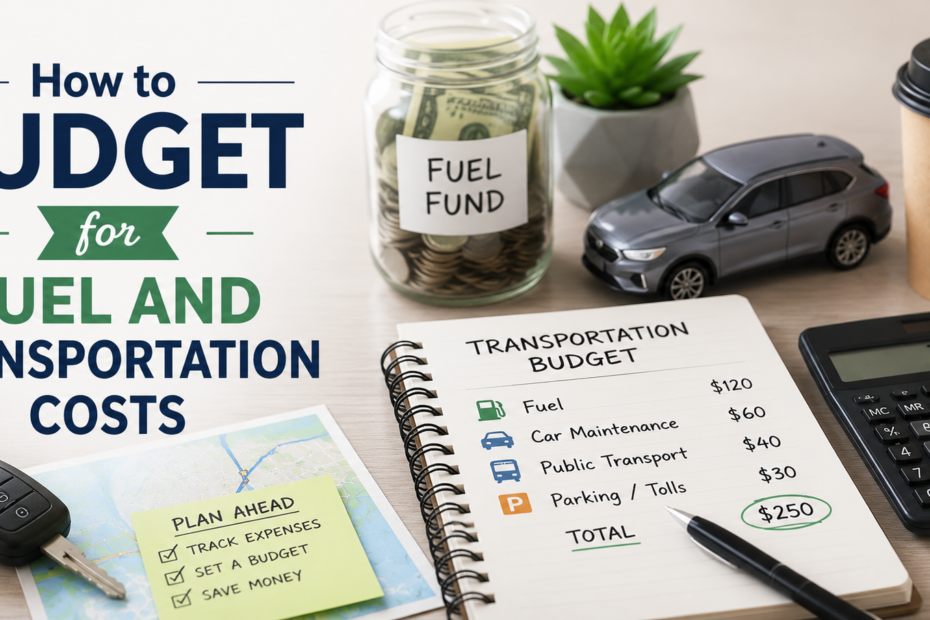
Fuel and transportation costs take a large part of daily expenses for many people, especially in busy cities where prices change frequently.
Whether you use a personal car, motorcycle, or rely on public transport, movement is something you cannot avoid.
This is why having a clear transport budget is very important. Without proper planning, it becomes easy to overspend without even realizing it, and this can lead to financial stress by the end of the month.
When transport costs are not controlled, other important financial goals like saving money, paying bills, or investing may suffer.
Many people struggle because they treat transportation as an unpredictable expense, but in reality, it can be planned.
By understanding its importance and setting limits, you gain better control of your monthly income and reduce unnecessary pressure on your finances.
Track Your Daily and Weekly Transport Spending
One of the most important steps in managing fuel and transportation costs is tracking exactly how much you spend every day and every week.
Many people struggle financially not because they earn too little, but because they do not know where their money goes.
When transport expenses are not recorded, it becomes very easy to underestimate how much is actually being spent on daily movement.
Start by writing down every transport expense you make. This includes your daily work commute, trips to the market, school runs, visits to friends or family, and even emergency movements.
Each small trip may seem insignificant on its own, but when added together over a week or month, the total can be surprisingly high.
To make tracking easier, you can use simple tools such as a notebook, a phone note app, or budgeting applications designed for expense tracking.
The goal is consistency, not complexity. Every time you spend on transport or fuel, record it immediately so you don’t forget.
Over time, this habit will help you identify patterns in your spending. You may discover that certain trips are unnecessary or that some days cost more than others.
With this information, you can make better decisions, reduce waste, and create a more realistic transport budget that truly matches your lifestyle.
Separate Transport Budget from Other Expenses
One of the common mistakes many people make when managing their money is mixing transport costs with general daily expenses.
When this happens, it becomes difficult to know exactly how much is being spent on movement each month.
As a result, transport spending often increases silently without proper control, leading to overspending and financial imbalance.
Transportation is a regular and unavoidable expense, just like food or rent. Because of this, it deserves its own clear category in your monthly budget.
When you separate it from other expenses, you gain better visibility and control over your spending habits.
You can easily see whether you are spending more than necessary and make quick adjustments before it affects your entire financial plan.
Creating a dedicated transport budget also helps you plan better. Instead of guessing or borrowing from other expense categories when transport money finishes, you already have a fixed amount set aside for it.
This reduces financial stress and prevents you from disturbing money meant for other important needs like savings, bills, or investments.
To make it more effective, treat your transport budget like a fixed bill. Once it is used up for the month, you either adjust your movements or find cheaper alternatives instead of pulling money from other categories.
This simple discipline helps you stay financially stable and ensures your money is used exactly as planned.
Plan Routes and Reduce Unnecessary Trips
One of the most effective ways to reduce fuel and transportation costs is by planning your routes ahead of time.
Many people spend more money on transport simply because they make multiple unnecessary trips or move around without proper planning.
When you fail to organize your movements, you end up using more fuel, paying more fares, and wasting both time and money.
By planning your routes in advance, you can combine several errands into one trip.
For example, instead of going to the market today, the bank tomorrow, and visiting a friend the next day, you can arrange all these activities into a single day.
This simple habit significantly reduces the number of trips you make and helps you save fuel or transport fare.
It is also important to avoid unnecessary outings. Ask yourself if each trip is really important before leaving the house. In many cases, some movements can be postponed, handled online, or completely avoided.
Choosing closer alternatives, such as nearby shops or services, can also reduce the distance you travel and lower your overall transport cost.
When you consistently plan your movements, you gain better control over your spending and reduce stress caused by unexpected transport expenses.
Over time, this habit becomes a powerful money-saving strategy that helps you stay within your monthly transport budget and improves your overall financial discipline.
Consider Public Transport or Ride Sharing Options
One practical way to reduce fuel and transportation costs is to consider switching between personal vehicles and public transport depending on the situation.
Many people spend more money than necessary because they rely only on their personal cars or motorcycles for every trip.
However, public transportation can often be a cheaper and more efficient alternative, especially for routine commutes like going to work, school, or busy city routes.
Using buses, tricycles, or other shared transport options can significantly reduce how much you spend on fuel and maintenance of your own vehicle.
Instead of driving in heavy traffic and burning fuel, you can reserve your personal vehicle for specific situations such as family emergencies, long-distance trips, or days when convenience is more important than cost.
Another effective cost-saving method is ride sharing or carpooling. This involves sharing a ride with friends, colleagues, or neighbors who are going in the same direction.
By splitting fuel costs or transport fares, everyone saves money while reducing the number of vehicles on the road.
Being flexible with your transport choices helps you adapt to different financial situations. On days when income is tight or fuel prices are high, public transport can help you stay within budget.
When used wisely, combining personal transport with public options and ride sharing can greatly reduce monthly expenses and give you better control over your overall budget.
Prepare for Fuel Price Changes and Emergencies
Fuel prices are not always stable. Due to inflation, changes in government policies, global oil prices, and local market conditions, the cost of fuel and transportation can rise unexpectedly.
This is why relying on a fixed transport budget without any flexibility can sometimes lead to financial pressure. When prices increase suddenly, many people struggle because they did not prepare for such changes in advance.
To stay financially stable, it is important to include a buffer in your transport budget. This means setting aside a small extra amount every month specifically for fuel price increases or unexpected transportation needs.
You can think of it as an “emergency transport fund.” This fund acts as a safety net when prices rise or when you have urgent trips that were not planned for.
For example, if your monthly transport budget is ₦50,000, you can add an extra ₦5,000 to ₦10,000 as a cushion. This way, even if fuel prices go up or you need extra trips, your main budget will not be completely disrupted.
Having this emergency allowance also reduces stress and prevents you from borrowing money or cutting into other essential expenses like food or savings.
Over time, it gives you more financial control and stability, even in unpredictable economic conditions.
By planning ahead for fuel price changes, you protect your budget and ensure your transportation needs are always covered without financial strain.
Set a Monthly Transport Limit and Stick to It
One of the most effective ways to control fuel and transportation spending is to set a fixed monthly limit and treat it as a non-negotiable part of your budget.
Just like rent, food, or electricity bills, your transport budget should have a defined amount that you do not exceed under normal circumstances.
This helps you bring structure and discipline into how you manage your daily movement expenses.
When you do not set a limit, transport spending becomes flexible and uncontrolled. You may find yourself spending more than necessary because there is no clear boundary.
However, when you assign a fixed amount—such as ₦30,000 or ₦50,000 per month depending on your income—you automatically become more mindful of how you move around and how often you travel.
The key is to stick to this limit strictly. Once your transport budget is used up, you should avoid unnecessary trips and instead look for cheaper alternatives such as public transport, ride sharing, or combining errands into fewer journeys.
This discipline forces you to make smarter decisions about movement and reduces wasteful spending.
Treating your transport budget like a fixed bill also helps you plan your finances better. It ensures that money is always reserved for movement and prevents you from dipping into savings or other essential expenses.
Over time, this habit builds strong financial control and helps you live within your means, even when fuel prices or transportation costs increase unexpectedly.
Use Fuel-Saving Habits
Small daily habits can make a big difference when it comes to reducing fuel and transportation costs.
Many people focus only on budgeting money, but forget that how you use your vehicle or manage your movement also directly affects how much you spend.
By adopting fuel-saving habits, you can stretch your transport budget further without changing your lifestyle completely.
One important habit is maintaining proper tire pressure. When your tires are under-inflated, your vehicle uses more fuel to move, which increases consumption over time.
Checking your tire pressure regularly helps improve fuel efficiency and reduces unnecessary fuel waste.
Another useful strategy is avoiding traffic-heavy hours whenever possible. Driving during peak traffic leads to more idling, slow movement, and frequent stopping, all of which increase fuel usage. Planning your trips during less busy hours can help you save both time and fuel.
Regular vehicle servicing is also essential. A well-maintained engine runs more efficiently and consumes less fuel.
Simple maintenance tasks like oil changes, air filter checks, and engine tuning can significantly improve performance and reduce long-term costs.
Other habits such as driving smoothly, avoiding sudden acceleration or braking, and turning off the engine when parked for long periods also contribute to fuel savings.
When these habits are practiced consistently, they help you reduce daily fuel consumption and keep your transport expenses within your budget.
Review and Adjust Your Transport Budget Monthly
Budgeting is not something you set once and forget; it is a continuous process that needs regular review and adjustment.
When it comes to fuel and transportation costs, this is even more important because prices can change at any time and your movement needs may also vary from month to month.
At the end of every month, take time to compare your planned transport budget with your actual spending.
Did you spend more or less than expected? If there is a difference, try to understand the reason.
It could be due to fuel price increases, more frequent trips, or unexpected emergencies. This review helps you see your real spending pattern instead of relying on assumptions.
Once you identify these patterns, adjust your budget for the next month. If transport costs have increased, you may need to increase your allocation slightly or find new ways to reduce usage.
On the other hand, if you spent less, you can redirect the extra money toward savings or other important needs.
Regular review also helps you stay flexible and realistic. Instead of struggling with an unrealistic budget, you continuously refine it to match your actual lifestyle. This makes your financial planning more accurate and sustainable over time.
By reviewing and adjusting your transport budget monthly, you stay in control of your money, avoid financial surprises, and build stronger financial discipline that adapts to changing conditions.
Conclusion
Managing fuel and transportation costs is not just about cutting expenses, but about building smart financial habits that help you stay in control of your money.
When you track your spending, estimate fuel usage, separate your transport budget, and plan your movements carefully, you begin to see clear improvements in how you manage your income.
Small decisions like using public transport when necessary, combining errands, and practicing fuel-saving habits can significantly reduce your monthly expenses over time.
It is also important to prepare for unexpected changes such as fuel price increases by setting aside an emergency transport fund.
More importantly, treating your transport budget as a fixed and important part of your monthly plan helps you avoid overspending and financial stress.
Remember, budgeting is not a one-time activity. It requires regular review and adjustment to match your real-life needs and changing economic conditions.
With consistency and discipline, you can take full control of your transportation costs and create a more stable and balanced financial life.
Frequently Asked Questions
How to budget for fuel?
Budgeting for fuel starts with understanding your daily or weekly travel habits. In a country like Nigeria, especially in busy cities such as Lagos, transportation costs can fluctuate due to traffic, fuel price changes, and distance covered.
The first step is to track how often you travel and the average distance of your regular trips, such as going to work, school, market, or business locations.
Once you understand your movement pattern, the next step is to estimate how much fuel your vehicle consumes per kilometer or per liter.
Most vehicles have an average fuel consumption rate, for example, 10–15 km per litre depending on engine size, traffic conditions, and driving style. By estimating your monthly travel distance, you can calculate how many litres of fuel you will likely need.
After determining fuel usage, multiply the total litres by the current fuel price. This gives you a realistic monthly fuel budget. It is also important to add a buffer of about 10–20% because fuel prices can increase unexpectedly, or you may travel more than planned.
A good fuel budget should also include maintenance considerations because poorly maintained vehicles consume more fuel. Regular servicing, proper tyre pressure, and smooth driving habits help reduce fuel consumption.
Finally, budgeting for fuel is not just about calculation but discipline. You should separate your fuel money from other expenses so it is not spent elsewhere. A structured fuel budget helps you avoid financial stress, especially in urban environments where transport costs are a daily necessity.
How to calculate fuel budget?
To calculate a fuel budget, you need three main pieces of information: the distance you travel, your vehicle’s fuel efficiency, and the current fuel price.
The process begins by estimating how many kilometers you cover in a day, week, or month. For example, if you commute to work daily, you multiply the distance of a round trip by the number of working days in a month.
Next, you divide the total distance by your vehicle’s fuel consumption rate. If your car covers 12 km per litre, you divide your total monthly distance by 12. This gives you the total litres of fuel required for the month.
After that, multiply the total litres by the current price per litre of fuel in your area. This gives you the estimated monthly fuel cost. In places like Nigeria, fuel prices can change frequently, especially in cities such as Lagos, so it is wise to check current rates regularly.
It is also important to include a buffer in your budget. Adding 10–15% extra helps cover unexpected trips, traffic delays, or price increases. Without this buffer, your fuel budget may fall short before the month ends.
Finally, tracking your actual fuel spending helps you refine your calculation over time. By comparing estimates with real expenses, you can adjust your driving habits or budget more accurately in the future. This makes fuel budgeting more reliable and practical.
How to estimate transportation costs?
Estimating transportation costs involves calculating how much money you spend moving from one place to another over a specific period. The first step is to identify your daily or weekly travel routes.
This includes work, school, business errands, and personal trips. In cities like Lagos, transportation costs can vary depending on distance, traffic, and transport type, whether it is buses, taxis, ride-hailing services, or private vehicles.
Once you know your routes, record the cost of each trip. For public transport, note the fare per trip. For private vehicles, calculate fuel cost and add maintenance expenses. If you use ride-hailing services, track the average fare per trip over a few days or weeks to get a realistic estimate.
Next, multiply the daily transportation cost by the number of days you travel in a month. This gives you a monthly estimate. For example, if you spend a certain amount daily, multiplying it by 20–26 working days provides a realistic monthly figure.
It is also important to consider fluctuations. Transport fares can increase due to fuel price changes, bad weather, or peak-hour demand. Therefore, adding a 10–20% buffer ensures your estimate remains realistic.
Finally, reviewing your transport expenses regularly helps you identify patterns and opportunities to save. You may discover cheaper routes, shared transport options, or ways to reduce unnecessary trips. Over time, this improves financial planning and reduces stress.
What is the formula for calculating fuel cost?
The basic formula for calculating fuel cost is:
Fuel Cost = (Total Distance ÷ Fuel Efficiency) × Fuel Price per Litre
This formula helps you determine how much money you will spend on fuel for any trip or time period. First, you calculate the total distance you plan to travel. Then you divide that distance by your vehicle’s fuel efficiency, which is usually measured in kilometers per litre. This gives you the total litres of fuel required.
After that, you multiply the result by the current fuel price per litre. In a country like Nigeria, especially in cities such as Lagos, fuel prices can change frequently, so using the most recent price is important for accuracy.
For example, if you travel 240 km in a month, and your car consumes 12 km per litre, you will need 20 litres of fuel. If fuel costs a certain amount per litre, multiplying those values gives your total fuel expense.
This formula is widely used because it is simple and effective. However, it does not account for traffic congestion, driving habits, or vehicle condition, which can affect real fuel consumption. That is why it is recommended to add a small buffer when budgeting.
How do I calculate my fuel cost?
To calculate your fuel cost, you need to understand how far you travel, how efficiently your vehicle uses fuel, and the current price of fuel. Start by estimating your total travel distance over a specific period, such as a week or a month. This includes commuting, errands, and any additional trips.
Next, check your vehicle’s fuel consumption rate. For example, if your car travels 10–15 kilometers per litre, you use that figure to divide your total distance. This gives you the number of litres required for your travel.
After calculating the litres needed, multiply it by the current fuel price per litre. This gives you your total fuel cost for that period. In places like Nigeria and cities such as Lagos, fuel prices can vary frequently, so it is important to use up-to-date rates.
For example, if you estimate needing 30 litres of fuel and the price per litre is known, multiplying them gives your total cost. If prices rise or you travel more than expected, your cost will increase accordingly.
It is also wise to include a small buffer in your calculation. This helps cover unexpected trips, traffic delays, or price changes. Over time, tracking your actual spending will help you improve accuracy and manage your transport budget more effectively.
What is the cost of 1 litre of fuel?
The cost of 1 litre of fuel is not fixed because it changes based on government policy, global crude oil prices, exchange rates, and local distribution costs.
In a country like Nigeria, fuel prices have been particularly variable in recent years due to subsidy adjustments and market deregulation. In cities such as Lagos, the price per litre may also differ slightly depending on the filling station, location, and transportation costs to that area.
Because of these fluctuations, it is important to always check the current pump price at the time of purchase rather than relying on a fixed estimate.
Some stations may also offer slight variations in pricing due to competition or operational costs. For budgeting purposes, many people use an average daily or weekly price to estimate their fuel expenses.
Fuel price is influenced by several global and local factors. International crude oil prices directly affect how much refined fuel costs.
Currency exchange rates also play a major role because fuel is often imported or influenced by international markets. Additionally, logistics such as transportation, storage, and distribution costs contribute to the final price consumers pay.
Since the cost is dynamic, individuals and businesses are encouraged to monitor fuel price trends regularly. This helps in planning transportation budgets more accurately and avoiding unexpected financial pressure when prices increase suddenly.
How to calculate fuel per 100km?
Fuel consumption per 100km is a standard way of measuring how efficiently a vehicle uses fuel. It shows how many litres of fuel a car needs to travel 100 kilometers. To calculate it, you need to know the distance traveled and the amount of fuel used during that distance.
The formula is:
Fuel Consumption (L/100km) = (Fuel Used ÷ Distance Traveled) × 100
For example, if your vehicle uses 8 litres of fuel to travel 80 kilometers, you divide 8 by 80, then multiply by 100. This gives you the fuel consumption per 100km. This method helps you understand how efficient your vehicle is compared to others.
In real-life situations in places like Nigeria and urban areas such as Lagos, fuel consumption can vary due to traffic congestion, road conditions, and driving habits. Stop-and-go traffic usually increases fuel consumption, while smooth highway driving reduces it.
This measurement is useful for budgeting because it helps you estimate how much fuel you will need for long trips. Once you know your fuel consumption per 100km, you can easily calculate total fuel usage for any distance and multiply it by the current fuel price.
Understanding this figure also helps you compare vehicles and make better financial decisions when buying or using a car.
How to calculate the cost per liter?
Calculating cost per litre is usually straightforward because fuel is already sold per litre at filling stations. However, in budgeting and analysis, “cost per litre” can also refer to how much you are effectively spending based on your driving habits.
If you are trying to understand the actual cost efficiency of your travel, you first determine how much you spend on fuel over a period and divide it by the total litres consumed. The formula is:
Cost per litre = Total Fuel Cost ÷ Total Litres Purchased
For example, if you spend a certain amount of money on fuel and buy 20 litres, dividing total cost by 20 gives you the average cost per litre.
In places like Nigeria, especially in cities such as Lagos, this calculation is important because fuel prices can vary across different filling stations and change frequently. By tracking your expenses, you can understand where you are getting better value.
For businesses and drivers, this calculation helps in managing transport costs more accurately. It also helps identify inefficiencies, such as buying fuel at higher prices or consuming more fuel than expected due to poor vehicle maintenance or traffic conditions.
Understanding cost per litre in a practical sense allows individuals to plan better, reduce waste, and make informed financial decisions about transportation.
Can Google Maps calculate fuel cost?
Google Maps can help estimate fuel cost indirectly, but it does not always calculate exact fuel expenses automatically in all regions.
In some countries and app versions, Google Maps provides an estimated fuel cost based on distance, average fuel consumption, and current fuel prices. However, this feature may not always be fully accurate or available everywhere.
In a country like Nigeria, especially in cities such as Lagos, fuel cost estimation may be limited because fuel prices fluctuate frequently and real-time pricing data may not always be integrated into the system. Instead, Google Maps mainly focuses on showing distance, travel time, and route options.
Even without direct fuel cost calculation, you can still use Google Maps effectively. By checking the total distance of a trip, you can manually calculate fuel cost using your vehicle’s fuel consumption rate and current fuel price. For example, once you know the kilometers, you divide by your car’s efficiency and multiply by fuel price per litre.
Some alternative navigation apps offer more detailed fuel cost estimation features, but accuracy still depends on updated fuel price data and correct vehicle settings.
Overall, Google Maps is useful for planning routes and estimating travel distance, but for precise fuel budgeting, manual calculation or dedicated fuel tracking apps provide better accuracy.
How are fuel charges calculated?
Fuel charges are calculated based on three main factors: distance traveled, vehicle fuel efficiency, and current fuel price per litre. The basic idea is to determine how much fuel is needed for a trip and multiply it by the cost of fuel.
The standard formula is:
Fuel Charge = (Distance ÷ Fuel Efficiency) × Fuel Price per Litre
For example, if a vehicle travels a certain distance and consumes 1 litre for every 10–15 kilometers, you divide the total distance by that efficiency rate to get fuel usage in litres. Then you multiply by the current fuel price.
In countries like Nigeria and cities such as Lagos, fuel charges can also be influenced by additional factors such as traffic conditions, road quality, and driving behavior. Heavy traffic increases fuel consumption, while smooth driving reduces it.
For transport businesses, fuel charges may also include additional costs such as driver allowances, vehicle maintenance, and occasional price fluctuations. Ride-hailing services often adjust fares dynamically based on fuel costs and demand.
Understanding how fuel charges are calculated helps individuals and businesses plan transportation budgets more effectively. It also encourages better driving habits and financial discipline, especially in environments where fuel prices change frequently.
How accurate are fuel calculators?
Fuel calculators are generally useful tools, but their accuracy depends on the quality of the data you input and real-world driving conditions.
Most fuel calculators estimate fuel consumption based on average vehicle performance, distance, and fuel price. However, they cannot perfectly predict real-life usage because driving conditions constantly change.
In a country like Nigeria, especially in busy urban areas such as Lagos, factors like traffic congestion, poor road conditions, and frequent stop-and-go movement can significantly affect fuel consumption.
Fuel calculators usually assume a steady driving pattern, which is rarely the case in real life. For example, highway driving is more fuel-efficient than driving in heavy traffic. Additionally, vehicle maintenance, tyre pressure, engine condition, and driving behavior (such as speeding or sudden braking) all influence actual fuel usage.
Because of these variations, fuel calculators are best used as estimation tools rather than exact measurement systems. They are very helpful for budgeting, planning trips, and comparing different travel options, but they should always include a margin of error. A good practice is to add 10–20% extra fuel allowance to your estimate to cover unexpected situations.
Overall, fuel calculators are moderately accurate when used correctly, but real-world conditions will always cause some differences between estimated and actual fuel consumption.
How to calculate the amount of fuel needed?
To calculate the amount of fuel needed, you must know two key things: the total distance of your trip and your vehicle’s fuel efficiency. Fuel efficiency is usually measured in kilometers per litre (km/L), which tells you how far your vehicle can travel using one litre of fuel.
The formula is:
Fuel Needed = Total Distance ÷ Fuel Efficiency
For example, if you plan to travel 200 km and your vehicle covers 10 km per litre, you divide 200 by 10. This means you will need 20 litres of fuel for that trip.
In real-life situations in Nigeria, especially in cities like Lagos, fuel usage may increase due to traffic congestion, road delays, and frequent stops. Because of this, it is advisable to add a small buffer of extra fuel to your estimate.
This calculation is very useful for planning travel budgets, especially for long-distance trips or business transportation. It helps you avoid running out of fuel unexpectedly and allows you to manage expenses more effectively.
How much diesel is required for 500 km in a bus?
The amount of diesel required for a 500 km bus trip depends on the bus’s fuel efficiency, which varies based on engine size, load, road condition, and driving style. On average, a standard bus may consume between 3 to 6 km per litre of diesel depending on whether it is fully loaded or traveling on highway or city roads.
To calculate diesel needed, you use the formula:
Fuel Needed = Distance ÷ Fuel Efficiency
If a bus averages 5 km per litre, then for 500 km:
500 ÷ 5 = 100 litres of diesel
If the bus is less efficient, say 4 km per litre due to heavy load or traffic, then:
500 ÷ 4 = 125 litres of diesel
In a country like Nigeria, especially in traffic-heavy cities such as Lagos, fuel consumption may be higher because of congestion and frequent stops.
For safety, transport operators often add extra fuel allowance to avoid shortages during delays. Therefore, a realistic estimate for a 500 km bus trip could range from 100 to 130 litres depending on conditions.
How to calculate 1 litre per km?
Calculating “1 litre per km” is actually a measure of very low fuel efficiency, meaning the vehicle consumes 1 litre of fuel to travel only 1 kilometer. To understand or calculate this, you use the basic fuel consumption formula:
Fuel Consumption = Fuel Used ÷ Distance Traveled
If a vehicle uses 10 litres to travel 10 km, then:
10 ÷ 10 = 1 litre per km
This means the car consumes 1 litre of fuel for every 1 kilometer traveled.
However, in real-world situations in Nigeria and cities like Lagos, this level of fuel consumption is extremely high and usually indicates either a very large vehicle, heavy load conditions, poor road conditions, or mechanical issues.
Most modern cars are far more efficient, typically ranging from 10 km per litre to 20 km per litre depending on engine type and driving conditions. If a vehicle is consuming 1 litre per km, it may require servicing or inspection because it is not fuel-efficient.
Understanding this measurement helps in comparing vehicle performance and identifying fuel wastage.
How to calculate fuel cost per litre?
Fuel cost per litre is usually the actual price you pay at the pump, but it can also be analyzed for budgeting purposes. The simplest way to determine it is:
Fuel Cost per Litre = Total Money Spent on Fuel ÷ Total Litres Purchased
For example, if you spend a certain amount of money and receive 25 litres of fuel, dividing the total cost by 25 gives you the price per litre.
In Nigeria, especially in places like Lagos, fuel prices can change frequently due to market forces, transportation costs, and government policies. This makes it important to track fuel purchases regularly.
From a budgeting perspective, understanding cost per litre helps individuals and businesses identify price variations across different fuel stations. It also helps in planning transport budgets more accurately by using a consistent reference price.
If fuel prices increase, your transportation cost automatically increases even if your travel distance remains the same. That is why monitoring fuel cost per litre is essential for financial planning and cost control.