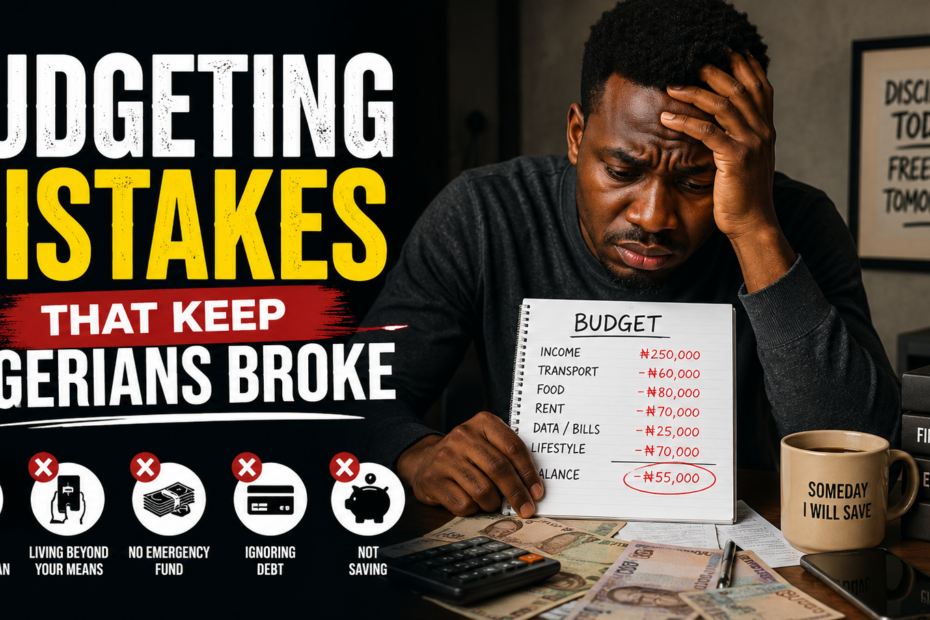
Many Nigerians work hard and earn income every month, yet they still find themselves struggling financially.
With rising inflation, increasing transportation costs, higher food prices, and daily expenses becoming more difficult to manage, earning money alone is no longer enough.
While economic conditions play a major role, poor money habits often make financial pressure even worse.
One common misconception is that budgeting is only for wealthy people or large families.
In reality, budgeting is a practical tool that helps anyone control spending, plan ahead, and make better financial decisions regardless of income level.
Unfortunately, certain budgeting mistakes often go unnoticed. Small spending habits, lack of planning, emotional purchases, and poor money management can quietly destroy financial progress over time.
Understanding these mistakes is the first step toward building stronger financial habits and achieving long-term financial stability.
Living Without a Monthly Budget
One of the biggest budgeting mistakes that keeps many Nigerians broke is living without a monthly budget.
Instead of planning where their money should go, many people receive income and begin spending immediately, hoping there will still be enough left at the end of the month.
This habit often leads to confusion about where the money went and why savings never increase.
When people spend first and calculate later, they lose control over their finances. Without tracking income and expenses, it becomes difficult to know whether money is being used for necessities or wasted on nonessential items.
Over time, this can result in unpaid bills, borrowing, financial stress, and an endless cycle of living from one paycheck to another.
The challenge is that not all spending appears large at first. Daily expenses quietly consume income without being noticed.
Small purchases such as transport fares, snacks, bottled drinks, data subscriptions, online orders, unnecessary airtime purchases, and impulse spending can add up significantly over weeks and months.
Creating a monthly budget does not mean restricting yourself from enjoying life. It simply means giving every naira a purpose so your money works for you instead of disappearing without explanation.
Spending Based on Expected Income Instead of Actual Income
Another budgeting mistake that quietly keeps many Nigerians financially unstable is spending based on expected income instead of actual money already available.
This happens when people begin making financial commitments before receiving their salary, business profits, side hustle earnings, commissions, or promised payments.
For example, someone expecting to receive salary at the end of the month may already start buying items on credit, making expensive plans, or promising money to others.
Others count future bonuses, client payments, or extra income that is not guaranteed. The problem begins when those expected funds arrive late, come in smaller amounts than expected, or fail to come at all.
Depending too heavily on anticipated income creates a false sense of financial security. Instead of making decisions based on current reality, spending becomes based on assumptions.
This often leads to borrowing, delayed bill payments, and accumulating unnecessary debt.
Over time, this habit creates financial pressure because future income becomes tied to old expenses before it even arrives. Rather than moving forward financially, each new payment is used to settle previous commitments.
A healthier budgeting habit is to spend based on money already received and treat side hustles, bonuses, or extra income as additional support—not guaranteed income.
Ignoring Small Daily Expenses
Another major budgeting mistake that keeps many Nigerians broke is ignoring small daily expenses.
Many people focus only on big costs like rent, school fees, or transportation, while overlooking the small, frequent spending that quietly drains their income over time.
These small expenses may look harmless individually, but together they can take a significant portion of monthly earnings.
For example, daily transport fares, snacks, bottled drinks, airtime top-ups, mobile data subscriptions, online shopping, and impulse buying often go untracked.
Because these expenses are small, people rarely pay attention to them or include them in their budget.
However, when added together across a week or month, they can equal a large amount of money that could have been saved or invested.
This is where the concept of “money leakage” comes in. Money leakage refers to small, unnoticed spending habits that gradually drain your income without delivering real financial value.
It is like having tiny holes in a pocket—money keeps going out without you realizing how much is lost.
The danger of money leakage is that it creates the illusion of discipline while still keeping you financially unstable. To fix this, it is important to track every expense, no matter how small, and include them in your monthly budget.
Lifestyle Inflation (Increasing Spending as Income Increases)
Lifestyle inflation is one of the silent reasons many Nigerians remain broke even when their income increases.
It happens when spending grows immediately after income increases, instead of saving or investing the extra money. In simple terms, earning more does not automatically mean becoming wealthier.
Many people fall into the trap of upgrading their lifestyle every time they get a salary raise, new job, or business profit.
Instead of improving financial stability, the extra income is quickly absorbed by new spending habits. Over time, financial pressure remains the same, even though earnings have increased.
Common examples of lifestyle inflation include upgrading to more expensive phones too quickly, going out to costly restaurants and lounges more often, and spending heavily on fashion items, designer clothes, or unnecessary accessories.
While these purchases may feel rewarding in the moment, they often do not contribute to long-term financial growth.
The problem with lifestyle inflation is that it creates a cycle where income increases but savings do not. As expenses rise alongside earnings, there is little room left for emergency funds, investments, or meaningful financial progress.
To avoid this mistake, it is important to maintain a simple lifestyle even when income improves and intentionally direct extra money toward savings and investments instead of unnecessary upgrades.
Not Saving Before Spending
Another serious budgeting mistake that keeps many Nigerians financially stuck is not saving before spending. Many people follow the pattern of spending first and hoping that whatever is left will be saved.
In most cases, there is nothing left at the end of the month, which makes saving almost impossible.
A better approach is the “save first, spend later” principle. This means setting aside a portion of your income immediately after you receive it, before any other expense is made.
By doing this, saving becomes intentional rather than accidental. It also helps you build discipline and ensures that your financial future is protected regardless of daily spending pressure.
One important part of saving is building an emergency fund. An emergency fund is money set aside specifically for unexpected situations such as medical bills, job loss, urgent repairs, or sudden family responsibilities.
In a country like Nigeria, where economic conditions can change quickly and income is not always stable, having an emergency fund is very important.
Without savings, any unexpected expense can force you into borrowing, which often leads to more financial stress. But with an emergency fund, you can handle surprises without disrupting your monthly budget or going into debt.
Saving before spending may feel difficult at first, but even small consistent amounts can grow over time. The key is discipline and consistency, not the size of the income.
Depending Too Much on Loans and Borrowing
Relying heavily on loans and borrowing is another budgeting mistake that keeps many Nigerians financially trapped.
While borrowing can seem like a quick solution to financial pressure, frequent borrowing often creates a cycle that becomes harder to escape over time.
Instead of solving money problems, it usually postpones them and adds interest or repayment stress.
The cycle typically starts when a person borrows money to cover expenses such as rent, food, or personal needs.
When income arrives, it is immediately used to repay the loan, leaving little or nothing for savings or other obligations.
If another financial need arises before the next income, the person borrows again. Over time, this pattern repeats and creates a situation where a large portion of income is always tied to debt repayment.
It is important to understand the difference between productive debt and lifestyle debt.
Productive debt is borrowing used to generate income or improve financial stability, such as investing in a business, education, or tools that can increase earnings.
Lifestyle debt, on the other hand, is borrowing used to fund consumption such as luxury items, parties, fashion, or non-essential spending. This type of debt does not generate any return and often worsens financial struggles.
To build financial stability, borrowing should be intentional, limited, and tied to clear income-generating goals rather than everyday spending needs.
Failing to Separate Needs from Wants
One of the most common budgeting mistakes that keeps many Nigerians broke is failing to separate needs from wants.
When people cannot clearly distinguish between what is necessary and what is optional, it becomes very easy to overspend and lose financial control.
Needs are the basic essentials required for survival and daily living. These include food, rent, transportation, basic clothing, healthcare, and other important responsibilities that cannot be avoided.
Without meeting these needs, life becomes unstable and difficult to manage.
Wants, on the other hand, are things that improve comfort or lifestyle but are not essential for survival.
Examples include luxury purchases, expensive gadgets, designer clothes, frequent entertainment outings, and other non-essential items.
While there is nothing wrong with enjoying wants, problems arise when they are prioritized over needs or consumed beyond one’s financial capacity.
For example, spending money meant for rent on the latest smartphone, or using funds for transportation on unnecessary shopping, creates financial imbalance. Over time, this leads to debt, unpaid bills, and constant financial stress.
A strong budgeting habit requires clear prioritization. Needs should always come first, followed by savings, and then wants if money is still available.
When individuals learn to control their wants and focus on their needs, they gain better control over their finances and reduce the risk of living from paycheck to paycheck.
No Emergency Fund
Not having an emergency fund is another budgeting mistake that keeps many Nigerians financially vulnerable. Life is unpredictable, and unexpected expenses can appear at any time.
Without financial preparation, even a small emergency can completely disrupt someone’s budget and push them into debt.
Common examples of emergencies include medical situations such as sudden illness, hospital admission, or urgent treatment that requires immediate payment. In many cases, these costs are not planned for, yet they must be settled quickly to avoid serious consequences.
Job loss is another major financial shock that many people are not prepared for.
When income stops suddenly, individuals who have no savings are forced to depend on borrowing, friends, or high-interest loans just to survive. This creates more pressure and delays financial recovery.
Family obligations can also arise without warning. In many Nigerian households, individuals are expected to support relatives during emergencies such as funerals, urgent school fees, or other unexpected responsibilities.
Without an emergency fund, meeting these obligations becomes stressful and financially draining.
An emergency fund acts as a financial cushion that protects you during difficult times. It ensures that you do not have to borrow or sell assets whenever unexpected expenses occur. Even small, consistent savings can gradually build a strong safety net.
Without this protection, one emergency is enough to destabilize an entire budget and keep a person trapped in a cycle of financial struggle.
Emotional Spending and Peer Pressure
Emotional spending and peer pressure are major budgeting mistakes that silently affect many Nigerians, especially in the age of social media.
Many people spend money not because they truly need something, but because they want to impress friends, match others, or feel included in a certain lifestyle.
Social media platforms often make this worse by constantly showing luxury lifestyles, expensive outings, fashion trends, and “perfect” experiences.
This creates comparison culture, where individuals feel pressured to keep up even when their income cannot support it. As a result, people may buy things they do not need just to appear successful or fit into a certain social circle.
This pressure is often described as “soft life pressure,” where the desire for comfort, luxury, and enjoyment becomes stronger than financial discipline.
While there is nothing wrong with enjoying life, problems begin when spending is driven by emotions and comparison rather than actual financial capacity.
For example, someone may go out to expensive restaurants or lounges simply because friends are going, even when it is not in their budget.
Others may buy trendy outfits, shoes, or gadgets just to avoid feeling left out or looking “less successful” online or in real life.
Over time, emotional spending drains savings, increases debt, and prevents long-term financial growth. Learning to make financial decisions based on personal goals rather than external pressure is key to building financial stability.
Not Reviewing and Adjusting the Budget
Another common budgeting mistake that keeps many Nigerians financially stuck is failing to review and adjust their budget regularly.
Many people create a budget once and expect it to work perfectly for months or even years without changes. However, financial situations are constantly changing, and a static budget quickly becomes outdated.
Income can increase or decrease due to job changes, business performance, side hustles, or unexpected financial setbacks.
At the same time, expenses such as transport, food, rent, and utility bills may also rise due to inflation and changing economic conditions. When a budget is not updated to reflect these changes, it becomes unrealistic and ineffective.
A good budget should be flexible and adaptable. Reviewing your budget weekly or at least monthly helps you understand where your money is going and whether you are still on track with your financial goals.
It also allows you to identify new spending patterns, cut unnecessary expenses, and reallocate money to more important priorities like savings or investments.
Regular budget reviews also help you stay disciplined. Instead of guessing your financial position, you have a clear picture of your income and spending habits.
This makes it easier to correct mistakes early before they become bigger financial problems.
Ultimately, budgeting is not a one-time activity but a continuous process. Adjusting your budget regularly ensures that it remains relevant, realistic, and aligned with your current financial situation.
Poor Record Keeping
Poor record keeping is another budgeting mistake that keeps many Nigerians confused about their finances.
A lot of people cannot clearly explain where their money goes each month because they do not track their income and expenses properly. This leads to the common situation of “I earned money, but I don’t know what I spent it on.”
When expenses are not recorded, it becomes difficult to identify spending patterns or detect financial leaks.
Small transactions such as transport, food, airtime, and impulse purchases are easily forgotten, but they gradually accumulate into a large amount over time.
Without records, it is almost impossible to know the true state of your finances or make informed budgeting decisions.
Poor record keeping also makes it harder to control overspending. If you do not track what you spend daily, you may continue repeating the same mistakes without realizing it.
This often leads to running out of money before the end of the month and relying on borrowing or waiting for the next income.
Simple tracking methods can make a big difference. You can use a notebook to write down daily expenses, a spreadsheet on your phone or computer, or budgeting apps that automatically categorize spending.
Even basic note apps can help if used consistently. The goal is not complexity but consistency.
By keeping clear financial records, you gain awareness and control over your money. This helps you make better decisions, reduce unnecessary spending, and improve your overall financial discipline.
Ignoring Multiple Income Opportunities
Another budgeting mistake that keeps many Nigerians financially limited is ignoring multiple income opportunities.
Many people focus only on managing their expenses without also thinking about how to increase their income.
While budgeting helps control spending, it becomes even more effective when combined with efforts to grow earnings.
Relying on a single source of income can make financial stability difficult, especially in an economy where costs continue to rise.
When income remains fixed but expenses keep increasing, even the best budgeting plan may struggle to create lasting financial progress. This is why exploring additional income streams is important.
Multiple income opportunities can come in different forms, such as side businesses, freelance work, digital skills, small-scale trading, or monetizing personal talents and hobbies.
The goal is not necessarily to start something big immediately, but to gradually build extra sources of income that support financial growth.
Budgeting and income growth work hand in hand. A budget helps you manage what you already earn, while additional income gives you more flexibility to save, invest, and improve your standard of living.
Without increasing income, budgeting alone may feel like constant restriction. But with extra income, it becomes easier to achieve financial goals without stress.
The key is balance: manage your money wisely while also looking for realistic ways to increase what comes in.
Ignoring income growth opportunities limits financial progress and keeps many people stuck in the same financial position for years.
Practical Tips Nigerians Can Use Immediately
Improving your financial habits does not have to be complicated. With a few simple and consistent actions, anyone can start gaining better control over their money.
One of the most effective steps is to write down every expense for 30 days. This helps you clearly see where your money is going and identify unnecessary spending habits that were previously unnoticed.
Another useful guideline is the 50/30/20 rule. This means allocating about 50% of your income to needs, 30% to wants, and 20% to savings or debt repayment.
However, this can be adjusted based on your personal income level and financial responsibilities. The goal is not perfection but structure and discipline in managing money.
Creating spending limits is also very important. Setting a clear limit for categories like food, transport, entertainment, and shopping helps prevent overspending and ensures that your income lasts throughout the month.
Saving automatically is another powerful habit. Instead of saving what is left after spending, set aside a fixed amount as soon as you receive income. This ensures consistency and builds financial discipline over time.
Finally, cutting at least one unnecessary expense each month can make a big difference.
It could be a subscription you do not fully use, frequent impulse purchases, or costly habits that do not add real value. Small sacrifices like these gradually improve your financial health.
When practiced consistently, these simple tips can transform your budgeting habits and help you move toward financial stability.
Conclusion
In conclusion, being broke is not always about earning too little money. In many cases, it is the result of repeated budgeting mistakes that slowly destroy financial stability over time.
From living without a budget, spending based on expected income, ignoring small daily expenses, to failing to save or review financial plans, these habits can quietly keep anyone stuck in a cycle of financial struggle.
The good news is that these mistakes can be corrected with awareness and discipline.
When you learn to track your spending, prioritize needs over wants, save consistently, and avoid unnecessary debt, your financial situation begins to improve gradually. Even small changes in how you manage money can lead to significant results over time.
Building wealth is not about sudden income increases, but about consistent financial habits practiced daily. Every decision you make with money either moves you closer to financial freedom or keeps you in the same position.
“Being broke is not always about earning too little. Sometimes, it is the result of repeated budgeting mistakes. Fixing small money habits today can create long-term financial freedom.”