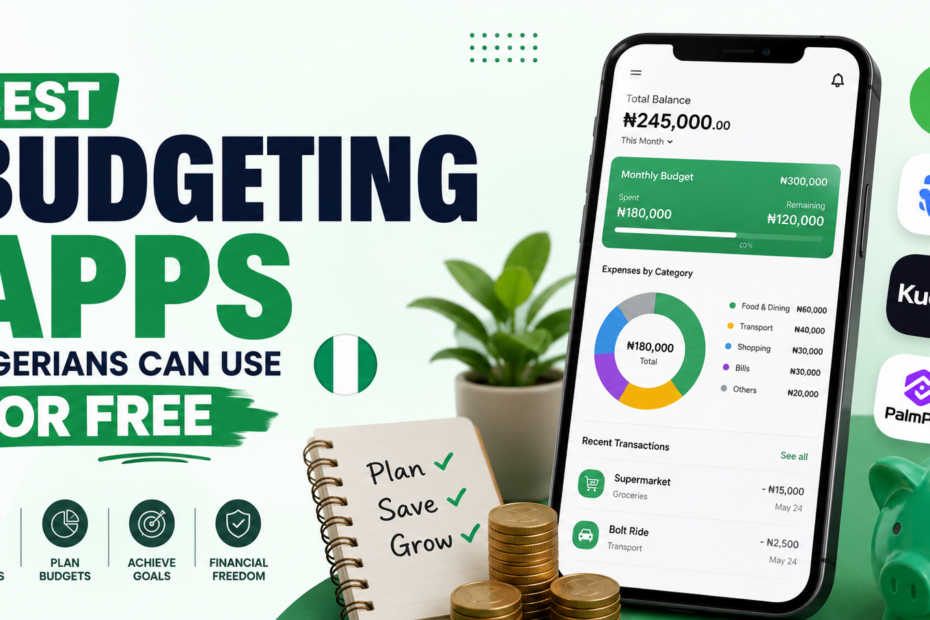
Managing money in Nigeria is becoming increasingly challenging due to rising living costs, inflation, and fluctuating income levels.
Many individuals, especially salary earners, students, and small business owners, often find it difficult to track where their money goes each month.
Without proper planning, expenses can quickly exceed income, leading to financial stress and poor saving habits. This is why budgeting has become more important than ever in today’s economy.
Fortunately, technology has made personal finance easier through budgeting apps. These apps help users track daily spending, categorize expenses, set savings goals, and monitor financial progress in real time.
Instead of relying on memory or manual calculations, users can now manage their money more efficiently using their smartphones.
In this guide, we will explore the best free budgeting apps Nigerians can use to take control of their finances and build stronger money management habits.
What Is a Budgeting App?
A budgeting app is a mobile or web application designed to help individuals manage their money by tracking income, expenses, and savings in one place.
It acts like a digital financial assistant that gives users a clear picture of how they are spending and saving their money.
Budgeting apps work by allowing users to input their income and record daily or monthly expenses. Some apps also connect to bank accounts or mobile money services to automatically track transactions.
Once data is entered, the app organizes spending into categories such as food, transport, rent, or entertainment, making it easier to see where money is going.
Most budgeting apps include useful features that simplify money management.
Expense tracking helps users monitor every purchase they make, while savings goals allow them to set targets like saving for rent, school fees, or emergencies.
Budget categories help divide income into different spending areas so users do not overspend in one area.
Spending reports give a summary of financial habits over time, showing patterns and trends. Alerts and reminders notify users when they are close to their budget limit or when bills are due.
Overall, budgeting apps make personal finance easier, more organized, and more disciplined, especially for people who want better control over their money.
Why Nigerians Should Use Budgeting Apps
Budgeting apps offer several important benefits that make them very useful for managing personal finances in Nigeria today.
One of the biggest advantages is that they help users avoid overspending. By setting clear limits for different spending categories, individuals can easily control how much they spend and reduce unnecessary purchases.
These apps also help users track daily expenses in real time. Every small or large expense is recorded, making it easier to understand where money is going each day or month. This awareness naturally leads to better financial discipline.
Another key benefit is that budgeting apps build strong saving habits. When users set savings goals within the app, they are more motivated to put aside money regularly, whether for emergencies, rent, or personal projects.
Budgeting apps are also helpful for both students and salary earners. Students can manage limited allowances, while workers can plan their salaries more effectively throughout the month.
Finally, these apps make it easier to achieve financial goals by breaking them into simple, trackable steps, helping users stay focused and consistent over time.
Features to Look for in a Free Budgeting App
When choosing a budgeting app, especially a free one, it is important to consider certain features that will make money management easier and more effective.
One of the most important features is an easy interface. The app should be simple to understand and navigate so that users can quickly record expenses without confusion.
Another key factor is free version availability. Since the focus is on free budgeting apps, the app should offer useful features without requiring payment or subscriptions for basic use.
It is also important that the app supports Nigerian users. This includes compatibility with local currency (Naira), and in some cases, integration with local banks or mobile money systems for easier tracking.
Security and privacy are also very important. A good budgeting app should protect user data with strong encryption and not expose sensitive financial information.
Expense categorization is another useful feature. It helps users group their spending into areas like food, transport, rent, and entertainment, making it easier to analyze spending habits.
Offline access can also be beneficial, especially in areas with unstable internet connections, allowing users to log expenses anytime.
Finally, bank connection (optional) is a helpful feature in some apps, as it automatically syncs transactions, saving time and improving accuracy.
Best Free Budgeting Apps Nigerians Can Use
Below are some of the best free budgeting apps that Nigerians can use to manage their money more effectively. Each app offers different features, so the best choice depends on personal needs and financial goals.
Budget by Koody
Budget by Koody is a simple budgeting app designed to help users plan and track their monthly expenses with ease.
Overview:
It focuses on helping users set monthly budgets and monitor spending habits in a straightforward way.
Key Features:
- Monthly budget planning
- Expense tracking
- Simple financial overview
- Category-based spending
Pros:
- Easy to use
- Clean interface
- Good for beginners
Cons:
- Limited advanced features
- Not widely known globally
Best For:
Beginners who want a simple budgeting tool without complexity.
Wallet
Wallet is a popular budgeting app that helps users track expenses, manage income, and plan financial goals.
Overview:
It allows users to sync bank accounts and automatically track transactions.
Key Features:
- Bank synchronization
- Expense tracking
- Financial reports
- Budget planning tools
Pros:
- Automated tracking
- Detailed reports
- Supports multiple currencies
Cons:
- Some features require premium version
- Bank sync may not support all Nigerian banks
Best For:
Users who want automation and detailed financial tracking.
Goodbudget
Goodbudget uses the envelope budgeting system, where users divide money into categories or “envelopes.”
Overview:
It helps users allocate income into spending categories before they spend.
Key Features:
- Envelope budgeting system
- Expense tracking
- Debt tracking
- Sync across devices
Pros:
- Encourages discipline
- Great for planning ahead
- Works on multiple devices
Cons:
- Manual entry required
- Free version has limitations
Best For:
People who want strict budgeting control and discipline.
Money Manager
Money Manager is a powerful expense tracking app that provides detailed financial records.
Overview:
It focuses on tracking income and expenses with strong reporting tools.
Key Features:
- Daily expense tracking
- Detailed reports and charts
- Password protection
- Budget management
Pros:
- Very detailed analysis
- Secure and reliable
- Good reporting tools
Cons:
- Interface may feel complex
- Ads in free version
Best For:
Users who want detailed financial analysis and control.
Spendee
Spendee is a modern budgeting app that helps users manage shared and personal finances.
Overview:
It offers visual budgeting tools and shared wallets for families or groups.
Key Features:
- Shared wallets
- Expense tracking
- Visual financial insights
- Budget categories
Pros:
- Attractive interface
- Good for group budgeting
- Easy to understand reports
Cons:
- Some features locked behind premium
- Limited offline use
Best For:
Families, couples, or shared financial planning.
Monefy
Monefy is a simple expense tracker that focuses on quick and easy input.
Overview:
It helps users record expenses quickly with minimal effort.
Key Features:
- One-tap expense entry
- Budget tracking
- Simple charts
- Category management
Pros:
- Very easy to use
- Fast expense logging
- Lightweight app
Cons:
- Limited advanced features
- Manual tracking only
Best For:
Users who want a fast and simple expense tracker.
YNAB (You Need A Budget)
You Need A Budget is a well-known budgeting system that focuses on giving every naira a job.
Overview:
It is designed to help users plan every aspect of their income before spending it.
Key Features:
- Zero-based budgeting
- Goal setting
- Real-time tracking
- Educational budgeting system
Pros:
- Very effective budgeting method
- Strong financial discipline tool
- Excellent learning resources
Cons:
- Mostly paid (free trial only)
- Can be complex for beginners
Best For:
Serious users who want full control of their finances.
Google Sheets (Manual Budgeting)
Google Sheets is not a traditional budgeting app but a powerful free tool for manual budgeting.
Overview:
Users create their own budget templates and track everything manually.
Key Features:
- Fully customizable budgets
- Templates available
- Cloud storage
- Works on all devices
Pros:
- Completely free
- Highly flexible
- No subscription needed
Cons:
- Requires manual input
- No automatic tracking
Best For:
Users who prefer full control and customization.
Mint Alternatives
Since Mint is no longer fully available in some regions, many users rely on alternatives like Wallet and Money Manager.
Overview:
These alternatives provide similar budgeting and expense tracking features.
Key Features:
- Expense tracking
- Budget creation
- Financial insights
Pros:
- Wide variety of options
- Many free features available
Cons:
- Not a single unified app
- Features vary across apps
Best For:
Users looking for Mint-like budgeting experience.
Summary
Each budgeting app serves a different type of user. Whether you want something simple like Monefy, structured like Goodbudget, or advanced like Wallet, there is a free option that fits your financial lifestyle.
| App | Free Version | Best For | Android/iPhone | Offline |
|---|---|---|---|---|
| Budget by Koody | Yes | Beginners simple budgeting | Android / iPhone | Limited |
| Wallet | Yes (with premium upgrade) | Automated tracking & reports | Android / iPhone | Limited |
| Goodbudget | Yes (limited envelopes) | Envelope budgeting discipline | Android / iPhone | Yes |
| Money Manager | Yes (ads included) | Detailed expense tracking | Android / iPhone | Yes |
| Spendee | Yes (basic features) | Shared/family budgeting | Android / iPhone | Limited |
| Monefy | Yes | Quick expense tracking | Android / iPhone | Yes |
| YNAB | Free trial only | Serious budgeting system | Android / iPhone | Yes |
| Google Sheets | 100% free | Custom manual budgeting | Android / iPhone (web/app) | Yes |
If you want, I can also help you create the SEO conclusion + FAQ section to complete your blog and make it rank better.
How to Start Budgeting Using These Apps
Starting a budgeting habit using these apps is simple, but consistency is what makes it effective. Follow these steps to begin managing your money more wisely.
The first step is to download the budgeting app of your choice from a trusted source like the Google Play Store or Apple App Store.
Choose an app that matches your needs, whether it is simple expense tracking or advanced financial planning.
Next, set your monthly income inside the app. This includes your salary, business profit, or any other source of income. This helps the app understand how much money you have available to spend and save each month.
After that, create spending categories. Divide your money into groups such as food, transport, rent, utilities, savings, and entertainment. This makes it easier to control where your money goes.
Then, track your expenses daily. Every time you spend money, record it immediately in the app. This helps you stay aware of your spending habits and avoid unnecessary expenses.
Finally, review your budget weekly. Checking your progress regularly helps you see if you are overspending in any category and allows you to adjust your budget before the month ends.
By following these steps consistently, you can build better financial discipline and gain full control over your money.
Common Mistakes Nigerians Make When Using Budgeting Apps
While budgeting apps are powerful tools for managing money, many users in Nigeria do not get the best results because of common mistakes they make during usage. Understanding these mistakes can help improve financial discipline and success.
One major mistake is not updating expenses regularly. Some users download the app but fail to record their daily spending, which makes the budget incomplete and inaccurate. Without consistent updates, it becomes difficult to know where money is actually going.
Another common issue is setting unrealistic budgets. Many people create very strict or overly ambitious spending limits that do not match their real lifestyle or income. This often leads to frustration and eventually abandoning the budget altogether.
Ignoring small spending is also a big problem. Expenses like transportation, snacks, or airtime may seem small, but they add up quickly over time. Failing to track them can distort the entire budget.
Some users also make the mistake of downloading too many budgeting apps at once. Instead of focusing on one app and building consistency, they switch between multiple tools, which reduces effectiveness and causes confusion.
Finally, giving up too early is a common challenge. Budgeting is a habit that takes time to develop, but many people stop using apps after just a few weeks when they do not see immediate results.
Avoiding these mistakes can help users get the full benefit of budgeting apps and improve their financial management over time.
Which Budgeting App Is Best for Different People?
Different people have different financial needs, so the best budgeting app depends on lifestyle, income type, and spending habits. Below is a simple breakdown to help you choose the right app based on your situation.
For students, simple and easy-to-use apps like Monefy or Money Manager are ideal. Students usually have limited income, so these apps help them quickly track daily expenses like transport, food, and data without complexity.
For salary earners, apps such as Wallet or Goodbudget are more suitable. These apps help users plan monthly salaries, divide money into categories, and control spending throughout the month.
Small business owners can benefit more from Google Sheets or Money Manager because they allow detailed tracking of income and business expenses, helping them monitor profit and loss more effectively.
For freelancers, flexible tools like Spendee or You Need A Budget work well. These apps help manage irregular income, track multiple clients, and plan finances based on varying cash flow.
For families, shared budgeting apps like Spendee or Wallet are very useful. They allow multiple users to track shared expenses, plan household budgets, and manage bills together in one place.
Choosing the right app based on your financial situation makes budgeting easier, more realistic, and more effective in the long run.
Are Free Budgeting Apps Safe?
Free budgeting apps are generally safe to use, but their level of security depends on the app itself and how users handle their personal information. Understanding basic safety practices can help protect your financial data while using these tools.
One important factor is data protection. Reputable budgeting apps use encryption and security systems to protect user data from unauthorized access.
However, it is always important to choose well-known apps with positive reviews and strong security policies.
Another key safety practice is password usage. Users should always set strong, unique passwords for their budgeting apps and avoid using the same password across multiple platforms.
Some apps also offer additional security features like PIN codes or biometric login, which provide extra protection.
It is also advisable to avoid sharing banking details unnecessarily. While some apps allow bank synchronization for automatic tracking, users should be careful about granting full access to sensitive financial accounts unless they fully trust the app.
Finally, downloading apps from official stores is very important. Always install budgeting apps from trusted platforms like the Google Play Store or Apple App Store to avoid fake or malicious versions that could compromise your data.
By following these safety practices, users can confidently enjoy the benefits of free budgeting apps while keeping their financial information secure.
Conclusion
In conclusion, budgeting apps have made it easier than ever for Nigerians to take control of their finances, track spending, and build strong saving habits.
Whether you are a student, salary earner, freelancer, or business owner, there is a free budgeting app that can suit your lifestyle and help you manage money more effectively.
However, the real success does not come from simply downloading an app—it comes from consistent use.
The most important step is to choose one app that fits your needs and stick with it long enough to build a habit. Avoid switching between apps or giving up too quickly when results do not appear immediately.
Remember, financial discipline is built over time through small, repeated actions. If you stay consistent, track your expenses regularly, and follow your budget, you will begin to see real improvements in your financial life.
“The best budgeting app is not necessarily the one with the most features—it is the one you consistently use to control your money and build better financial habits.”
Frequently Asked Questions
Best Free Apps to Make Money and Budget Better in Nigeria ?
Many people in Nigeria are looking for practical ways to earn extra income and manage money better. The good approach is to focus on platforms that offer real value, match your skills, and do not require risky upfront payments.
When people ask about the best free app to make money in Nigeria, there is no single app that works for everyone because income depends on consistency, skills, available time, and demand. However, several reliable options exist.
If you want freelance work, platforms like Upwork and Fiverr allow Nigerians to offer services such as writing, graphic design, virtual assistance, video editing, and social media management.
If you prefer surveys and microtasks, Toloka is another option. For content creators, TikTok and YouTube can become income sources over time. For selling products online, Jiji Nigeria is commonly used.
Can ChatGPT Make You a Budget?
Yes. ChatGPT can help create a budget.
You can tell me:
- Your monthly income
- Fixed expenses (rent, transport, subscriptions)
- Average food spending
- Savings goal
- Debt obligations
- Financial targets
Then I can create a personalized budget plan for you.
For example, if you earn ₦150,000 monthly, I can help divide it into essentials, savings, investment, and flexible spending categories based on your goals.
Top 5 Budgeting Apps ?
Some of the most popular budgeting apps include:
- YNAB (You Need A Budget) — excellent for intentional budgeting and planning.
- Goodbudget — uses a digital envelope system.
- PocketGuard — helps control spending.
- EveryDollar — simple and beginner friendly.
- Wallet by BudgetBakers — useful for expense tracking.
How to Earn ₦5,000 Per Day in Nigeria ?
Making ₦5,000 daily is achievable but usually requires active effort.
You could combine:
- Freelancing (writing, design, editing)
- Selling digital services
- Affiliate marketing
- Managing social media for small businesses
- Online tutoring
- Mini importation and resale
- Creating content
For example, earning ₦1,000 from writing, ₦2,000 from social media tasks, and ₦2,000 from sales can reach the target.
How to Make ₦1,000 Per Day ?
₦1,000 daily is often easier because it can start from simple activities.
You can:
- Offer assignment typing services
- Sell snacks or small items
- Do delivery assistance
- Complete online microtasks
- Edit short videos
- Create simple Canva designs
- Offer basic phone setup services
The important part is consistency. Small daily earnings repeated over months can become meaningful savings and create opportunities for larger income streams later.
Are Free Budgeting Apps Safe to Use?
Free budgeting apps can be safe, but safety depends more on the company behind the app than on whether the app is free or paid.
Before connecting your bank account or entering personal financial details, check whether the app uses security features such as encryption, password protection, and two-factor authentication. Read the privacy policy and understand what data they collect and whether they share information with third parties.
Also pay attention to app reviews and how long the service has existed. A budgeting app with millions of users and regular updates is generally more trustworthy than a new app with little history.
A safer approach for beginners is to start with apps that allow manual expense entry instead of connecting directly to your bank account. That way, you still get budgeting benefits while reducing risk.
No budgeting app can completely replace good security habits. Use strong passwords, avoid public Wi-Fi for financial activities, and monitor account activity regularly.
How Do I Choose the Right Budgeting App?
The best budgeting app is the one you will actually use consistently.
If your goal is controlling overspending, choose an app focused on expense tracking. If your goal is aggressive saving, choose one that emphasizes savings targets. If your income changes monthly—such as freelancing or business income—look for flexible budgeting tools.
Ask yourself:
- Do I want automatic tracking or manual entry?
- Do I need savings goals?
- Will I share the budget with family?
- Is the interface easy for me to understand?
- Does it support my country and currency?
Simple apps usually work better than feature-heavy apps that become difficult to maintain.
What Is Goodbudget?
Goodbudget is a budgeting app built around the envelope budgeting method.
Instead of physically putting cash into envelopes, you create digital categories such as food, transport, savings, rent, and entertainment. You assign portions of your income to each category and spend only from those amounts.
For example, if you budget ₦40,000 for feeding and spend ₦20,000, you can immediately see how much remains.
Goodbudget is popular because it encourages planning before spending rather than tracking after money is gone.
How to Make ₦3,000 Daily in Nigeria
Making ₦3,000 daily is often more realistic when you combine multiple income sources instead of depending on one.
You could aim for:
- Freelance writing or virtual assistance
- Graphic design using free tools
- Selling digital products
- Social media management for small businesses
- Phone accessories resale
- Mini delivery services
- Content creation
- Online tutoring
- Data entry and microtasks
For example, earning ₦1,500 from freelance work and ₦1,500 from local services can reach ₦3,000 daily.
The strongest strategy is to focus on skills that can grow income over time rather than only quick cash opportunities.
Can ChatGPT Make Me Money?
ChatGPT itself does not pay people, but it can help you create opportunities to earn money.
You can use ChatGPT to:
- Generate business ideas
- Write blog articles
- Create content calendars
- Draft emails and proposals
- Build budgets
- Learn skills faster
- Create product descriptions
- Research side hustles
- Plan freelance services
For example, if you start a blog, YouTube channel, freelancing service, or digital business, ChatGPT can support planning and productivity.
Think of ChatGPT as a tool that helps you work smarter—not as an automatic income source.
How to Turn ₦1,000 Into ₦10,000 Quickly
Turning ₦1,000 into ₦10,000 quickly is possible, but it usually requires effort, skill, selling, or providing value—not a guaranteed shortcut. Be careful of anyone promising instant multiplication of money, especially through investment schemes or “double your money” offers.
One practical way is small trading. With ₦1,000, some people buy low-cost items that solve immediate needs and resell them with a margin. Another option is service-based work where money is not the main limitation.
For example, using your phone to offer simple services such as writing, social media posting, Canva designs, editing, typing, or helping local businesses can generate more than the starting capital.
You can also combine small capital with skill. If ₦1,000 buys data and internet access that helps you get freelance work, the return can become much higher than the original amount.
The goal should not only be turning ₦1,000 into ₦10,000 once—but creating a repeatable system that keeps producing income.
Is There a Truly Free Budgeting App?
Yes, there are budgeting apps that offer useful free versions.
Goodbudget offers a free plan with basic budgeting features.
Wallet by BudgetBakers also provides a free version for expense tracking.
EveryDollar includes a free option for manual budgeting.
Some people also use simple spreadsheet tools like Google Sheets because they are flexible and completely free.
A free budgeting app is often enough for most beginners. You only need premium features if you want automation, advanced reports, or bank integrations.
How to Budget Money for Beginners
Budgeting becomes easier when you stop seeing it as restriction and start seeing it as giving each naira a purpose.
Begin by writing down your monthly income. Then separate fixed expenses such as rent, transport, electricity, and food. After that, create a savings category before allocating money to wants.
A beginner-friendly structure is:
- Essentials
- Savings
- Flexible spending
Track where your money goes for at least one month. Many people discover they spend more than expected on transport, subscriptions, snacks, or impulse purchases.
Keep your first budget simple. Complicated systems usually fail because they become difficult to maintain.
Are Budgeting Apps Good for Beginners?
Yes, budgeting apps can be very good for beginners because they reduce manual calculations and make spending easier to understand.
Most budgeting apps show categories visually and help users notice spending patterns. Instead of trying to remember every expense, you record transactions and monitor progress.
For beginners, the biggest benefit is awareness. Once you start seeing where money goes, financial decisions usually improve naturally.
However, avoid downloading many apps at once. Choose one and use it consistently for several weeks.
What Is the Cheapest Budgeting App?
The cheapest budgeting app is usually the one that offers enough features without requiring payment.
If cost is the priority, free plans from Goodbudget, EveryDollar, and Wallet by BudgetBakers are good starting points.