In Nigeria today, managing salary effectively has become more important than ever.
With the rising cost of living, increasing food prices, transport fares, and unpredictable utility bills, many people find that their income is no longer enough to comfortably cover all their needs.
For individuals with fixed salaries or irregular income, poor financial planning often leads to debt, stress, and living from paycheck to paycheck.
This is why budgeting is no longer optional but a necessary life skill. One of the simplest and most effective ways to manage money is the 50/30/20 rule.
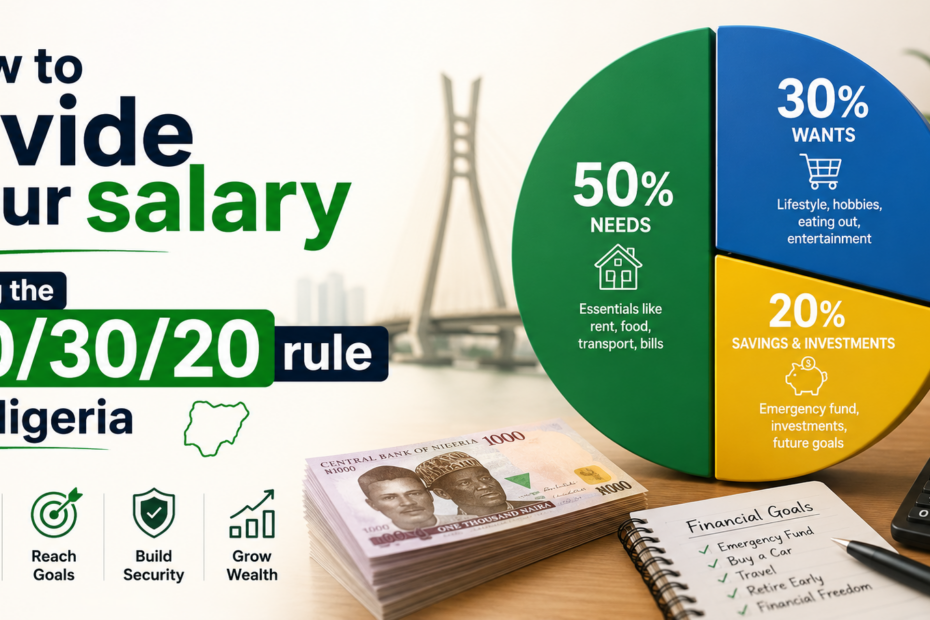
This framework helps individuals divide their income into three clear parts: 50% for needs, 30% for wants, and 20% for savings or investments.
By following this structure, anyone can gain better control over their finances, reduce unnecessary spending, and build a more stable financial future even in a challenging economy.
What is the 50/30/20 rule?
The 50/30/20 rule is a simple budgeting method that helps you manage your salary in a clear and balanced way.
It divides your income into three main parts so you always know where your money is going and avoid unnecessary financial stress.
The first part, 50% for needs, covers your essential expenses—things you cannot live without. This includes rent, feeding, transport, electricity, and other basic bills. These are the priority costs that must be taken care of first.
The second part, 30% for wants, is for things that make life enjoyable but are not essential.
This includes eating out, entertainment, buying clothes, subscriptions, or any personal lifestyle choices. It allows you to enjoy your money without overspending.
The last part, 20% for savings and investments, is what you set aside for your future. This includes emergency savings, investments, or building a small business.
This portion helps you prepare for unexpected situations and grow your financial stability over time.
In simple terms, the 50/30/20 rule helps you balance survival, enjoyment, and future security all at the same time.
50% Needs: What counts as survival expenses in Nigeria
The 50% needs category in the 50/30/20 rule refers to all the essential expenses you must cover to live and function daily. In Nigeria, these survival expenses can take a large part of your salary due to the rising cost of living.
One major need is rent or house contribution, which includes monthly rent payments or shared housing costs. For many people, this alone can consume a big portion of their income.
Another important need is feeding and groceries, such as buying rice, beans, garri, oil, vegetables, and other food items, as well as transport to the market.
Transport costs are also essential, including daily bus fares, fuel for those who drive, or ride-hailing services like Bolt or Uber. Depending on your location, transport can fluctuate and increase quickly.
Additionally, utility bills such as electricity, water, and mobile data are necessary for communication, work, and basic comfort in modern life.
In Nigeria, inflation significantly affects this category. Prices of food, fuel, and rent often increase without a corresponding rise in income.
This makes it difficult for many people to stay within the 50% limit. As a result, some individuals may need to adjust their budget while still prioritizing essential needs first.
Proper planning helps ensure that even with rising costs, basic survival expenses are still managed wisely.
30% Wants: Lifestyle and comfort spending
The 30% wants category in the 50/30/20 rule represents the portion of your salary used for lifestyle enjoyment and personal comfort.
These are not essential for survival, but they are important for maintaining balance, reducing stress, and improving your quality of life.
This category includes things like eating out, hangouts, and entertainment.
For example, going to restaurants, buying snacks, watching movies, attending events, or spending time with friends can all fall under this section. It helps you enjoy your income instead of feeling restricted all the time.
It also covers fashion, gadgets, and subscriptions. This may include buying new clothes, shoes, smartphones, accessories, or paying for services like Netflix, Spotify, or other digital platforms that support your lifestyle.
Additionally, social activities and weekend fun such as parties, outings, traveling short distances, or celebrating special occasions are part of this category. These experiences contribute to emotional well-being and help you maintain a healthy social life.
The goal of the 30% wants category is not to encourage overspending, but to promote balance, not deprivation. It allows you to enjoy your money responsibly while still staying financially disciplined.
When managed well, this category ensures that budgeting does not feel like punishment but a healthy lifestyle choice.
20% Savings and investments
The 20% savings and investments category is the most important part of the 50/30/20 rule because it focuses on your financial future and protects you from unexpected financial shocks.
While needs and wants cover your present lifestyle, this portion builds long-term stability and growth.
One of the most important elements here is your emergency fund.
In Nigeria’s unpredictable economy, emergencies like medical bills, job loss, or urgent repairs can happen at any time. Having savings set aside ensures you don’t fall into debt when these situations arise.
This category also includes savings accounts and thrift contributions (ajo/esusu). Many Nigerians use traditional savings groups to stay disciplined and build money consistently over time.
It is a reliable way to save, especially when self-control is difficult.
Another key part is investments, such as stocks, mutual funds, real estate, or starting a small business. Investing allows your money to grow instead of just sitting idle, helping you build wealth over time and fight inflation.
Finally, the 20% can also go into skill development and courses. Learning new skills—such as digital marketing, tech skills, or business training—increases your earning potential and opens doors to better opportunities.
In summary, this 20% is not just about saving money; it is about securing your future, building wealth, and improving your financial resilience in the long run.
Common mistakes Nigerians make with the 50/30/20 rule
The **50/30/20 rule is simple in theory, but many Nigerians struggle to apply it correctly due to lifestyle pressure, rising costs, and lack of financial discipline. As a result, several common mistakes often reduce its effectiveness.
One major mistake is putting “wants” inside “needs.” Many people mistakenly classify things like expensive clothing, frequent eating out, or premium subscriptions as “needs” instead of “wants.” This distorts the budget and leaves little room for real essentials and savings.
Another common issue is not keeping a record of spending. Without tracking income and expenses, it becomes easy to overspend unknowingly.
Many people rely on memory, which often leads to financial confusion and poor money control.
A third mistake is not saving consistently. Some individuals only save what is left after spending, instead of treating savings as a priority. This makes it difficult to build financial stability or achieve long-term goals.
Lastly, many people ignore emergency funds. In Nigeria’s unpredictable economy, unexpected expenses like medical emergencies, job loss, or urgent repairs can happen anytime. Without an emergency fund, people are forced into debt or financial stress.
Avoiding these mistakes is key to making the 50/30/20 rule work effectively. With discipline and proper planning, anyone can take control of their income and build a healthier financial future.
How to adjust the rule for low or irregular income
The 50/30/20 rule is a helpful guide, but in reality, many Nigerians earn low or irregular income, which makes it difficult to follow strictly. In such cases, the rule should be adjusted to fit your financial situation instead of being followed rigidly.
For example, you can modify it to 60/20/20 or 70/20/10 depending on your income level. With 60/20/20, you allocate more money to needs (60%) because basic expenses like food, rent, and transport may take a larger portion of your income.
The remaining 20% goes to wants, and another 20% is still dedicated to savings or investments.
For very tight budgets, the 70/20/10 model allows 70% for needs, 20% for savings, and 10% for wants, ensuring survival comes first while still maintaining some financial discipline.
The key idea is flexibility, not perfection. The goal is to avoid debt and still maintain some level of saving, even if the amounts are small.
Another important strategy is building side hustles to balance income gaps.
Because salaries or earnings may not always be stable, having additional income sources—such as freelancing, small trading, food business, or digital skills—can help you stay afloat.
Side hustles also increase your ability to follow budgeting rules more effectively in the long run.
In summary, the rule should adapt to your reality. What matters most is consistency, discipline, and the willingness to improve your financial situation over time.
Tools to help you budget
There are several simple but powerful tools that can help you successfully manage your salary using the 50/30/20 rule. These tools make budgeting easier, more organized, and less stressful.
One of the most common tools today is mobile banking apps. Most Nigerian banks now offer apps that allow you to track your spending, view transaction history, and sometimes even categorize expenses.
This helps you monitor where your money is going in real time and avoid unnecessary spending.
Another very effective tool is Excel or Google Sheets. With a simple spreadsheet, you can manually record your income, divide your salary into the 50/30/20 categories, and track your progress every month. It gives you a clear visual of your financial habits and helps you stay disciplined.
The envelope system (cash method) is also a traditional but powerful budgeting technique. In this method, you divide your cash into physical envelopes labeled “needs,” “wants,” and “savings.”
Once the money in an envelope is finished, you stop spending from that category. This method is especially useful for people who struggle with overspending or want a more hands-on approach to budgeting.
In conclusion, whether you prefer digital tools or cash-based methods, the key is consistency. Using the right budgeting tools helps you stay in control of your money and makes it easier to follow the 50/30/20 rule successfully.
In conclusion,
Building financial discipline is the real foundation of successful money management, not just the amount you earn.
The 50/30/20 rule is a practical guide that helps you organize your income, but its true power comes from consistency and commitment over time.
Even if your salary is small or irregular, what matters most is your ability to apply the rule regularly and make intentional decisions about your spending.
Many people think financial stability only comes when they start earning more, but the truth is that discipline plays a bigger role than income size.
Starting small with savings, controlling unnecessary spending, and gradually improving your financial habits can lead to long-term stability and growth.
The key is to begin with what you have. As your income increases, you can adjust your percentages and strengthen your savings and investments.
Over time, these small and consistent actions will build a strong financial foundation that supports your goals and protects you from financial stress.
Frequently Asked Questions
What Is the 70-10-10-10 Budget Rule?
The 70-10-10-10 budget rule is a simple money management method that helps people divide their income into four clear categories so they can cover expenses, save consistently, and build financial discipline. The idea is to give every part of your salary a purpose instead of spending without a plan.
Under this rule, 70% of your salary is used for living expenses. This includes necessities such as rent, food, transportation, electricity, internet, school costs, family responsibilities, and other daily needs. Since this portion takes the largest share, the goal is to keep your lifestyle within this limit and avoid unnecessary spending.
The first 10% is usually allocated to savings. This money is set aside for future goals such as building an emergency fund, buying important assets, education, business plans, or long-term financial security. Saving first before spending is one of the strongest habits this method encourages.
The second 10% is often used for investing or wealth building. This may include starting a small business, investing in skills, investment accounts, or creating additional income streams. The purpose is to make your money work for you instead of relying only on salary.
The final 10% is commonly reserved for giving, charity, family support, religious contributions, or personal development depending on individual priorities.
For example, if your monthly salary is ₦300,000:
- ₦210,000 → Living expenses (70%)
- ₦30,000 → Savings (10%)
- ₦30,000 → Investment (10%)
- ₦30,000 → Giving or personal goals (10%)
This rule works best for people who want a balanced approach that allows enjoyment of income while still preparing for the future.
How To Properly Divide Salary?
Properly dividing salary means assigning every naira a job before spending begins. A good salary structure should cover essentials, protect your future, and leave room for personal enjoyment without creating financial pressure.
The first step is to calculate your total monthly income after deductions. Once you know the exact amount available, list your fixed expenses. These are expenses that rarely change, such as rent, transportation, subscriptions, school fees, utilities, and loan payments.
After fixed expenses, estimate variable expenses such as food, fuel, data, entertainment, and miscellaneous purchases. Tracking these categories helps reveal where money disappears each month.
A practical structure for many people is:
- 50–70% → Needs and bills
- 10–20% → Savings
- 10–20% → Investments or future goals
- 5–10% → Enjoyment, giving, or flexible spending
The exact percentage depends on income level and personal responsibilities. Someone earning less may temporarily spend more on necessities, while someone earning more may increase savings and investments.
One useful habit is paying yourself first. Immediately after receiving salary, move savings and investment amounts before spending begins. Another effective strategy is keeping separate accounts for spending and saving to reduce temptation.
Proper salary division is not about strict rules—it is about ensuring your money supports both your present life and future goals.
What Is The 50 30 20 Salary Percentage?
The 50/30/20 rule is one of the most popular budgeting systems because it is simple and flexible. It divides income into three categories to create balance between responsibility and enjoyment.
Under this method, 50% of your salary goes to needs. These are essential expenses required for living and working. Examples include housing, feeding, transport, utilities, healthcare, and minimum debt payments.
The next 30% is allocated to wants. Wants are expenses that improve comfort but are not necessary for survival. This category may include entertainment, eating out, subscriptions, shopping, vacations, and hobbies.
The remaining 20% goes toward savings and financial goals. This can include emergency funds, investments, retirement plans, debt repayment above minimum requirements, or building assets.
Example with a ₦500,000 monthly salary:
- ₦250,000 → Needs (50%)
- ₦150,000 → Wants (30%)
- ₦100,000 → Savings and future goals (20%)
This system works well because it encourages enjoying life while maintaining financial discipline. However, if living expenses are high, adjustments may be necessary. Some people use 60/20/20 or 70/20/10 depending on their circumstances.
The most important part is consistency. A simple budget followed regularly often performs better than a perfect budget that is abandoned after one month.
What Is The 70/20/10 Rule?
The 70/20/10 rule is another budgeting approach designed to create a healthy balance between current living expenses and future financial growth.
According to this rule, 70% of income is used for spending and daily living. This covers housing, feeding, transport, family support, bills, and other lifestyle costs.
The next 20% is dedicated to saving and investing. This portion is intended to strengthen financial stability and create opportunities over time. Many people combine emergency savings and investments inside this category.
The final 10% is often reserved for debt repayment, giving, personal growth, or additional financial goals depending on personal preference.
For example, with ₦400,000 income:
- ₦280,000 → Living expenses
- ₦80,000 → Savings and investments
- ₦40,000 → Extra goals or giving
This budgeting rule is especially useful for people trying to increase savings while still managing everyday responsibilities. Compared to the 50/30/20 method, the 70/20/10 rule provides more flexibility for higher living expenses.
The key advantage is sustainability. A budget should be realistic enough that you can continue using it month after month.
What Is The 3 6 9 Rule For Money?
The 3-6-9 money rule is commonly connected to emergency savings and financial preparedness. It suggests building savings based on how many months of living expenses you can cover if income suddenly stops.
The idea is built around three levels:
- 3 months of expenses → Basic emergency protection
- 6 months of expenses → Strong financial security
- 9 months of expenses → Maximum preparedness
For example, if your monthly expenses are ₦200,000:
- 3 months = ₦600,000 emergency fund
- 6 months = ₦1,200,000 reserve
- 9 months = ₦1,800,000 reserve
People with stable jobs may target three to six months, while self-employed individuals or business owners sometimes aim for six to nine months because income can fluctuate.
This rule does not mean saving all your salary for nine months. Instead, it means gradually building a reserve account that protects you during emergencies such as job loss, unexpected medical costs, business slowdown, or urgent family needs.
The 3-6-9 rule promotes financial resilience because emergencies become easier to handle when money has already been prepared in advance.
Which Is Better, 70/20/10 Or 50/30/20?
Neither budget rule is universally better because each one is designed for different financial situations and goals. The right option depends on your income level, responsibilities, savings target, and spending habits.
The 70/20/10 budget rule gives more room for essential expenses. Under this system, 70% goes to living costs, 20% goes to savings and investments, and 10% is used for giving, debt repayment, or personal goals.
This method works especially well for people living in places where necessities consume a large portion of income or for people supporting family members.
The 50/30/20 rule creates stronger balance between needs and lifestyle spending. Fifty percent covers necessities, thirty percent covers wants, and twenty percent goes to savings and financial growth. This approach encourages enjoying income while still protecting the future.
If your salary is tight and your cost of living is high, the 70/20/10 approach may feel more realistic and easier to maintain. If your income comfortably covers expenses, the 50/30/20 system can help prevent lifestyle inflation and encourage healthier spending decisions.
For many people, the best budget is not the most popular one—it is the one they can follow consistently for months and years.
Which Is Better, 70/30 Or 80/20?
The comparison between 70/30 and 80/20 depends on what those percentages represent in your budget.
If the percentages mean spending versus saving, then 70/30 is generally stronger for building wealth because it allows you to save or invest more money over time. Saving 30% of income can accelerate emergency funds, investments, and long-term financial goals.
An 80/20 structure gives more flexibility for current lifestyle needs. It allows more spending room while still maintaining a healthy saving habit.
For example, with ₦300,000 monthly income:
Under 70/30:
- ₦210,000 for expenses
- ₦90,000 for savings or investing
Under 80/20:
- ₦240,000 for expenses
- ₦60,000 for savings
The difference may seem small monthly but becomes significant over several years.
Choose 70/30 if:
- You want faster savings growth
- You are reducing debt
- You are building investments
Choose 80/20 if:
- Your current expenses are high
- You are starting budgeting for the first time
- You need a more flexible lifestyle
Is 70/30 Better Than 60/40?
A 60/40 budget can be more aggressive and financially powerful than 70/30 because it pushes a larger portion of income toward savings and investing.
With 60/40, only 60% goes toward living expenses while 40% is directed toward financial growth. This method can significantly increase wealth accumulation if maintained over time.
However, “better” should not mean more extreme.
A 60/40 budget only works well if:
- Your income comfortably covers necessities
- You already control unnecessary spending
- You do not constantly withdraw from savings
A 70/30 budget is often more practical for many households because it creates less pressure and is easier to maintain consistently.
Think of budgeting like exercise. The strongest plan is not the hardest plan—it is the one you can continue without quitting.
What Is The 777 Rule In Finance?
The 777 rule in finance does not have one universal definition because different financial educators and communities use it differently. However, one of the most common interpretations connects it to balanced money allocation.
A popular version suggests dividing income into three broad priorities:
- Save or invest regularly
- Control spending carefully
- Build multiple future opportunities
Another version describes reaching financial growth through repeating disciplined habits consistently over time rather than relying on one big financial breakthrough.
Some people also use the 777 rule as a motivational savings challenge where money is intentionally separated into daily, weekly, and future wealth goals.
Unlike budgeting systems such as 50/30/20 or 70/20/10, the 777 rule is not an officially standardized financial framework. Because of that, anyone using it should first define exactly what the percentages or targets represent.
The important lesson behind most versions of the 777 rule is intentional money management and consistency.
What Is The 333 Rule For Money?
The 333 rule for money is another flexible budgeting concept rather than a formal financial standard. One common interpretation is dividing money into three equal priorities.
Under this approach:
- One-third for present living expenses
- One-third for savings and investments
- One-third for future opportunities or personal goals
The rule encourages balance by preventing all income from being consumed by immediate spending.
Another version of the 333 rule is used for spending decisions. Before making purchases, people ask themselves three questions:
- Do I need it?
- Will I still value it in three weeks?
- Will it improve my life in three months?
This method is intended to reduce impulse spending and encourage thoughtful financial choices.
Although the 333 rule can improve discipline, it may not fit everyone equally because equal allocation is difficult for people with high living expenses.
The strongest financial rule is usually the one that helps you spend responsibly, save consistently, and still live comfortably within your income.
What Is The Rule Of 72 In Money?
The Rule of 72 is a simple financial formula used to estimate how long it will take for money to double through investment growth. Instead of doing complicated calculations, this rule gives a quick estimate by dividing 72 by the annual rate of return.
The formula is:
Years to double = 72 ÷ annual interest rate
For example, if you invest money and earn an average return of 8% per year:
72 ÷ 8 = 9 years
That means your money would approximately double in about nine years.
If the return is 12%:
72 ÷ 12 = 6 years
So your investment may double in around six years.
The Rule of 72 is popular because it helps people understand the power of long-term investing and compound growth. It also works in reverse. If inflation averages 6% annually, dividing 72 by 6 shows purchasing power could roughly halve in about 12 years.
The rule is an estimate, not a guarantee. Actual results depend on market performance, fees, taxes, and whether returns remain consistent. Still, it remains one of the easiest ways to understand why starting early matters in personal finance.
What Is The 80 20 Rule In Investing?
The 80/20 rule in investing can mean different things depending on context, but the most common interpretation is that approximately 80% of investment results often come from 20% of decisions or assets. This idea comes from the Pareto Principle.
In practical investing, this may mean:
- A small number of investments generate most of your returns.
- A few financial habits create most of your wealth.
- Most investment success comes from consistency rather than constant trading.
Another common use of the 80/20 investing rule refers to portfolio allocation.
In that version:
- 80% of assets go into growth investments such as stocks.
- 20% stay in safer assets such as bonds or cash equivalents.
This structure is often considered more growth-oriented and may suit people with longer investment timelines.
The broader lesson behind the 80/20 principle is that investors should focus more on high-impact actions such as regular investing, controlling costs, staying invested, and avoiding emotional decisions rather than trying to perfect every financial move.
Is 60/40 Good For Retirement?
A 60/40 retirement portfolio has traditionally been one of the most well-known retirement investment approaches.
The idea is simple:
- 60% invested in growth assets, commonly stocks
- 40% invested in lower-volatility assets, commonly bonds or fixed-income investments
The purpose is balance. Stocks provide long-term growth potential while bonds aim to reduce portfolio swings and provide stability.
Whether 60/40 is good for retirement depends on factors such as age, income needs, risk tolerance, and retirement timeline.
For someone close to retirement, a 60/40 mix may reduce overall investment volatility compared with heavier stock exposure.
For someone decades away from retirement, a higher growth allocation may sometimes be considered because there is more time to recover from market declines.
A retirement portfolio should support three major goals:
- Growth to outpace inflation
- Stability during market changes
- Access to funds when needed
Because retirement situations vary widely, many people adjust allocations over time instead of using one fixed percentage forever.
Is It 80/20 Or 70/30?
There is no single correct answer because both ratios serve different purposes.
If you are talking about budgeting:
- 80/20 gives 80% for expenses and 20% for saving.
- 70/30 gives 70% for expenses and 30% for saving.
If your priority is building savings faster, 70/30 is usually stronger because more money goes toward future goals.
If your priority is maintaining flexibility while still developing financial discipline, 80/20 may feel easier to sustain.
Example using ₦400,000 monthly income:
Under 80/20:
- ₦320,000 expenses
- ₦80,000 savings
Under 70/30:
- ₦280,000 expenses
- ₦120,000 savings
Neither ratio wins automatically. The better one is the ratio that fits your income and can be maintained consistently without creating financial stress.
What Are The 3 M’s Of Money?
The 3 M’s of money are commonly described as:
Making Money, Managing Money, and Multiplying Money.
Making money means generating income. This can come from salary, business, freelancing, side income, or other sources. Earning is the starting point of financial growth.
Managing money means controlling what comes in and what goes out. This includes budgeting, reducing unnecessary spending, avoiding harmful debt, and building savings habits.
Multiplying money means growing wealth over time. This stage involves investing, building assets, increasing income streams, and allowing compound growth to work.
Many people focus heavily on making money but overlook managing and multiplying it. A person can earn a high income and still struggle financially if spending remains uncontrolled.
Financial progress often becomes stronger when all three M’s work together: earn wisely, manage intentionally, and grow consistently.
What Is The Golden Rule Of Money?
The golden rule of money is often stated as: Pay yourself first.
This principle means that before spending on bills, entertainment, shopping, or unnecessary expenses, you first set aside a portion of your income for savings, investing, or future financial goals.
Most people save what is left after spending. The golden rule reverses that process by treating saving as a priority instead of an afterthought.
For example, if you earn ₦300,000 monthly and decide to save 20%, you move ₦60,000 into savings or investments immediately after receiving income. Then you manage your remaining ₦240,000 for expenses.
This rule matters because wealth is usually built through repeated financial habits rather than occasional large amounts of money.
The golden rule also extends beyond saving. It encourages living below your means, avoiding unnecessary debt, and making money decisions based on long-term value rather than short-term satisfaction.
People who consistently apply this rule often create stronger financial stability because their future receives attention every month, not only when extra money appears.
Money management becomes easier when saving happens automatically instead of depending on discipline alone.
What Creates 90% Of Millionaires?
A popular statement often repeated in personal finance says that real estate creates many millionaires. However, becoming a millionaire is rarely caused by one factor alone.
In reality, wealth creation commonly comes from a combination of several behaviors:
- Consistent investing over time
- Long-term ownership of appreciating assets
- Business ownership or entrepreneurship
- Controlled spending habits
- Compound growth
- Multiple income streams
Real estate is frequently mentioned because property can generate rental income, appreciate over time, and allow leverage through financing. However, many millionaires also build wealth through investing, professional careers, businesses, and disciplined saving.
One pattern appears repeatedly among financially successful people: they focus less on appearing wealthy and more on acquiring assets.
Assets are things that may generate income or grow in value over time.
Becoming wealthy is usually not about finding one secret opportunity. It is often the result of earning consistently, saving intentionally, investing patiently, and allowing time to multiply results.
What Are The 3 C’s Of Finance?
The 3 C’s of finance are commonly described as Cash Flow, Capital, and Credit.
Cash flow refers to the movement of money in and out of your life or business. Positive cash flow means more money enters than leaves.
Capital refers to money or assets available to create future value. Capital may be savings, investments, equipment, business funds, or financial resources.
Credit refers to the ability to borrow responsibly and access financial opportunities when needed. Healthy credit management can support growth, while poor credit habits can create long-term limitations.
These three areas work together.
Good cash flow creates capital.
Capital reduces dependence on debt.
Responsible credit expands opportunities.
Many financial problems occur not because income is low but because one of these areas becomes weak.
Understanding and improving all three creates a stronger financial foundation.
What Are The 6 Laws Of Wealth?
The 6 laws of wealth are not officially standardized, but a widely accepted version of wealth principles includes the following ideas.
Earn more than you spend. Building wealth begins with creating a gap between income and expenses.
Save consistently. Small amounts saved regularly often outperform irregular large deposits.
Invest to grow money. Savings protect money while investing aims to expand it.
Protect wealth. Insurance, emergency funds, and risk management reduce financial setbacks.
Create multiple income sources. Depending entirely on one income stream increases vulnerability.
Allow time and discipline to work. Wealth generally compounds gradually rather than appearing suddenly.
These laws emphasize that financial growth is usually built through systems, habits, patience, and repeated good decisions.
Money becomes more powerful when it is managed intentionally instead of emotionally.