Skip to content
Home » How to turn ₦10,000 into profit in Nigeria (realistic guide)

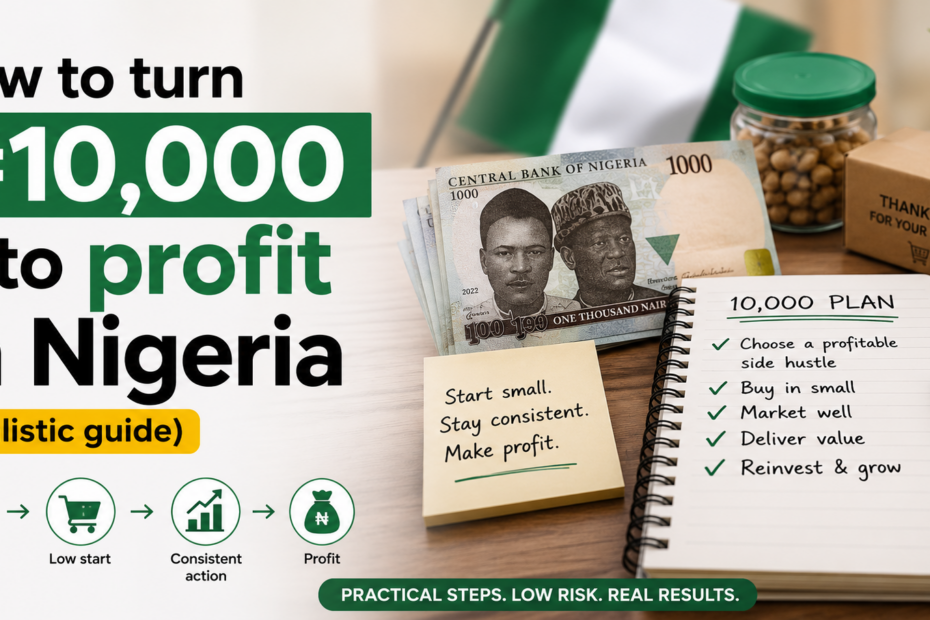
How to turn ₦10,000 into profit in Nigeria (realistic guide)

    ₦10,000 often feels like an amount that is too small to do anything meaningful with, especially in a tough economy like Nigeria’s. Many people assume that real business or investment requires large capital, but that mindset is what keeps most people stuck.

    The truth is, ₦10,000 will not make you rich overnight, and it is not meant to. However, it can absolutely be the beginning of something bigger if used correctly.

    What matters most is not the size of the money, but how you use it. When you combine the right small-scale opportunity with consistency and basic skill, that ₦10,000 can start generating steady cash flow. Over time, that small profit can be reinvested and grown.

    ₦10,000 is not a limitation—it is a launchpad.

    Mindset Shift

    Before you even think about how to turn ₦10,000 into profit, the first thing that must change is your mindset. The biggest mistake most beginners make is expecting “big money” immediately from small capital. That expectation usually leads to disappointment or falling for scams that promise to double money quickly.

    The smarter approach is to think in stages: reinvest → grow → scale. Your first ₦10,000 is not the final result; it is the starting cycle. You buy something small, sell it for a profit, then reinvest both your capital and profit back into the next round. That is how real businesses grow.

    Avoid anything that looks like “quick doubling” schemes—they almost always end in loss. Instead, focus on real value creation.

    The key principle is simple: profit comes from buying low, selling value, and solving real problems people already have.

    Best Small Business Ideas with ₦10,000 in Nigeria

    A. Food Resale Business

    This is one of the fastest ways to start making daily cash flow with low capital because food is a basic necessity—people buy it every day.

    With ₦10,000, you can start small by focusing on fast-moving items like Indomie, eggs, bread, sachet water, and sachet drinks. The strategy is simple: buy in bulk at a cheaper price from local markets or wholesalers, then resell in smaller units at a profit.

    For example, instead of selling a full crate of eggs, you can break it down and sell per piece. The same applies to bread and drinks—buy at wholesale price and sell retail.

    Your main target customers are students, office workers, and neighbors who need quick and affordable meals or snacks. If you position yourself in a busy area like a student hostel or residential street, you can make daily sales consistently.

    The key advantage of this business is fast turnover—money comes back quickly, allowing you to reinvest and restock frequently.

    B. Phone Accessories Reselling

    Phone accessories are always in demand because almost everyone owns a mobile phone. With ₦10,000, you don’t need to stock many items at once. Start small with just 2–3 fast-moving products like earpods, chargers, and screen guards.

    The strategy here is simple: buy cheap from wholesale markets (like computer villages or online suppliers) and resell at a higher price. Your profit may look small per item, but it adds up quickly with volume.

    To sell faster, focus on places where people frequently need these items—offices, campuses, bus stops, and social media platforms like WhatsApp and Instagram. Consistency and trust matter more than location at the beginning.

    C. Mini Importation / Online Reselling

    This involves buying cheap products in bulk from wholesalers or foreign suppliers (often through agents) and reselling them locally at a higher price.

    With ₦10,000, you may start with very low-cost items like gadgets, fashion accessories, or small household items. The goal is to test what sells fast before scaling.

    You can market your products using WhatsApp status, Instagram pages, and Jiji listings. Good product photos and clear pricing can make a big difference in sales.

    This model works best when you focus on trending, low-cost items people already want.

    D. POS / Airtime + Data Reselling (Micro-Level)

    This is one of the most practical low-capital businesses in Nigeria today. With ₦10,000, you may not own a full POS machine yet, but you can start as an agent under an existing POS operator or fintech partner.

    Your role is to help people withdraw cash, buy airtime, or purchase data bundles, and you earn a small commission on every transaction.

    It works best in busy areas like student environments, markets, and residential communities where people need quick cash access and mobile services.

    The key to growing here is high traffic and trust, because the more transactions you handle, the more daily income you generate.

    E. Recharge Card Printing / Data Vending

    This is a simple but effective small business that still works in many parts of Nigeria. With low capital, you can start selling recharge pins and mobile data bundles either manually or through small digital platforms.

    You don’t need a physical shop at the beginning—you can operate from home and sell via WhatsApp, street customers, or small retail shops around you.

    It works especially well in busy residential areas, campuses, and neighborhoods where people frequently need quick airtime and data without going to big shops.

    The advantage is flexibility and low risk, but success depends on speed, availability, and customer trust.

    Digital Ways to Turn ₦10,000 into Profit

    A. Learn a Skill + Offer Services

    One of the smartest ways to grow ₦10,000 is to invest it into a digital skill that can generate long-term income. Instead of spending everything on physical goods, you use part of it to learn and position yourself for service-based earnings.

    Skills like copywriting, graphics design (using Canva), and social media management are highly in demand in Nigeria because businesses constantly need content and online visibility.

    Your ₦10,000 can be used strategically for:

    • Buying affordable data to learn online consistently
    • Enrolling in a short mini-course or YouTube-based training
    • Creating a basic brand identity (simple logo, WhatsApp business setup, or small ads to reach first clients)

    Once you learn even the basics, you can start offering services to small businesses, vendors, and startups. The key advantage here is that your skill becomes the real asset, not the ₦10,000.

    B. Affiliate Marketing

    Affiliate marketing is a digital system where you promote other people’s products and earn a commission when someone buys through your link.

    With ₦10,000, you don’t need to buy products. Instead, you focus on promotion and traffic generation using platforms like WhatsApp, Instagram, Facebook, or TikTok.

    Your money can be used for:

    • Data to stay consistently online and active
    • Boosting posts or running small targeted ads
    • Creating simple content (designs, short videos, or promotional posts)

    The main idea is simple: you sell without owning inventory. You just connect buyers to products and earn per sale.

    This model works best when you focus on trust, consistency, and choosing products people already want (like gadgets, skincare, fashion, or digital services).

    How to Multiply the ₦10,000 (Step-by-Step Strategy)

    Turning ₦10,000 into real profit is not about doing many things at once—it is about doing one thing properly and consistently until it grows. Most people fail because they jump from one idea to another too quickly without giving any business time to work.

    Step 1: Start with ONE Idea Only

    Pick just one business model from earlier sections—food resale, phone accessories, POS agent work, or a digital skill. Focus only on that one.
    The goal is to avoid confusion and master the flow of buying, selling, and making small profit consistently.

    Step 2: Reinvest 50–70% of Profit

    When you start making profit, don’t spend everything. A strong rule is to reinvest at least 50% to 70% back into the business.
    This helps you restock more products, increase service capacity, or improve marketing. The faster you reinvest, the faster your business grows.

    Step 3: Don’t Withdraw Everything

    One of the biggest mistakes is treating every small profit like salary. If you withdraw everything, your business will stay small.
    Instead, allow the business to “breathe” by keeping enough capital inside it to keep moving forward. Think long-term, not daily spending.

    Step 4: Track Every Income and Expense

    Even with small capital, tracking matters. Write down or use your phone to record:

    • What you bought
    • What you sold
    • Your profit
    • Any expenses

    This helps you understand what is actually working and prevents silent losses.

    Step 5: Scale After 2–4 Weeks

    After consistently running your chosen idea for 2–4 weeks, review your results. If you are making steady profit, reinvest more and expand gradually.
    Scaling could mean buying more stock, increasing your service reach, or boosting your online visibility.

    See also  Simple weekly savings plan for low-income earners in Nigeria

    The key principle is simple: small consistent growth beats random big attempts.

    Common Mistakes People Make

    Many people don’t fail because the idea is bad—they fail because of how they approach it. With a small capital like ₦10,000, discipline and patience matter more than the business itself.

    1. Trying Too Many Businesses at Once

    One of the fastest ways to lose money is jumping between multiple ideas. Today it’s food resale, tomorrow it’s phone accessories, next week it’s affiliate marketing.

    This creates confusion, scattered focus, and zero real progress. Small capital needs focus, not variety. One clear idea executed properly will always outperform five half-started ones.

    2. Expecting Overnight Profit

    Many beginners expect immediate success after a few days. When they don’t see fast results, they quit or switch ideas.

    In reality, small businesses grow gradually. The first few days or weeks are about learning the market, understanding customers, and building consistency—not getting rich quickly.

    3. Spending Profit Instead of Reinvesting

    Another major mistake is treating every small profit as personal income. Once ₦500 or ₦1,000 comes in, it is quickly spent.
    This breaks the growth cycle. Without reinvestment, the business never scales. Profit should first build the business before it builds lifestyle.

    4. Copying Without Understanding Demand

    Copying what others are doing without understanding your own market is risky. Just because a business works for someone else doesn’t mean it will work for you.
    Location, customers, pricing, and timing all matter. Always ask: “Who is my customer and what problem am I solving?”

    Successful business with small capital is not about luck—it is about focus, patience, reinvestment, and understanding real demand.

    Realistic Profit Expectation

    It is important to be honest here so expectations stay realistic. ₦10,000 is a starting capital, not a shortcut to wealth. If you apply the right strategy, choose a good business model, and stay consistent, it can grow—but not instantly or magically.

    In a short business cycle, ₦10,000 can realistically grow into about ₦15,000 to ₦30,000, depending on the type of business, demand in your area, and how disciplined you are with reinvestment. Some people may grow faster, while others may grow slower—it is not the same for everyone.

    What truly determines your result is not just the idea itself, but consistency, location, customer demand, and how well you manage your profit. If you reinvest properly and avoid wasteful spending, your capital keeps multiplying gradually over time.

    The key takeaway is simple: small money can grow, but only when you treat it like a system, not a one-time hustle.

    Conclusion

    At the end of the day, the most important step is not finding the perfect business—it is starting with what you already have. Many people wait for bigger capital, better timing, or ideal conditions, but those moments rarely come. Progress begins when you take action, even with something as small as ₦10,000.

    Starting small is always better than waiting endlessly. Small capital teaches you discipline, customer behavior, reinvestment habits, and how real profit is built step by step. These lessons are more valuable than the money itself.

    If you stay consistent, focus on one idea, and reinvest wisely, that small beginning can grow into something meaningful over time. The goal is not just quick profit, but long-term financial understanding and growth.

    “Your first ₦10,000 is not about money—it’s about learning how money works.”

    Frequently Asked Questions

    How to make 1k per day?

    Making ₦1,000 per day in Nigeria is realistic if you focus on small, fast-moving income activities that solve daily needs. The key is not looking for a “big business,” but instead combining consistency with simple services or products that people already buy every day.

    One of the easiest ways is reselling small items. You can buy things like snacks, bottled water, sweets, airtime, or data subscriptions in bulk and resell them in your area or school.

    Even if you make ₦100–₦300 profit per sale, completing a few transactions daily can easily reach ₦1,000. Another strong option is food-related hustle, such as selling bread, eggs, or homemade drinks in busy locations like bus stops or schools.

    You can also make ₦1,000 per day through digital or service-based work. For example, simple tasks like typing documents, helping people design flyers on Canva, managing WhatsApp business pages, or writing short content for small businesses can generate daily income. Many people overlook these micro-services, but they are in high demand.

    Another method is delivery or errand services if you are in a busy environment. Running small errands for shop owners or individuals can bring multiple small payments that add up quickly.

    The most important factor is location and consistency. If you stay in a low-traffic area, it will be harder to reach ₦1,000 daily. But if you place yourself where people constantly spend money—schools, markets, or busy streets—you increase your chances significantly.

    In summary, ₦1,000 per day is not about luck; it is about choosing simple, repeatable activities and doing them consistently. Small profits multiplied many times daily is the real strategy.

    Where can I invest my money and get monthly income?

    If your goal is to earn monthly income from investments in Nigeria, you need to focus on options that provide regular returns, low risk, or semi-passive income. The most important rule is to avoid “get rich quick” schemes and instead choose stable and proven investment channels.

    One of the safest options is money market funds offered by reputable asset management companies. These funds invest in low-risk instruments like treasury bills and commercial papers, and they usually pay interest monthly or quarterly. They are suitable for beginners who want steady returns without stress.

    Another option is fixed deposits or high-yield savings accounts offered by banks and fintech apps. While the returns may not be very high, they are stable and predictable. Some fintech platforms in Nigeria offer daily or monthly interest payouts depending on your plan.

    You can also consider real estate investment groups or cooperatives. Some cooperatives pool funds to invest in land, rental properties, or housing projects, and they share profits monthly or quarterly. However, you must carefully verify the legitimacy before investing.

    For higher returns, there is small-scale agriculture investment, such as poultry or fish farming partnerships. Some people invest capital while farmers handle operations, and profits are shared monthly after sales cycles.

    Finally, dividend-paying stocks can provide periodic income when companies share profits with shareholders, although this is less predictable monthly.

    The best strategy is diversification—don’t put all your money in one place. Combine a safe option like money market funds with a small portion in higher-risk investments. This balance helps you earn steady monthly income while protecting your capital.

    What business can I do with 10k in Nigeria?

    Starting a business with ₦10,000 in Nigeria is very possible if you focus on low-capital, fast-turnover businesses. The goal is not luxury or big infrastructure, but simple daily sales that bring quick returns.

    One of the most effective businesses is food and snack reselling. You can buy items like sachet water, bread, biscuits, egg rolls, or small drinks and resell them in busy areas like schools, bus stops, or construction sites. These items move fast and require little starting knowledge.

    Another strong option is airtime and data reselling. With ₦10,000, you can fund a small digital business where you sell airtime and data subscriptions through WhatsApp or mobile apps. Even small profits per transaction add up daily.

    You can also consider thrift (okrika) sales. Use your ₦10,000 to buy second-hand clothes in bulk and resell them individually at a higher price. Clothing is always in demand, especially if you pick clean and trendy items.

    Another idea is small cosmetics or beauty products, such as lip balm, body cream sachets, or hair accessories. These items are cheap to buy and easy to sell among young people and women.

    If you are skilled, you can invest in a service-based business, like phone charging services, typing jobs, or helping small shops manage social media pages.

    The most important thing is not the amount of money, but how fast you rotate it. With ₦10,000, your focus should be daily profit cycles. Reinvesting your profit is how small capital grows into a stable business over time.

    What are 7 sources of income?

    Having multiple sources of income is one of the smartest financial strategies because it reduces dependence on a single job or business. Here are seven common and practical income sources anyone can build over time.

    1. Active income (salary or wages): This is money earned from working a job or providing services. It is the most common but also the most limited because income stops when you stop working.
    2. Business income: This comes from owning a business, such as selling goods, running a shop, or offering services. Unlike salary, business income can scale if managed properly.
    3. Freelancing income: This includes earning money from skills like writing, graphic design, programming, or social media management. It is flexible and can be done online or offline.
    4. Investment income: Money earned from investments such as stocks, mutual funds, or treasury bills. This income is usually passive and grows over time.
    5. Rental income: Income from renting out property, land, or equipment. It provides steady cash flow, especially in urban areas.
    6. Dividend income: Some companies share profits with shareholders. If you own shares, you receive regular payouts depending on company performance.
    7. Side hustles or gig income: This includes small jobs like delivery services, tutoring, or selling small products online or offline.
    See also  How to Receive Money from Abroad in Nigeria

    The key to financial stability is not relying on one source. Even starting with one or two sources, you can gradually build up to multiple streams. Over time, this reduces financial stress and increases long-term security.

    Can ChatGPT make me money?

    Yes, ChatGPT can help you make money, but it is important to understand something clearly—it is not the AI itself that makes money, but how you use it. ChatGPT is a tool that can speed up work, improve productivity, and help you deliver services faster, which can then be converted into income.

    One way people make money using ChatGPT is through content creation. You can use it to write blog posts, YouTube scripts, social media captions, or marketing content for businesses. Many small businesses are willing to pay for content but do not have time to create it themselves.

    Another way is freelancing services. You can offer services like article writing, copywriting, resume creation, or business proposals using ChatGPT to help you work faster. Platforms like Fiverr or Upwork allow you to sell these services globally.

    You can also use ChatGPT for digital product creation, such as eBooks, online guides, or business templates. Once created, these products can be sold repeatedly without extra work, making them a source of passive income.

    In addition, ChatGPT can support business ideas by helping you plan, research, and market your products. For example, if you start a small business, it can help you write ads, business names, and marketing strategies.

    However, success depends on skill, creativity, and consistency. Many people have access to AI tools, but only those who apply them properly actually earn money.

    In conclusion, ChatGPT is not a money machine, but it is a powerful assistant. If you combine it with real skills and action, it can significantly increase your earning potential.

    Which investment is best in Nigeria?

    The “best” investment in Nigeria depends on your goal, risk tolerance, and how long you are willing to leave your money. There is no single investment that fits everyone, but there are a few options that consistently perform well for most people.

    For beginners and low-risk investors, money market funds are often considered one of the best starting points. These funds are managed by licensed asset management companies and invest in safe instruments like treasury bills and commercial papers.

    They are popular because they provide steady returns with relatively low risk compared to other investments. You can also withdraw your money fairly easily, which makes them flexible.

    Another strong option is government securities like Treasury Bills and Federal Government Bonds. These are backed by the government, making them more stable than many private investment options. They usually offer fixed returns over a set period, making them predictable.

    For people willing to take moderate risk, real estate investment is highly attractive in Nigeria. Buying land in developing areas or joining real estate cooperatives can generate long-term profit. Property value tends to increase over time, especially in fast-growing cities like Lagos, Abuja, and Port Harcourt.

    There is also agriculture investment, such as poultry, fish farming, or crop production. These can generate good returns if properly managed or if you invest in trusted farming partnerships.

    In conclusion, the best investment in Nigeria is usually a combination of low-risk financial instruments (like money market funds) and long-term assets (like real estate or agriculture). Diversifying your investments helps protect your money while still allowing it to grow steadily over time.

    How to invest money to get monthly income for beginners?

    For beginners in Nigeria, investing for monthly income should focus on safety, consistency, and simplicity. The goal is to avoid complex or high-risk investments at the start and instead build a stable income foundation.

    One of the easiest entry points is money market funds. These are managed by professional financial institutions and are designed to generate steady interest. Many of them pay returns monthly or quarterly, depending on the provider. You simply deposit your money, and the fund manager invests it on your behalf.

    Another option is fixed income savings plans offered by fintech apps and banks. Some platforms allow you to lock your money for a specific period while receiving monthly interest payouts. Although the returns may not be very high, they are stable and beginner-friendly.

    Beginners can also explore cooperative societies. Many cooperatives pool money from members and invest in businesses or loans, then distribute profits monthly. However, it is very important to join only trusted and registered cooperatives to avoid fraud.

    If you want a more active approach, you can invest in small-scale businesses that generate daily cash flow, such as food vending or retail trading. The profit can then be collected and treated as monthly income.

    The key principle for beginners is “start small and stay consistent.” Instead of chasing high returns, focus on protecting your capital and building financial discipline. Over time, you can reinvest profits into larger opportunities.

    In summary, the safest beginner path is a combination of money market funds, fixed savings plans, and simple cash-flow businesses. This approach allows you to earn monthly income while gradually learning how investment works.

    Which investment is 100% safe?

    The honest answer is that no investment is 100% safe. Every form of investment carries at least a small level of risk, whether it is inflation risk, market risk, or institutional risk. However, some investments are considered extremely low-risk and are generally regarded as “safe” compared to others.

    In Nigeria, government-backed securities such as Treasury Bills and Federal Government Bonds are among the safest options. They are supported by the government, which makes default risk very low. Investors receive fixed interest over a specific period, making returns predictable.

    Another relatively safe option is money market funds managed by licensed asset management companies. These funds invest in highly secure financial instruments like short-term government and corporate debt. While they are not risk-free, they are designed to preserve capital while providing modest returns.

    Bank savings accounts are also considered safe because deposits are often insured up to a certain amount by regulatory bodies. However, the downside is that interest rates are usually very low and may not keep up with inflation.

    It is important to understand that “safe” does not always mean “profitable.” The safest investments typically provide lower returns because they prioritize capital protection over high growth.

    Many people lose money not because investments are unsafe, but because they fall for scams or unregulated schemes promising unrealistic profits. Avoiding such platforms is more important than trying to find a “perfectly safe” investment.

    In conclusion, while no investment is 100% safe, government securities, money market funds, and insured savings accounts are the closest options available. The best strategy is to prioritize safety first, then gradually explore higher-return opportunities as your knowledge grows.

    What sells very fast in Nigeria?

    In Nigeria, products that sell fast are usually everyday needs or low-cost items that people consume frequently. Fast-selling goods are often affordable, accessible, and in constant demand regardless of economic conditions.

    One of the fastest-selling categories is food items. Products like bread, eggs, sachet water, noodles, rice, and cooked street food move quickly because people need to eat daily. Food businesses tend to have consistent turnover when located in busy areas like schools, markets, or bus stops.

    Another high-demand category is mobile accessories and data-related services. Items such as phone chargers, earphones, power banks, and airtime/data subscriptions sell quickly because almost everyone uses a mobile phone.

    Cosmetics and personal care products also move fast. Items like body creams, soaps, hair products, and perfumes are in constant demand, especially among young people and women.

    Additionally, fashion items like thrift clothing (okrika) sell very quickly because they are affordable alternatives to new clothes. Many Nigerians prefer quality second-hand clothes due to lower prices.

    See also  How to Invest 50k in Nigeria

    Small household items such as buckets, cooking utensils, and cleaning supplies also sell fast because they are essential in every home.

    The key factor behind fast sales is necessity. If people need it daily or weekly, it will likely sell quickly. Location also matters greatly—busy areas increase turnover significantly.

    In summary, food, mobile accessories, cosmetics, thrift clothing, and household essentials are among the fastest-selling products in Nigeria because they meet everyday needs.

    What small business can you start with 10k?

    Starting a small business with ₦10,000 in Nigeria requires focusing on simplicity, fast turnover, and low risk. The goal is to choose businesses that do not require rent, expensive equipment, or large stock.

    One of the best options is food and snack resale. With ₦10,000, you can buy items like bread, sachet water, eggs, biscuits, or small drinks and resell them in busy areas. These items are always in demand, and profit comes quickly.

    Another good business is airtime and data reselling. You can use your capital to fund a mobile-based business where you sell recharge cards or data bundles through WhatsApp or physical customers. This business has very low startup cost and daily turnover potential.

    You can also start a thrift clothing business (okrika). With ₦10,000, you can buy a small bale or select pieces of used clothing and resell them individually. This business can grow quickly if you pick quality items.

    Another idea is small cosmetics sales, such as lip gloss, body creams, soaps, and hair accessories. These products are cheap to buy and easy to sell among students and women.

    If you prefer services, you can start a basic service business, such as helping people with typing, printing coordination, or phone charging services in your area.

    The key to success with ₦10,000 is not the amount but how fast you rotate your money. Reinvesting profit daily or weekly helps the business grow over time.

    In conclusion, with ₦10,000, focus on fast-moving products and simple services. Consistency and smart location choice matter more than capital size.

    Which business brings money faster in Nigeria?

    Businesses that bring money faster in Nigeria are usually those that involve daily demand, quick turnover, and low entry barriers. In simple terms, the faster a product or service is needed by people, the faster you can make money from it. However, “fast money” still depends on your location, consistency, and how well you manage customers.

    One of the fastest cash-flow businesses is food sales. This includes selling cooked meals, snacks, bread, eggs, or even small roadside food items. People eat every day, so demand is constant. If you position yourself near schools, bus stops, markets, or busy streets, you can make sales within hours of starting.

    Another fast-moving business is airtime and data reselling. Almost everyone in Nigeria uses a phone, so data and recharge cards sell daily. The profit per transaction is small, but the speed and frequency of sales make it reliable for daily income.

    Thrift clothing (okrika) sales is also another fast business. Many Nigerians prefer affordable second-hand clothes, so if you pick good quality items, they can sell quickly within days or even hours depending on your market.

    You can also consider delivery or errand services, especially in busy urban areas. People and small shops often need help moving goods, delivering items, or running errands, and they pay immediately.

    However, it is important to understand that “fast money” does not mean “easy money.” Even fast businesses require effort, customer interaction, and reinvestment of profit. The real secret is not just speed, but consistency—when you repeat small profits daily, it becomes significant income over time.

    In summary, food sales, airtime/data reselling, thrift clothing, and small logistics services are among the fastest-paying businesses in Nigeria when done properly and consistently.

    How to make money like a millionaire?

    Making money like a millionaire is not about a single job or quick trick; it is about building systems, thinking differently about money, and developing long-term financial habits. Millionaires focus more on growth, ownership, and multiple income streams rather than just working for monthly salary.

    The first mindset shift is thinking long-term instead of short-term. Most people focus on immediate spending, while millionaires focus on how money can multiply. They invest in assets such as businesses, real estate, stocks, or intellectual property that generate income over time.

    Another key principle is building multiple income streams. Millionaires rarely rely on one source of income. They combine business income, investments, and passive income sources. This reduces risk and increases financial stability.

    They also prioritize skills that generate high value. Skills such as sales, marketing, negotiation, leadership, and digital skills often lead to higher earnings. Instead of only saving money, they focus on increasing their earning capacity.

    Another important habit is reinvesting profits. Instead of spending all income, they reinvest a large portion back into assets or businesses that generate more money.

    Millionaires also understand risk management. They do not gamble blindly; they take calculated risks backed by research and experience.

    Finally, they surround themselves with the right information and networks. The people you learn from and interact with often influence your financial growth.

    In summary, making money like a millionaire is about discipline, investment thinking, skill development, and consistency. It is not an overnight process, but a gradual build-up of smart financial decisions that compound over time.

    What are the 7 habits of billionaires?

    Billionaires share common habits that help them grow and maintain their wealth over time. These habits are not secret tricks but consistent behaviors that shape how they think and act about money and opportunities.

    1. They think long-term: Billionaires focus on the future impact of their decisions rather than short-term rewards. They invest in ideas and businesses that may take years to fully grow.
    2. They read and learn constantly: Many billionaires spend time reading books, studying markets, and learning new skills. Continuous learning helps them stay ahead of changes in business and technology.
    3. They invest instead of just saving: Instead of keeping money idle, they put it into businesses, stocks, real estate, and other income-generating assets.
    4. They take calculated risks: Billionaires are not afraid of risk, but they do not act blindly. They analyze opportunities carefully before committing resources.
    5. They surround themselves with smart people: Successful individuals build networks of experts, mentors, and talented teams to help them grow their ideas.
    6. They focus on solving big problems: Wealth often comes from solving problems that affect many people. The bigger the problem solved, the bigger the reward.
    7. They manage time strictly: Billionaires understand that time is more valuable than money. They delegate tasks and focus on high-value activities.

    These habits are not exclusive to billionaires; anyone can adopt them. The difference is consistency. Small actions repeated over time eventually lead to significant results.

    In conclusion, billionaire habits are built on discipline, learning, smart investment, and strategic thinking rather than luck or shortcuts.

    How can I make money fast?

    Making money fast is possible, but it depends on your skills, location, and the opportunities available to you. It is important to be realistic because “fast money” usually means quick cash flow, not long-term wealth.

    One of the quickest ways is offering services immediately in demand, such as typing, graphic design, social media management, or errand services. People often pay instantly for urgent tasks like printing documents, designing flyers, or handling small business pages.

    Another fast method is buying and reselling items. You can buy cheap fast-moving goods like snacks, drinks, airtime, or thrift clothing and resell them at a small profit. The key is quick turnover rather than high profit per item.

    You can also make fast money through daily labor or gig work, such as helping shops move goods, assisting at events, or doing delivery services. These jobs often pay same-day or within a short time.

    Digital platforms also offer opportunities. For example, short freelance tasks on WhatsApp, Fiverr, or local online groups can bring quick payments if you already have a skill.

    However, it is important to avoid unrealistic schemes that promise very high returns in a short time. Many “get rich quick” offers are risky or scams.

    The most reliable way to make money fast is to combine urgency with value—solve a problem someone needs solved immediately and get paid for it. Speed comes from demand, not desperation.

    In summary, fast money comes from services, reselling, and gig work, but sustainable income requires building skills and consistency over time.

    Leave a Reply

    Your email address will not be published. Required fields are marked *

    error: Content is protected !!