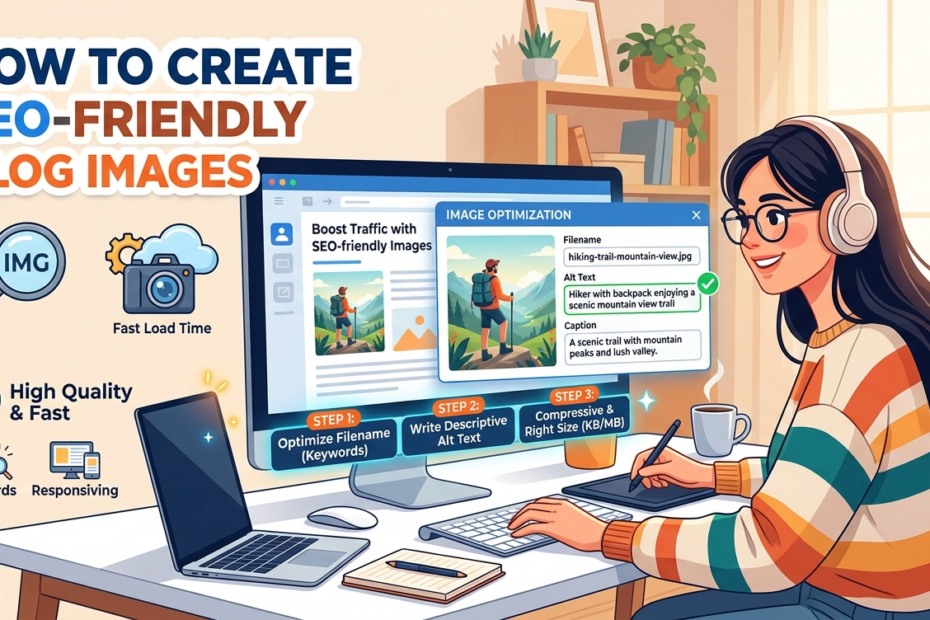
Using SEO-friendly blog images is one of the most effective ways to enhance your website’s performance and attract more visitors. Images not only make your content visually appealing but also increase user engagement, encourage social sharing, and help readers better understand your message.
However, simply adding images is not enough—optimizing them for search engines is essential. Properly optimized images can improve your page speed, contribute to higher search engine rankings, and make your site more accessible to users with disabilities.
In this guide, we’ll show you practical strategies to create, optimize, and use blog images that both captivate your audience and satisfy search engine requirements, helping your blog stand out in a crowded online space.
Choose the Right Image
Selecting the right images is the first step toward creating SEO-friendly blog images. Always use high-quality visuals that are relevant to your content and enhance the reader’s understanding.
Original images are ideal, as they make your blog stand out and can improve your search rankings. However, stock photos can also work if properly optimized and used thoughtfully.
Adding context to your images is equally important. Ensure that the image aligns with your blog’s topic, as search engines use surrounding text and captions to understand the content.
SEO Tips:
-
Descriptive filenames: Name your images using keywords, e.g.,
seo-friendly-blog-images.jpg. -
Avoid generic filenames: Skip names like
IMG1234.jpg, which provide no SEO value.
By choosing relevant, high-quality images with optimized filenames, you make your content both user- and search-engine-friendly.
Optimize Image Size and Format
Optimizing your images is essential for creating SEO-friendly blog images that load quickly and provide a smooth user experience. Large, uncompressed images can slow down your website, increasing bounce rates and negatively affecting your search rankings. To avoid this, compress images without sacrificing quality using reliable tools such as TinyPNG, ShortPixel, or ImageOptim.
Choosing the right image format is also important:
-
JPEG: Best for photos with many colors, offering good quality with smaller file sizes.
-
PNG: Ideal for graphics, logos, and images requiring transparency.
-
WebP: A modern format that delivers excellent compression and speed, making it perfect for web use.
By compressing images and using the right format, you improve page speed, enhance user experience, and boost your blog’s SEO performance.
Use Descriptive Alt Text
Adding descriptive alt text to your images is a crucial step in creating SEO-friendly blog images. Alt text not only improves accessibility for visually impaired users but also helps search engines understand the content of your images, contributing to better rankings.
When writing alt text, describe the image clearly and concisely, making sure to naturally include your focus keyphrase. Avoid keyword stuffing; the description should feel natural and informative. For example, instead of a vague description like “image1,” use:
“SEO-friendly blog images guide showing image optimization techniques.”
Alt text also appears if an image fails to load, ensuring your content remains understandable to readers. By crafting meaningful alt text, you enhance both accessibility and SEO, making your blog more user-friendly and search-engine optimized.
Add Captions and Titles
Including captions and titles for your images is another effective way to enhance both user experience and SEO. Captions are visible to readers and can increase engagement by providing context or emphasizing key points. Titles, while not always visible, give additional information that search engines can use to better understand your content.
When writing captions and titles, make them descriptive and relevant to the image. Incorporate your focus keyphrase naturally where it fits. For example:
Caption/Title: “Step-by-step guide to creating SEO-friendly blog images.”
Well-crafted captions and titles not only make your blog more informative and visually appealing but also help search engines associate your images with your content, improving your chances of ranking higher in search results.
Leverage Image Sitemaps and Lazy Loading
To maximize the SEO benefits of your images, it’s important to ensure that search engines can easily find and index them. Submitting an image sitemap to Google Search Console helps Google discover all the images on your site, improving their chances of appearing in search results. This is especially useful for blogs with many visuals or complex layouts.
In addition, implementing lazy loading can significantly enhance your website’s performance. Lazy loading ensures that images only load when they enter the user’s viewport, reducing initial page load time and improving overall site speed. Faster-loading pages lead to lower bounce rates and better rankings in search engines.
By combining image sitemaps with lazy loading, you make your SEO-friendly blog images more discoverable and your website more efficient.
Use Structured Data (Optional Advanced Tip)
For bloggers aiming to take their SEO to the next level, adding structured data to your images can improve visibility in search results. By marking up your images with schema types like Article or BlogPosting, you help Google understand the content and context of your images more clearly.
This can increase the chances of your images appearing as rich snippets in search results, which can drive more traffic and enhance click-through rates.
When implementing structured data, include important details such as image URL, caption, and description. Tools like Google’s Structured Data Markup Helper make it easier to generate accurate schema code.
By combining structured data with other optimization techniques, your SEO-friendly blog images can stand out in both search results and user experience.
Include Social Sharing Options
Optimizing your images for social media is an important part of creating SEO-friendly blog images. When your images are properly formatted for platforms like Facebook, Twitter, and LinkedIn, they are more likely to be shared, driving additional traffic to your blog.
Implementing Open Graph tags and Twitter Cards ensures that your images appear correctly when shared, along with the title and description of your post.
Additionally, using visually appealing featured images can encourage users to click and engage with your content. Choose images that are bright, clear, and relevant to the topic, and ensure they are sized correctly for each platform. By optimizing your images for social sharing, you increase visibility, engagement, and the potential for higher SEO rankings.
Conclusion
Creating SEO-friendly blog images is essential for improving both user experience and search engine rankings. By choosing relevant, high-quality visuals, optimizing image size and format, adding descriptive alt text, captions, and titles, and implementing advanced techniques like image sitemaps, lazy loading, and structured data, you can make your blog more accessible, engaging, and discoverable. Optimizing images for social sharing further amplifies your reach and drives additional traffic to your site.
Investing time in proper image optimization not only boosts SEO but also enhances the overall appeal of your content. Start implementing these strategies today, and watch your blog’s visibility, engagement, and traffic grow with every SEO-friendly image you create.
Frequently Asked Questions
How to make images SEO friendly?
Making your images SEO friendly is an essential step in improving both your website’s visibility and user experience. Search engines cannot “see” images the way humans do, so you need to optimize them properly to help them understand what your visuals represent.
Start by using descriptive file names before uploading your image. Instead of something generic like “IMG1234.jpg,” rename it to something meaningful like “seo-friendly-blog-writing-tips.jpg.” This gives search engines context about the image content.
Next, always include alt text (alternative text). This is a short description of the image that helps search engines and improves accessibility for users with screen readers. Your alt text should be clear, concise, and naturally include relevant keywords without stuffing.
Image size and format also matter. Large images can slow down your website, which negatively affects SEO. Compress your images using tools while maintaining quality. Use modern formats like WebP or optimized JPEG/PNG files to balance quality and performance.
Another important factor is contextual relevance. Place images near related text so search engines can better understand their purpose. Captions can also improve SEO by adding extra context.
Finally, use responsive images so they display properly on mobile devices. Since mobile usability is a ranking factor, this step is crucial.
Optimized images improve page speed, accessibility, and search visibility, making them a key part of any SEO strategy.
How to create SEO friendly blog content?
Creating SEO-friendly blog content involves writing for both search engines and human readers. The goal is to provide valuable, relevant content while making it easy for search engines to understand and rank your page.
Start with keyword research. Identify low-competition, high-intent keywords that your audience is searching for. Focus on long-tail keywords because they are easier to rank for and more targeted.
Next, structure your content properly. Use headings (H1, H2, H3) to organize your ideas and improve readability. Your main keyword should appear naturally in the title, introduction, and throughout the content without overuse.
Write high-quality, original content that solves a specific problem. Google prioritizes helpful content that matches user intent. Avoid fluff and focus on actionable insights, examples, and clear explanations.
Internal linking is also important. Link to related posts on your website to improve navigation and distribute SEO value. Additionally, include external links to credible sources to build trust.
Optimize your meta title and description to improve click-through rates. These should be clear, compelling, and include your target keyword.
Don’t forget readability. Use short paragraphs, simple language, and a conversational tone. This keeps readers engaged and reduces bounce rates.
Finally, update your content regularly to keep it relevant. SEO is not a one-time task—it requires consistency and improvement over time.
What is the 80/20 rule in SEO?
The 80/20 rule in SEO, also known as the Pareto Principle, suggests that 80% of your results come from 20% of your efforts. In SEO, this means that a small portion of your content, keywords, or strategies will generate most of your traffic and results.
For example, you may have dozens of blog posts, but only a few of them bring in the majority of your organic traffic. These are your high-performing pages. Instead of spreading your effort equally across all content, the 80/20 rule encourages you to focus on improving and promoting these top pages.
You can apply this rule by identifying your best-performing content using analytics tools. Once identified, optimize these pages further by updating information, improving keywords, adding internal links, and enhancing readability.
The rule also applies to keyword targeting. Instead of chasing hundreds of keywords, focus on the few that bring the most valuable traffic. These are often long-tail keywords with strong intent.
Another application is link building. A few high-quality backlinks can have more impact than many low-quality ones.
In summary, the 80/20 rule helps you prioritize high-impact activities. It allows you to achieve better results by focusing on what works, rather than trying to do everything at once.
Can ChatGPT write SEO articles?
Yes, ChatGPT can write SEO articles, but the quality of the output depends on how it is used. ChatGPT is a powerful tool for generating ideas, outlines, and even full-length articles, but it works best when combined with human input and strategy.
One of its main strengths is speed. It can quickly produce content based on a given topic, keyword, or prompt. This makes it useful for brainstorming blog ideas, creating drafts, and structuring articles.
However, SEO success requires more than just writing. You still need to conduct proper keyword research, understand search intent, and optimize the content for your target audience. ChatGPT does not automatically know your niche, competitors, or specific audience needs unless you guide it.
Another important factor is originality and personalization. While ChatGPT generates unique content, adding your own insights, examples, and voice makes the article more authentic and valuable.
You should also review and edit the content for accuracy, readability, and optimization. This includes adding internal links, optimizing headings, and ensuring the content aligns with your SEO goals.
In summary, ChatGPT is a powerful assistant for writing SEO articles, but it should not replace human strategy. When used correctly, it can save time, improve productivity, and help you create high-quality content at scale.
What are the 4 types of SEO?
The four main types of SEO are on-page SEO, off-page SEO, technical SEO, and local SEO. Each type focuses on a different aspect of improving your website’s visibility in search engine results.
On-page SEO involves optimizing the content and elements on your website. This includes using keywords, writing high-quality content, optimizing headings, and improving internal linking. It focuses on making your content relevant and useful to readers.
Off-page SEO refers to actions taken outside your website to improve its authority. The most important part of off-page SEO is building backlinks from other websites. Social signals and brand mentions also play a role.
Technical SEO deals with the backend structure of your website. It ensures that search engines can crawl and index your pages properly. This includes improving site speed, mobile-friendliness, security (HTTPS), and fixing technical errors.
Local SEO focuses on optimizing your website for location-based searches. It is especially important for businesses targeting a specific area. This includes optimizing your Google Business Profile, local keywords, and customer reviews.
All four types work together to create a strong SEO strategy. Ignoring one can limit your results, so it is important to balance all aspects for long-term success.
Can I do SEO myself?
Yes, you can absolutely do SEO yourself, especially if you are willing to learn and apply the fundamentals consistently. Many successful bloggers and website owners start by handling their own SEO before scaling or outsourcing later.
To begin, you need to understand the basics: keyword research, content creation, on-page optimization, and link building. You don’t need advanced technical skills at the start. Tools like Google Search Console and Google Analytics can help you track your performance and understand what’s working.
Start small by targeting low-competition, long-tail keywords. Create helpful, problem-solving content that matches what people are searching for. Then, optimize your titles, headings, and internal links. Over time, these small steps build strong results.
However, SEO requires patience. Results do not happen overnight, and consistency is key. You will also need to stay updated because search engine algorithms change regularly.
While you can do SEO yourself, there may come a point where you want to invest in tools, training, or professional help to scale faster. But for beginners and growing bloggers, DIY SEO is both practical and effective.
In short, yes—you can do SEO yourself, and it is one of the most valuable skills you can learn for building long-term online success.
What is the 80/20 rule for blogging?
The 80/20 rule in blogging means that 80% of your results come from 20% of your efforts. In practical terms, a small portion of your blog content will generate most of your traffic, engagement, and income.
For example, you might have 30 blog posts, but only 5–6 of them bring in the majority of your visitors. These are your high-performing posts. Instead of constantly creating new content, the 80/20 rule encourages you to focus on improving and promoting these top articles.
You can update them with fresh information, optimize them for better keywords, add internal links, and improve readability. These small improvements can lead to significant growth in traffic.
The rule also applies to topic selection. Some blog topics have higher demand and lower competition, making them more effective. Focusing on these high-impact topics will yield better results than writing randomly.
Promotion is another area where the 80/20 rule applies. Spending more time sharing and repurposing your best content can drive more traffic than publishing new posts daily.
Overall, the 80/20 rule helps you work smarter, not harder. By focusing on what already works, you can maximize your results without unnecessary effort.
What are the 4 pillars of SEO?
The four pillars of SEO are technical SEO, on-page SEO, content, and off-page SEO. These pillars form the foundation of any successful SEO strategy.
Technical SEO ensures that your website is accessible and easy for search engines to crawl and index. This includes site speed, mobile responsiveness, secure connections (HTTPS), and fixing errors.
On-page SEO focuses on optimizing elements within your website. This includes titles, headings, keywords, meta descriptions, and internal linking. It helps search engines understand your content.
Content is the core of SEO. High-quality, relevant, and valuable content is what attracts visitors and keeps them engaged. Without strong content, other SEO efforts will have limited impact.
Off-page SEO involves building your website’s authority through backlinks and external signals. When other reputable websites link to your content, it increases your credibility in the eyes of search engines.
These four pillars work together. Strong content supported by technical optimization, on-page improvements, and backlinks creates a powerful SEO strategy that drives long-term results.
Will AI replace SEO experts?
AI is transforming SEO, but it is unlikely to fully replace SEO experts. Instead, it is changing how SEO professionals work and making their processes more efficient.
Tools like ChatGPT can generate content, suggest keywords, and automate repetitive tasks. This reduces the time required for research and writing. However, SEO involves more than just content creation.
Human expertise is still needed for strategy, creativity, and decision-making. Understanding search intent, analyzing competitors, building relationships for backlinks, and adapting to algorithm changes require critical thinking that AI alone cannot fully replicate.
AI also lacks real-world experience and deep audience understanding unless guided by humans. Without proper direction, AI-generated content may lack originality, accuracy, or strategic focus.
Rather than replacing SEO experts, AI is becoming a powerful tool that enhances their work. Professionals who learn how to use AI effectively will have a competitive advantage.
In summary, AI will not replace SEO experts, but it will reshape the industry. The future belongs to those who combine human insight with AI efficiency.
What industry will boom in 2026?
Several industries are expected to experience significant growth in 2026, driven by technology, changing consumer behavior, and global trends. One of the fastest-growing sectors is artificial intelligence and automation. Businesses are increasingly adopting AI tools to improve efficiency, reduce costs, and enhance customer experiences.
Another booming industry is digital marketing and content creation. As more businesses move online, the demand for SEO, social media marketing, and content strategy continues to grow. This creates opportunities for bloggers, freelancers, and agencies.
The e-commerce industry is also expanding rapidly. Online shopping continues to increase globally, especially in emerging markets. Entrepreneurs who build niche online stores or dropshipping businesses can benefit from this trend.
Online education and e-learning is another fast-growing sector. More people are investing in digital skills, remote learning, and professional development. Platforms offering courses, coaching, or digital products are expected to grow significantly.
Additionally, health and wellness industries—including fitness, mental health, and nutrition—are gaining more attention as people prioritize well-being.
In conclusion, industries connected to technology, digital services, and personal development are likely to boom in 2026. For individuals and businesses, aligning with these trends can create strong opportunities for growth and success.
What are the 5 pillars of SEO?
The five pillars of SEO provide a well-rounded framework for building long-term search visibility. While different experts group them slightly differently, a practical and widely accepted set includes technical SEO, on-page SEO, content, off-page SEO, and user experience (UX).
Technical SEO ensures your website can be crawled and indexed efficiently. This includes site speed, mobile responsiveness, secure HTTPS, clean URL structures, and fixing crawl errors. Without a solid technical foundation, even great content may struggle to rank.
On-page SEO focuses on optimizing individual pages. This includes keyword placement, title tags, meta descriptions, headings, and internal linking. It helps search engines understand what your page is about.
Content is the core pillar. High-quality, relevant, and helpful content that matches search intent is what attracts and retains visitors. Evergreen content performs especially well over time.
Off-page SEO builds your website’s authority through backlinks, brand mentions, and online reputation. Links from credible sites act as trust signals to search engines.
User experience (UX) has become increasingly important. Factors like page readability, navigation, dwell time, and mobile usability influence how users interact with your site—and indirectly affect rankings.
When these five pillars work together, they create a strong SEO strategy that improves both visibility and user satisfaction.
Which type of SEO is best?
There is no single “best” type of SEO because each type serves a different purpose, and success comes from combining them effectively. However, if one must stand out, content-driven on-page SEO is often considered the most impactful starting point.
Without high-quality content, other SEO efforts have limited effect. Even if your site is technically perfect and has backlinks, poor content will not engage users or rank well. Content that solves real problems and matches search intent is the foundation of SEO success.
That said, technical SEO is equally important because it ensures your content can be discovered. A slow or broken website can prevent rankings regardless of content quality.
Off-page SEO, especially backlinks, plays a major role in building authority and competing in more competitive niches. Meanwhile, local SEO is essential for businesses targeting specific geographic areas.
The best approach is not choosing one type over another but balancing all of them. Start with strong content and on-page optimization, then improve technical aspects, and finally build authority through off-page strategies.
In summary, content is the heart of SEO, but a combination of all SEO types produces the best long-term results.
Is SEO an IT skill?
SEO is partly an IT-related skill, but it is not limited to the IT field. It sits at the intersection of marketing, content creation, and technical knowledge.
On the technical side, SEO involves understanding how websites work—things like site structure, page speed, indexing, and basic HTML. These aspects are closer to IT skills, especially in technical SEO.
However, a large portion of SEO is non-technical. It includes keyword research, content writing, audience understanding, and marketing strategy. These areas rely more on creativity and communication than programming.
You do not need to be a software developer to succeed in SEO. Many successful SEO professionals come from writing, marketing, or business backgrounds.
That said, having some technical knowledge can give you an advantage. Understanding how search engines crawl websites or how to fix technical issues can improve your results.
In summary, SEO is a hybrid skill. It combines elements of IT, marketing, and content creation, making it accessible to beginners while still offering depth for advanced learners.
Can ChatGPT do an SEO audit?
Yes, ChatGPT can assist with an SEO audit, but it works best as a supportive tool rather than a complete replacement for specialized SEO software.
ChatGPT can help analyze content, suggest keyword improvements, review meta descriptions, and identify on-page SEO issues. You can provide your blog post, website structure, or specific data, and it can give recommendations based on best practices.
However, a full SEO audit requires data such as traffic metrics, backlinks, crawl errors, and keyword rankings. For this, tools like Google Search Console and Google Analytics are essential because they provide real-time performance data.
ChatGPT does not have direct access to your website’s backend or live analytics unless you share the information. This limits its ability to perform deep technical analysis.
That said, it is very useful for:
- Content optimization suggestions
- SEO checklists
- Competitor analysis guidance
- Identifying common SEO mistakes
In summary, ChatGPT can help you understand and improve your SEO, but combining it with dedicated SEO tools gives you the most accurate and effective audit results.
Is SEO difficult to learn?
SEO is not inherently difficult to learn, but it can feel overwhelming at the beginning because it involves multiple concepts and ongoing changes. The good news is that the basics are relatively easy to understand.
At its core, SEO is about helping search engines understand your content and making it useful for users. Learning how to do keyword research, write optimized content, and use internal links can be done with practice and consistency.
The challenge comes from the depth of the field. Advanced topics like technical SEO, algorithm updates, and link building strategies require more time and experience to master.
Another factor is that SEO is constantly evolving. Search engines update their algorithms regularly, which means you need to stay informed and adapt your strategies.
Despite this, SEO is one of the most learnable digital skills because there are many free resources, tools, and practical opportunities to experiment. You can start small, test strategies, and improve over time.
In summary, SEO is not too difficult, but it requires patience, consistency, and a willingness to learn. With the right approach, anyone can build strong SEO skills and achieve meaningful results.