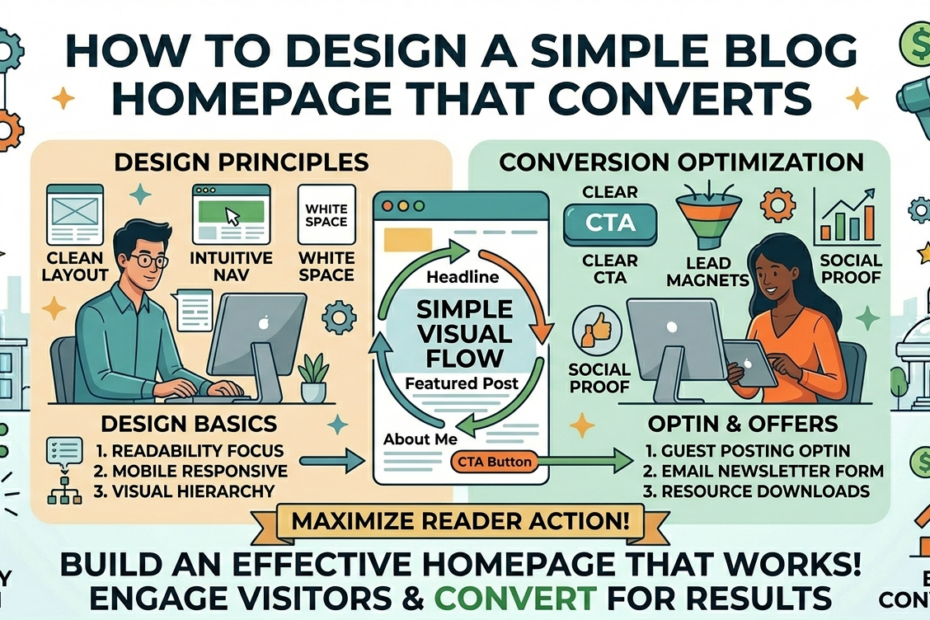
A blog’s homepage is often the first impression visitors get, and in the digital world, first impressions matter more than ever. While many bloggers focus on creating visually stunning pages, they often overlook one crucial goal: converting visitors into subscribers, readers, or customers.
A cluttered or confusing homepage can overwhelm users, causing them to leave before exploring your content. This is where a simple, conversion-focused design becomes a game-changer.
By streamlining your homepage layout, highlighting your best content, and strategically placing calls-to-action, you can guide visitors effortlessly toward meaningful actions.
Learning how to design a simple blog homepage that converts ensures that your blog not only looks appealing but also drives engagement, builds your audience, and maximizes the potential of every visitor who lands on your page.
Know Your Audience
Understanding your target audience is the foundation of a high-converting blog homepage. Without knowing who your visitors are, it’s nearly impossible to design a homepage that resonates with them or encourages them to take action.
Start by analyzing key demographics such as age, location, interests, and online behavior. Identify their pain points and challenges—what problems are they looking to solve by visiting your blog? Understanding their goals will help you create content and calls-to-action that speak directly to their needs.
One effective strategy is to create detailed user personas, fictional representations of your ideal visitors. These personas should include information about their motivations, challenges, and preferred content formats. By keeping these personas in mind, you can craft a homepage that feels personalized, intuitive, and designed to convert.
Clear and Compelling Headline
The headline is the first thing visitors see when they land on your blog homepage, making it a critical factor in capturing attention and encouraging further exploration.
A strong, benefit-driven headline immediately communicates what your blog offers and why it matters to the reader. It should be clear, concise, and focused on the value your audience will gain.
For example, instead of a generic headline like “Welcome to My Blog,” consider more compelling alternatives such as:
-
“Boost Your Productivity with Simple, Actionable Tips”
-
“Learn How to Start a Blog That Actually Converts”
-
“Your Go-To Guide for Effortless Healthy Living”
Make sure your headline aligns with your blog’s purpose and speaks directly to your audience’s needs. A well-crafted headline above the fold sets the tone, builds curiosity, and motivates visitors to explore your content and take action.
Minimalist Design
When it comes to designing a blog homepage that converts, simplicity is key. A cluttered page can overwhelm visitors and distract them from taking meaningful actions, whereas a clean, minimalist layout guides them effortlessly toward your goals.
Incorporating whitespace around content allows your key elements—headlines, CTAs, and featured posts—to stand out, making the page easier to scan and navigate.
Choose easy-to-read fonts and a limited color palette to maintain a professional and cohesive look. This not only improves readability but also enhances your site’s overall aesthetic appeal.
Use visual hierarchy to direct attention to your most important elements, such as newsletter signups, popular posts, or product offers. By strategically placing these elements, you create a smooth user journey that naturally encourages conversions without overwhelming your visitors.
Strong Call-to-Actions (CTAs)
A high-converting blog homepage relies on clear, visible, and actionable calls-to-action (CTAs). CTAs guide your visitors toward taking meaningful steps, whether it’s subscribing to your newsletter, reading your top posts, or exploring a product or service you offer. Without well-placed CTAs, even the most beautifully designed homepage may fail to convert visitors.
Examples of effective CTAs include:
-
Newsletter signup: “Join 5,000+ readers and get weekly blogging tips.”
-
Popular post links: “Check out our most-read guides to start growing your blog today.”
-
Product promotion: “Grab our free e-book and boost your productivity instantly.”
To maximize conversions, it’s essential to A/B test your CTAs. Experiment with different wording, colors, sizes, and placements to see which versions drive the highest engagement. Small adjustments can lead to significant improvements in subscriber rates and overall user action.
Feature Your Best Content
Highlighting your top-performing or cornerstone posts on your blog homepage is an effective way to engage visitors and keep them exploring your site. By showcasing your best content, you demonstrate value immediately and encourage readers to spend more time on your blog.
Use visuals, summaries, or card-style layouts to make your featured content easily scannable. Readers should be able to quickly understand what each post is about and why it’s worth their attention. Incorporating eye-catching images or graphics can further draw interest and improve the overall user experience.
Additionally, use internal linking within these featured posts to guide visitors to related content. This not only increases page views and session duration but also boosts your SEO by signaling site structure and relevance to search engines.
Social Proof and Trust Elements
Incorporating social proof and trust signals on your blog homepage can significantly boost credibility and conversion rates. Visitors are more likely to engage with your content or take action when they see evidence that others trust and value your blog.
Consider adding elements such as testimonials from readers or clients, subscriber counts, awards, or logos of media mentions. These signals reassure new visitors that your blog is reliable, authoritative, and worth their time.
By strategically placing trust indicators near key actions—like newsletter signups or product offers—you can increase confidence and motivate users to convert.
Social proof not only enhances the perception of your brand but also helps your blog stand out in a crowded digital space, encouraging visitors to stay, explore, and engage.
Optimize for Speed and Mobile
A fast, mobile-friendly blog homepage is essential for both user experience and search engine rankings. Site speed directly affects how long visitors stay on your page—slow-loading sites frustrate users and increase bounce rates. Optimize images, minimize heavy scripts, and use efficient hosting to ensure your homepage loads quickly.
Responsive design ensures your blog looks and functions perfectly on all devices, from desktops to smartphones. With more than half of web traffic coming from mobile devices, a mobile-first approach is critical. Mobile-friendly layouts, touch-friendly buttons, and readable fonts enhance usability, making it easier for visitors to navigate and engage with your content.
By prioritizing speed and mobile optimization, you create a smoother user experience, improve conversion rates, and signal search engines that your blog is high-quality and trustworthy.
SEO Best Practices
Optimizing your blog homepage for search engines is essential to attract organic traffic and increase conversions. Start with descriptive titles and meta tags that accurately reflect your content and include your focus keyphrase naturally. A well-crafted title and meta description not only improve rankings but also encourage clicks from search results.
Use alt text for images and incorporate headings with your keyphrase to make your content more accessible and SEO-friendly. This helps search engines understand your content and improves visibility in image and web searches.
Implement internal linking by connecting your homepage to other relevant posts or pages. This guides visitors deeper into your blog, improves user engagement, and strengthens your site’s SEO structure.
For advanced optimization, consider using structured data to enable rich snippets, which can enhance your appearance in search results and increase click-through rates.
Test, Analyze, and Improve
Creating a high-converting blog homepage is an ongoing process that requires careful testing and analysis. Use analytics tools like Google Analytics or heatmaps to track visitor behavior, measure conversions, and identify which elements are performing well. Monitoring metrics such as click-through rates, time on page, and bounce rates provides valuable insights into how users interact with your homepage.
Encourage continuous iteration by A/B testing different elements, including headlines, calls-to-action, featured content, and layouts. Even small changes—like tweaking button colors, rewording CTAs, or rearranging featured posts—can lead to significant improvements in engagement and conversion rates. By consistently testing and refining your homepage, you ensure that it remains optimized to attract, retain, and convert visitors effectively.
Conclusion
Designing a simple blog homepage that converts doesn’t have to be complicated. By understanding your audience, crafting a clear and compelling headline, keeping your design minimalist, featuring your best content, and strategically placing strong calls-to-action, you can create a homepage that engages visitors and drives meaningful actions. A
dding social proof, optimizing for speed and mobile, and following SEO best practices further enhances both credibility and search visibility.
Remember, testing and refining your homepage through analytics and A/B experiments ensures continuous improvement and higher conversions over time. Start applying these strategies today to transform your blog into a user-friendly, conversion-focused platform.
Ready to take action? Download our free homepage checklist to make sure your blog is fully optimized for engagement and conversions.
Frequently Asked Questions
How to design a website that converts?
Designing a website that converts means creating a site that turns visitors into customers, subscribers, or leads. A high-converting website is not just about beauty—it is about clarity, trust, and user experience.
First, start with a clear goal. Every page should have one main purpose, whether it is getting sign-ups, sales, or inquiries. Too many goals confuse visitors and reduce conversions.
Second, use a strong headline and value proposition. Within the first few seconds, visitors should understand what you offer and why it matters to them.
Third, keep the design simple and focused. Avoid clutter, too many colors, or unnecessary elements that distract users from taking action.
Fourth, use strong call-to-action (CTA) buttons. Phrases like “Get Started,” “Download Now,” or “Join Free” should be visible and repeated strategically.
Fifth, build trust. Add testimonials, reviews, case studies, or logos of clients to show credibility.
Sixth, optimize for mobile users. Most traffic comes from mobile, so your website must load fast and look clean on phones.
Finally, improve page speed and navigation. A slow or confusing website kills conversions quickly.
In summary, a converting website is simple, clear, fast, and trust-focused with a strong call to action.
How to create a blog homepage?
A blog homepage is the front door of your blog. It should clearly show what your blog is about and guide visitors to your best content.
Start with a clear header or hero section. This should explain your blog’s purpose in one sentence. For example, “Helping you learn personal finance and online income strategies.”
Next, include a featured posts section. Highlight your best or most recent articles so new visitors can quickly find valuable content.
Then, organize your blog into categories. This helps users navigate easily. For example: Saving Money, Budgeting, Making Money Online, etc.
You should also include a search bar so visitors can quickly find topics they are interested in.
Add an about section that briefly explains who you are and why your blog is trustworthy.
Include email subscription forms to build your audience. Offer something valuable like a free guide or tips in exchange for emails.
Finally, ensure your homepage is clean, fast, and mobile-friendly. Avoid clutter and focus on readability.
A good blog homepage is simple, organized, and designed to guide readers into your content.
What are the 7 C’s of a website?
The 7 C’s of a website are a framework used to evaluate and design effective websites that perform well and engage users. They are:
- Context – The overall look, design, and layout of the website. It should be clean, visually appealing, and easy to navigate.
- Content – The information on the site. It should be useful, clear, and relevant to the audience.
- Community – Features that allow interaction, such as comments, forums, or social sharing.
- Customization – The ability for users to personalize their experience or for the site to adapt to user needs.
- Communication – How the website interacts with users, such as emails, chat, or feedback forms.
- Connection – Links to other websites, social media platforms, or external resources.
- Commerce – If applicable, the ability to buy products or services directly through the website.
Together, these 7 C’s help ensure a website is not only visually appealing but also functional, engaging, and effective.
Is a 2.5% conversion rate good?
A 2.5% conversion rate is generally considered average to slightly good, depending on the industry and traffic source. Conversion rate refers to the percentage of visitors who complete a desired action, such as making a purchase, signing up, or filling a form.
In many industries, typical conversion rates range from 1% to 5%. This means a 2.5% conversion rate is within a healthy range, especially for blogs, e-commerce sites, or landing pages.
However, whether it is “good” depends on context:
- For e-commerce websites, 2.5% is often considered decent.
- For highly optimized landing pages, businesses may aim for 5% or higher.
- For cold traffic (new visitors from ads), 2.5% is actually quite strong.
The most important factor is improvement over time. A website should always aim to increase its conversion rate through better design, stronger calls-to-action, and improved user experience.
In summary, 2.5% is a solid baseline, but there is always room for optimization depending on your goals and industry.
What should a blog homepage look like?
A blog homepage should be simple, organized, and focused on guiding visitors to your content quickly. It is not just a design space—it is a navigation hub for your readers.
At the top, you should have a clear header or hero section that explains what your blog is about in a few words. This helps visitors immediately understand your niche.
Next, include a featured posts section that highlights your best or most recent articles. This is important because most new visitors will judge your blog based on your top content.
Below that, organize your content into categories or sections. This makes it easier for readers to explore topics they are interested in.
A search bar is also important so users can quickly find specific content.
You should also include an about section that briefly explains who you are and what value your blog provides.
Adding a newsletter signup form helps you build an email audience for long-term traffic.
Finally, your blog homepage should be fast, mobile-friendly, and clutter-free. Avoid too many distractions so users can focus on reading your content.
In summary, a good blog homepage is clean, structured, and designed to guide users into your content smoothly while building trust and engagement.
What is the 80/20 rule for blogging?
The 80/20 rule for blogging, also known as the Pareto Principle, means that 80% of your blogging results usually come from 20% of your efforts. In blogging, this idea helps you focus on what actually drives traffic, engagement, and income instead of wasting time on low-impact tasks.
For example, in most blogs, a small percentage of posts (around 20%) will generate the majority of traffic from search engines like Google. This means not all your articles will perform equally—some will bring in most of your readers.
It also applies to content creation. Instead of writing random topics, successful bloggers focus on high-performing keywords, evergreen content, and SEO-optimized posts that continue bringing traffic over time.
Another application is in marketing. A few social media platforms or promotion strategies often bring the majority of visitors to your blog, while others may contribute very little.
The key lesson is focus on what works best and double down on it. Identify your best-performing content and create more similar content. Improve, update, and promote your top articles instead of spreading your energy too thin.
In summary, the 80/20 rule in blogging teaches you to focus on the small percentage of actions that produce the biggest results, helping you grow faster with less wasted effort.
What platform is best for a blog?
The best blogging platform depends on your goals, technical skill, and budget. There is no single “perfect” platform, but some are more suitable for beginners while others are better for advanced users.
One of the most popular platforms is WordPress.org, which is widely used by professional bloggers. It gives full control over your website, design, and monetization. However, it requires hosting and some basic setup knowledge.
For beginners, WordPress.com is easier to use because it is hosted for you, but it has limited customization unless you upgrade.
Another beginner-friendly option is Blogger, which is free and simple to set up. It is good for learning blogging basics but has fewer customization features.
Platforms like Wix and Squarespace are also popular because they offer drag-and-drop design tools, making it easy to build visually appealing blogs without coding.
If your goal is long-term growth and income, WordPress.org is generally considered the best choice because of its flexibility, SEO capabilities, and scalability.
In summary, the best platform depends on your needs, but WordPress.org is often recommended for serious bloggers, while Blogger and Wix are good for beginners.
What are the 7 steps in creating a website?
Creating a website involves a structured process that ensures it is functional, user-friendly, and effective. The seven main steps are:
- Define your goal
Decide what your website is for—blogging, business, portfolio, or e-commerce. A clear goal guides all other decisions.
- Choose a domain name
Pick a simple, memorable name that represents your brand or content.
- Select a web hosting service
Hosting is where your website lives online. It stores your files and makes your site accessible.
- Choose a website platform
Platforms like WordPress, Wix, or Shopify help you build your website without coding.
- Design your website
Choose a layout, colors, and structure that are simple, clean, and user-friendly.
- Create content
Add pages like Home, About, Blog, or Services. Content should be clear, helpful, and engaging.
- Launch and promote your website
Once everything is ready, publish your site and promote it using SEO, social media, or ads.
These steps ensure your website is not only functional but also effective in achieving its purpose.
Which blog is best for beginners?
The best blog for beginners is one that is easy to set up, low-cost, and simple to manage without technical skills. For most beginners, the goal is to learn blogging basics like writing, SEO, and audience building before moving to advanced platforms.
One of the best options is Blogger (Blogspot). It is free, easy to use, and owned by Google. You don’t need to worry about hosting or technical setup, making it ideal for complete beginners.
Another good option is WordPress.com, which offers a simple interface and free plan. It is slightly more advanced than Blogger but still beginner-friendly.
However, if a beginner is serious about long-term blogging and income, many experts recommend starting directly with WordPress.org. While it requires a small investment for hosting, it offers full control, better SEO potential, and more growth opportunities.
For beginners who prefer visual design and simplicity, platforms like Wix are also a good choice because of drag-and-drop features.
In summary, Blogger and WordPress.com are best for absolute beginners, while WordPress.org is best for beginners who want to build a long-term blogging business.
What are common blogging mistakes?
Many new bloggers make mistakes that slow down their growth or prevent them from succeeding. Understanding these mistakes helps you avoid them early.
- Not choosing a clear niche
Trying to write about everything makes it hard to build an audience. Focus on a specific topic.
- Ignoring SEO
Without search engine optimization, your blog will struggle to get traffic from Google.
- Inconsistent posting
Posting randomly or stopping for long periods reduces audience trust and search visibility.
- Writing for yourself instead of the audience
Successful blogs focus on solving readers’ problems, not just personal opinions.
- Poor website design
A cluttered or slow website can make visitors leave quickly.
- Not promoting content
Publishing alone is not enough. You must share your posts on social media or other platforms.
- Giving up too early
Blogging takes time to grow. Many beginners quit before seeing results.
In summary, successful blogging requires consistency, focus on value, SEO knowledge, and patience. Avoiding these common mistakes increases your chances of long-term success.
What are common homepage mistakes?
A website homepage is the most important part of your site because it creates the first impression. Many websites lose visitors due to simple but costly mistakes.
One common mistake is having too much clutter. When a homepage is filled with too many images, buttons, or text blocks, visitors get confused and leave quickly. A good homepage should be clean and easy to scan.
Another mistake is unclear messaging. If users cannot immediately understand what your website is about, they will not stay. Your headline should clearly explain your purpose within a few seconds.
Poor navigation is also a major issue. If menus are confusing or hidden, users struggle to find information. A good homepage should guide visitors naturally to other pages.
Many websites also make the mistake of missing a clear call-to-action (CTA). Without guidance like “Read Blog,” “Sign Up,” or “Get Started,” visitors may not know what to do next.
Slow loading speed is another serious problem. Even a few seconds delay can cause users to leave.
Finally, not optimizing for mobile devices is a big mistake. Most users browse on phones, so a non-mobile-friendly homepage reduces engagement.
In summary, a good homepage should be simple, clear, fast, and action-driven.
Who is the richest blogger?
The richest blogger is widely considered to be Arianna Huffington, the co-founder of The Huffington Post. She built one of the most successful online news and blog platforms in the world before it was acquired by AOL for a reported $315 million.
Arianna Huffington became extremely successful by combining journalism, blogging, and digital media strategy. Her platform grew rapidly because it focused on viral content, political news, lifestyle topics, and opinion pieces that attracted massive global traffic.
While she is often recognized as the richest blogger in terms of influence and business success, other bloggers have also built significant wealth through niche blogging, affiliate marketing, and digital products.
It’s also important to note that today, many top earners in blogging don’t rely on traditional “blogs” alone. They combine content creation with YouTube, newsletters, courses, and brand deals.
In summary, Arianna Huffington is one of the most recognized and successful figures in blogging history, especially for turning a blog-based platform into a global media empire.
What not to do in a blog?
There are several mistakes that can damage a blog’s growth, credibility, and traffic if not avoided early.
One major mistake is copying content from other websites. This harms your SEO ranking and reduces trust with readers. Original content is essential for long-term success.
Another mistake is writing without a clear niche. A blog that covers too many unrelated topics confuses both readers and search engines.
Ignoring SEO (Search Engine Optimization) is also a big problem. Without SEO, your content will struggle to appear on Google, no matter how good it is.
Many bloggers also fail by posting inconsistently. Irregular posting reduces audience engagement and slows growth.
Poor website design is another issue. If your blog is slow, messy, or hard to navigate, visitors will leave quickly.
Another mistake is not understanding your audience. Writing without knowing what readers want leads to low engagement.
Finally, many bloggers give up too early. Blogging takes time, and quitting before results appear is a common failure point.
In summary, avoid copying content, ignoring SEO, inconsistent posting, and lack of focus if you want a successful blog.
What is replacing blogging?
Blogging is not completely disappearing, but it is evolving. Traditional blogging (long written articles only) is being replaced or supported by more interactive and multimedia content formats.
One major replacement trend is video content, especially platforms like YouTube, TikTok, and Instagram Reels. Many people now prefer watching short videos instead of reading long articles.
Another growing format is podcasting, where people consume content through audio while multitasking.
Newsletters and email content are also becoming more popular. Instead of visiting blogs, users subscribe and receive content directly in their inbox.
In addition, social media micro-content (short posts, threads, and visuals) is replacing long blog reading for quick information.
However, blogging is not dead—it has evolved. Many successful creators now combine blogging with video, SEO, and email marketing.
In summary, blogging is being transformed rather than replaced, with video, podcasts, and newsletters leading the shift in content consumption.
Which type of blog is the most popular?
The most popular type of blog depends on audience demand, but some categories consistently perform better than others across the internet.
One of the most popular is lifestyle blogging. This includes topics like daily life, fashion, relationships, personal development, and routines. It attracts a wide audience because it is relatable.
Another highly popular category is money and finance blogs. Topics like saving money, investing, side hustles, and budgeting are always in demand because people want financial improvement.
Health and fitness blogs are also extremely popular. People constantly search for weight loss tips, workout routines, and healthy living advice.
Technology blogs perform very well too, especially topics like gadgets, software, AI tools, and online trends.
Lastly, educational and how-to blogs are highly successful because they solve specific problems, such as “how to make money online” or “how to start a business.”
In summary, finance, lifestyle, health, technology, and educational blogs are among the most popular because they consistently solve real-life problems and attract evergreen traffic.
How can I make $100 on my blog?
Making your first $100 from a blog is realistic, but it requires focus on traffic + monetization strategy, not just writing posts. A blog earns money only when it attracts visitors and those visitors take action.
First, you need traffic from search engines or social media. Without visitors, there is no income. Focus on writing 5–15 high-quality, SEO-optimized articles targeting long-tail keywords like “how to save money in Nigeria” or “best side hustles for beginners.”
Next, choose one simple monetization method first instead of trying everything at once:
- Affiliate marketing (recommending products/services and earning commission)
- Ad networks like Google AdSense (earn per clicks/impressions)
- Digital products like eBooks or guides
- Services like writing, coaching, or consulting
For beginners, affiliate marketing + simple blog content is often the fastest path to $100.
To reach $100, you might need:
- A few thousand page views (ads model), OR
- A few affiliate conversions, OR
- 5–10 product sales (depending on pricing)
Finally, consistency matters more than speed. Most bloggers don’t earn in the first few weeks. Focus on publishing helpful content and improving it over time.
In summary, $100 comes from combining traffic + simple monetization + consistency, not from writing alone.
Which niches are best for blogging?
The best blogging niches are those with high demand, good monetization potential, and long-term relevance (evergreen topics). A strong niche solves real problems people search for regularly.
Here are some of the best blogging niches:
- Personal finance and money
Topics like saving, budgeting, investing, and side hustles perform very well because people constantly search for ways to improve their finances.
- Health and fitness
Weight loss, workouts, nutrition, and healthy living content always attract large audiences.
- Make money online / digital skills
Freelancing, blogging, affiliate marketing, and remote jobs are highly popular and profitable niches.
- Technology and AI tools
Reviews, tutorials, and updates about apps, gadgets, and AI tools are in high demand.
- Education and career growth
Study tips, exam guides, scholarships, and career advice attract consistent traffic.
- Lifestyle and personal development
Topics like productivity, habits, motivation, and relationships are widely consumed.
The best niche for you is not just the most popular one, but the one you can consistently write about.
In summary, money, health, tech, education, and lifestyle are top blogging niches because they solve real problems and generate long-term traffic.
What is the easiest site to start a blog?
The easiest platforms for starting a blog are those that require little to no technical setup. They are beginner-friendly and allow you to start publishing content quickly.
One of the easiest platforms is Blogger (Blogspot). It is free, owned by Google, and very simple to set up. You don’t need hosting or advanced skills. This makes it perfect for beginners who just want to start writing.
Another easy option is WordPress.com. It offers a clean interface and guided setup process. You can start a blog in minutes, although advanced customization requires paid plans.
Wix is also beginner-friendly because it uses drag-and-drop design. You can visually build your blog without coding.
For people who want more control but are still beginners, WordPress.org with hosting is slightly more complex but more powerful in the long run.
If the goal is just to start quickly and learn, Blogger is often considered the easiest. If the goal is long-term growth, WordPress.org is better.
In summary, Blogger is the easiest for beginners, while WordPress is better for long-term blogging success.
Is it better to use a website or blog?
A website and a blog are not completely separate—they often work best together. The better option depends on your goal.
A website is broader. It is used for businesses, portfolios, services, or selling products. It usually has static pages like Home, About, Services, and Contact.
A blog is content-focused. It is regularly updated with articles, tutorials, or posts. Blogs are powerful for attracting traffic through search engines like Google.
If your goal is branding, business, or selling services, a website is important.
If your goal is traffic, audience growth, and content marketing, a blog is essential.
However, the best option today is a combined website + blog. Many successful sites use both:
- Website pages for structure and branding
- Blog section for traffic and SEO growth
For example, businesses use blogs to attract visitors and then convert them into customers through their website pages.
In summary, it is not “either or”—the most effective strategy is to use both a website and a blog together for maximum growth and income potential.
Related