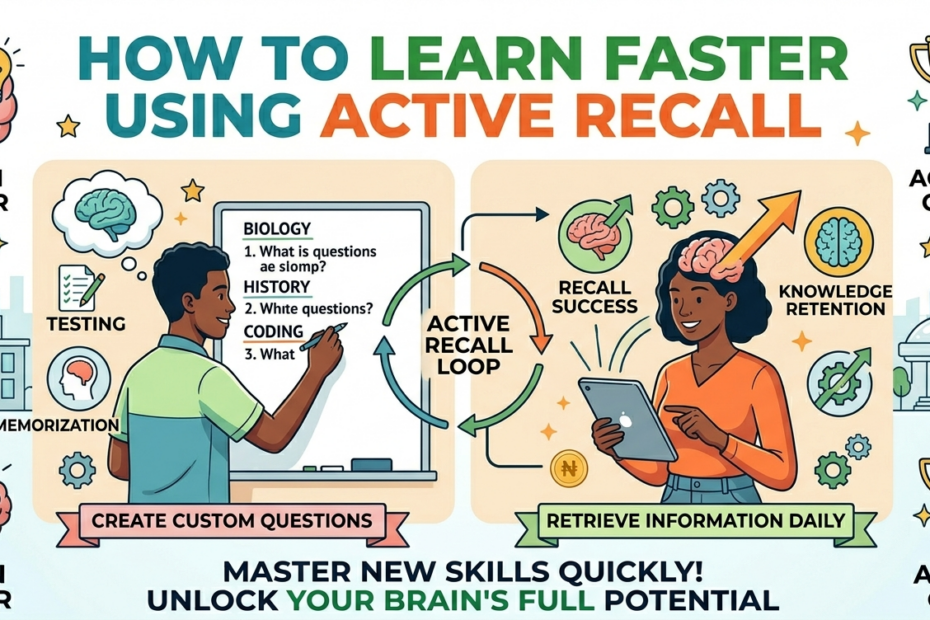
Struggling to retain everything you study can be frustrating, especially when exams or deadlines are looming. Many students spend hours rereading notes or highlighting textbooks, yet find that the information slips away as soon as they stop studying.
The key to breaking this cycle is learning faster using active recall, a scientifically proven technique that trains your brain to retrieve information instead of just passively absorbing it.
By actively testing yourself on what you’ve learned, you strengthen memory pathways, improve understanding, and retain knowledge for the long term.
Whether you’re preparing for school exams, professional certifications, or simply want to learn more efficiently, active recall offers a practical and highly effective approach to mastering information faster than traditional study methods.
What is Active Recall?
Active recall is a study technique that involves actively retrieving information from your memory rather than passively reviewing it. In simple terms, it means testing yourself on what you’ve learned instead of just rereading notes or textbooks. For example, after studying a chapter, you might close your book and try to write down or explain the key concepts from memory.
The science behind active recall is rooted in how our brains form and strengthen neural connections. Each time you successfully retrieve information, you reinforce these pathways, making it easier to remember the material in the future.
This process is far more effective for long-term memory retention than passive methods like highlighting or rereading, which often create a false sense of familiarity without actually improving recall.
Incorporating active recall into your study routine is one of the most efficient learning strategies available. It not only boosts memory retention but also improves focus, understanding, and problem-solving skills, making it a cornerstone technique for anyone looking to learn faster and smarter.
Benefits of Learning Faster Using Active Recall
Active recall is more than just a study technique—it’s a powerful tool that can transform the way you learn. Here are some of the key benefits:
-
Improved Memory Retention: Actively retrieving information strengthens neural connections, making it easier to recall knowledge long-term compared to passive study methods.
-
Faster Study Sessions: By focusing on what you don’t know rather than rereading material you already understand, you can study more efficiently and save time.
-
Better Understanding and Application: Active recall encourages deeper engagement with the material, helping you grasp concepts fully and apply them in real-life or exam scenarios.
-
Reduced Exam Stress: Confidence grows when you consistently test yourself and see improvement. This reduces anxiety and helps you perform better under pressure.
Incorporating active recall into your study routine turns learning into an interactive process. It’s a proven learning strategy that not only improves memory retention but also enhances focus, understanding, and overall academic performance. By practicing active recall regularly, you can learn faster and retain more, making your study sessions both effective and efficient.
How to Use Active Recall Effectively
Learning faster using active recall isn’t just about testing yourself randomly—it works best with structured strategies. Here are some proven methods to apply active recall effectively:
1. Flashcards
Create question-and-answer flashcards for key concepts. Digital tools like Anki or Quizlet can make this process easier by automatically organizing cards for review. Regularly testing yourself with flashcards forces your brain to retrieve information, strengthening memory retention over time.
2. Practice Tests
Simulate real exam conditions by taking practice tests. This method not only helps you identify gaps in your knowledge but also trains your brain to recall information under pressure. The more you practice, the more confident and efficient you become.
3. Teach Someone Else
Explaining concepts to a friend, family member, or even yourself reinforces understanding. Teaching forces your brain to organize information logically and recall details actively, making it easier to retain complex material.
4. Spaced Repetition
Combine active recall with spaced repetition for maximum results. Review information at increasing intervals—after one day, three days, a week, and so on. This spacing strengthens memory retention and prevents forgetting.
5. Summarization
After reading a chapter or completing a study session, close your notes and summarize the main points from memory. This simple exercise challenges your brain to retrieve information and identify areas that need more focus.
By consistently applying these active recall strategies, you can significantly boost learning efficiency, improve memory retention, and reduce study time. Integrating these techniques into your daily routine is one of the most effective learning strategies for students, professionals, and lifelong learners alike.
Common Mistakes to Avoid
While active recall is a highly effective learning strategy, certain mistakes can reduce its effectiveness.
-
Passive Studying Instead of Active Recall: Simply rereading notes or highlighting text gives a false sense of understanding. Without actively retrieving information, memory retention remains low.
-
Overloading Sessions Without Breaks: Cramming large amounts of information in one sitting can overwhelm your brain. Short, focused sessions with breaks improve concentration and long-term recall.
-
Ignoring Spaced Repetition Principles: Reviewing information only once or irregularly diminishes the benefits of active recall. Spaced repetition ensures that knowledge is reinforced over time, preventing forgetting.
Avoiding these common pitfalls will help you maximize the benefits of active recall, making your study sessions more efficient, focused, and productive.
Conclusion
Learning faster using active recall is a proven strategy that boosts memory retention, improves understanding, and makes study sessions more efficient.
By incorporating techniques like flashcards, practice tests, teaching others, spaced repetition, and summarization, you can transform the way you learn and retain information.
Start applying active recall in your daily study routine today to see tangible results. Have you tried active recall before? Share your experience in the comments and let others learn from your tips.