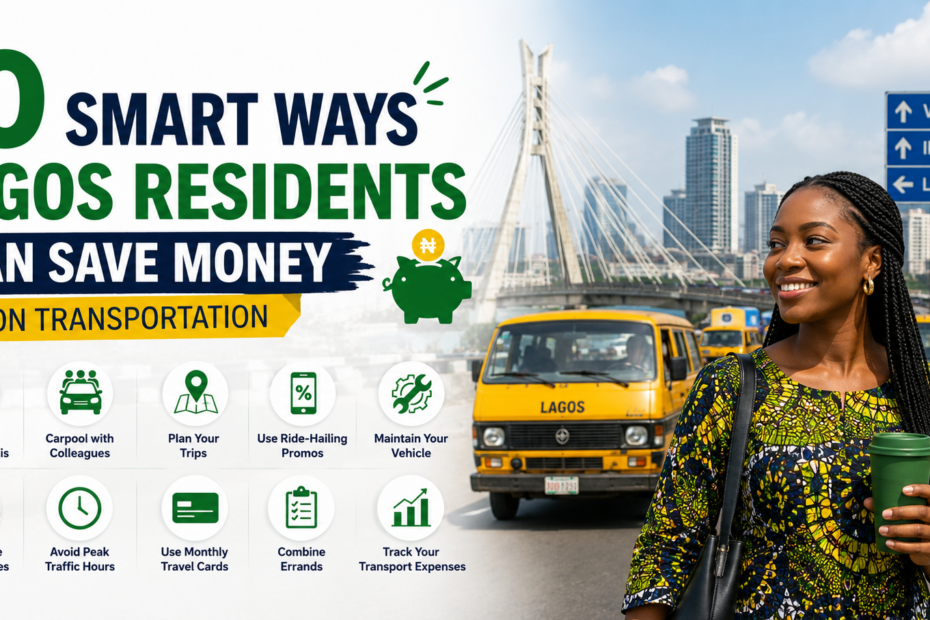
In Lagos, transportation often feels like a daily bill you never planned for. One moment you think you’ve budgeted your day, and the next, transport fares have changed again—whether it’s danfo, keke, or ride-hailing services. Rising fuel prices and unpredictable fare increases mean that even short trips can quickly add up and affect your weekly spending.
On top of that, Lagos traffic can turn a simple journey into hours on the road, increasing both stress and the cost of movement. What should be a quick commute to work, school, or the market often becomes a draining and expensive experience.
But the truth is, small smart habits can reduce how much you spend on transportation every week. With better planning and simple adjustments to how you move around the city, you can cut costs without necessarily reducing your daily activities.
1. Plan Your Trips Ahead of Time
One of the biggest reasons people in Lagos spend more money on transportation than necessary is poor planning. When your movements are not planned, every trip becomes a separate expense.
You might leave home in the morning for work, come back in the afternoon for something you forgot, and then go out again in the evening. Each of these back-and-forth movements increases your transport cost and drains your daily budget without you even noticing.
Planning your trips ahead of time helps you avoid this waste. Instead of moving randomly, try to combine errands into one trip. For example, if you need to go to the market, visit the bank, and also see a friend, arrange them in a single route rather than making three different journeys. This simple habit can significantly reduce how much you spend on transport each day.
Another smart approach is to think in terms of a weekly movement plan. At the start of the week, map out where you need to go and on which days. This helps you group activities that are in the same direction or area, reducing unnecessary travel across long distances. It also gives you better control over your time and money.
In a busy city like Lagos, unplanned movement is expensive movement. But with a little structure and awareness, you can make every trip more intentional and cost-effective.
2. Travel During Off-Peak Hours
In Lagos, when you travel can be just as important as how you travel. Timing has a direct impact on both your transport cost and the level of stress you experience on the road. During peak hours, transportation becomes more expensive, crowded, and slower due to heavy traffic.
For example, the morning rush hour—usually between 6:30 am and 9:30 am—is one of the most expensive and stressful times to move around the city. Roads are congested, buses are packed, and ride-hailing fares often increase because of high demand. In contrast, traveling mid-morning, after the rush has reduced, is usually cheaper and more comfortable. You can get transport faster, and in many cases, even negotiate better fares with drivers.
The same pattern applies in the evening. Peak hours, typically from 4:30 pm to 7:30 pm, are filled with workers returning home, which leads to traffic jams and higher transport costs. However, late-night travel, although requiring caution, is often cheaper and faster since the roads are clearer.
Ride-hailing services like Bolt and Uber are especially affected by surge pricing during peak hours. When demand is high, prices can double or even triple compared to off-peak times. This means the same route can cost significantly more simply because of timing.
By adjusting your schedule slightly and avoiding peak periods when possible, you can reduce both your transport expenses and the stress that comes with navigating Lagos traffic.
3. Use Public Transport Strategically
Using public transport in Lagos is not just about “taking a bus” or hopping on a keke—it’s about making smart choices based on cost, distance, and timing. When used strategically, public transport can significantly reduce how much you spend on daily movement.
One effective approach is mixing different transport options depending on your route. For short distances, a keke or even a short walk may be more cost-effective than entering a bus or ordering a ride-hailing service.
For longer journeys, combining danfo buses with a short keke ride at the final stage of your trip can help you save money while still reaching your destination efficiently.
Another important habit is reducing unnecessary ride-hailing trips. While services like Bolt and Uber offer comfort and convenience, they are often the most expensive option, especially for daily commuting.
Instead of using them for every movement, reserve them for situations where public transport is not practical, such as late-night travel or emergencies.
It also helps to choose routes that reduce multiple connections. Every time you switch from one transport mode to another, you are likely to spend more money and time. Learning routes that take you closer to your destination with fewer stops can make a big difference in your monthly transport budget.
In a city like Lagos, smart commuters don’t just move—they plan how they move. Using public transport wisely is one of the simplest ways to stay mobile while keeping your expenses under control.
4. Live Closer to Work or School (or Choose Smarter Routes)
One of the most powerful long-term ways to save money on transportation in Lagos is to live closer to where you work or school. While this may not always be immediately possible, it is a strategy that can significantly reduce your daily expenses over time.
Many people focus only on cheaper rent when choosing accommodation, without considering how much they will spend on transport every month. In reality, a location with lower rent but far from your workplace can end up costing more overall because of daily commuting expenses. When you add up transport costs for weeks and months, the difference becomes very clear.
Your location has a direct impact on your daily spending. Living far away often means multiple bus rides, keke trips, or even frequent use of ride-hailing services just to get to your destination. This not only increases costs but also adds stress and time loss due to Lagos traffic.
Even moving a little closer to your workplace or school can make a noticeable difference. You don’t necessarily have to live directly next door—reducing your commute from two hours to thirty minutes can already cut transport expenses significantly and improve your daily routine.
If relocating is not an option, then choosing smarter routes becomes important. Look for neighborhoods or bus stops that reduce the number of connections you need. The less complicated your daily route is, the more money and time you save in the long run.
5. Learn Cheaper Alternative Routes
One of the smartest ways to reduce transport costs in Lagos is to learn cheaper alternative routes to the same destination. Many people automatically stick to the main roads, not realizing that there are often multiple ways to get to the same place—some faster, and more importantly, cheaper.
Local drivers and conductors often know shortcuts that can save both time and money. These routes may not always be widely known or obvious, but they help avoid heavy traffic areas where transport fares can increase due to delays and fuel consumption.
By using these alternative paths, you can sometimes pay less and still arrive faster than those stuck on busy main roads.
A common mistake many commuters make is “main road only” thinking. They assume the biggest or most popular road is the only reliable option. However, in a city like Lagos, main roads are often the most congested and expensive due to high demand. Limiting yourself to only these routes can increase your transport expenses unnecessarily.
Another practical way to discover cheaper routes is by asking regular commuters. People who travel the same direction daily often know the best bus stops, connections, and shortcuts that are not obvious to newcomers. Engaging with conductors, drivers, or even co-passengers can reveal better and more affordable travel options.
By learning and using alternative routes, you gain more control over your movement. Instead of following expensive crowd patterns, you start making smarter decisions that reduce both your travel cost and stress level in Lagos.
6. Walk Short Distances Instead of Taking Rides
A simple but often ignored way to save money on transportation in Lagos is walking short distances instead of always taking a ride. Many people spend money on keke, bike, or even buses for trips that could easily be completed on foot within 5 to 15 minutes.
If your destination is just a few streets away or a short walk from the bus stop, choosing to walk instead of paying for another ride can save you small amounts of money that add up over time. While it may look insignificant daily, these small savings become noticeable at the end of the week or month, especially for people who move around frequently.
However, this approach should be used when it is safe and realistic. Always consider factors like road safety, weather conditions, and the security of the area before deciding to walk. In busy or unsafe routes, it may be better to use transport instead of taking risks. The goal is smart saving, not unnecessary discomfort.
Beyond saving money, walking also comes with health benefits. It helps you stay active, reduces stress from traffic, and improves overall fitness. Instead of sitting in traffic for short distances, you get to stretch your legs and move your body, which is a bonus for your well-being.
In a city like Lagos, where transport costs can quickly pile up, learning to walk short distances when appropriate is a simple lifestyle habit that helps you save money while also improving your health.
7. Share Rides with Colleagues or Neighbors
Ride-sharing is one of the most practical ways to reduce transportation costs in Lagos, especially for people who travel to similar locations daily. Instead of paying full fare alone, sharing rides with colleagues or neighbors helps split the cost and makes commuting more affordable.
For example, if you and a colleague work in the same area like Ikeja, Victoria Island, or Lekki, you can agree to take a Bolt or Uber together and split the fare.
This simple arrangement can cut your transport cost by half or even more, depending on the number of people sharing the ride. It also makes ride-hailing services more useful for regular commuting instead of being an expensive solo option.
Beyond ride-hailing apps, there is also a strong informal ride-sharing culture in many parts of Lagos. Neighbors who live in the same area often travel around the same time and can coordinate movement to reduce expenses. This type of arrangement is especially helpful for people working in offices or markets with fixed working hours.
However, trust and consistency are very important for successful ride-sharing. It works best when you share rides with people you know or can rely on. Clear communication about timing, contribution, and pick-up points helps avoid misunderstandings and makes the arrangement sustainable.
In a city where transport costs can quickly add up, sharing rides is a smart and social way to save money while still enjoying convenience and comfort.
8. Use Transport Budgeting
One of the most effective ways to control transportation expenses in Lagos is to treat it like a real financial budget. Instead of spending randomly each day, set a clear weekly transport limit and try to stick to it. This helps you become more intentional about how and when you move around the city.
For example, if you estimate how much you spend on transport in a week, you can divide it into daily limits. This makes it easier to avoid overspending on unnecessary trips or expensive transport options. Once your daily limit is reached, you become more careful with extra movements that are not important.
Another important habit is tracking your daily transport spending. You don’t need anything complicated—simple phone notes or a basic budgeting app is enough. Write down each transport expense as it happens, whether it’s for a bus, keke, bike, or ride-hailing service. Over time, this helps you see where your money is going and identify patterns of waste.
Many people lose money through “small small spending” that doesn’t feel significant at the moment. A quick keke ride here, an extra Bolt trip there—it all adds up by the end of the week. Without tracking, these small expenses can quietly take a large portion of your income.
By budgeting your transport like any other expense, you gain better control over your finances. Instead of wondering where your money went, you are actively directing how it is spent, which is a key step toward smarter living in a city like Lagos.
9. Avoid Unnecessary Movements
In a city like Lagos, one of the fastest ways people waste money on transportation is through unnecessary movements. These are the small, unplanned trips that don’t really have urgency but still end up costing money. Over time, they quietly drain your transport budget without you even realizing it.
A common example is the “I just want to check something” trip. You might decide to step out just to confirm one small detail, buy a single item, or visit someone briefly. But each of these movements comes with transport costs that add up quickly, especially when done frequently within a week.
Impulse outings also play a big role. Sometimes you are not originally planning to go out, but a sudden invitation or boredom pushes you into spending money on transport. While social life is important, repeated unplanned outings can significantly increase your weekly expenses.
A smarter approach is to plan your social visits instead of moving randomly. If you know you want to see friends, go to the market, or handle errands, try to schedule them together or set specific days for outings. This helps you reduce repeated trips and makes your movement more intentional.
In Lagos, every trip has a cost attached to it—whether small or big. The more you reduce unnecessary movement, the more control you gain over your transport spending. Being intentional about when and why you go out is one of the simplest but most powerful ways to save money.
10. Use Work-from-Home or Hybrid Opportunities if Available
One modern and highly effective way to reduce transportation costs in Lagos is to take advantage of work-from-home or hybrid work arrangements when they are available. Instead of commuting every single day, working remotely even a few days a week can significantly reduce how much you spend on transport.
Reducing commuting days means fewer trips to the office, which directly translates to lower daily transport expenses. For example, if you normally spend money on transport five or six days a week, cutting that down to three or four days can save a noticeable portion of your monthly budget. It also reduces the stress of dealing with Lagos traffic on a regular basis.
If your job allows flexibility, it is worth negotiating a hybrid arrangement with your employer. Many companies are now more open to flexible work schedules, especially for roles that can be done effectively from home or with limited office presence. Even agreeing on specific remote workdays can make a big difference in your routine and finances.
Beyond saving money, this approach also saves time and energy. Less time spent in traffic means more time for rest, productivity, or side activities that can improve your income or quality of life.
In today’s work environment, smarter commuting is not just about finding cheaper transport—it is also about reducing how often you need to move at all.
Conclusion
Saving money on transportation in Lagos is not about suffering or completely restricting your movement. Instead, it is about making smarter decisions with how, when, and why you move. When you understand your travel patterns and adjust them slightly, you begin to see real financial improvement without changing your entire lifestyle.
The key lesson is that small daily changes create big monthly savings. Whether it’s planning your trips better, avoiding peak hours, using public transport wisely, or simply reducing unnecessary movements, each small habit contributes to reducing your overall transport expenses.
Over time, these simple adjustments add up and give you more control over your finances, time, and energy. You don’t necessarily need a higher income to feel relief—you often just need better movement choices.
In Lagos, you don’t always need more money—you often just need a better movement strategy.
Frequently Asked Quetions
How can you save money on transportation?
Saving money on transportation requires a combination of planning, discipline, and smart daily choices. One of the most effective strategies is reducing unnecessary trips.
Many people spend more than they realize on short, avoidable journeys that could be combined into one route. Planning your day ahead helps you group activities so you move once instead of multiple times.
Another important approach is choosing cost-effective transport modes such as shared buses, public transport, or carpooling, which are generally far cheaper than private taxis or ride-hailing services. In cities like Lagos, this difference can significantly reduce monthly expenses, especially for daily commuters.
You can also save money by traveling during off-peak hours when fares are often more stable and traffic delays are reduced, helping you avoid surge pricing and wasted time. Walking short distances instead of taking transport for every small movement also adds up to long-term savings over weeks and months.
Budgeting is another key factor. Set a weekly transport limit and track your spending daily so you don’t overspend unconsciously. You can also reduce costs by choosing routes with fewer transfers, since multiple vehicle changes increase total fare. Additionally, maintaining good timing and leaving earlier can help you avoid expensive emergency rides.
Overall, saving money on transportation is about awareness, consistency, and better decision-making. Small changes in movement habits, when repeated daily, can lead to significant financial relief over time.
What are the transportation options in Lagos?
Transportation options in Lagos are diverse due to the city’s large population, fast-paced economy, and constant movement of people. One of the most common options is the “danfo” bus, which operates across major routes and remains the cheapest way for many residents to commute daily.
Alongside this is the Bus Rapid Transit (BRT) system, which offers more organized, safer, and relatively comfortable travel on designated lanes.
Tricycles, commonly called “keke,” are widely used for short-distance travel within neighborhoods, especially in areas where buses may not easily access. Motorcycles (okada) are also used in some locations, although they are restricted in several major parts of the city due to safety regulations.
Ride-hailing services such as Uber and Bolt provide more comfort and convenience, though they are more expensive than public transport options.
Water transportation is another growing option, especially for people living in coastal areas like Lekki, Ikoyi, and Victoria Island. Ferries help reduce pressure on road traffic by offering alternative routes across waterways. In addition, the Lagos Rail Mass Transit system, including the Blue Line, is gradually improving fast and reliable movement across key corridors.
Private cars remain common, offering flexibility but often facing heavy traffic congestion and fuel costs. Walking is also used for short distances within local communities. Overall, Lagos transportation is a blend of affordability, convenience, and necessity shaped by traffic conditions.
How to reduce the cost of transportation?
Reducing the cost of transportation requires a strategic approach that focuses on efficiency, planning, and smarter use of available options. One of the most effective methods is relying more on public transportation instead of private or ride-hailing services. Shared buses and mass transit systems significantly lower daily commuting expenses.
Proper route planning is also very important. Many people overspend because they take longer or indirect routes. By identifying the shortest and most efficient paths for daily movement, both time and money can be saved. Carpooling with colleagues, friends, or neighbors is another practical way to share costs such as fuel or fares.
Avoiding peak hours can also reduce expenses, especially for ride-hailing services that increase prices during high demand. Walking short distances instead of using transport for every small errand helps reduce unnecessary spending over time.
For vehicle owners, regular maintenance is essential because poorly maintained vehicles consume more fuel and require expensive repairs. In addition, using simple budgeting methods or tracking transport expenses weekly helps build awareness of spending habits and prevents waste.
Flexible work options such as remote or hybrid arrangements can also drastically reduce daily commuting needs. Overall, reducing transportation costs is about making intentional decisions that prioritize efficiency, consistency, and smarter movement patterns.
What are the solutions to transportation in Nigeria?
Solving transportation challenges in Nigeria requires a combination of infrastructure development, strong policies, and improved urban planning. One major solution is investment in reliable and affordable public transportation systems. Expanding bus networks and improving their efficiency would reduce the heavy dependence on private vehicles and ease congestion in major cities.
Another important solution is strengthening rail and water transport systems. Expanding rail networks can provide faster and safer long-distance travel, while inland waterways—especially in cities like Lagos—can significantly reduce road traffic by offering alternative routes for commuters and goods.
Improving road infrastructure is also essential. Many roads are poorly maintained, leading to delays, accidents, and higher transport costs. Regular repairs, expansion of highways, and better road design would greatly improve movement across the country.
Traffic management systems should also be modernized using smart technologies such as automated traffic lights, surveillance systems, and real-time traffic monitoring. This can reduce congestion and improve road discipline. Strong enforcement of traffic laws is equally important to maintain order.
Urban planning is another key factor. Reducing overpopulation in major cities by decentralizing economic activities can help balance movement across regions. Overall, solving transportation in Nigeria requires cooperation between government, private sector, and citizens to build a more efficient and sustainable system.
What are 10 types of transportation?
Transportation can be classified into different types based on how and where movement occurs. Road transportation is the most common and includes cars, buses, motorcycles, and trucks used for daily travel and goods delivery. Rail transportation involves trains that move on tracks and are highly efficient for long-distance and bulk transportation.
Air transportation includes airplanes and helicopters, which are the fastest means of moving people and goods across countries and continents. Water transportation covers ships, boats, and ferries used for transporting passengers and cargo across oceans, seas, and rivers.
Pipeline transportation is used for moving liquids and gases such as oil and natural gas over long distances. Human-powered transportation includes walking and cycling, which are simple, affordable, and environmentally friendly.
Animal transportation, though less common today, still exists in some rural and traditional areas and involves animals like horses and camels. Cable transportation includes systems like cable cars and ropeways, often used in mountainous regions or tourist areas.
Space transportation refers to rockets and spacecraft used for exploration beyond Earth. Finally, electric micro-mobility includes modern transport options such as electric scooters and e-bikes, which are becoming popular in urban areas.
Together, these ten types of transportation serve different needs based on distance, cost, environment, and purpose.
What are the 7 types of transportation?
Transportation can be grouped into seven major types based on the medium and technology used to move people or goods. The first is road transportation, which includes cars, buses, motorcycles, bicycles, and trucks.
It is the most common because it offers flexibility and door-to-door movement. The second is rail transportation, which uses trains running on tracks to move passengers and heavy cargo over long distances efficiently and at relatively low cost.
The third is air transportation, which involves airplanes and helicopters. It is the fastest mode and is mostly used for long-distance travel, international trips, and urgent deliveries.
The fourth is water transportation, which includes ships, ferries, boats, and tankers used across seas, rivers, and oceans, especially for bulk goods and coastal movement.
The fifth is pipeline transportation, used for moving liquids and gases such as crude oil, natural gas, and water over long distances safely and continuously. The sixth is cable transportation, which includes cable cars and ropeways often found in mountainous regions or tourist areas where road construction is difficult.
The seventh is space transportation, which involves rockets and spacecraft used for satellite deployment, scientific exploration, and space missions. Each type serves a unique purpose depending on distance, cost, terrain, and urgency. Together, they form an interconnected system that supports modern economic and social activities across the world.
What can we do to improve transportation?
Improving transportation requires a combination of infrastructure development, policy reforms, and technological innovation. One major step is investing in better road networks, bridges, and rail systems to reduce congestion and improve travel efficiency. Poor road conditions often slow movement and increase vehicle maintenance costs, so regular repairs and expansion are essential.
Another important improvement is expanding public transportation systems. Efficient buses, trains, and ferries can reduce the number of private vehicles on the road, which helps ease traffic congestion and lower pollution levels. Making public transport more affordable and reliable encourages more people to use it daily.
Technology also plays a key role. Introducing smart traffic management systems, such as synchronized traffic lights, GPS tracking for buses, and real-time traffic updates, can improve flow and reduce delays. Digital payment systems can also make transportation more convenient and transparent.
Urban planning is another critical factor. Cities should be designed to reduce long-distance commuting by placing residential areas closer to workplaces, schools, and markets. This reduces daily travel pressure.
Finally, strong enforcement of traffic laws helps maintain order and safety on the roads. Encouraging carpooling, cycling lanes, and walking-friendly infrastructure also supports sustainable transport. Overall, improving transportation is about building a system that is efficient, affordable, safe, and environmentally friendly for everyone.
What is Nigeria’s full name?
Nigeria’s full name is the Federal Republic of Nigeria. This name reflects the country’s political structure and system of government. The term “Federal” indicates that Nigeria operates a federal system, where power is shared between the central government and individual states. This structure allows different regions of the country to have some level of autonomy while still remaining united under one national government.
The word “Republic” means that Nigeria is a country where the head of state is elected by the people or their representatives, rather than being a monarch or king. It emphasizes democratic governance, where leadership is based on elections and constitutional processes.
Nigeria is located in West Africa and is made up of 36 states and the Federal Capital Territory, Abuja. It is the most populous country in Africa and has a diverse population with many ethnic groups, languages, and cultures. The name “Nigeria” itself was derived from the Niger River, one of the most important rivers in the region.
Understanding the full name of Nigeria helps explain how the country is organized politically and administratively. It also highlights its commitment to federalism and democratic governance. The Federal Republic of Nigeria continues to evolve as a nation, working toward development, unity, and stability despite its size and diversity.
What are the two methods to solve the transportation problem?
In operations research, the transportation problem is solved using systematic methods to minimize cost while meeting supply and demand requirements. The two commonly used initial solution methods are the North-West Corner Method and the Least Cost Method.
The North-West Corner Method is a simple technique that starts allocation from the top-left cell of the transportation matrix (the “north-west” corner). It assigns as much supply as possible to that cell before moving either right or downward, depending on demand and supply limits. This method is easy to apply but does not always produce the most cost-efficient solution.
The Least Cost Method, on the other hand, focuses on minimizing cost from the beginning. It identifies the cell with the lowest transportation cost in the entire matrix and allocates as much as possible to it.
The process continues by selecting the next lowest cost cell until all supply and demand are satisfied. This method usually produces a better initial solution compared to the North-West Corner Method.
Both methods are used to find an initial feasible solution, which can later be optimized using techniques like the MODI method or stepping stone method. Together, they help businesses and logistics planners reduce transportation costs and improve efficiency in distribution systems.
What are the five ways of transportation?
The five main ways of transportation are road, rail, air, water, and pipeline transportation. Each of these modes plays an important role in moving people and goods across different distances and environments.
Road transportation is the most widely used and includes cars, buses, motorcycles, and trucks. It is flexible and allows direct movement between locations, making it essential for daily commuting and short-distance travel.
Rail transportation uses trains running on fixed tracks and is highly efficient for carrying large numbers of passengers and heavy goods over long distances at a relatively low cost.
Air transportation is the fastest mode and includes airplanes and helicopters. It is mainly used for international travel, urgent deliveries, and long-distance movement where time is critical.
Water transportation involves ships, boats, and ferries that move across oceans, seas, and rivers. It is especially useful for transporting heavy and bulk goods at lower costs over long distances.
Pipeline transportation is used for moving liquids and gases such as oil, petroleum, and natural gas through pipelines. It is efficient, continuous, and reduces road congestion for energy transport.
Together, these five modes form the backbone of global and national transportation systems, supporting trade, mobility, and economic development across regions.
What are the 6 types of transport?
Transportation can be broadly classified into six main types based on the medium through which movement occurs. The first is road transport, which includes cars, buses, motorcycles, bicycles, and trucks.
It is the most common and flexible form, widely used for short and medium distances. The second is rail transport, which involves trains moving on fixed tracks. It is efficient for carrying large numbers of passengers and heavy goods over long distances at a relatively low cost.
The third is air transport, which includes airplanes and helicopters. It is the fastest mode of transportation and is mainly used for international travel, emergency services, and high-value cargo.
The fourth is water transport, which covers ships, boats, and ferries used on seas, rivers, and oceans. It is especially important for international trade and bulk goods movement.
The fifth is pipeline transport, which is used to move liquids and gases such as crude oil, natural gas, and water through pipelines. It is continuous, safe, and cost-effective for energy distribution. The sixth is cable transport, which includes cable cars and ropeways, often used in mountainous or tourist areas where building roads is difficult.
Together, these six types form a complete transportation system that supports trade, mobility, and economic activities across regions. Each type is chosen based on distance, cost, speed, and terrain conditions.
What are the top 10 modes of transportation?
The top 10 modes of transportation represent the most commonly used ways people and goods move across different environments. First is walking, the simplest and oldest form of transport, requiring no cost and used for very short distances. Second is cycling, which is affordable, healthy, and environmentally friendly.
Third is motorcycles, widely used in many developing countries for quick movement in traffic-heavy areas. Fourth is cars, which offer privacy, comfort, and flexibility for personal and family travel. Fifth is buses, one of the most important public transport systems for carrying many passengers at low cost.
Sixth is trains, which are efficient for long-distance travel and heavy cargo movement. Seventh is airplanes, the fastest mode of transport used for international travel and urgent deliveries. Eighth is ships, essential for global trade and transporting heavy goods across oceans.
Ninth is ferries, used for crossing rivers and coastal waters, especially in cities with waterways. Tenth is pipelines, which transport liquids and gases like oil and natural gas over long distances safely and continuously.
These ten modes together create a balanced transportation system that supports daily commuting, global trade, and economic development. Each mode serves a unique purpose depending on speed, distance, cost, and infrastructure availability.
How old is 🇳🇬?
The country represented by the flag 🇳🇬 is Nigeria, officially known as the Federal Republic of Nigeria Nigeria. Nigeria gained independence from British colonial rule on October 1, 1960. This means the country’s age is measured from that independence date.
As of June 2026, Nigeria has not yet reached its next independence anniversary for the year. Since 1960 to 2025 is 65 full years, Nigeria is currently 65 years old, and it will turn 66 years old on October 1, 2026.
Nigeria’s age is often discussed in terms of both independence and nation-building progress. While it is relatively young compared to many countries in Europe and Asia, it is one of the most influential nations in Africa due to its large population, rich cultural diversity, and economic strength.
The country is made up of 36 states and the Federal Capital Territory, Abuja. Over the decades, Nigeria has experienced rapid population growth, political changes, and economic development in sectors like oil, agriculture, entertainment, and technology.
So, while Nigeria is 65 years old in 2026 (pre-independence anniversary period), it is still considered a developing nation with significant potential for future growth and transformation.
How do Nigerians say “I love you”?
In Nigeria, the phrase “I love you” is expressed in many creative and cultural ways depending on language, emotion, and context. In English, which is widely spoken, people simply say “I love you”, especially among younger generations and in urban areas. However, Nigeria is a multilingual country, so expressions vary across ethnic groups.
In Yoruba, one of the major languages, people say “Mo nifẹ rẹ”, which directly translates to “I love you.” In Igbo, it is expressed as “A hụrụ m gị n’anya.” In Hausa, people say “Ina son ka” (to a male) or “Ina son ki” (to a female). These expressions carry deep emotional meaning within each culture.
Beyond direct translations, Nigerians often express love through actions and local slang. For example, phrases like “you mean the world to me,” “I got you,” or “you’re my person” are commonly used in relationships. Some also use affectionate nicknames such as “baby,” “my person,” or “my gist partner.”
In Nigerian culture, love is not only verbal but also demonstrated through care, support, sharing food, and consistent communication. Many people believe actions speak louder than words, so showing up for someone is often considered a stronger expression of love than saying the words alone.
Is Nigeria a rich or poor country?
Nigeria is often described as a country with both great wealth and significant poverty, depending on how it is viewed. As the largest economy in Africa, Nigeria has vast natural resources, especially crude oil and natural gas, which generate substantial national revenue.
It also has a strong agricultural sector, a fast-growing technology industry, and one of the most influential entertainment industries in the world, known as Nollywood.
Despite this wealth, many citizens still experience poverty due to issues such as unemployment, inflation, unequal wealth distribution, and inadequate infrastructure. This creates a situation where the country is economically rich in resources but faces challenges in converting that wealth into widespread living standards for all citizens.
Nigeria also has a large population, which means resources must be shared among more than 200 million people. This puts pressure on housing, education, healthcare, and transportation systems. Corruption and economic instability have also contributed to development challenges in some regions.
At the same time, Nigeria is home to many successful entrepreneurs, businesses, and industries that continue to grow and attract international investment. Cities like Lagos and Abuja are major economic hubs in Africa.
So, Nigeria is neither simply rich nor poor—it is a resource-rich developing nation with strong economic potential but ongoing structural challenges that affect how wealth is distributed among its people.