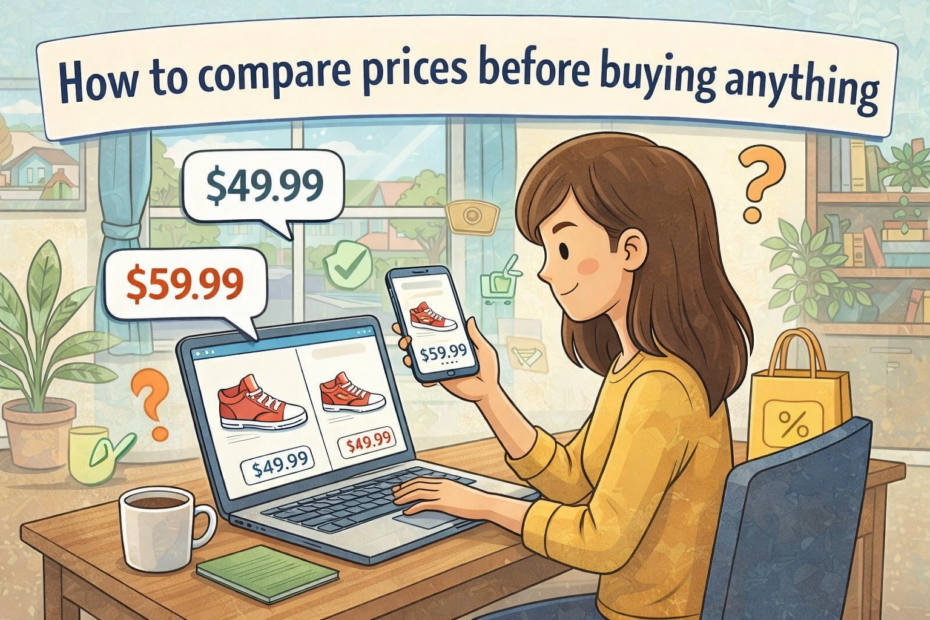
Tired of overpaying for products every time you shop? Learning how to compare prices before buying can save you hundreds of dollars each year and ensure you get the best value for your money.
With so many online stores, apps, and local shops offering different prices for the same product, failing to compare can lead to unnecessary spending and buyer’s remorse. By taking a few extra minutes to research and compare prices, you can uncover hidden deals, take advantage of discounts, and avoid impulse purchases.
Not only does this strategy stretch your budget further, but it also empowers you to make smarter, more informed buying decisions. Understanding how to compare prices before buying is the first step toward becoming a savvy shopper.
Why Comparing Prices Matters
Failing to compare prices before buying can cost you more than just money—it can lead to buyer’s remorse and missed opportunities for better deals. Many shoppers impulsively purchase products without checking other options, only to find the same item cheaper elsewhere or discover better alternatives.
Studies show that online shoppers who compare prices save an average of 20% per purchase, which can add up to significant savings over time. By taking the time to compare prices before buying, you not only ensure you’re getting the best deal but also make smarter choices that align with your budget and needs. Price comparison is a simple yet powerful tool for saving money and avoiding unnecessary spending.
Methods to Compare Prices
When it comes to saving money, knowing the right methods to compare prices before buying can make a huge difference. One of the easiest ways is using online tools and apps such as Google Shopping, PriceGrabber, or ShopSavvy. These platforms allow you to quickly check prices across multiple stores, saving time and effort.
Another effective method is visiting multiple stores in person. While online research is convenient, seeing products firsthand can help you spot deals or discounts that aren’t listed online.
It’s also important to check reviews and shipping costs. Sometimes the lowest price isn’t the best deal once you consider quality, shipping fees, or additional charges.
Finally, don’t forget to use coupons and deals. Price comparison isn’t just about the listed price—it includes checking promo codes, seasonal sales, or bundle offers to maximize savings.
Step-by-Step Guide to Compare Prices
Knowing how to compare prices before buying is easier when you follow a clear step-by-step process. Start by making a list of products or services you want to purchase. Having a list helps you stay organized and prevents impulse buying.
Next, search multiple sources for prices, both online and offline. Check different e-commerce websites, local stores, and apps to get a comprehensive view of available options.
Don’t forget to include hidden costs such as shipping fees, taxes, or installation charges. Sometimes a slightly higher listed price can end up being cheaper once these extras are considered.
It’s equally important to compare quality, not just price. Paying a bit more for a reliable product can save money in the long run by reducing replacements or repairs.
Finally, for big purchases, track price trends using tools like CamelCamelCamel for Amazon. Monitoring price history ensures you buy at the best possible time and avoid overpaying.
Tips for Smarter Shopping
To get the most out of your efforts to compare prices before buying, consider these practical tips. First, set a budget before starting your search. Knowing your spending limit helps you focus on products within your range and avoid overspending.
Next, subscribe to price alerts or newsletters from online stores and deal websites. These notifications can help you catch discounts and special offers as soon as they appear.
It’s also crucial to avoid impulsive buying. Give yourself 24–48 hours to research prices and options—this cooling-off period often leads to better decisions and savings.
Finally, always compare products with similar features, not just brand names. Two items from different brands may offer the same functionality at vastly different prices, so looking beyond the brand ensures you get the best value for your money.
Conclusion
Learning how to compare prices before buying anything is a simple yet powerful way to save money, avoid buyer’s remorse, and make smarter purchasing decisions.
By taking the time to research products, check multiple sources, and consider hidden costs, you can ensure that every purchase gives you the best value. Start implementing these strategies today—whether using online tools, visiting stores, or tracking deals—and watch how much you can save.
Remember, being a savvy shopper doesn’t just protect your wallet; it also helps you make more informed choices that benefit you in the long run. Don’t wait—begin comparing prices before buying and take control of your spending now.
Frequently Asked Questions
How can I compare prices effectively?
Comparing prices effectively requires a systematic approach that goes beyond simply looking at the numbers. The first step is to identify the exact product or service you want to purchase, ensuring that you are comparing identical items in terms of quality, specifications, brand, and features. This avoids misleading comparisons where one item may appear cheaper but lacks essential components or quality.
Next, gather pricing information from multiple sources. This can include online stores, local shops, marketplaces, or even catalogs. Digital tools and apps can make this process faster by automatically aggregating prices across different vendors. While collecting data, take note of hidden costs such as shipping fees, taxes, installation charges, or service fees, as these can significantly impact the final cost.
Once you have collected prices, create a structured comparison. A table or spreadsheet can help, allowing you to list each option along with its price, additional costs, and key features. This visual representation makes it easier to see which option offers the best value rather than just the lowest price.
It is also important to consider the timing of the purchase. Prices can fluctuate due to sales, seasonal discounts, or market trends. By observing pricing trends over time, you may identify opportunities to buy at the most advantageous moment.
Finally, consider qualitative factors alongside quantitative ones. A slightly higher price may be justified if it comes with better warranty, customer support, or brand reliability. Effective price comparison balances cost with value, ensuring you make an informed decision that meets your needs and budget.
What are the 5 C’s of pricing?
The 5 C’s of pricing provide a framework for setting and evaluating prices strategically. They are Company, Customers, Costs, Competition, and Channel.
-
Company: The internal objectives and goals of the company shape its pricing strategy. For instance, a company may prioritize market penetration, aiming to set lower prices to attract more customers. Alternatively, it may focus on premium positioning, charging higher prices to signal quality and exclusivity. Understanding company goals ensures pricing aligns with overall business strategy.
-
Customers: Pricing must consider the target audience’s willingness and ability to pay. Customer perception of value, purchasing behavior, and price sensitivity all influence how a product should be priced. Researching consumer demand and preferences helps identify the price range that customers are willing to accept.
-
Costs: Determining the total cost of production, distribution, and marketing is critical. Prices must cover these costs and ensure profitability. A thorough understanding of both fixed and variable costs ensures the business avoids losses while maintaining competitiveness.
-
Competition: Market conditions and competitor pricing influence strategic decisions. Evaluating what competitors charge, and how they differentiate themselves, helps a company position its products effectively. Pricing too high may push customers toward alternatives, while pricing too low can erode profits.
-
Channel: The distribution channel affects pricing. Different channels—retail stores, online platforms, or wholesale—can add costs or value to the product. Companies must consider how intermediaries, shipping, and logistics impact the final price to the consumer.
These five factors combined provide a holistic approach, balancing internal objectives with external market realities, allowing companies to set prices that are both competitive and profitable.
How to do a pricing comparison?
Pricing comparison involves a structured analysis to determine which product or service offers the best value for money. The first step is defining the exact items or services to compare. Make sure they are equivalent in quality, features, and specifications to avoid misleading conclusions.
Next, collect data from multiple sources. This can include online marketplaces, local retailers, catalogs, and price comparison websites. Ensure that you include all associated costs such as shipping, taxes, and installation fees, as these can significantly alter the actual cost.
Once the data is gathered, organize it in a way that allows easy evaluation. Spreadsheets, tables, or comparison charts are useful tools for visualizing differences. Include columns for price, additional costs, and key attributes, which allows for a more thorough comparison beyond just the sticker price.
Analyzing the data involves more than finding the lowest price. Consider the value each option provides. For instance, a higher-priced item might offer a longer warranty, better customer service, or superior quality, which could justify the additional cost. This approach ensures the comparison focuses on value rather than just cost.
Finally, review trends and timing. Prices can fluctuate based on promotions, seasonal discounts, or market demand. Monitoring these trends may help identify the optimal time to purchase. By combining careful data collection, structured organization, and value-based analysis, pricing comparison can guide informed purchasing decisions.
Why is it important to compare prices before making a purchase?
Comparing prices before making a purchase is essential for both financial efficiency and informed decision-making. One of the most immediate benefits is cost savings. Different retailers or platforms often sell the same product at varying prices due to discounts, overhead costs, or promotional strategies. By comparing prices, consumers can identify the most economical option without sacrificing quality.
Price comparison also promotes better value assessment. It encourages consumers to evaluate what they receive for the price, including warranties, support, and additional services. A slightly higher price may offer greater durability, better features, or superior customer service, which can result in a more satisfying purchase.
Additionally, price comparison helps avoid buyer’s remorse. When buyers make purchases without evaluating alternatives, they risk overpaying or selecting inferior products. A careful comparison ensures that the decision aligns with both budgetary constraints and personal requirements.
From a broader perspective, price comparison fosters market competitiveness. When consumers consistently compare prices, businesses are incentivized to maintain fair pricing, improve quality, and offer promotions, which benefits the overall market.
In summary, comparing prices safeguards financial resources, enhances decision-making, and encourages consumers to make purchases that align with their needs and priorities, ensuring satisfaction and value for money.
What are the 4 pricing methods?
There are four primary pricing methods businesses commonly use to set product or service prices: Cost-Based Pricing, Value-Based Pricing, Competition-Based Pricing, and Penetration/Premium Pricing.
-
Cost-Based Pricing: This method calculates the price by adding a fixed markup to the total cost of production. It ensures that costs are covered and a profit margin is maintained. While straightforward, it may not always align with market demand or perceived customer value.
-
Value-Based Pricing: Prices are set according to the perceived value of the product to the customer rather than its production cost. This approach requires understanding customer preferences, brand perception, and willingness to pay. Luxury brands often use this method to reflect quality and exclusivity.
-
Competition-Based Pricing: Prices are determined by analyzing competitors’ pricing strategies. The product may be priced slightly below, equal to, or above competitors depending on positioning and value differentiation. This method is common in highly competitive markets where consumer choice is sensitive to price differences.
-
Penetration/Premium Pricing: Penetration pricing sets a low initial price to attract customers and gain market share, then gradually increases the price. Premium pricing, conversely, sets a higher price to signal superior quality or exclusivity, appealing to customers willing to pay more for perceived benefits.
Each method has advantages and challenges, and businesses often combine strategies to match market conditions, customer behavior, and company goals. Effective pricing requires careful analysis to balance profitability, competitiveness, and consumer perception.
Can AI do price comparison?
Yes, AI can perform price comparison, and in many ways, it can do it faster and more accurately than a human. AI systems, particularly those using machine learning algorithms, can scan vast amounts of online data from multiple retailers, marketplaces, and e-commerce platforms in real-time. This allows AI to identify pricing trends, variations, and promotions much more efficiently than manual searches.
AI-powered price comparison tools typically work by collecting data through web scraping, APIs, or direct integrations with e-commerce platforms. Once the data is gathered, AI algorithms process it to standardize product specifications, remove duplicates, and match similar products across different sources. This ensures that comparisons are accurate and meaningful, avoiding mistakes such as comparing items with differing specifications or features.
Beyond simple price matching, AI can analyze historical pricing trends to predict future price changes. For example, some systems can indicate when a product is likely to be discounted or when a price drop is temporary. Additionally, AI can factor in shipping costs, taxes, delivery times, and other hidden expenses to calculate the total cost more precisely.
AI also enables personalization in price comparison. By learning user preferences, past behaviors, and spending habits, AI can highlight the most relevant options, helping users make better purchasing decisions that align with their needs and budgets. Advanced AI systems may even negotiate prices in some contexts, such as dynamic pricing environments or subscription services.
However, it is important to note that AI price comparison relies on accurate, up-to-date data. Any errors in data collection, mismatched product details, or incomplete information can lead to misleading comparisons. Despite these limitations, AI has become a powerful tool for both consumers and businesses, improving transparency, efficiency, and decision-making in price evaluation.
What are the 4 P’s of pricing?
The 4 P’s of pricing refer to Product, Price, Place, and Promotion, which are elements of the marketing mix that directly influence pricing strategies.
-
Product: The characteristics, quality, and features of the product impact its price. A premium-quality product with unique features can command a higher price, whereas a basic version may need competitive pricing to attract buyers. Product differentiation is crucial in setting a price that reflects value.
-
Price: This is the actual amount customers pay for the product. Pricing must balance profitability for the company with perceived value for the consumer. Companies consider production costs, competitor pricing, market demand, and consumer willingness to pay when setting prices.
-
Place: Distribution channels affect pricing as they influence accessibility and costs. Selling through retail stores, online platforms, or direct channels may have different associated costs and pricing implications. Efficient distribution can reduce expenses and make products more competitive.
-
Promotion: Marketing and promotional activities can justify price points or create perceived value. Sales campaigns, advertising, and special offers can temporarily or permanently influence how consumers perceive the price and its fairness. Promotions can also help penetrate new markets or maintain customer loyalty.
Together, these four elements ensure that pricing aligns with the overall marketing strategy, customer expectations, and business goals.
What are the 5 P’s of pricing?
The 5 P’s of pricing expand the traditional marketing mix to include Purpose, Product, Price, Promotion, and Place, offering a more strategic perspective for setting prices.
-
Purpose: Understanding the primary goal of pricing is essential. Businesses may aim to maximize profit, gain market share, penetrate new markets, or create a premium brand image. The purpose guides how aggressively or conservatively prices are set.
-
Product: The product’s attributes, features, and perceived value influence the price. High-quality, unique, or innovative products often justify higher prices. The product strategy ensures that pricing reflects both quality and customer expectations.
-
Price: This is the actual cost to the customer and must be competitive while ensuring profitability. Price-setting considers cost, demand, competitor pricing, and perceived value. The right price balances revenue objectives with market acceptance.
-
Promotion: Promotion supports pricing by communicating value. Discount strategies, marketing campaigns, and incentives can influence customer perception of price fairness and urgency. Effective promotion ensures that pricing strategies are understood and accepted by the target audience.
-
Place: Distribution strategy impacts pricing decisions. Costs associated with logistics, channel intermediaries, and geographic reach must be considered to maintain profitability and competitive positioning.
By integrating these five factors, businesses can develop pricing strategies that align with their overall goals, market conditions, and customer expectations.
What are the 7 factors that determine the correct pricing strategy?
Several factors influence the determination of an effective pricing strategy, and businesses must carefully consider them to remain competitive and profitable. The seven key factors are Costs, Customer Demand, Market Competition, Product Life Cycle, Brand Positioning, Regulatory Environment, and Distribution Channels.
-
Costs: A fundamental factor is the total cost of producing and delivering a product. Pricing must cover both fixed and variable costs to ensure profitability.
-
Customer Demand: Understanding how much customers are willing to pay is crucial. Price elasticity of demand indicates how sensitive customers are to price changes, helping determine optimal pricing levels.
-
Market Competition: Prices must consider competitors’ pricing strategies. Positioning the product as more affordable, premium, or comparable can affect sales volume and market share.
-
Product Life Cycle: The stage of the product—introduction, growth, maturity, or decline—affects pricing decisions. Early-stage products may use penetration or skimming pricing, while mature products may focus on maintaining competitive pricing.
-
Brand Positioning: The brand’s perceived value influences pricing. Premium brands can command higher prices due to perceived quality, while budget brands focus on affordability and volume sales.
-
Regulatory Environment: Legal restrictions, taxes, tariffs, or industry regulations can constrain pricing options. Companies must comply with rules to avoid fines or penalties.
-
Distribution Channels: Costs and efficiency of distribution channels impact pricing. Selling directly may allow more flexibility, while intermediaries may increase the final price.
Considering these factors ensures a pricing strategy that is balanced, competitive, and aligned with the company’s objectives and market conditions.
How to compare two different prices?
Comparing two different prices requires a methodical approach to ensure that the comparison reflects true value rather than just the numeric cost. Start by ensuring that the products or services being compared are identical in terms of quality, specifications, brand, and features. Differences in these aspects can make one seemingly cheaper option less valuable.
Next, consider all associated costs. A lower sticker price may not be the cheaper option if shipping, taxes, handling fees, or installation costs are higher. Calculate the total cost for both options to get an accurate comparison.
Once total costs are determined, evaluate qualitative factors. For example, a higher-priced option may come with better warranty coverage, superior customer support, or longer durability. Factor in these elements because they can affect long-term value and overall satisfaction.
Using a simple table or spreadsheet helps organize the comparison. List each price, additional costs, and qualitative benefits side by side. This visualization allows a clear assessment of which option offers better overall value.
Finally, consider timing and promotions. One option may be temporarily discounted, which affects immediate savings but may not be sustainable long-term. Comparing both current prices and potential future trends ensures a more strategic decision.
By analyzing total costs, qualitative factors, and timing, you can compare two prices accurately and make a decision that maximizes value while minimizing unnecessary expenditure.
What is the .99 pricing strategy?
The .99 pricing strategy, also known as charm pricing, is a psychological pricing technique where prices are set just below a round number, typically ending in .99 or .95.
For example, a product priced at $9.99 instead of $10.00 appears significantly cheaper to customers, even though the difference is only one cent. This strategy leverages consumer perception, making the price seem lower than it actually is.
The effectiveness of .99 pricing is based on the way people read numbers from left to right. When customers see $9.99, their attention is drawn to the “9” at the beginning, perceiving it as closer to $9 than $10. This subtle psychological effect can increase sales by creating the impression of better value.
Retailers use this strategy extensively in both physical stores and online markets. It is particularly effective for low- to mid-priced items, impulse purchases, and high-volume products where small differences in perceived cost can significantly impact buying decisions. Some studies suggest that .99 pricing can boost conversion rates because customers feel they are getting a deal, even if the actual savings are minimal.
However, the .99 strategy has limitations. It may be less effective for luxury or premium products, where customers associate round numbers with quality and prestige. In these cases, pricing items as $100 rather than $99.99 can reinforce the perception of exclusivity and higher value. Additionally, overuse of charm pricing can lead to skepticism, especially if customers recognize the tactic and feel manipulated.
In conclusion, the .99 pricing strategy is a psychological tool designed to make products appear more affordable and encourage purchases. Its success depends on context, target audience, and product type, making it most suitable for everyday consumer goods rather than high-end luxury items.
Which is the best pricing strategy?
There is no single “best” pricing strategy because the optimal approach depends on the product, market conditions, customer behavior, and business objectives. However, several widely used strategies consistently perform well when applied correctly. These include cost-based pricing, value-based pricing, competitive pricing, penetration pricing, and premium pricing.
-
Cost-based pricing ensures profitability by adding a markup to production costs. It is simple and guarantees coverage of expenses but may not maximize revenue if market demand allows higher prices.
-
Value-based pricing focuses on the perceived value to customers, often allowing higher margins. This approach is ideal for products with unique features or brand recognition.
-
Competitive pricing considers rival prices to stay attractive in crowded markets. It helps maintain market share but requires careful monitoring of competitors’ strategies.
-
Penetration pricing sets low initial prices to attract customers and gain market share quickly. It is effective for new products but may lower perceived value if not managed properly.
-
Premium pricing targets customers willing to pay more for higher quality, exclusivity, or luxury perception. It enhances brand positioning but limits the audience to those who can afford it.
Ultimately, the “best” pricing strategy balances profitability, market competitiveness, and customer perception. Businesses often combine strategies depending on product type, market lifecycle stage, and overall objectives to maximize both sales and revenue.
What’s it called when you compare prices?
Comparing prices is commonly referred to as price comparison or comparison shopping. This practice involves evaluating the prices of the same product or service across different sellers, retailers, or platforms to determine which option offers the best value. Price comparison is an essential tool for consumers seeking to make informed decisions and avoid overpaying.
Businesses also conduct price comparisons to monitor competitors and adjust their pricing strategies. This process helps maintain competitiveness and ensures that their offerings remain attractive to customers. Online tools, apps, and websites have made price comparison more efficient by automatically collecting and displaying pricing information from multiple sources, allowing quick and accurate evaluations.
Does it cost to use Compare the Market?
Using Compare the Market, a popular price comparison platform, is generally free for consumers. The service allows users to compare prices for insurance, energy, financial products, and more without paying a fee. Revenue for the platform primarily comes from referrals, partnerships, and commissions from companies whose products are purchased through the website.
Consumers benefit from access to a wide range of options in one place, including quotes, features, and provider ratings. While the comparison itself is free, users should review the details of any product they select through the platform to understand costs, terms, and conditions fully.
How to do comparison shopping?
Comparison shopping is the process of evaluating products or services from multiple sources to find the best price, quality, and value. The first step is identifying the exact item you want, including brand, model, size, and features. Accurate specification ensures that you are comparing equivalent products.
Next, gather price information from various retailers or platforms, including online stores, local shops, and marketplaces. Consider total costs, not just the listed price, by factoring in taxes, shipping, and additional fees.
Organize the information using a spreadsheet or table to visualize differences in price, features, warranties, and customer service. This approach allows you to make a more informed decision beyond just the cheapest option.
Additionally, monitor promotions, discounts, and seasonal sales to identify the optimal time to purchase. Reading product reviews and checking return policies also helps ensure that quality and reliability are considered alongside cost.
Finally, weigh qualitative aspects such as brand reputation, customer support, and longevity, since these can affect the overall value. By combining thorough research, careful organization, and critical evaluation, comparison shopping enables smarter purchasing decisions and maximizes value for money.
What is a C5 in marketing?
In marketing, the term C5 is sometimes used to refer to an expanded version of the traditional 4 C’s model, which is an alternative framework to the 4 P’s of marketing.
While the 4 C’s originally include Customer, Cost, Convenience, and Communication, the C5 model adds a fifth element, often interpreted as Care or Collaboration, depending on the context.
-
Customer: Focuses on understanding the needs, preferences, and behaviors of the target audience. Effective marketing strategies are customer-centric, aiming to create value and meet consumer expectations.
-
Cost: Refers to the total cost to the customer, including price, time, effort, and any other sacrifices associated with obtaining the product or service. This broadens the traditional pricing focus to consider overall perceived value.
-
Convenience: Ensures the product or service is easily accessible and available where and when customers need it. This includes distribution channels, online availability, and ease of purchase.
-
Communication: Involves how the company interacts with its audience, including advertising, promotions, social media engagement, and customer service. Clear and consistent communication builds trust and brand loyalty.
-
Care/Collaboration: The fifth element emphasizes nurturing relationships, building long-term loyalty, or partnering with customers for co-creation. It focuses on maintaining engagement beyond the initial purchase.
The C5 framework is useful for modern marketing strategies because it incorporates relationship management, customer experience, and holistic value creation. It highlights the importance of going beyond transactional marketing to foster lasting connections with consumers, ensuring that strategies are aligned with evolving market expectations.
What are six steps in the pricing process?
Developing a pricing strategy typically involves a structured process to ensure that prices align with business goals, market conditions, and customer expectations. The six main steps in the pricing process are:
-
Identify Pricing Objectives: Determine what the business wants to achieve with pricing, such as maximizing profit, gaining market share, or entering a new market. Clear objectives guide all subsequent decisions.
-
Analyze Costs: Calculate both fixed and variable costs associated with producing and delivering the product. Pricing must cover costs and ensure profitability.
-
Study Market Demand: Understand customer behavior, price sensitivity, and perceived value. Market research helps identify acceptable price ranges and demand elasticity.
-
Assess Competitors: Analyze competitors’ prices, positioning, and strategies. This helps identify opportunities to differentiate or align pricing to maintain competitiveness.
-
Select a Pricing Method: Choose a method such as cost-based, value-based, competition-based, or dynamic pricing based on insights from previous steps.
-
Set the Price and Monitor: Establish the final price and implement monitoring mechanisms to track performance, sales, and market reactions. Adjust prices as necessary based on feedback, competition, and changing market conditions.
Following these steps ensures a systematic, informed approach to pricing, reducing the risk of underpricing or overpricing while optimizing revenue and customer satisfaction.
How to develop a pricing strategy?
Developing a pricing strategy involves combining market research, business objectives, and financial analysis to determine the optimal price for a product or service. The first step is defining the company’s objectives, such as maximizing profit, increasing market share, or establishing a premium brand. These objectives will shape the pricing approach.
Next, analyze cost structures to determine minimum price thresholds that cover production, distribution, and marketing expenses. Understanding costs ensures the business avoids losses while maintaining profitability.
Market research is critical to gauge customer demand and perceived value. Identify how much consumers are willing to pay, their price sensitivity, and how they perceive value relative to competitors. This insight allows businesses to align prices with what customers consider fair and appealing.
Evaluate competitor pricing to understand market positioning and identify gaps or opportunities. Consider whether to price above, below, or at parity with competitors, depending on differentiation and strategic goals.
Choose a pricing method that aligns with objectives and market conditions. Options include cost-based, value-based, competition-based, or dynamic pricing strategies. The choice should balance profitability with competitiveness.
Finally, implement the pricing strategy and continuously monitor performance. Track sales trends, customer feedback, and competitor reactions, adjusting prices if necessary to maintain alignment with objectives and market dynamics. A well-developed pricing strategy is flexible, data-driven, and customer-focused, ensuring sustainable profitability and market relevance.
What is the formula for price comparison?
The formula for price comparison is relatively straightforward but must account for total costs rather than just the listed price. A basic formula is:
Total Cost = Listed Price + Additional Costs
Where additional costs may include shipping, taxes, installation fees, service charges, or subscription fees. Once the total cost for multiple options is calculated, the prices can be compared directly:
Price Difference = Total Cost of Option A − Total Cost of Option B
To express the comparison as a percentage difference:
Percentage Difference = (Price Difference ÷ Total Cost of Option B) × 100
This formula allows consumers or businesses to evaluate which option provides the best value, factoring in all associated costs rather than relying solely on the sticker price. For more complex scenarios, qualitative factors such as warranties, customer service, or product lifespan can be incorporated to assess overall value.
What chart is best for price comparison?
The best chart for price comparison is typically a bar chart, as it clearly displays differences between multiple products or options. Bar charts allow viewers to compare prices visually, making it easier to identify the highest and lowest values quickly. Each bar represents a product or service, and the height corresponds to the price, enabling immediate comparison.
For more complex comparisons that include multiple factors like features, shipping, or additional fees, a stacked bar chart can be used. This format shows the total cost while breaking it down into individual components, such as base price, taxes, and delivery charges.
In cases where trends over time are important, such as monitoring price fluctuations, a line chart may be more appropriate. This visualizes how prices change over days, weeks, or months, helping identify the best time to buy.
Ultimately, the choice of chart depends on the data and context, but bar charts are generally the most straightforward and effective for comparing prices across different products or sellers.
What are the 4 P’s of competitor analysis?
The 4 P’s of competitor analysis focus on Product, Price, Place, and Promotion—the same foundational elements used in marketing strategy but applied specifically to evaluate competitors. This approach helps businesses understand how rivals operate in the market and identify opportunities for differentiation or improvement.
-
Product: Analyze competitors’ products in terms of features, quality, design, and innovation. Understanding what makes a competitor’s product appealing or unique helps identify gaps or areas where your offering can be improved or positioned differently.
-
Price: Examine how competitors price their products. This includes not just the list price but also discounts, promotional offers, and bundling strategies. Understanding competitor pricing helps a business determine whether to align with market rates, undercut, or adopt a premium strategy.
-
Place: Assess how competitors distribute their products. This includes physical stores, online platforms, direct sales, or third-party channels. Knowing where and how competitors reach customers can inform decisions about distribution efficiency and coverage.
-
Promotion: Evaluate competitors’ marketing strategies, including advertising, social media presence, public relations, and sales promotions. Understanding how competitors communicate value can guide your promotional campaigns and help create differentiation in messaging.
By analyzing these four areas, businesses gain a comprehensive understanding of competitor strengths, weaknesses, and market positioning, enabling more informed strategic decisions.
What are the 4 P’s of pricing strategy?
The 4 P’s of pricing strategy refer to Product, Price, Place, and Promotion and provide a framework for determining how pricing interacts with the overall marketing strategy.
-
Product: The nature of the product, including quality, features, and uniqueness, influences its price. Products with higher perceived value or specialized features can command higher prices, while basic products may require competitive pricing.
-
Price: The actual monetary value assigned to the product is central to the pricing strategy. Businesses must consider costs, demand, competition, and perceived value when setting prices to ensure profitability and market alignment.
-
Place: Distribution channels affect how pricing is implemented. Products sold directly to consumers, through retail outlets, or via online platforms may have different associated costs and pricing considerations. Efficient distribution can lower costs and support competitive pricing.
-
Promotion: Marketing activities influence how prices are perceived. Sales, discounts, advertising, and campaigns can justify or enhance price points, attract attention, and influence purchase decisions. Promotion ensures that pricing strategy aligns with customer expectations and brand positioning.
The 4 P’s approach ensures that pricing decisions are integrated into the overall marketing mix, supporting both revenue goals and customer value perception.
What is the rule of 6 in marketing?
The Rule of 6 in marketing is a principle suggesting that a potential customer needs to be exposed to a marketing message at least six times before they take action or make a purchase decision. This concept is based on the idea that repeated exposure increases brand familiarity, trust, and recall, which in turn improves conversion rates.
The rule emphasizes the importance of consistent messaging across multiple touchpoints, such as social media, emails, advertisements, and in-store promotions. By reaching customers multiple times, businesses can overcome hesitation, reinforce value, and stay top-of-mind in a competitive market.
Implementing the Rule of 6 requires careful planning of campaigns to ensure messages are repeated without becoming annoying or intrusive. It also encourages multi-channel marketing to maximize exposure, ensuring potential customers encounter the brand across different platforms.
What are the 7 C’s of pricing?
The 7 C’s of pricing is a framework that helps businesses set prices strategically by considering seven critical factors: Customer, Costs, Competition, Channel, Company, Conditions, and Communication.
-
Customer: Understand the target audience, their willingness to pay, and perceived value.
-
Costs: Include all production, distribution, and marketing costs to ensure profitability.
-
Competition: Monitor competitor pricing and positioning to stay competitive.
-
Channel: Consider distribution channels and their impact on final price.
-
Company: Align pricing with internal objectives and brand positioning.
-
Conditions: Factor in market conditions, economic trends, and regulatory constraints.
-
Communication: Ensure pricing strategies are clearly conveyed to customers to reinforce perceived value and fairness.
Using the 7 C’s framework ensures a comprehensive and balanced pricing approach that accounts for both internal and external factors affecting market performance.
What is the 50/30/20 rule in marketing?
The 50/30/20 rule in marketing is a budgeting guideline adapted from personal finance principles to help businesses allocate marketing resources efficiently. It suggests dividing the marketing budget into three categories:
-
50% for Core Activities: Half of the budget should be spent on essential marketing efforts that directly drive revenue and support primary business objectives. This may include advertising campaigns, lead generation, and content creation.
-
30% for Growth Initiatives: Nearly a third of the budget should focus on experiments, new channels, or strategies that have the potential to increase market share, reach new audiences, or enhance brand awareness.
-
20% for Contingencies and Optimization: The remaining portion is reserved for unexpected opportunities, market adjustments, or improvements in existing campaigns. This allows flexibility and responsiveness in dynamic markets.
Applying the 50/30/20 rule helps marketers maintain balance between consistent performance, innovation, and adaptability, ensuring resources are used efficiently to achieve both short-term and long-term objectives.