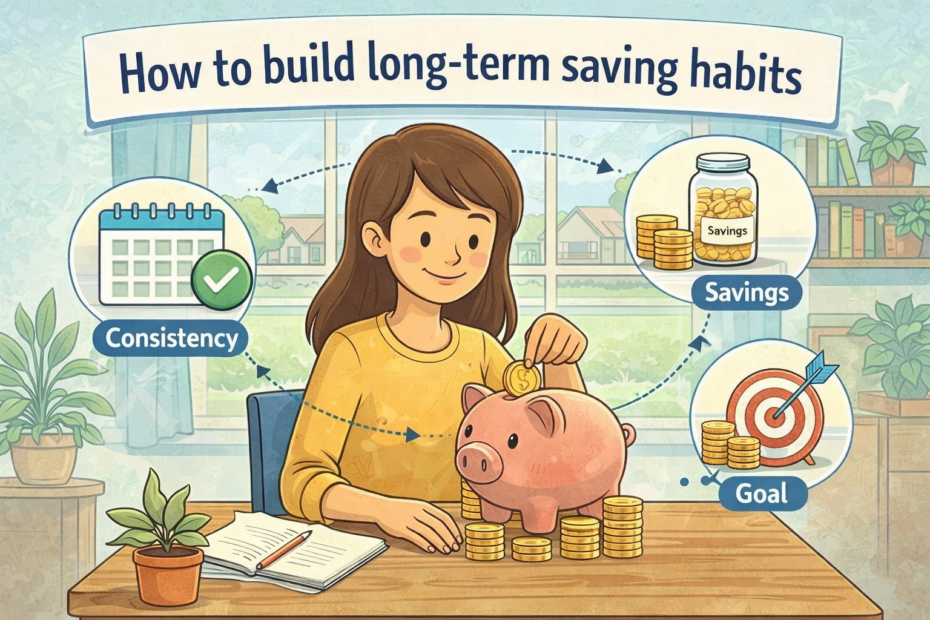
Building long-term saving habits is one of the most important steps toward achieving financial security and independence. While many people earn steadily, few develop the discipline to save consistently, which can make unexpected expenses and future goals feel overwhelming.
By establishing effective saving routines early, you can turn small, regular contributions into a significant financial cushion over time. This guide will walk you through practical strategies to build long-term saving habits that are realistic, easy to maintain, and adaptable to any lifestyle.
Whether your goal is buying a home, creating an emergency fund, or planning for retirement, these tips will help you stay on track and make saving a natural part of your daily life.
Why Long-Term Saving Habits Are Important
Developing how to build long-term saving habits is essential for financial stability and peace of mind. Consistent saving allows you to build an emergency fund that acts as a financial safety net when life throws unexpected challenges your way, such as medical bills, car repairs, or job loss, without resorting to high-interest debt.
Research shows that a significant portion of adults would struggle to cover even modest emergency expenses without savings, highlighting why this foundational financial practice matters.
In addition to short-term security, long-term saving habits support retirement planning. With traditional pension plans becoming less common and individuals increasingly responsible for their own retirement funds, disciplined saving today can make the difference between a comfortable retirement and financial uncertainty later in life.
Beyond safety and retirement, consistent saving gradually builds financial freedom, giving you the flexibility to pursue opportunities—whether buying a home, investing in education, or starting a business—without undue stress. By practicing strong saving routines now, you enhance your ability to reach both immediate needs and future goals with confidence.
Common Challenges People Face in Saving
Even when people understand the importance of saving, many struggle to turn intention into action. One of the most common obstacles is a lack of budgeting.
Without a clear plan for income and expenses, it’s easy to overspend and lose track of where money is going. Impulsive spending is another challenge; small, unplanned purchases can quickly add up, leaving little left for long-term savings.
External factors, such as inflation, also make saving more difficult. As the cost of living rises, the same amount of money covers less, requiring more discipline to maintain regular savings.
Additionally, existing debt can drain resources and make it seem impossible to start saving consistently. Credit card balances, loans, and other obligations often take priority over building a financial cushion, creating a cycle that’s hard to break.
Understanding these challenges is the first step to building long-term saving habits. Once you recognize the obstacles, you can adopt practical strategies that address them directly, helping you create a consistent, sustainable saving routine that withstands both personal and economic pressures.
Proven Strategies to Build Long-Term Saving Habits
Developing strong saving routines requires more than good intentions—it demands actionable strategies that you can follow consistently. Here are some proven methods to help you build long-term saving habits effectively.
1. Set Clear Financial Goals
Setting clear financial goals is the foundation of long-term saving habits. Start by distinguishing between short-term and long-term objectives. Short-term goals might include saving for a vacation or paying off a small debt, while long-term goals could involve buying a house, funding education, or preparing for retirement.
Make your goals measurable by using the SMART framework—Specific, Measurable, Achievable, Relevant, and Time-bound. For example, instead of saying “I want to save money,” aim for “I will save $200 every month for the next 12 months.” Clear goals give your saving efforts direction and motivation.
2. Create a Budget and Track Expenses
A budget acts as a roadmap for your finances. By tracking your income and expenses, you can identify where your money is going and spot opportunities to save.
Consider using budgeting apps or tools such as Mint, YNAB, or PocketGuard to simplify this process. When you consistently monitor your spending, you can adjust habits, prioritize saving, and ensure that your money is being used in alignment with your financial goals.
3. Automate Your Savings
Automation is a powerful way to ensure consistency. Set up automatic transfers from your checking account to a savings account or investment plan each month. This “pay yourself first” approach reduces the temptation to spend what you should be saving and builds your financial cushion steadily over time.
4. Reduce Unnecessary Expenses
Cutting non-essential costs can free up money for savings. Conduct a subscription audit to cancel unused services, plan meals to avoid last-minute takeout, and shop with a list to prevent impulse purchases. Small changes in daily spending can accumulate into substantial savings over the long term.
5. Build an Emergency Fund
An emergency fund is a cornerstone of long-term saving habits. By setting aside three to six months’ worth of living expenses, you protect yourself from unexpected costs without resorting to debt. Knowing that you have a financial safety net reinforces the habit of saving regularly and reduces stress during emergencies.
6. Use Rewards to Stay Motivated
Saving doesn’t have to feel like a chore. Track your milestones and celebrate small wins—whether it’s treating yourself to a modest reward after hitting a savings goal or simply acknowledging your progress. Positive reinforcement strengthens your saving habits and keeps you motivated over the long term.
Implementing these strategies consistently will help you develop long-term saving habits that stick. By combining clear goals, disciplined budgeting, automation, cost-cutting, and motivation, you can gradually build a strong financial foundation that supports both short-term needs and long-term aspirations.
Mindset and Behavioral Changes
Developing long-term saving habits isn’t just about numbers—it’s also about mindset and behavior. One of the most important traits to cultivate is consistency.
Saving a small amount regularly is far more effective than saving large sums sporadically. By making saving a routine part of your financial life, you reinforce discipline and create habits that last for years.
Patience is another critical factor. Long-term savings grow slowly, especially when relying on interest, investments, or gradual accumulation. It’s natural to want immediate rewards, but learning to delay gratification is key to achieving larger financial goals.
Overcoming impulses to spend on non-essential items allows you to redirect resources toward meaningful objectives like an emergency fund, a home, or retirement.
Behavioral strategies, such as visualizing goals, setting reminders, or using budgeting apps, can help maintain focus and reduce temptation. By combining practical strategies with the right mindset, you can ensure that saving becomes an automatic, stress-free part of your life. Ultimately, embracing consistency, patience, and self-discipline is what solidifies long-term saving habits and sets the stage for lasting financial security.
Conclusion
In building long-term saving habits is a crucial step toward financial stability and freedom. By setting clear goals, creating a budget, automating savings, reducing unnecessary expenses, and maintaining an emergency fund, you establish a strong foundation for consistent saving.
Equally important is cultivating the right mindset—practicing patience, overcoming impulses, and staying disciplined ensures that your financial efforts are sustainable over time.
Remember, you don’t need to make drastic changes overnight. Start small, whether it’s saving a modest amount each week or cutting back on minor expenses, and gradually increase your contributions as your habits strengthen. Consistency and persistence are the keys to lasting results.
Start implementing these strategies today and take control of your financial future by building long-term saving habits that will serve you for years to come. Your future self will thank you.
Frequently Asked Questions
How do I build a long-term savings plan?
Building a long-term savings plan requires a disciplined approach and a clear understanding of your financial goals. The first step is to define your objectives, whether it is retirement, buying a house, education, or building an emergency fund. Knowing the purpose of your savings helps determine the amount you need to save and the timeframe required.
Next, assess your current financial situation by evaluating income, expenses, debts, and existing savings. Create a budget that identifies how much money can be allocated to savings each month. This ensures you save consistently without compromising essential living expenses.
Once you understand your budget, set a savings target. Break the target into achievable monthly or annual contributions. Automating transfers to a dedicated savings account or investment vehicle ensures that saving becomes a routine habit, reducing the temptation to spend.
Choosing the right savings or investment instruments is critical for long-term growth. High-yield savings accounts, certificates of deposit, stocks, bonds, and retirement accounts each offer different returns and risk levels. Diversifying investments helps balance potential returns against risks.
Monitoring and adjusting your plan over time is essential. Life circumstances, income changes, inflation, and market fluctuations can affect your strategy. Periodic reviews allow you to adjust contributions or investment choices to stay on track toward your goals.
Finally, incorporate discipline and patience. Long-term savings growth is gradual, and maintaining consistency over years is more important than short-term gains. A well-structured savings plan combined with regular review ensures financial security and the ability to achieve long-term goals.
What is the 3 6 9 rule of money?
The 3 6 9 rule of money is a guideline designed to help individuals manage debt repayment effectively. According to this rule, debts are categorized into three timeframes: short-term (3 months), medium-term (6 months), and long-term (9 months). Each category helps prioritize repayments based on urgency and interest rates.
Short-term debts, usually high-interest or urgent obligations, are addressed first within three months to prevent compounding interest and financial strain. Medium-term debts, typically manageable loans, are planned to be repaid over six months, providing balance between obligations and savings.
Long-term debts, such as mortgages or large loans, are structured over nine months or longer, allowing systematic repayment without jeopardizing financial stability.
By organizing debts into these timeframes, individuals can create a structured repayment plan, reduce stress, and avoid missed payments. The 3 6 9 approach promotes accountability and ensures that financial resources are allocated efficiently, fostering better money management.
What is the 70/20/10 rule money?
The 70/20/10 rule is a budgeting method that allocates income into three main categories: 70% for essentials, 20% for savings or debt repayment, and 10% for discretionary spending.
-
70% Essentials: This portion covers necessities such as rent or mortgage, utilities, groceries, transportation, insurance, and other essential living expenses. Managing this category ensures that basic needs are met without financial strain.
-
20% Savings/Debt Repayment: This portion is dedicated to long-term financial goals, including savings, retirement contributions, or paying down debt. Consistently allocating this amount builds wealth and reduces financial vulnerabilities over time.
-
10% Discretionary Spending: This portion allows flexibility for entertainment, hobbies, dining out, or non-essential purchases. Allocating a small percentage for personal enjoyment helps maintain a balanced and sustainable financial plan.
Following the 70/20/10 rule promotes discipline while ensuring that savings and debt management are prioritized without completely eliminating enjoyment or lifestyle choices.
What is the 3 jar method?
The 3 jar method is a money management system designed to help individuals allocate their income into three distinct categories: Necessities, Savings, and Personal Spending.
-
Necessities Jar: This jar covers essential expenses, including rent, bills, groceries, and transportation. Allocating a fixed percentage of income ensures that all basic needs are funded.
-
Savings Jar: This jar is for long-term financial goals, such as building an emergency fund, investing, or saving for large purchases. Regular contributions create financial security and future growth.
-
Personal Spending Jar: This jar allows discretionary spending on entertainment, hobbies, and lifestyle choices. Limiting this portion encourages responsible spending while still providing flexibility.
The 3 jar method simplifies budgeting, encourages financial discipline, and helps individuals visualize their money allocation. It is particularly effective for beginners or those struggling to maintain control over spending habits.
What is the 50 30 20 rule?
The 50/30/20 rule is a widely used budgeting framework that divides after-tax income into three categories: 50% for needs, 30% for wants, and 20% for savings or debt repayment.
-
50% Needs: Covers essential living expenses such as housing, utilities, groceries, insurance, and transportation.
-
30% Wants: Covers discretionary spending on non-essentials, including entertainment, travel, dining out, and hobbies.
-
20% Savings/Debt Repayment: Allocates money to build an emergency fund, contribute to retirement accounts, or pay down debts systematically.
This rule promotes balanced financial management, ensuring that immediate needs are met, lifestyle choices are satisfied, and long-term financial stability is maintained.
What is the 10 5 3 rule?
The 10 5 3 rule is a financial guideline designed to help individuals manage their income and spending effectively. While variations exist, the most common interpretation divides income into three main categories: 10% for charitable giving or community contributions, 5% for discretionary splurges, and 3% for emergency or unexpected expenses. The remaining portion of income is generally allocated to essentials, savings, and long-term investments.
The 10% for charitable giving emphasizes the importance of social responsibility and fostering a sense of contribution to society. This portion encourages consistent philanthropy or support for causes, creating a positive impact on communities while instilling disciplined allocation of funds.
The 5% for discretionary splurges allows flexibility for personal enjoyment, hobbies, or entertainment. By setting aside a small percentage of income for indulgence, the rule promotes a balanced financial life where individuals can enjoy rewards for their efforts without compromising overall financial stability.
The 3% for emergency expenses ensures that unexpected costs, such as minor repairs, medical bills, or sudden travel, are covered without disrupting the main budget. While small, this allocation encourages planning for unforeseen circumstances and fosters a habit of financial preparedness.
By following the 10 5 3 rule, individuals can develop a disciplined financial routine that balances responsibility, enjoyment, and contingency planning, helping maintain long-term financial health.
What is the quickest way to manifest money?
The concept of manifesting money is rooted in psychology and personal development rather than a guaranteed financial formula. The quickest way to manifest money involves combining clarity, belief, action, and strategy.
First, clearly define the financial goal. Be specific about the amount, purpose, and timeframe. Writing down the goal reinforces intention and provides focus. Visualization techniques can also enhance clarity, as imagining the achievement of financial objectives engages the subconscious mind and motivates action.
Second, cultivate a positive mindset and belief in the ability to achieve the goal. Limiting beliefs or negative thoughts about money can hinder progress. Focusing on abundance rather than scarcity encourages openness to opportunities.
Third, take deliberate actions aligned with the goal. This may include improving skills, seeking new income sources, budgeting effectively, investing wisely, or exploring business opportunities. Manifestation without concrete action is unlikely to yield results.
Finally, remain consistent and patient. Tracking progress, adjusting strategies, and maintaining discipline amplify results. Combining mental focus with practical financial steps is the fastest way to move toward manifesting money while ensuring sustainable growth and security.
How long will $500,000 last using the 4% rule?
The 4% rule is a guideline used in retirement planning to estimate how much money can be withdrawn annually without running out of funds. According to this rule, withdrawing 4% of the initial retirement portfolio per year allows the funds to last approximately 25 years.
For a $500,000 portfolio, 4% equals $20,000 per year. This assumes a balanced investment strategy, accounting for inflation and moderate market returns. The rule is designed for long-term sustainability, providing a steady income stream while minimizing the risk of depleting funds prematurely.
It is important to note that the 4% rule is a guideline, not a guarantee. Variations in market performance, inflation, and unexpected expenses can affect the longevity of the funds. Regular monitoring and adjustments to withdrawals may be necessary to maintain financial stability throughout retirement.
What is the 40 rule money?
The 40 rule in money management refers to a budgeting strategy where 40% of income is allocated toward needs or essentials, while the remaining 60% is split between wants and savings, depending on individual goals. This rule emphasizes prioritizing necessary expenses while ensuring flexibility and financial growth.
The 40% allocation covers essential living costs such as housing, utilities, transportation, groceries, and insurance. By limiting these expenditures to a set portion of income, individuals maintain control over their financial situation and reduce the risk of overspending.
The remaining income is divided between discretionary spending and saving or investing. This approach encourages financial discipline, balances lifestyle enjoyment with long-term planning, and ensures that future goals such as retirement, debt repayment, or emergency funds are adequately funded.
What is the 27 dollar rule?
The $27 rule is a simple financial principle used to guide spending or saving habits. While its interpretation can vary, a common version suggests that individuals should aim to save or invest at least $27 each day or roughly $810 per month, depending on income and financial goals.
The rule is designed to create consistency in financial habits. By setting aside a small, manageable daily amount, individuals can accumulate significant savings over time, harnessing the power of compounding interest and disciplined financial planning.
The $27 rule emphasizes the idea that consistent, small contributions can have a substantial long-term impact. It encourages individuals to focus on incremental progress rather than attempting large, unsustainable savings goals, making financial growth more achievable and realistic.
Can I retire at 70 with $400,000?
Retiring at 70 with $400,000 is possible, but whether it is sufficient depends on your lifestyle, expenses, and other income sources. The key is understanding your annual spending needs in retirement. For example, if your annual expenses are $40,000, $400,000 could provide about ten years of income without investment growth. However, if you invest the money wisely, it can grow and support a longer retirement period.
Using conservative investment strategies, such as a balanced portfolio of stocks and bonds, you may be able to generate annual returns of 4%–6%. Applying the 4% rule, $400,000 could safely provide approximately $16,000 per year. Additional income sources, such as Social Security, pensions, or part-time work, can supplement this and make retirement more feasible.
Other factors to consider include healthcare costs, inflation, and unexpected expenses. Planning a realistic budget, minimizing debt, and delaying retirement benefits until age 70 can increase financial security. Ultimately, retiring at 70 with $400,000 is achievable, but careful planning and disciplined financial management are essential to ensure that your savings last throughout retirement.
What if I invest $200 a month for 20 years?
Investing $200 a month for 20 years can lead to significant wealth accumulation, especially when compounded over time. Assuming an average annual return of 7%, typical of a diversified stock portfolio, the future value can be calculated using the formula for the future value of a series of contributions:
FV = P × [(1 + r)^n − 1] ÷ r,
where P is the monthly contribution, r is the monthly interest rate, and n is the total number of months.
With $200 monthly contributions, a 7% annual return (0.583% monthly), and 240 months (20 years), the future value would be approximately $120,000–$130,000. This demonstrates the power of consistent, long-term investing, even with moderate contributions. Starting earlier or increasing monthly contributions can further enhance growth, making this a practical strategy for retirement or long-term financial goals.
What is the Ramsey method?
The Ramsey Method, popularized by financial expert Dave Ramsey, is a debt reduction and wealth-building strategy. It emphasizes a step-by-step approach to personal finance, focusing on eliminating debt, building emergency savings, and investing for the future.
The method begins with the Baby Steps, starting with saving $1,000 for an emergency fund, then using the debt snowball method—paying off smallest debts first while maintaining minimum payments on others. After clearing all non-mortgage debt, the next steps involve building a full emergency fund, investing 15% of income into retirement accounts, saving for college or large purchases, and ultimately paying off the mortgage.
The Ramsey Method emphasizes discipline, budgeting, and consistent financial behaviors. It is particularly effective for individuals struggling with debt or lacking financial structure, providing a clear roadmap to financial independence.
What is the easiest way to save money?
The easiest way to save money is to automate the process. By setting up automatic transfers from your checking account to a savings or investment account, you ensure consistent contributions without relying on willpower. Treating savings as a fixed expense rather than discretionary spending reinforces discipline.
Other effective strategies include reducing unnecessary spending by tracking expenses, creating a budget, using cash envelopes for discretionary categories, and cutting recurring costs like subscriptions or premium services you rarely use.
Buying generic brands, avoiding impulse purchases, and leveraging discounts or loyalty programs can also increase savings without significantly altering lifestyle.
Combining automation, budgeting, and mindful spending creates a simple yet powerful approach to saving money consistently over time.
How to be debt free in 6 months?
Becoming debt-free in six months requires aggressive planning and strict financial discipline. The first step is listing all debts along with interest rates, minimum payments, and balances.
Prioritize either the debt avalanche method (highest interest first) or the debt snowball method (smallest balances first) depending on whether you want to minimize cost or gain psychological wins.
Next, increase income through side jobs, freelance work, or selling unused items. Allocate as much extra income as possible to debt repayment. Simultaneously, reduce expenses drastically by cutting discretionary spending, renegotiating bills, and limiting lifestyle costs.
Creating a strict repayment schedule and tracking progress ensures accountability and motivation. While challenging, with determination, careful budgeting, and consistent focus, achieving debt-free status in six months is possible for many individuals, especially if debts are manageable and temporary sacrifices are feasible.
At what age should you have $100,000 saved?
Financial experts often suggest having $100,000 saved by age 30–35, depending on your income, lifestyle, and career trajectory. Reaching this milestone provides a strong foundation for long-term financial security, enabling investment growth, major life purchases, and preparation for retirement.
Achieving this target requires disciplined saving and consistent investment. A common approach is to aim to save 15%–20% of income annually while taking advantage of compound interest through retirement accounts, stocks, or other investment vehicles. Early contributions have a greater impact due to compounding over time, making starting in your 20s highly advantageous.
Additionally, maintaining a budget, minimizing debt, and controlling discretionary spending are critical steps. By combining strategic savings with smart investments and lifestyle management, reaching $100,000 by your early 30s is realistic for many individuals. This milestone not only builds wealth but also instills financial discipline and confidence for future goals.
What is the 75-15-10 rule?
The 75-15-10 rule is a budgeting guideline that divides income into three categories: 75% for essentials, 15% for savings or investments, and 10% for discretionary spending.
-
75% Essentials: Covers necessities such as housing, utilities, groceries, transportation, and insurance. Limiting essentials to 75% ensures financial stability while allowing room for other allocations.
-
15% Savings/Investments: This portion is dedicated to building wealth, retirement funds, or emergency savings, supporting long-term financial growth.
-
10% Discretionary Spending: Reserved for non-essential items, entertainment, or leisure activities.
The rule emphasizes prioritizing basic needs and long-term savings while maintaining a small allowance for enjoyment. It is particularly useful for individuals seeking a structured, conservative budgeting framework.
What is the 90 5 5 budget?
The 90-5-5 budget is an aggressive savings strategy designed to maximize wealth accumulation. Under this framework: 90% of income is allocated to essential expenses, 5% to savings, and 5% to discretionary spending.
The principle is aimed at individuals who want to save intensively while still covering basic needs and maintaining minimal flexibility for lifestyle or leisure. The small discretionary portion encourages mindful spending and reduces financial waste. The 90% allocation toward essentials ensures that living expenses are controlled and carefully managed.
While highly restrictive, the 90-5-5 budget can accelerate debt repayment, investment growth, and long-term financial security when executed with discipline. It is most suitable for individuals with clear financial goals who are committed to aggressive savings or preparing for early retirement.
How to save money aggressively?
Saving money aggressively requires structured planning, discipline, and maximizing income while minimizing expenses. Start by assessing your budget and cutting non-essential spending drastically. This may involve canceling subscriptions, reducing entertainment costs, limiting dining out, and finding more affordable alternatives for daily expenses.
Next, increase income streams through side hustles, freelance work, or part-time jobs. Additional income should be directed entirely toward savings or investments to accelerate wealth accumulation. Automating savings ensures consistency and reduces the temptation to spend.
Using financial tools such as high-yield savings accounts, automatic transfers, and investment platforms enhances growth while maintaining discipline. Setting short-term and long-term financial goals provides motivation and measurable milestones.
Finally, monitor progress regularly and adjust the strategy as needed. Aggressive saving requires focus and temporary lifestyle sacrifices, but the long-term benefits include financial independence, reduced debt, and the ability to pursue significant life goals earlier.
What are the biggest wastes of money?
The biggest wastes of money typically involve unnecessary spending, poor financial planning, and lack of awareness of cost-effective alternatives. Common examples include:
-
Impulse Purchases: Buying items without planning or research often leads to spending on things that are rarely used.
-
High-Interest Debt: Paying excessive interest on credit cards or loans reduces disposable income and limits savings.
-
Unused Subscriptions: Paying for streaming services, gyms, or memberships that are rarely utilized.
-
Brand Overpaying: Choosing premium brands when generic or alternative options provide similar quality.
-
Frequent Dining Out: Restaurant meals or takeout are significantly more expensive than home-prepared food.
-
Late Fees and Penalties: Overlooking bill due dates or loan payments results in unnecessary charges.
Identifying and eliminating these wastes allows individuals to redirect money toward savings, investments, or essential expenses, improving overall financial health and long-term security.
Is it better to pay off debt or save?
Deciding whether to pay off debt or save depends on the type of debt, interest rates, financial goals, and personal circumstances. High-interest debt, such as credit card balances, generally should be prioritized because the interest can accumulate rapidly, outweighing potential returns from savings or investments. Eliminating high-interest debt first reduces financial strain, improves cash flow, and provides psychological relief.
For low-interest debt, such as some mortgages or student loans, a balanced approach may be more appropriate. In this scenario, continuing to make regular debt payments while simultaneously saving or investing can maximize long-term financial growth.
The decision also depends on emergency preparedness; having a small savings buffer ensures unexpected expenses do not force additional borrowing, which could lead to higher debt.
Ultimately, a combination strategy—paying off high-interest debt aggressively while maintaining an emergency fund—is often the most prudent approach. This strategy minimizes financial risk while still building a foundation for future wealth and financial stability.
What are the 5 C’s of debt?
The 5 C’s of debt are a framework used by lenders to evaluate borrowers’ creditworthiness, and they also serve as a guide for individuals managing debt. They include Character, Capacity, Capital, Collateral, and Conditions.
-
Character: Reflects the borrower’s reputation and trustworthiness, including credit history and payment reliability.
-
Capacity: Measures the borrower’s ability to repay the debt based on income, expenses, and existing obligations.
-
Capital: Represents the borrower’s net worth or assets that could be used to repay debt if necessary.
-
Collateral: In secured loans, this is the asset pledged to the lender, which can reduce lending risk.
-
Conditions: Refers to the terms of the loan, interest rates, and external economic factors affecting repayment.
Understanding these five factors can help individuals assess their financial position and make informed decisions about borrowing and debt management.
How to become rich in 6 months?
Becoming wealthy in six months is exceptionally challenging and requires extraordinary circumstances, such as starting a high-growth business, receiving a significant inheritance, or making very high-risk investments. There is no guaranteed path to rapid wealth, and strategies promising quick riches often involve substantial risk and potential losses.
Practical approaches to financial growth include creating multiple income streams, leveraging skills to generate high-paying opportunities, cutting unnecessary expenses, and investing intelligently.
While six months is too short for typical investment growth, it can be a period for laying the groundwork for long-term wealth through strategic planning, entrepreneurship, and disciplined saving.
What are 7 Ramsey steps to get out of debt?
Dave Ramsey’s 7 Baby Steps for debt reduction provide a structured approach:
-
Save $1,000 for a starter emergency fund.
-
Use the debt snowball method to pay off all debts except the mortgage.
-
Build a fully funded emergency fund covering 3–6 months of expenses.
-
Invest 15% of household income in retirement accounts.
-
Save for children’s college funds, if applicable.
-
Pay off your mortgage early.
-
Build wealth and give generously.
These steps emphasize discipline, prioritization, and long-term financial planning, focusing on debt elimination and wealth building.
Can I retire at 60 with $500k in savings?
Retiring at 60 with $500,000 depends on your annual expenses, expected lifespan, healthcare costs, and other income sources such as Social Security or pensions. Using the 4% rule, $500,000 could provide roughly $20,000 per year.
If your lifestyle requires more, you may need additional income or part-time work. Investment growth, inflation, and risk tolerance will influence sustainability. Careful planning, conservative budgeting, and strategic withdrawals are essential to ensure retirement funds last.
What is the $27.39 rule?
The $27.39 rule is a money management principle that provides a practical approach to saving and budgeting. While interpretations vary, it generally suggests that individuals should aim to save or invest $27.39 per day. Over a month, this accumulates to roughly $820, and over a year, it totals approximately $10,000.
The rule highlights the power of small, consistent contributions. By breaking savings into daily amounts, the goal becomes manageable and less intimidating, encouraging discipline and consistency. It also leverages the principle of compound interest, meaning that even modest daily savings grow significantly over time when invested intelligently.
The $27.39 rule is particularly effective for individuals who struggle with budgeting or procrastinate on saving. By converting larger financial goals into small, achievable daily actions, it makes long-term wealth accumulation more realistic and attainable.
This strategy works well alongside automated savings accounts or investment plans to maintain consistency and reduce the temptation to spend the allocated funds.
Is 25 too late to start saving for retirement?
Starting retirement savings at 25 is not too late, though earlier is always better. By age 25, you still have decades to benefit from compound interest, which can significantly increase your retirement fund over time.
Even modest contributions made consistently can grow substantially, particularly if invested in diversified portfolios or retirement accounts like 401(k)s or IRAs.
The key is to maximize contributions, invest wisely, and remain disciplined. If saving was delayed until age 25, consider increasing monthly contributions or taking advantage of employer matching programs to accelerate growth. Budgeting to reduce unnecessary expenses and avoiding high-interest debt can also free up funds for retirement investments.
While starting earlier (e.g., at 20) provides more time for compounding, age 25 still allows sufficient time to build a substantial retirement fund if you maintain consistency and smart financial strategies.
What is the smartest way to pay off debt?
The smartest way to pay off debt depends on your priorities and psychological preferences. Two widely used methods are the debt snowball and debt avalanche strategies.
-
Debt Snowball: Focus on paying off the smallest debt first while making minimum payments on others. This approach provides quick wins, motivating continued progress.
-
Debt Avalanche: Prioritize debts with the highest interest rates first to minimize the total interest paid over time. This method is mathematically optimal and reduces financial costs.
Regardless of the method, the strategy involves creating a strict budget, cutting unnecessary expenses, and directing extra income toward debt repayment. Avoiding new debt, negotiating lower interest rates, and maintaining an emergency fund are also essential components of a smart debt payoff strategy. Combining discipline, planning, and motivation ensures faster and more efficient debt elimination.
What are the 7 pillars of financial success?
The 7 pillars of financial success provide a holistic framework for long-term wealth and financial stability:
-
Budgeting: Maintaining a clear plan for income and expenses.
-
Emergency Fund: Saving a safety net to cover unexpected expenses.
-
Debt Management: Reducing and eliminating high-interest debt.
-
Investing: Building wealth through strategic, long-term investments.
-
Insurance: Protecting assets and income against unforeseen risks.
-
Retirement Planning: Preparing for financial security in later years.
-
Financial Education: Continuously improving knowledge and understanding of personal finance principles.
Together, these pillars ensure balanced financial health, reducing risk, building wealth, and enabling individuals to achieve both short-term and long-term financial goals.
What is Dave Ramsey’s 8% rule?
Dave Ramsey’s 8% rule refers to the suggested long-term annual return on conservative investments, such as a diversified stock portfolio. Ramsey recommends planning retirement savings and investment growth assuming an average 8% return per year.
This assumption helps individuals calculate how much they need to save and invest to reach financial independence. For example, if you contribute consistently to a retirement account and assume 8% annual growth, you can estimate how long it will take to reach your desired retirement fund.
While actual returns can vary due to market fluctuations, the 8% rule provides a reasonable guideline for long-term financial planning, helping investors set realistic expectations and maintain disciplined investment strategies over decades.