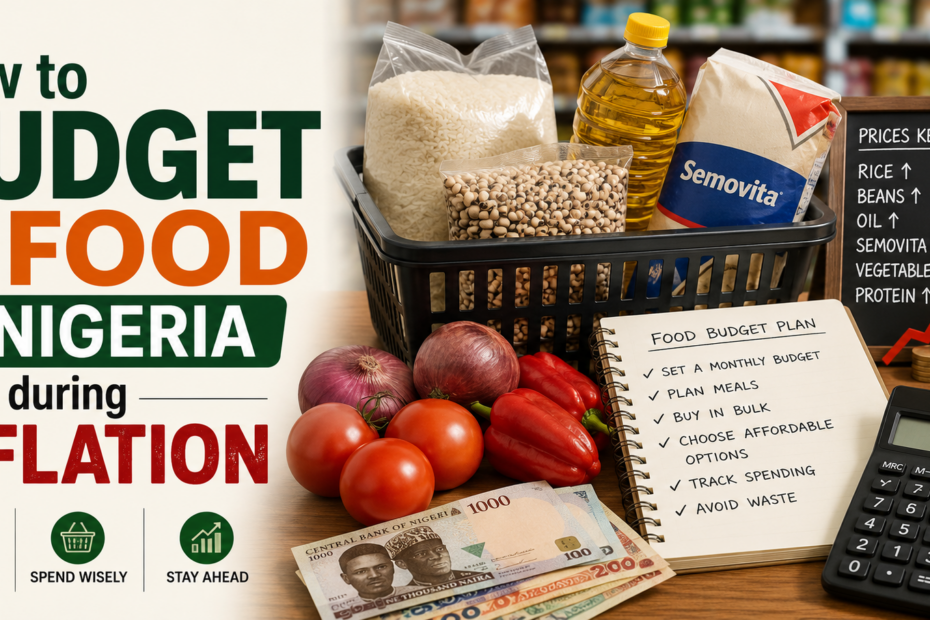
Setting a Realistic Food Budget (Not Wishful Thinking)
A common budgeting mistake in Nigeria is planning based on old prices instead of current market reality.
Inflation changes food prices quickly, so your budget must reflect what things actually cost today, not what they used to cost last year. If you ignore this, your budget will fail before the month even ends.
A smarter approach is to divide your monthly food money into weekly portions. For example, if you set aside a monthly food budget, break it into four weeks and stick strictly to each week’s limit.
This helps you control spending and prevents you from running out of money too early in the month.
Many people make the mistake of spending most of their food money in the first 10 days, leaving the rest of the month difficult and stressful.
Weekly budgeting creates discipline, balance, and ensures your food lasts throughout the month without unnecessary pressure.
Smart Food Prioritization (Needs vs Wants)
During inflation, one of the smartest ways to manage your food budget is learning how to separate needs from wants.
Your priority should always be staple foods that can sustain you and your family throughout the month.
Items like rice, beans, yam, and garri are essential because they are filling, affordable, and versatile for different meals.
On the other hand, luxury foods such as snacks, soft drinks, pastries, and expensive cuts of meat should be reduced or avoided when money is tight.
These items may be enjoyable, but they quickly drain your food budget without providing long-term value.
Another important strategy is learning substitution. Instead of buying beef all the time, you can switch to fish, eggs, or even plant-based protein options depending on what is cheaper at the moment.
This flexibility helps you maintain nutrition while staying within budget. Smart prioritization is not about deprivation—it is about making intentional choices that keep you financially stable.
Buying Strategy: Market vs Supermarket vs Bulk Buying
Another important way to manage your food budget during inflation is understanding where and how to buy your foodstuff. Your buying strategy can either save you money or drain your budget quickly.
Buying in bulk is one of the smartest approaches because it reduces the long-term cost of food items.
Items like rice, beans, garri, and oil are usually cheaper when bought in large quantities compared to buying them little by little every week. Bulk buying also protects you from sudden price increases in the market.
When comparing local markets and supermarkets, local markets are usually more affordable.
In markets, you can negotiate prices, compare different sellers, and sometimes get better deals.
Supermarkets, on the other hand, offer convenience and cleanliness, but their prices are often higher due to packaging and overhead costs.
Timing also matters. The best time to buy foodstuff is early in the morning or on official market days when fresh stock arrives and prices are more flexible. Going late in the day often means fewer options and less room for bargaining.
A smart buyer does not just spend money—they plan when, where, and how to buy.
Meal Planning to Reduce Waste
One of the most effective ways to control food spending during inflation is through proper meal planning.
Instead of going to the market and buying food randomly, it is better to plan your meals for the entire week before you shop.
This helps you know exactly what you need, reduces impulse buying, and ensures that every item you purchase has a purpose.
Another smart habit is cooking in batches. For example, you can prepare a large pot of stew that will last for 3–4 days, which saves both time and money.
This reduces the frequency of cooking from scratch every day, helping you manage ingredients better and avoid unnecessary repetition of expenses.
It is also important to avoid cooking based on sudden hunger or cravings. When you cook without a plan, you tend to overspend, waste ingredients, and make repeated market trips.
Meal planning brings structure to your food budget and helps you stretch your money while reducing waste significantly.
Inflation-Proof Food Habits in Nigeria
To survive rising food prices in Nigeria, you need to build strong habits that protect your wallet every day. One of the most important habits is cooking at home instead of eating out.
Buying food from restaurants, bukas, or food vendors may look convenient, but it is always more expensive in the long run compared to preparing meals yourself.
Another key habit is reducing food waste. Many households lose money simply by throwing away leftover food or not reusing it properly.
With good planning, leftovers can be stored safely and turned into another meal, helping you stretch your food budget further.
Proper food storage is also very important. Items like rice, garri, beans, and vegetables should be stored in dry, safe conditions to prevent spoilage or insect damage. When food goes bad, it becomes direct financial loss.
Finally, always compare prices before buying. Inflation affects sellers differently, so prices can vary from one market stall to another.
Taking a few minutes to check and compare can save you a significant amount of money over time.
Cheap but Nutritious Nigerian Food Options
Eating well during inflation does not mean you must spend a lot of money.
In Nigeria, there are many affordable foods that are still rich in nutrients and can keep you healthy and strong if you plan properly.
Some of the best budget-friendly options include beans and garri, which provide a good balance of protein and carbohydrates.
Another simple but nutritious meal is rice with egg and vegetables, which is both filling and easy to prepare.
You can also enjoy yam with stew, a classic Nigerian meal that can be made in a cost-effective way depending on the ingredients used.
Pap with akara is another affordable breakfast option that provides energy and keeps you satisfied for longer hours.
In addition, local vegetables such as ugu, ewedu, and okra are not only cheap but also very rich in vitamins and minerals. They can be combined with different staples to make balanced meals.
The truth is simple: eating cheap does not mean eating badly. With the right choices, you can stay healthy, full, and financially stable even during inflation.
Side Income Idea to Support Food Budget
While good budgeting is important, sometimes budgeting alone is not enough during periods of high inflation.
Prices can rise faster than income, making it difficult to rely only on salary or existing earnings. This is why having a small side income can make a big difference in managing your food expenses.
You can explore simple side hustles such as reselling goods, where you buy items in small quantities and sell them for a profit.
Food vending is another practical option, especially for people who can cook or sell snacks like akara, puff-puff, or small chops.
For those who prefer online opportunities, learning digital skills like freelancing, social media management, or basic graphic design can also bring in extra income.
The goal is not to start something big immediately, but to create a small additional cash flow that helps support your daily needs.
Even a little extra income can reduce pressure on your food budget and make life easier during inflation.
Common Mistakes People Make
Many people struggle with food budgeting in Nigeria not because they don’t earn enough, but because of avoidable mistakes that drain their money quickly.
One major mistake is buying food without a list. When you go to the market without a clear plan, you tend to forget important items and buy unnecessary things, which increases your spending.
Another common issue is impulse buying in the market. This happens when you see attractive items or get influenced by sellers and end up buying things you did not plan for.
People also make the mistake of ignoring price changes. With inflation, food prices change frequently, so failing to compare or check current prices can make you overspend without realizing it.
Lastly, eating out too often is a big financial drain. Buying food from restaurants or street vendors regularly is much more expensive than cooking at home, and it quickly reduces your monthly food budget.
Avoiding these mistakes can make a big difference in how far your money goes during inflation.
Conclusion: Survival Mindset During Inflation
In today’s Nigeria, budgeting is no longer just a financial habit—it has become a survival skill.
With rising food prices and unstable income levels, the ability to plan and manage your food spending wisely can determine how comfortably you live each month.
The key lesson is simple: small discipline leads to long-term stability. The little decisions you make daily—what to buy, how to cook, and how to spend—add up over time to either strengthen or weaken your financial situation.
Most importantly, consistency matters more than income size. Even with a small salary, someone who consistently budgets, tracks spending, and avoids waste will manage better than someone who earns more but spends without control. In times of inflation, it is not just about how much you earn, but how wisely you manage what you have.
Frequently Asked Questions
How Does Inflation Affect Food Prices in Nigeria?
Inflation affects food prices in Nigeria by steadily reducing the purchasing power of money, which means the same amount of naira buys fewer food items over time.
As inflation rises, the cost of production, transportation, fuel, and importation also increases, and these added costs are passed down to consumers in the form of higher food prices.
This is especially noticeable in Nigeria because many food supply chains depend on fuel and transportation, which are sensitive to price changes.
Another major factor is the cost of agricultural inputs such as fertilizer, seeds, and labor.
When these inputs become more expensive due to inflation, farmers increase the price of their produce to recover costs.
Additionally, currency depreciation plays a role because Nigeria imports certain food items or agricultural inputs, and a weaker naira makes imports more expensive.
Inflation also affects food distribution. Transporters spend more on fuel, maintenance, and logistics, which increases the final price paid by consumers in markets.
Over time, this leads to continuous price increases, even for locally produced foods.
In simple terms, inflation creates a ripple effect across the entire food system—from production to transportation to retail—making food more expensive for the average household in Nigeria.
How Do I Create a Food Budget?
Creating a food budget starts with understanding your income and estimating how much you can realistically spend on food each month without affecting other essential needs.
The first step is to calculate your total monthly income and then decide what percentage should be allocated to food.
For many individuals or families, food typically takes a significant portion of the budget, so it must be planned carefully.
Next, you should list your common food items and meals. This helps you understand your eating habits and avoid unnecessary purchases.
Once you know what you regularly consume, you can set a fixed weekly or monthly amount for groceries and meals.
It is important to separate food spending from other expenses so that it does not mix with transport or entertainment costs.
Another key step is shopping with a list. Impulse buying is one of the main reasons food budgets are exceeded.
Planning meals in advance and buying only what is needed helps reduce waste and overspending.
You should also track your food expenses regularly. This allows you to see where your money is going and adjust when necessary. A good food budget is flexible but controlled, ensuring that you eat well without overspending.
How Do You Budget for Inflation?
Budgeting for inflation requires adjusting your financial plan to account for rising prices over time.
The first step is to review your current expenses and identify areas most affected by inflation, such as food, transport, and utilities. These are usually the first categories to increase when prices rise.
Next, you should build flexibility into your budget. Instead of fixed spending amounts that never change, allow a margin for price increases.
This means slightly overestimating expenses so you are not caught off guard when prices rise unexpectedly.
Another important strategy is increasing income sources. Since inflation reduces the value of money, relying on a single income stream can be risky. Side hustles, freelancing, or small businesses can help balance rising costs.
It is also important to prioritize essential spending and cut unnecessary expenses. During inflation, luxury spending should be reduced so that basic needs are protected.
Finally, investing in assets that grow with inflation, such as mutual funds, real assets, or businesses, can help preserve purchasing power.
Budgeting for inflation is not just about cutting costs but also about adapting financially to a changing economy.
What Are the Solutions to Food Inflation?
Solving food inflation requires both government action and individual financial strategies.
On a national level, improving agricultural productivity is one of the most important solutions.
This includes supporting farmers with better access to fertilizers, improved seeds, mechanized farming tools, and storage facilities. When food supply increases, prices naturally stabilize.
Reducing transportation and fuel costs is also important because logistics heavily influence food prices in Nigeria.
Better road networks and stable fuel pricing can significantly reduce the cost of moving food from farms to markets.
Import policies also play a role. When essential food items are expensive locally, controlled importation can help balance supply and reduce price spikes.
On an individual level, people can adapt by practicing better budgeting, buying in bulk, reducing food waste, and growing small home gardens where possible.
Supporting local produce instead of expensive imported alternatives can also help reduce pressure on household budgets.
Diversifying income sources is another personal solution because it helps households cope with rising food costs without financial stress.
In summary, food inflation is solved through increased supply, improved logistics, stable policies, and smarter household financial management.
Is Food Calculated in Inflation?
Yes, food is one of the most important components in inflation calculations. In most countries, including Nigeria, food prices are a major part of the consumer price index (CPI), which is used to measure inflation.
This is because food represents a large percentage of household spending, especially for low and middle-income earners.
When economists calculate inflation, they track the prices of essential goods and services over time, and food items are a key category in this basket.
Items such as rice, bread, yam, meat, vegetables, and cooking oil are commonly included because they reflect the cost of living for everyday people.
Food inflation specifically refers to the rate at which food prices increase over time.
In many cases, food inflation can rise faster than general inflation due to factors like supply shortages, weather conditions, transportation costs, and currency changes.
Because food is essential for survival, it has a strong impact on overall inflation figures.
When food prices rise significantly, it affects household welfare and reduces purchasing power, making it one of the most closely monitored parts of inflation measurement.
What Are the 4 Types of Inflation?
The four main types of inflation are demand-pull inflation, cost-push inflation, built-in inflation, and hyperinflation. Each type explains a different reason why prices in an economy increase over time.
Demand-pull inflation happens when the demand for goods and services becomes higher than the available supply. When too many people are trying to buy limited goods, prices naturally rise.
This often occurs in growing economies where income levels increase and consumer spending becomes stronger than production capacity.
Cost-push inflation occurs when the cost of producing goods increases.
This can be due to rising fuel prices, higher transportation costs, increased wages, or expensive raw materials. Businesses pass these extra costs to consumers, leading to higher prices.
Built-in inflation is linked to expectations. When workers expect prices to rise, they demand higher wages.
Businesses then increase prices to cover those wages, creating a cycle of rising costs and salaries.
Hyperinflation is an extreme form of inflation where prices rise rapidly and uncontrollably. In such cases, money loses value very quickly, and economic stability becomes very weak.
Each type of inflation shows how different forces in the economy can lead to rising prices.
What Is the 4 Rule for Inflation?
The “4 rule” for inflation is not a formal economic law, but in personal finance discussions it often refers to the idea of planning finances around an estimated 4% inflation adjustment or maintaining a buffer that accounts for moderate inflation growth.
In practical terms, it encourages individuals to expect that prices will increase over time and to adjust their budgets and investments accordingly.
In some financial planning contexts, it is also loosely connected to the idea of the “4% withdrawal rule,” which suggests that retirees can withdraw about 4% of their investment portfolio annually while maintaining long-term stability.
However, in relation to inflation, the key idea is adjustment and protection of purchasing power.
The main takeaway is that inflation should always be considered in financial planning.
Whether through budgeting, saving, or investing, people are encouraged to factor in gradual price increases so that their money does not lose value over time.
What Type of Budget Should Be Prepared During Inflation?
During inflation, the best type of budget is a flexible or zero-based budget with inflation adjustments.
A zero-based budget ensures that every unit of income is assigned a purpose, leaving no unplanned spending. This helps control expenses during times when prices are increasing.
However, because inflation causes frequent price changes, flexibility is also important.
A flexible budget allows you to adjust spending categories such as food, transport, and utilities based on current market prices. This prevents financial shock when costs rise unexpectedly.
A strong inflation budget should prioritize essential needs first, including food, housing, transportation, and healthcare.
Non-essential spending such as luxury items or entertainment should be reduced or controlled.
It is also important to include a savings or emergency buffer category. This helps protect against sudden price increases or income disruptions.
In summary, the best inflation budget is structured but adaptable, ensuring that basic needs are protected while allowing room for price changes.
Where to Put Money During Inflation?
During inflation, it is important to place money in assets that protect or grow your purchasing power rather than letting it lose value in idle cash.
One of the safest places is money market funds or treasury bills, which provide relatively stable returns and help preserve value.
Another good option is investing in real assets such as land, property, or agriculture. These tend to increase in value over time and often move with or above inflation rates.
Investing in strong businesses is also effective. Businesses that provide essential goods and services, especially food-related or high-demand services, tend to perform well during inflation because demand remains steady.
Foreign currency savings, such as holding stable currencies, can also help protect value when local currency loses strength, although this depends on regulations and access.
Skills and education are also important “investments” during inflation. Increasing your earning ability helps you keep up with rising costs.
The key principle is to avoid keeping large amounts of idle cash during inflation because its value decreases over time.
What Foods Are Good to Reduce Inflation?
While food itself does not directly reduce inflation in an economic sense, certain food choices can help individuals manage the impact of rising food prices by being more affordable, filling, and locally available.
During inflation, staple foods that are locally produced tend to be more cost-effective compared to imported or processed foods.
Foods like rice alternatives (such as yam, cassava, potatoes, and plantain), beans, maize, and local grains are often more stable in price compared to imported items.
These foods are also rich in nutrients and can form the foundation of a budget-friendly diet.
Vegetables grown locally, such as leafy greens, are also important because they are usually cheaper when in season.
Protein sources like eggs, beans, and locally sourced fish can provide affordable nutrition compared to expensive meat options.
Reducing reliance on processed or imported foods helps households manage food inflation better. Cooking at home instead of eating out also significantly reduces food expenses.
In summary, the best “inflation-friendly” foods are local, seasonal, and minimally processed, as they are more stable in price and easier to afford during economic pressure.
What Is the 2 2 2 Rule for Food?
The 2-2-2 rule for food is a simple nutritional and budgeting guideline that helps individuals or families maintain a balanced and affordable diet while avoiding overconsumption and unhealthy eating habits.
While it is not a strict scientific law, it is commonly used in basic meal planning to promote balance, especially in environments where food costs are rising.
In many interpretations, the first “2” refers to two servings of carbohydrates or staple foods such as rice, yam, pasta, or potatoes. These provide energy and form the foundation of most meals.
The second “2” represents two servings of protein sources such as beans, eggs, fish, chicken, or meat.
Proteins are essential for body repair, growth, and overall health. The third “2” refers to two servings of fruits and vegetables, which provide vitamins, minerals, and fiber that support digestion and immunity.
The idea behind this rule is balance and affordability. By structuring meals into simple proportions, individuals can avoid over-relying on expensive or unhealthy foods while still meeting nutritional needs.
It also helps reduce food waste because meals are planned intentionally rather than based on impulse.
In practical terms, the 2-2-2 rule encourages people to think in structure rather than randomness when it comes to eating.
It is especially useful during inflation periods when food prices are unstable, because it helps households prioritize essential nutrients while staying within budget.
The goal is not perfection but consistency in eating balanced meals without overspending.
What Are the 7 Types of Food Processing?
Food processing refers to the methods used to transform raw ingredients into consumable or preservable food products.
There are seven major types of food processing, each serving a different purpose in improving safety, taste, storage life, and convenience.
The first type is primary processing, which involves basic preparation such as washing, peeling, cutting, and sorting raw foods like fruits, vegetables, or grains.
The second is secondary processing, where raw ingredients are transformed into more usable forms, such as turning wheat into flour or milk into cheese.
The third type is thermal processing, which uses heat to preserve or cook food. This includes boiling, pasteurization, and sterilization.
The fourth is fermentation, where microorganisms are used to transform food, such as in yogurt, bread, or certain traditional beverages.
The fifth type is preservation processing, which includes methods like drying, freezing, salting, and canning. These methods help extend the shelf life of food and reduce spoilage.
The sixth is mechanical processing, which involves physical changes like grinding, mixing, or pressing food ingredients.
The seventh type is packaging and labeling, which protects food, extends shelf life, and provides important information to consumers.
Together, these seven types of food processing ensure that food is safe, accessible, and available for consumption in different forms.
They also play a major role in reducing food waste and improving food security globally.
What Food Is Most Affected by Inflation?
The foods most affected by inflation are usually imported foods, transport-dependent goods, and staple items that rely heavily on supply chains.
In many countries like Nigeria, inflation impacts food prices unevenly, but certain categories are more vulnerable than others.
Imported foods such as wheat-based products, rice (when not locally produced enough), dairy products, and processed foods are highly affected because they depend on foreign exchange rates.
When currency value weakens, import costs rise, and this directly increases retail prices.
Another highly affected category is protein-based foods like meat, chicken, and fish.
These are sensitive to inflation because they require feed, transportation, and energy to produce and distribute.
When fuel prices rise, the cost of raising livestock and transporting them to markets also increases.
Perishable foods like vegetables and fruits are also affected, especially due to transportation and storage costs.
Since they spoil quickly, any increase in logistics expenses immediately impacts market prices.
Staple foods such as rice, bread, and maize are also affected, but their level of impact depends on whether they are locally produced or imported. Locally produced staples tend to be more stable compared to imported ones.
In general, the most inflation-sensitive foods are those that rely on importation, energy, or complex supply chains.
This is why inflation often has a stronger impact on protein-rich and processed foods than on locally grown staples.
What Are the Three Measures of Inflation?
The three main measures of inflation are the Consumer Price Index (CPI), Producer Price Index (PPI), and Gross Domestic Product (GDP) deflator.
These indicators are used by economists to track how prices change over time in different parts of the economy.
The Consumer Price Index (CPI) measures changes in the average price of goods and services that households consume.
It includes items like food, housing, transportation, healthcare, and clothing. CPI is the most commonly used measure because it reflects the cost of living for ordinary people.
The Producer Price Index (PPI) measures changes in the prices that producers receive for goods at the wholesale level.
It tracks inflation before products reach consumers. When PPI rises, it often signals that consumer prices will increase in the future because production costs are going up.
The GDP deflator measures inflation across all goods and services produced within an economy.
Unlike CPI, which focuses on a fixed basket of goods, the GDP deflator includes everything produced domestically, making it a broader measure of inflation.
Together, these three measures provide a complete picture of inflation by showing how prices change for consumers, producers, and the overall economy.
How Much Is 3000 in 2000 Worth Today?
To understand how much 3,000 in the year 2000 is worth today, we need to consider inflation, which reduces the purchasing power of money over time.
Inflation means that the same amount of money buys fewer goods and services today than it did in the past.
The exact value depends on the country and its average inflation rate over the years.
However, to explain it generally, if we assume an average annual inflation rate of about 5% to 10% over a long period (which is common in many developing economies), the cumulative effect over more than 20 years becomes significant.
Using a simplified estimate, money could lose between 60% to 85% of its purchasing power over such a long period.
This means that 3,000 in 2000 might be equivalent to roughly 15,000 to 25,000 or more in today’s money, depending on the actual inflation rates experienced each year.
The important concept is that inflation compounds over time. Even small yearly increases in prices accumulate and significantly reduce the real value of money over decades.
This is why saving money without investing it often leads to loss of purchasing power.
In conclusion, the value of money changes over time, and historical comparisons must always consider inflation to understand real economic worth accurately.
What Two Foods Never Expire?
There are very few foods that can truly be described as “never expiring,” but honey and salt are the most commonly accepted examples because of their natural composition and preservation properties.
Honey is highly resistant to spoilage due to its low moisture content and acidic nature, which prevents bacteria and microorganisms from growing.
Archaeologists have even discovered edible honey in ancient tombs that is thousands of years old, showing its long-lasting nature when properly stored in sealed containers.
Salt is another food that does not expire in the traditional sense. It is a mineral, not an organic food product, so it does not spoil or decay.
Salt has been used for centuries as a natural preservative because it draws moisture out of food, making it difficult for bacteria to survive.
However, while salt itself does not expire, it can sometimes be contaminated or clump if exposed to moisture.
It is important to note that while these foods do not expire biologically, their quality can still be affected by storage conditions.
For example, honey can crystallize, and salt can absorb moisture or odors if not properly stored.
So, “non-expiring” does not mean completely unchanged forever, but rather extremely long shelf life under proper conditions.
What Are the 10 Most Processed Foods?
The most processed foods are typically those that undergo multiple industrial steps, including refining, adding preservatives, artificial flavors, and packaging.
One of the most common examples is sugary breakfast cereals, which are heavily refined and often contain added sugars and synthetic vitamins.
Packaged snacks such as chips and crackers are also highly processed because they contain refined starches, oils, and artificial flavor enhancers.
Instant noodles are another example, as they are pre-cooked, dried, and flavored with preservatives and seasoning powders.
Soft drinks and sugary beverages are also highly processed due to added sugars, artificial flavors, and carbonation.
Processed meats like sausages, hot dogs, and bacon undergo curing, smoking, and chemical preservation.
Frozen ready meals are heavily processed because they are pre-cooked, preserved, and packaged for long storage.
Baked goods like packaged bread and pastries often contain preservatives to extend shelf life.
Candy and chocolate products are processed with high sugar content and additives. Flavored yogurt often contains added sugars and artificial flavors beyond natural fermentation.
Processed cheese products are modified to melt easily and last longer, while margarine is heavily refined and chemically altered from natural oils.
These foods are convenient but often contain high levels of sugar, salt, and additives compared to whole foods.
What Are the 5 Methods of Preparing Food?
The five main methods of preparing food are boiling, frying, baking, steaming, and roasting. Each method affects taste, texture, and nutritional value differently.
Boiling involves cooking food in hot water or liquid until it becomes soft and edible. It is commonly used for foods like rice, pasta, eggs, and vegetables.
Frying uses hot oil to cook food, creating a crispy texture and rich flavor, though it may increase fat content.
Baking involves cooking food using dry heat in an oven. It is commonly used for bread, cakes, and pastries.
Steaming cooks food using vapor from boiling water, preserving more nutrients and natural flavors compared to other methods.
Roasting uses dry heat, usually in an oven or over fire, to cook meat, vegetables, or grains, enhancing flavor through browning and caramelization.
These methods form the foundation of most cooking practices and influence both nutrition and taste.
How to Stop Inflation?
Stopping inflation is a complex economic challenge that cannot be solved by individuals alone, as it requires coordinated government and central bank policies.
One of the main tools used is tightening monetary policy, which involves increasing interest rates to reduce borrowing and spending in the economy.
When people borrow less and spend less, demand decreases, which helps slow down price increases.
Another approach is controlling money supply. Central banks can reduce the amount of money circulating in the economy to prevent excessive spending power that drives prices up.
Governments also work to improve supply chains and production efficiency. When the supply of goods increases, prices tend to stabilize.
Supporting agriculture, reducing transportation costs, and improving infrastructure can help reduce inflationary pressure.
Fiscal discipline is also important. When governments reduce excessive spending and borrowing, it helps stabilize the economy and control inflation.
In simple terms, inflation is controlled by balancing demand and supply while managing money circulation in the economy.
It cannot be stopped instantly but can be reduced over time through consistent economic policies.
What Goods Are Used to Calculate Inflation?
The goods used to calculate inflation are based on a “basket of goods and services,” which represents what an average household typically spends money on.
This basket includes essential and non-essential items that reflect the cost of living.
Food items are one of the most important categories, including rice, bread, vegetables, meat, fish, and cooking oil.
Transportation costs such as fuel, public transport fares, and vehicle maintenance are also included.
Housing-related costs such as rent, electricity, water, and maintenance are part of the calculation. Clothing and footwear are also included because they are regular household expenses.
Healthcare services, including medicines and hospital visits, are part of the inflation basket. Education costs such as school fees and learning materials are also included.
Communication services like mobile data, airtime, and internet usage are part of modern inflation calculations.
In some cases, entertainment, personal care, and household goods are also included to reflect real consumer spending.
These goods and services together help economists measure how the cost of living changes over time, providing a clear picture of inflation in the economy.