Skip to content
Home » Weekly money-saving challenge for Nigerian workers

Weekly money-saving challenge for Nigerian workers

    Many Nigerian workers face a common financial problem: salary finishes before the month ends. Despite earning a steady income, expenses such as transport, food, rent, data, and family responsibilities quickly consume most of the money.

    This makes monthly saving feel difficult and unrealistic for many people. However, a weekly money-saving challenge offers a simpler and more practical approach.

    Instead of waiting till the end of the month to save whatever is left, you commit to saving a small amount every week.

    This method builds discipline faster because it is easier to manage smaller amounts consistently.

    Over time, it trains your mind to prioritize saving as part of your routine income habits. As the saying goes, “If you cannot save ₦1,000 weekly, saving ₦10,000 monthly will be even harder.”

    What is a Weekly Money-Saving Challenge?

    A weekly money-saving challenge is a simple financial system where you commit to saving a fixed amount of money every week.

    Instead of waiting until the end of the month to save whatever is left after spending, you intentionally set aside money on a weekly basis as part of your routine. This method helps you build a strong saving habit gradually and consistently.

    The amount you save does not have to be big. It can be as low as ₦500, ₦1,000, or ₦5,000 depending on your income level and financial responsibilities.

    The most important thing is not the size of the money, but the discipline of saving it regularly without skipping. Even small amounts, when saved consistently, can grow into a meaningful fund over time.

    The goal of a weekly money-saving challenge is consistency, not the amount. Many people struggle with saving because they try to save too much at once and end up quitting.

    This system removes that pressure by breaking saving into smaller, manageable steps. It also helps you become more aware of your spending habits during the week, making you more intentional with your money.

    Over time, this weekly practice builds financial discipline, improves your ability to manage income, and helps you develop a strong habit of saving that can support both short-term needs and long-term financial goals.

    Benefits of Weekly Saving for Nigerian Workers

    Weekly saving offers several practical benefits for Nigerian workers, especially in a system where daily expenses can easily take control of income.

    One of the biggest advantages is that it helps control impulse spending. Many workers lose money on transport adjustments, fast food, data subscriptions, and other “small small expenses” that add up quickly.

    When you commit to weekly saving, you become more mindful of these spending habits.

    Another benefit is that it matches the weekly income structure many workers already follow.

    For those who receive weekly or irregular payments, saving weekly feels more natural and less stressful than waiting for month-end. It fits into real-life cash flow patterns and makes saving easier to sustain.

    Weekly saving also reduces the pressure that comes with trying to save a large amount at once at the end of the month.

    Instead of struggling to find a big lump sum, you break it into smaller, manageable portions spread across the week.

    It also helps you build an emergency fund faster. Even small weekly contributions accumulate over time and can provide financial support during unexpected situations like medical needs or urgent bills.

    Most importantly, weekly saving improves financial discipline. It trains you to prioritize saving regularly, make better spending decisions, and develop long-term control over your money habits.

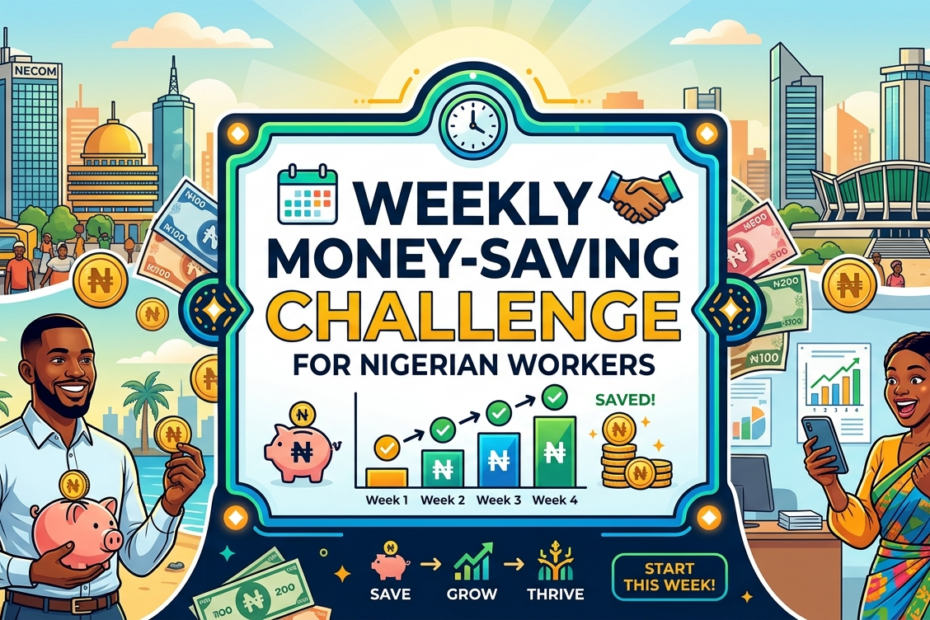
    4-Week Starter Challenge Plan

    This simple 4-week plan is designed to help Nigerian workers build a strong saving habit without pressure. The focus is gradual progress, not perfection, so you can adjust it based on your income and lifestyle.

    Week 1: Start Small

    Begin with a realistic amount such as ₦500 to ₦1,000. The goal for this first week is not how much you save, but building consistency.

    Once you are able to set money aside without skipping, you have already started developing a saving habit.

    Week 2: Increase Slightly

    In the second week, increase your savings by ₦200 to ₦500 more than what you saved in Week 1. This small adjustment helps you gradually stretch your discipline without feeling overwhelmed.

    Week 3: Cut One Expense

    Identify one unnecessary expense during the week, such as frequent takeaway food, extra transport costs, or impulse purchases. Reduce or eliminate it, and transfer the saved money directly into your savings.

    Week 4: Push Yourself

    Challenge yourself to do more than before. You can either double your Week 1 savings or commit to at least one “no unnecessary spending day” during the week. This helps you test your discipline and strengthen your control over money.

    By the end of these four weeks, you will not only have saved money but also built a stronger financial mindset.

    Where Nigerian Workers Can Save From

    Saving money does not always mean earning more—it often means identifying small daily leaks and controlling them.

    For Nigerian workers, there are several realistic areas where money can be saved without drastically affecting lifestyle.

    Transport savings: One of the biggest daily expenses for many workers is transport. You can reduce costs by planning your trips properly, leaving home earlier to avoid surge prices, or using shared transportation options where possible instead of more expensive private rides.

    Food savings: Buying food every day from restaurants or roadside vendors adds up quickly. Bringing lunch from home or cooking in batches can significantly reduce your weekly expenses while still keeping you well-fed.

    Data usage control: Mobile data is another hidden expense. Switching to Wi-Fi when available, using data-saving modes, or buying more cost-effective data bundles can help reduce unnecessary spending.

    Avoiding impulse buying: Many people lose money through unplanned purchases at markets, supermarkets, and online stores. Learning to delay buying non-essential items helps you avoid emotional or unnecessary spending.

    Reducing weekend outings: Social activities are important, but frequent weekend spending on outings, drinks, or events can drain your income. Choosing fewer but more intentional outings helps you save more without losing enjoyment.

    By managing these everyday expenses, Nigerian workers can free up extra money each week for consistent saving and long-term financial stability.

    Tools to Help You Save Weekly

    To succeed with a weekly money-saving challenge, you need simple tools that make saving easier and more automatic. These tools help reduce temptation and ensure consistency.

    Piggy bank method (physical or digital):

    This is one of the simplest saving tools. You can use a physical piggy bank at home or a digital version on savings apps. The idea is to move your weekly savings immediately so you don’t spend it.

    Separate savings account:

    Opening a different bank account strictly for savings helps you avoid mixing it with spending money. When your savings is not easily accessible, you are less likely to withdraw it for unnecessary expenses.

    Automatic transfers (every Monday or payday):

    Setting up an automatic transfer is one of the most effective ways to save consistently. Once your salary or weekly income arrives, a fixed amount is automatically moved to your savings account before you even start spending.

    Airtime-to-cash discipline trick:

    This method helps control small but frequent spending on airtime and data. Instead of constantly recharging, you plan your usage and only buy airtime or data when necessary, helping you avoid unnecessary top-ups.

    Using these tools makes saving less stressful and more structured, allowing you to stay consistent with your weekly financial goals.

    Common Mistakes People Make

    Even with the best intention to save, many Nigerian workers struggle because of avoidable mistakes that weaken their progress.

    Understanding these mistakes helps you stay consistent and committed to your weekly saving challenge.

    Starting too big and quitting quickly:

    One of the biggest mistakes is trying to save a large amount from the beginning. While it may feel motivating at first, it often becomes difficult to sustain, leading many people to give up completely. Starting small and building gradually is more effective.

    Not tracking expenses:

    Without tracking where your money goes, it becomes difficult to know why you are unable to save. Many small daily expenses go unnoticed, and over time they drain your income without you realizing it.

    Using savings during “small emergencies”:

    Another common mistake is breaking savings for minor or non-urgent needs. Once savings is frequently withdrawn, it loses its purpose and becomes ineffective.

    Waiting for extra income before saving:

    Some people believe they can only save when they earn more. This mindset delays financial growth and prevents habit formation. Saving should start with what you already have, no matter how small.

    Lack of clear goal (no motivation):

    Without a specific reason for saving—such as rent, school fees, or emergency funds—it becomes easy to lose motivation. A clear goal gives direction and makes it easier to stay disciplined.

    See also  How I saved ₦500,000 in 6 months on a low income in Nigeria

    Avoiding these mistakes will help you build a stronger and more consistent saving habit over time.

    How to Stay Consistent

    Consistency is the most important part of a weekly money-saving challenge. Without it, even the best plan will fail. The good news is that you can build consistency with simple, practical habits.

    Set a clear goal:

    Having a specific reason for saving makes it easier to stay committed. Whether it is school fees, rent, starting a small business, or building an emergency fund, a clear goal gives your saving direction and purpose.

    Use weekly reminders:

    Set reminders on your phone or calendar to alert you every week. This helps you stay on track and prevents you from forgetting or postponing your savings plan.

    Join a friend challenge:

    Saving becomes easier when you are not doing it alone. Partnering with a friend or colleague creates accountability. You can check in with each other weekly and encourage one another to stay disciplined.

    Reward yourself after 4 weeks:

    After successfully completing a full 4-week cycle, give yourself a small reward. It could be something simple like a treat or a low-cost activity. The key is not to spend all your savings, but to celebrate progress in a controlled way.

    By applying these strategies, you make saving a habit instead of a struggle, helping you stay consistent over the long term.

    Example Weekly Challenge Plan

    To make this easier to apply, here is a simple weekly saving template you can follow. It is flexible, so you can adjust it based on your income level, but the key idea is steady progress every week.

    • Week 1: ₦1,000
    • Week 2: ₦1,000
    • Week 3: ₦1,500
    • Week 4: ₦2,000

    Total Savings in One Month = ₦5,500

    This plan is designed to help you build momentum gradually. You start with a comfortable amount in the first two weeks, then slowly increase as you get more confident and disciplined.

    By the fourth week, you are already pushing yourself to save more than when you started, which strengthens your financial habit.

    The most important thing is not the exact figures, but the consistency of saving every week without skipping.

    Over time, you can increase the amounts as your income improves, turning this simple challenge into a long-term financial habit that supports your goals.

    Conclusion

    Building financial strength does not happen overnight—it starts with small, consistent actions. Even the smallest weekly savings, when done regularly, can grow into something meaningful over time. The key is not how much you start with, but your willingness to stay committed.

    Discipline matters more than income when it comes to saving money. Many people with high salaries still struggle financially because they lack control over their spending, while others with modest incomes build strong savings through consistency and planning. This shows that financial success is more about habits than earnings.

    Consistency is the real secret. When you save every week, no matter how small the amount, you are training yourself to think differently about money.

    Over time, this habit becomes part of your lifestyle and helps you achieve bigger financial goals with less stress.

    You don’t need a big salary to start saving—you need a weekly decision.

    Frequently Asked Questions

    What is the 50/30/20 rule for weekly pay?

    The 50/30/20 rule is a simple budgeting framework designed to help individuals manage their income in a balanced and structured way, and it can be easily adapted for weekly pay instead of monthly salary.

    The idea behind this rule is to divide your income into three main categories: 50% for needs, 30% for wants, and 20% for savings or debt repayment.

    When applied to weekly earnings, it becomes a practical way to control spending every time you receive money, rather than waiting until the end of the month.

    The first 50% is dedicated to essential needs—things you cannot avoid. This includes food, transportation, rent or accommodation contributions, electricity, data subscriptions for work or communication, and other basic living expenses.

    These are survival and responsibility costs, and they must always be prioritized first before any other spending decision.

    The next 30% is for wants, which are lifestyle choices that improve comfort but are not absolutely necessary.

    This may include entertainment, eating out, fashion, streaming subscriptions, or social activities. The goal is not to eliminate enjoyment but to control it so it does not interfere with financial stability.

    The final 20% is the most important for long-term financial health. It goes into savings, emergency funds, investments, or paying off debts.

    When done consistently on a weekly basis, this portion builds financial security over time and helps you prepare for unexpected situations or future goals.

    When you apply this rule to weekly income, discipline is key. Many people struggle not because they earn too little, but because they lack structure.

    Even small weekly earnings can grow into meaningful savings when consistently managed with this system.

    What is the 3-6-9 rule of money?

    The 3-6-9 rule of money is a flexible financial concept often used in personal finance discussions to describe stages or milestones of financial stability and wealth building.

    While it is not a strict global law, it is commonly interpreted as a progressive system that helps individuals structure their financial growth step by step.

    Different financial coaches may explain it in slightly different ways, but the core idea is always about building stability, security, and long-term wealth in stages.

    In many interpretations, the “3” represents the first stage of financial stability, where an individual focuses on covering at least three months of basic expenses.

    This is usually referred to as a mini emergency fund. It helps protect you from sudden financial shocks such as job loss, medical expenses, or unexpected urgent needs. At this stage, the focus is discipline and consistency rather than investment.

    The “6” often represents the second stage, which is building a stronger foundation of six months of emergency savings.

    This level provides more security and reduces financial stress significantly. At this point, a person can start thinking beyond survival and begin exploring small investments or side income opportunities while still maintaining stability.

    The “9” is usually interpreted as a long-term growth stage, where financial planning expands into wealth building, investments, and possibly multiple income streams.

    It symbolizes maturity in money management, where money is not just stored but actively working through assets, business, or investment channels.

    Overall, the 3-6-9 rule encourages gradual financial progress. It teaches that wealth is not built instantly but in structured phases that prioritize safety first, then growth, and finally expansion.

    How does the 52-week money challenge work?

    The 52-week money challenge is a popular savings method designed to help individuals build discipline by saving small amounts consistently over a year.

    The structure is simple but powerful: you save money every week for 52 weeks, gradually increasing the amount as the weeks progress.

    It is widely used because it does not require a large income to start, making it accessible to students, workers, and low-income earners.

    The traditional version starts with saving a small amount in the first week, such as 100 or 500 units of your local currency, and then increases the amount slightly each week.

    For example, if you start with ₦100 in week one, you save ₦200 in week two, ₦300 in week three, and so on until the final week of the year.

    By the end of the 52 weeks, the total amount saved becomes significant, even though each weekly contribution feels small and manageable.

    One of the key benefits of this method is psychological motivation. Because the savings start small, it does not feel like a burden.

    As weeks go by, the habit becomes stronger, and saving becomes part of your routine. It also teaches consistency, which is one of the most important principles of financial success.

    However, there is also a modified version of the challenge where individuals reverse the order—starting with higher amounts and decreasing over time—or keeping a fixed weekly amount depending on income stability. This flexibility makes it suitable for different financial situations.

    The 52-week challenge works best when the saved money is kept in a separate account or savings box to avoid temptation. Over time, it builds not only money but also discipline, which is even more valuable than the cash itself.

    How to save 1k in 30 days?

    Saving 1,000 units of money in 30 days may seem small, but it is actually a powerful exercise in financial discipline and habit formation.

    The goal is not the amount itself, but the consistency and mindset it builds. Whether “1k” refers to ₦1,000 or another currency, the strategy remains simple: break the goal into daily or weekly micro-targets that feel achievable.

    To save 1,000 in 30 days, you can divide it into small daily savings. This means saving about 33 to 34 units per day.

    When broken down this way, the target becomes less intimidating and more practical. You can use a savings box, a mobile savings app, or a separate bank account to keep the money away from daily spending temptation.

    Another approach is the alternate-day method. Instead of saving every day, you can save larger amounts every two or three days.

    See also  How I saved ₦100,000 on a small income

    For example, saving 100 units every three days will still help you reach or even exceed the target within the 30-day period. This method is useful for people who do not earn daily income.

    You can also increase your ability to save by cutting small unnecessary expenses. For instance, reducing impulsive data usage, snacks, or transportation costs can free up small amounts that add up quickly over time. Many people underestimate how small expenses drain their income.

    The key to success in this challenge is discipline, not income level. Even if your earnings are low, the ability to consistently set aside a small amount builds a strong financial habit.

    Once you can successfully save 1,000 in 30 days, you can gradually scale the same system to larger goals like 10,000 or more.

    What is the 70-10-10-10 budget rule?

    The 70-10-10-10 budget rule is a structured money management system that helps individuals distribute their income into four clear categories.

    It is designed to balance living expenses, savings, investments, and generosity in a way that promotes both financial stability and long-term growth. This method is especially useful for people who struggle with overspending or lack a clear financial plan.

    In this rule, 70% of your income is allocated to needs and daily living expenses. This includes food, rent, transportation, utilities, and other essential costs required for survival and basic comfort.

    The idea is to ensure that the majority of your income covers your lifestyle without going into debt or financial stress.

    The next 10% is dedicated to savings. This portion is set aside for emergencies or future planned expenses.

    It acts as a financial cushion that helps you handle unexpected situations such as medical bills, urgent repairs, or temporary income loss. Consistency in this category builds financial security over time.

    Another 10% is allocated to investments. This is where wealth creation begins. The money can be used for small businesses, stocks, digital investments, or any income-generating opportunity.

    The goal is to make your money work for you rather than relying only on active income.

    The final 10% is often reserved for generosity, charity, or personal development. This may include helping others, supporting causes, or investing in personal growth such as courses and skill development.

    This category encourages a balanced financial mindset that goes beyond just spending and saving.

    Overall, the 70-10-10-10 rule is powerful because it creates structure and ensures that every unit of income has a purpose, leading to better financial discipline and long-term stability.

    How to make an extra 500 a week?

    Making an extra 500 every week is achievable when you focus on small, consistent income streams rather than waiting for a big opportunity.

    The key is to identify simple services or micro-businesses that require little or no startup capital but can generate steady daily or weekly returns.

    In many cases, people overlook opportunities around them because they assume money-making must be complicated, but in reality, consistency matters more than complexity.

    One of the most practical ways is offering small services in your immediate environment.

    This could include errands, helping people run small tasks, laundry assistance, cleaning, or simple freelance work like typing, graphic design, or social media management.

    Even basic digital skills like WhatsApp marketing or posting for small businesses can generate small weekly income when done for multiple clients.

    Another method is buying and reselling small goods. Items like snacks, sachets of drinks, phone accessories, or prepaid recharge cards can be sold in small quantities with a profit margin added.

    When you calculate carefully, daily small profits accumulate into weekly 500 or more depending on your location and customer base.

    You can also explore digital platforms such as freelance websites, micro-task apps, or content creation.

    For example, short writing gigs, transcription, or even managing social media pages can contribute small but consistent income. The goal is not to depend on one source but to combine multiple small streams.

    The most important factor is discipline and reinvestment. When you start earning extra money, avoid spending it immediately.

    Instead, build consistency until it becomes part of your weekly financial structure. Over time, what starts as 500 weekly can grow into a much larger and stable income source.

    What is the 777 rule for money?

    The 777 rule for money is a modern financial mindset approach often used in personal finance coaching to encourage structured money allocation and long-term thinking.

    While interpretations may vary, the most common version of the 777 rule is centered on dividing money into three major priorities and maintaining consistency in financial discipline.

    It is less about strict mathematics and more about building a healthy relationship with money.

    In many explanations, the first “7” represents saving 70% or prioritizing the majority of your income toward essential financial stability and survival needs.

    This emphasizes controlling spending and ensuring that your basic responsibilities are covered without financial stress. It encourages people to live below their means and avoid unnecessary lifestyle inflation.

    The second “7” is often interpreted as setting aside 7% for savings or emergency funds. This portion is meant to build financial security over time. Even though the percentage is small, the idea is consistency.

    Regular savings, no matter how small, help build discipline and prepare you for unexpected financial challenges.

    The third “7” is usually linked to investments, personal development, or giving. This may include investing in skills, business opportunities, or charitable contributions. The goal is to ensure that money is not only stored but also used to create growth and value in the future.

    Overall, the 777 rule is not a rigid financial law but a motivational framework. It reminds people that money should be managed with balance—covering needs, building security, and creating future opportunities at the same time.

    What are the four numbers to attract money?

    The idea of “four numbers to attract money” is not a scientific financial formula but rather a motivational or mindset-based concept often shared in personal development and financial coaching spaces.

    It is usually used to help people organize their thinking around money habits, discipline, and financial growth.

    While different interpretations exist, one of the most common versions connects these four numbers to earning, saving, investing, and giving.

    The first number often represents earning. This is the foundation of all financial activity because without income, there is nothing to manage.

    It reminds individuals to focus on developing skills, finding opportunities, or creating multiple income streams. Money attraction in this sense begins with value creation.

    The second number is usually saving. Saving represents financial control and discipline. It ensures that not all income is spent and that a portion is always reserved for future needs or emergencies. This habit is what separates financial stability from financial struggle over time.

    The third number is investing. This step focuses on growth. Instead of keeping money idle, investing allows it to multiply through business, assets, or financial instruments. It is about making money work for you rather than relying only on active effort.

    The fourth number is often giving or generosity. This may include charity, helping others, or contributing to meaningful causes.

    The idea behind this is that financial flow is healthier when it is not purely self-centered, and it also encourages gratitude and balance.

    Together, these four “numbers” represent a complete financial mindset system rather than literal digits. They guide people toward discipline, growth, and long-term financial stability.

    What is the millionaire 8 4 3 rule?

    The millionaire 8-4-3 rule is a wealth-building concept that is often used in motivational finance discussions to describe how long-term financial growth can compound when consistent actions are taken over time.

    It is not a strict financial law, but rather a simplified model that explains how wealth is built in stages through discipline, investment, and patience.

    In many interpretations, the “8” represents the idea that it often takes around 8 years of consistent saving, investing, and disciplined financial behavior to start seeing significant financial transformation.

    This stage is about building habits, reducing unnecessary spending, and learning how money works in real life. It is the foundation stage where most people either develop discipline or give up.

    The “4” is often interpreted as the next phase of growth, where financial systems begin to stabilize and compound.

    After several years of consistency, investments, savings, or business efforts start producing noticeable returns. This stage is where money begins to grow faster than before because of accumulated effort and experience.

    The “3” represents acceleration and wealth expansion. In this phase, financial growth becomes more visible and sustainable.

    Income streams may multiply, investments become stronger, and financial decisions become more strategic. It is often where individuals begin to think and act like long-term wealth builders.

    Overall, the 8-4-3 rule teaches patience and consistency. It emphasizes that becoming a millionaire is not usually an overnight process but a structured journey of discipline over time.

    The key message is that financial success is built gradually through years of focused action rather than quick shortcuts.

    See also  How to Set Personal Goals and Stick to Them

    How to save 20k in 52 weeks?

    Saving 20,000 over 52 weeks is a realistic goal when broken into small, consistent weekly contributions.

    The principle behind this type of savings plan is simplicity: instead of trying to save a large amount at once, you divide the total target into manageable weekly portions that fit into your income level.

    When you break it down, 20,000 divided by 52 weeks equals approximately 385 per week, which makes the goal much easier to achieve.

    One effective method is setting a fixed weekly saving routine. You can choose a specific day of the week—such as payday or weekend—and consistently save around 385 or slightly more to stay ahead of the target.

    The key is consistency, not perfection. Even if some weeks are higher or lower, the overall discipline keeps you on track.

    Another approach is the increasing savings method, where you start with smaller amounts and gradually increase your weekly contribution.

    For example, you might begin with 200 per week and slowly increase as your income or financial comfort improves. This method helps build momentum without feeling financially pressured at the beginning.

    You can also use automation or physical separation to improve discipline. Keeping the money in a separate savings account or using a locked savings container reduces the temptation to spend it.

    Many people fail at saving not because they lack money, but because they keep their savings too accessible.

    The most important factor is mindset. Treat the 20,000 target as a financial commitment rather than an optional activity.

    Over 52 weeks, this habit not only helps you reach your goal but also builds long-term financial discipline that can be applied to larger savings goals in the future.

    How to do the 100 day money saving challenge?

    The 100-day money saving challenge is a structured savings method designed to help you build strong financial discipline within a short, focused time frame.

    The idea is simple: you save money every day for 100 consecutive days, either by increasing the amount gradually or by sticking to a fixed daily target.

    What makes this challenge powerful is not just the money saved, but the habit of consistency it builds over a relatively short period.

    One common approach is the increasing method, where you start small and increase your savings daily or weekly.

    For example, you might begin with a low amount like 100 on day one and gradually increase it as the days progress.

    Another approach is the fixed method, where you save the same amount every day, such as 200 or 500, depending on your income. Both methods work; the best one depends on your financial capacity and discipline level.

    To succeed in this challenge, separation of funds is very important. Keeping your savings in a different account, mobile wallet, or locked container helps reduce temptation.

    You also need to treat savings like a non-negotiable daily responsibility, similar to eating or transportation expenses.

    Another key strategy is tracking your progress. A simple notebook or mobile tracker helps you stay motivated as you see your savings grow over time.

    Many people abandon the challenge halfway, not because they lack money, but because they lose focus or fail to build a routine.

    Ultimately, the 100-day challenge is not just about money—it is about building financial discipline that can extend beyond the 100 days into lifelong saving habits.

    What are the biggest savings mistakes?

    One of the biggest savings mistakes people make is waiting to “earn more” before they start saving. This mindset creates delay and prevents financial discipline from forming early.

    In reality, saving is not about the amount but about consistency. Even small income levels can produce meaningful savings if managed properly.

    Another major mistake is saving without a goal. When people save without a clear purpose, it becomes easy to withdraw the money for unnecessary expenses.

    A defined goal—such as emergency funds, business capital, or rent—gives savings direction and emotional commitment.

    Many people also make the mistake of mixing savings with spending money. Keeping all funds in one account or wallet leads to impulsive spending because there is no separation between “usable money” and “protected money.” Without structure, savings easily disappear.

    A further mistake is inconsistent saving behavior. Some individuals save only when they feel motivated or when money is left over at the end of the week.

    This “leftover saving” method rarely works because expenses always expand to match income. Successful saving requires priority, not leftovers.

    Lastly, many people underestimate small daily expenses. Frequent spending on snacks, subscriptions, transportation, or impulse purchases slowly destroys savings potential. These small leaks often go unnoticed but accumulate into large financial losses over time.

    Avoiding these mistakes requires discipline, structure, and a clear financial plan. Once these habits are corrected, saving becomes easier and more sustainable.

    How to save 20k in 100 days?

    Saving 20,000 in 100 days is a realistic goal when broken down into small, daily or weekly targets. The first step is to divide the total amount by the number of days.

    This gives you a daily target of about 200 per day. When viewed this way, the goal becomes much more manageable and less overwhelming.

    One effective method is daily saving discipline. You can choose a fixed time each day—such as morning or evening—to set aside your 200 or more.

    Consistency is more important than perfection, so even if you miss a day, you can adjust the following day to stay on track.

    Another method is the weekly approach, where you save approximately 1,400 per week. This is useful for people who do not earn daily income.

    By saving in larger but less frequent intervals, you still achieve the same 20,000 goal within 100 days.

    To succeed, it is important to separate your savings immediately after receiving money. Treat it like a bill that must be paid first, not something saved from leftovers. This mindset shift is critical for success.

    Cutting unnecessary expenses also plays a big role. Small reductions in spending on data, transport, or impulse purchases can easily free up the amount needed for daily saving.

    With discipline and consistency, 100 days is enough time to not only save 20,000 but also develop a strong financial habit.

    How to save 12k in 3 months?

    Saving 12,000 in 3 months requires a simple and consistent savings structure spread across roughly 90 days.

    When you break it down, this equals about 133 per day or roughly 1,000 per week, depending on your preferred method.

    The goal becomes much easier when viewed in small, achievable portions rather than the full amount at once.

    One practical method is the weekly savings system. By saving about 1,000 every week, you can comfortably reach or even exceed your target within three months. This method works well for people who earn weekly or have irregular income patterns.

    Another approach is the daily micro-saving method, where you set aside a small amount every day.

    This method helps build discipline because it turns saving into a routine activity rather than a once-in-a-while decision. Even small amounts, when saved consistently, accumulate quickly over time.

    To make this challenge successful, separation of funds is essential. Keeping your savings in a different account or storage method prevents accidental or emotional spending.

    Many people fail not because they cannot save, but because they lack structure and separation.

    It is also important to control unnecessary expenses during the 3-month period. Reducing small daily costs like snacks, transport upgrades, or impulsive online purchases can significantly increase your ability to meet the target.

    Ultimately, saving 12,000 in 3 months is not about income level but about discipline. With consistency, even modest earnings can successfully achieve this goal.

    How to save 30k in 1 year?

    Saving 30,000 in one year is a long-term financial goal that becomes easy when broken into small, consistent contributions.

    Over 12 months, this means saving about 2,500 per month or roughly 580 per week. When divided this way, the goal feels achievable even for people with modest income levels.

    One effective method is the monthly savings plan. By setting aside 2,500 every month, preferably immediately after receiving income, you can steadily build your savings without feeling financial pressure. Treating savings as a fixed “bill” ensures consistency.

    Another approach is the weekly method, where you save about 580 each week. This method is useful for individuals who prefer smaller, more frequent saving habits. It also helps build discipline more naturally because the commitment feels lighter.

    To succeed in this plan, consistency is more important than amount. Missing a few months or weeks can delay progress, so it is important to prioritize savings before spending on non-essential items. Automation or separation of funds can also help reduce temptation.

    Reducing small unnecessary expenses is another powerful strategy. Over a year, minor daily spending habits accumulate significantly, and cutting them can easily free up the money needed for savings.

    Ultimately, saving 30,000 in one year is not just about reaching a financial target. It is about building a lifestyle of discipline, patience, and financial awareness that can support even bigger financial goals in the future.

    Leave a Reply

    Your email address will not be published. Required fields are marked *

    error: Content is protected !!