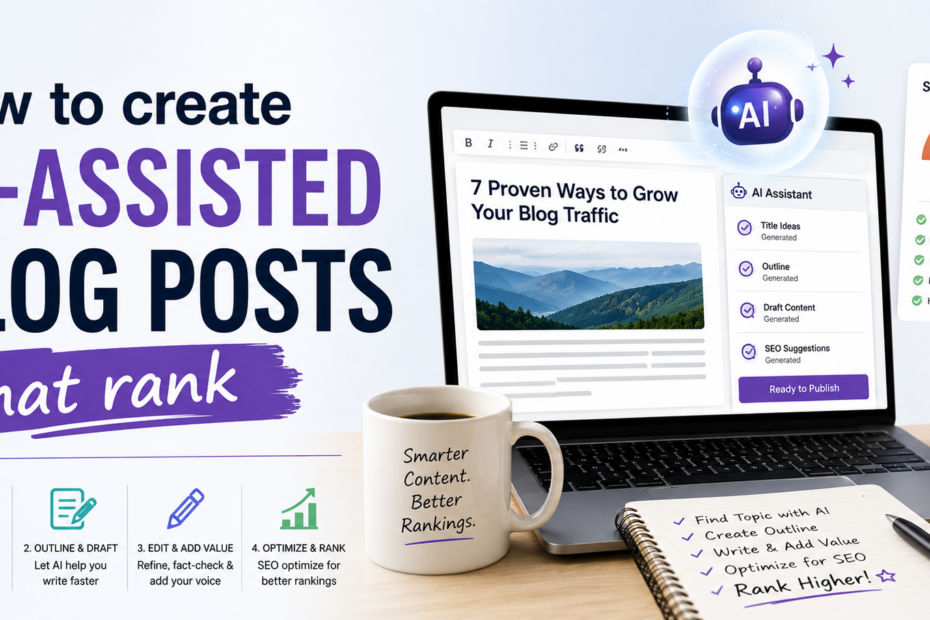
In today’s digital world, over 70% of marketers report that producing high-quality content consistently is their biggest challenge.
With the rise of AI tools, many bloggers are turning to artificial intelligence for help—but not all AI-generated content drives traffic or ranks on search engines. So, how can you leverage AI effectively without losing the human touch that keeps readers engaged?
Creating AI-assisted blog posts that rank requires strategy, not just technology. Simply generating content with an AI tool isn’t enough; you need to combine smart keyword research, SEO best practices, and human creativity to produce posts that both search engines and readers love.
AI can accelerate the writing process, suggest new ideas, and optimize your content, but without a clear plan, your blog risks blending into the countless generic posts online.
In this guide, we’ll explore how to harness AI to create blog posts that don’t just exist—they rank, attract traffic, and provide real value. By the end, you’ll understand how to merge AI efficiency with strategic SEO to elevate your blogging game.
Understanding AI-Assisted Blogging
AI-assisted blog posts are pieces of content created with the help of artificial intelligence tools that can generate ideas, draft text, and even optimize posts for search engines.
Unlike traditional writing, where every word comes directly from the author, AI-assisted blogging leverages software to accelerate content creation while still allowing the human writer to guide tone, structure, and messaging.
The benefits of AI-assisted blogging are significant. First, it saves time. Writers can quickly generate outlines, draft sections, or even entire articles, reducing the hours spent staring at a blank page. Second, AI provides endless content ideas.
By analyzing trends, keywords, and competitor content, AI content tools can suggest topics that are more likely to attract readers. Finally, AI can enhance SEO optimization.
Many AI writing software solutions include features like keyword integration, meta description suggestions, and readability scoring, helping your blog posts rank higher in search engine results.
Popular AI content tools not only streamline the writing process but also help maintain consistency and relevance across your blog. By combining these tools with strategic planning, bloggers can produce high-quality, SEO-friendly content without sacrificing originality or engagement.
In short, AI-assisted blogging is not about replacing human creativity—it’s about enhancing it, ensuring every post is both efficient to produce and optimized to perform.
Keyword Research for AI Blog Posts
Using AI-assisted blog posts that rank starts with thorough keyword research. Before generating any content with AI, it’s crucial to identify the right keywords—terms and phrases your target audience is actively searching for.
Without this foundational step, even well-written AI content may fail to attract traffic or perform in search engines. Keyword research ensures your blog posts address relevant topics, capture search intent, and compete effectively in your niche.
Several tools can make this process easier and more precise. Ahrefs and SEMrush allow you to analyze competitor content, search volume, and keyword difficulty, while Google Keyword Planner provides insight into search trends and potential traffic opportunities. Combining these tools with AI content software helps you prioritize high-value keywords and phrases that will improve your blog’s visibility.
Once you have your keywords, integrating them naturally into AI-generated content is key. AI writing software can suggest headings, subheadings, and sentences that include your target keywords without sounding forced.
For example, you might instruct the AI to use phrases like “AI SEO optimization” or “AI writing software for bloggers” strategically throughout your post. Remember, keyword placement should feel organic—overstuffing can hurt readability and SEO performance.
By investing time in careful keyword research, you create a strong foundation for AI-assisted blogging. This approach ensures your content is not only relevant and informative but also optimized to rank and attract the right audience.
Crafting High-Quality AI-Assisted Content
Creating AI-assisted blog posts that rank goes beyond generating text—it requires shaping that content into something readable, engaging, and valuable for your audience.
One of the first steps is to start with a clear outline. Even the most advanced AI tools benefit from a structured roadmap, including headings, subheadings, and key points you want to cover. An outline ensures the content flows logically, making it easier for readers to follow and for search engines to understand.
Next, customize AI suggestions for your audience. AI can generate ideas and draft content quickly, but it doesn’t automatically know your audience’s preferences or pain points.
Tailoring AI-generated content—adjusting tone, style, and examples—makes the post more relatable and authentic. Adding personal insights, case studies, or real-world examples further differentiates your blog from generic AI content, increasing trust and engagement.
Content length and structure are also critical for SEO. Studies show that long-form content (1,500–2,500 words) tends to rank better, especially when it’s well-organized with H2 and H3 headings.
Each section should focus on a single topic or keyword cluster to improve clarity and search engine comprehension. Incorporate keywords naturally, use bullet points or numbered lists, and keep paragraphs short for readability. Tools like Hemingway or Grammarly can help maintain a conversational and error-free style.
Finally, balance AI efficiency with human oversight. While AI can help speed up content creation, your unique perspective, storytelling, and critical edits ensure the post is original, high-quality, and optimized for both readers and SEO.
By following these practices, AI-assisted blog posts become not just quick to produce but also powerful tools for driving traffic and engagement.
SEO Optimization for AI Content
Creating AI-assisted blog posts that rank requires more than quality content—it demands effective SEO optimization. On-page SEO ensures that search engines can understand, index, and rank your posts, ultimately driving more organic traffic to your site.
Start with meta titles and descriptions. Your meta title should include the focus keyphrase naturally, be under 60 characters, and clearly convey the post’s value.
Similarly, craft a meta description under 160 characters that encourages clicks while integrating relevant keywords. For example, a meta description might read: “Learn how to create AI-assisted blog posts that rank with practical tips, SEO strategies, and AI content tools.”
Internal and external linking is another key factor. Link to your own related blog posts or pages to boost site structure and dwell time, while credible external sources improve trustworthiness. Make sure anchor text is relevant and descriptive.
Optimize headings using H1 for the main title, H2 for major sections, and H3 for subtopics. Naturally include your focus keyphrase in at least one heading, and sprinkle related LSI keywords like AI content tools or AI SEO optimization throughout subheadings and paragraphs.
Don’t overlook image SEO. Use descriptive file names and alt text that incorporate your keywords, helping search engines understand your images. For instance, an image showing AI content software could use alt text like: “AI writing software for high-ranking blog posts.”
By applying these on-page SEO strategies, you make AI-assisted blog posts not only readable for your audience but also optimized for search engines, increasing the chances of higher rankings and consistent organic traffic.
Editing and Plagiarism Check
Even the most advanced AI-generated content is not perfect. Creating AI-assisted blog posts that rank requires careful proofreading and editing to ensure clarity, accuracy, and originality.
AI can occasionally produce awkward phrasing, repetitive sentences, or factual errors, so human oversight is essential to maintain quality and readability.
A critical step is checking for plagiarism. Even if AI generates new content, some phrases may closely resemble existing material. Tools like Grammarly, Copyscape, and Quetext allow you to scan your content for duplicate text and ensure it’s unique.
This not only protects your blog from copyright issues but also helps maintain search engine credibility, as duplicate content can negatively impact rankings.
Beyond plagiarism, it’s important to make AI content human-like and engaging. Editing tools like Hemingway Editor or ProWritingAid help refine sentence structure, improve readability, and eliminate unnecessary complexity. You can also adjust tone, add personal insights, anecdotes, or case studies, and ensure the content flows naturally for your audience.
By combining careful editing with plagiarism checks and human customization, your AI-assisted blog posts become unique, authoritative, and optimized for readers and search engines alike. This step transforms raw AI drafts into professional, high-quality content that drives traffic and builds trust.
Publishing and Promoting Your Blog
Creating AI-assisted blog posts that rank is only half the battle—publishing and promotion are equally important for driving traffic and building an audience. Once your content is live, share it across social media platforms like Twitter, LinkedIn, and Facebook to reach a wider audience.
Engaging visuals, catchy headlines, and short snippets can encourage clicks and shares. Additionally, include your posts in email newsletters to connect directly with subscribers and keep them returning for more valuable content.
Another key strategy is building backlinks. When reputable websites link to your blog, it signals authority to search engines and improves your rankings. You can guest post on related blogs, collaborate with influencers, or create shareable resources like infographics to attract backlinks naturally.
Consistency matters. Regularly publishing new content and updating older posts with fresh insights, statistics, or keywords keeps your blog relevant and improves SEO over time. This practice helps maintain rankings and encourages repeat visitors.
Finally, track performance using tools like Google Analytics and Google Search Console. Monitor metrics such as page views, session duration, bounce rate, and keyword rankings to understand which posts perform best and identify opportunities for improvement.
By combining strategic promotion, consistent publishing, and data-driven insights, your AI-assisted blog posts can achieve maximum visibility, engagement, and long-term growth.
Conclusion
AI-assisted blogging offers a powerful way to save time, generate content ideas, and optimize posts for SEO without sacrificing quality. By leveraging AI tools alongside human creativity, bloggers can produce unique, engaging, and high-ranking content that attracts consistent traffic.
From careful keyword research to editing, optimization, and promotion, each step plays a crucial role in ensuring your posts perform well in search engines.
By following these steps, anyone can create AI-assisted blog posts that rank and attract traffic. Start experimenting with AI writing software today to streamline your content creation process, and don’t forget to share your insights or tips with fellow bloggers. With the right strategy and tools, AI-assisted blogging can elevate your blog’s visibility and turn ideas into impactful, results-driven posts.
Frequently Asked Questions
How to Write Blogs That Can Get Ranked in AI
To write blogs that perform well in AI-driven search results like Google’s AI Overviews, you need to focus on clarity, authority, structure, and usefulness. Modern search systems on platforms like Google Search don’t just look for keywords anymore—they try to understand meaning, intent, and trustworthiness.
Start by choosing topics with clear search intent. Instead of vague ideas, target specific questions people actually ask, such as “how to fix slow Wi-Fi on Android” or “best budgeting tips for students.” AI systems prefer content that directly answers real user problems.
Structure your blog clearly. Use headings (H1, H2, H3), short paragraphs, bullet points, and step-by-step explanations. This makes it easier for both readers and AI systems to understand your content.
Another important factor is topical authority. Instead of writing random posts, build clusters of related content. For example, a blog about blogging should include posts on SEO, keyword research, WordPress setup, and content writing. This helps search engines recognize your site as an expert source.
Also, include original insights. AI systems prefer content that adds value beyond generic explanations. Real examples, personal experience, and practical steps improve your chances of ranking.
Finally, ensure your content is accurate, well-written, and regularly updated. Outdated or low-quality content is less likely to appear in AI-generated summaries.
How to Rank a Blog in AI Overview
Ranking in AI Overviews on Google Search requires a strong combination of SEO fundamentals and content quality. AI Overviews usually pull information from pages that already rank well on page one of search results.
First, focus on strong keyword targeting. Use tools like Google Keyword Planner or Ahrefs to find keywords with clear search intent. Long-tail keywords often perform better because they match specific user questions.
Second, create content that directly answers questions in a structured format. AI systems prefer content that is easy to extract and summarize. Use clear headings, concise explanations, and step-by-step answers.
Third, build authority. Websites with strong backlinks, consistent publishing, and high-quality content are more likely to be referenced by AI systems. Internal linking between related posts also helps search engines understand your site structure.
Fourth, optimize for featured snippets. Many AI Overview results are influenced by pages that already appear in featured snippets. Writing clear definitions, lists, and direct answers improves your chances.
Fifth, improve user experience. Fast loading speed, mobile optimization, and clean design help reduce bounce rates, which indirectly supports better rankings.
Finally, consistency matters. Websites that regularly publish helpful, updated content are more likely to be trusted by search algorithms.
There is no guaranteed way to rank in AI Overviews, but following strong SEO practices significantly increases your chances over time.
How to Write a Blog Post That Ranks
Writing a blog post that ranks on Google Search requires a combination of keyword research, structure, content quality, and SEO optimization.
Start with keyword research using tools like Ubersuggest or SEMrush. Choose keywords with good search volume and low-to-medium competition, especially if your blog is new.
Next, match search intent. Understand what users want when they type a keyword. Are they looking for information, a tutorial, or a product comparison? Your content must directly satisfy that intent.
Structure your post properly. Use a clear title, introduction, main sections with headings, and a conclusion. Break content into short paragraphs for readability.
Add value by giving detailed explanations, examples, and actionable steps. High-ranking posts are usually more useful than shallow content.
Use internal linking to connect related blog posts. This helps search engines understand your website structure and improves user navigation.
Optimize on-page SEO by including your keyword in the title, headings, URL, and naturally throughout the content. Avoid keyword stuffing.
Include images, lists, and examples to improve engagement. Better user experience often leads to better rankings.
Finally, promote your content. Even great articles need backlinks and traffic signals to rank well. Share your posts on social media, forums, and other platforms.
Consistency is key. Blogs that publish regularly and improve old posts tend to rank higher over time.
How to Create a Blog Post With AI
Creating a blog post with AI tools like ChatGPT is now one of the fastest ways to produce content, especially for beginners or busy bloggers.
Start by giving the AI a clear prompt. Instead of saying “write a blog about fitness,” provide details like target audience, tone, word count, and SEO keyword. For example: “Write a 1200-word SEO blog post on ‘home workout for beginners’ targeting students.”
Next, let the AI generate a structured draft. Most AI tools can create introductions, headings, explanations, and conclusions in seconds. However, you should never publish raw AI content without editing.
Review and refine the content. Add personal experience, real examples, or local insights to make it unique. This improves quality and helps your blog stand out in search results on platforms like Google Search.
You should also optimize for SEO. Add keywords naturally, improve headings, and include internal links to other blog posts. AI-generated content is often generic, so optimization is important.
Fact-check the information before publishing. AI tools can sometimes produce outdated or incorrect details, especially in technical or financial topics.
Finally, format your post properly with headings, bullet points, and short paragraphs for better readability.
AI should be used as a writing assistant, not a replacement for human creativity. The best results come from combining AI speed with human editing and SEO strategy.
Can ChatGPT Write SEO Articles?
Yes, ChatGPT can write SEO articles, and it is widely used by bloggers, marketers, and content creators to speed up writing. It can generate blog posts, keyword-optimized articles, meta descriptions, titles, outlines, and even content ideas.
ChatGPT is especially useful for creating first drafts quickly. Instead of spending hours writing from scratch, you can generate a full article structure in minutes and then refine it manually.
It can also help with keyword placement, headline creation, and content expansion. For example, you can ask it to rewrite a paragraph to be more SEO-friendly or to include specific keywords naturally.
However, ChatGPT does not automatically guarantee ranking on search engines like Google Search. SEO success depends on many factors beyond writing, including backlinks, domain authority, user experience, and content originality.
One limitation is that AI-generated content can sometimes sound generic or repetitive. That is why human editing is important. Adding real experiences, updated facts, and unique insights improves content quality significantly.
Another important factor is accuracy. While ChatGPT is powerful, it may occasionally produce outdated or incorrect information, so fact-checking is necessary.
The best approach is to use ChatGPT as a writing assistant rather than a full replacement. It helps speed up research and drafting, while humans handle strategy, editing, and optimization.
In summary, ChatGPT can absolutely write SEO articles, but ranking depends on how well the content is optimized, structured, and improved after generation.