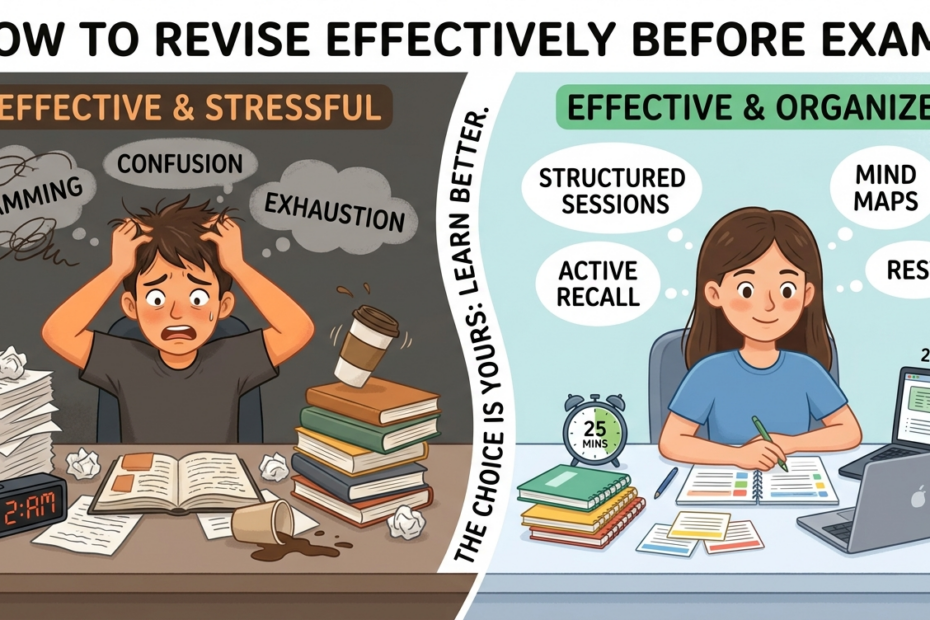
Exams can be stressful, and without the right approach, even the most prepared students may struggle. Mastering effective exam revision strategies is essential to turn hours of study into real results.
Effective revision helps you retain information, identify weak areas, and build confidence before the big day. However, many students face common challenges that make revision less effective: distractions from phones and social media, overwhelming amounts of study material, and stress that impacts focus.
Learning how to organize your time, prioritize topics, and use active learning techniques can make a significant difference. By adopting proven strategies, you can study smarter, reduce anxiety, and approach exams with clarity and confidence.
Plan Your Revision
Effective exam preparation begins with a well-structured plan. Without a clear schedule, it’s easy to feel overwhelmed and waste time. Here’s how to organize your revision for maximum results:
-
Create a Study Timetable:
Set aside dedicated time for each subject. Allocate specific hours for revision and stick to them consistently. A visual timetable can help you track progress and stay motivated. -
Break Subjects into Manageable Chunks:
Divide each subject into topics or chapters. Focus on one chunk at a time to avoid feeling overloaded. This method improves retention and reduces stress. -
Prioritize Based on Weak Areas and Exam Weight:
Identify topics you struggle with and those heavily weighted in the exam. Spend more time on these areas while maintaining a balanced revision for all subjects.
By following a structured plan, you make your study sessions more productive and reinforce your understanding efficiently—key elements of effective exam revision strategies.
Use Active Learning Techniques
Passive reading alone is rarely enough for effective exam preparation. To retain information better and understand concepts deeply, incorporating active learning techniques is crucial. Here are some strategies you can use:
-
Summarize Notes in Your Own Words:
Rewrite important points in simpler language. This reinforces understanding and helps you remember key concepts more effectively. -
Teach Someone Else What You’ve Learned:
Explaining topics to a friend or even to yourself out loud is a proven way to solidify knowledge and identify gaps in understanding. -
Use Flashcards or Mind Maps:
Visual tools like flashcards and mind maps help organize information, making it easier to recall during exams. Digital apps like Anki, Quizlet, or Coggle can make this process interactive and efficient.
Integrating these methods into your study routine ensures you engage actively with the material, a cornerstone of effective exam revision strategies.
Practice Past Papers
One of the most powerful techniques for effective exam preparation is practicing past papers. Working through previous exam questions under timed conditions helps simulate the real test environment, reducing anxiety and building confidence.
-
Improve Time Management:
Practicing under exam conditions trains you to allocate the right amount of time to each question, ensuring you complete the paper within the allotted period. -
Identify Weak Areas:
Past papers highlight topics where your understanding may be lacking. This allows you to focus your revision on areas that need improvement. -
Review Mistakes:
Carefully analyzing errors and misconceptions is a key part of effective exam revision strategies. By learning from mistakes, you reinforce correct knowledge and avoid repeating them in the actual exam.
Regularly incorporating past papers into your revision routine not only improves performance but also boosts confidence, making your study sessions more efficient and goal-oriented.
Take Care of Your Mind and Body
Effective revision isn’t just about the hours you spend with your books—it’s also about maintaining a healthy mind and body. Proper self-care enhances focus, memory, and overall performance.
-
Prioritize Sleep:
Aim for 7–9 hours of quality sleep each night. Sleep helps consolidate memory, making it easier to recall information during exams. -
Eat Nutritious Meals:
Fuel your brain with balanced meals rich in protein, healthy fats, and complex carbohydrates. Avoid excessive sugar or caffeine, which can lead to energy crashes and reduced concentration. -
Take Regular Breaks:
Use techniques like the Pomodoro method—study for 25–30 minutes, then take a 5-minute break. Longer breaks after 2–3 cycles help prevent burnout and keep your mind fresh.
Maintaining physical and mental health while revising is an essential part of effective exam revision strategies, ensuring you stay productive, alert, and motivated throughout your study sessions.
Avoid Common Revision Mistakes
Even with the best intentions, students often fall into habits that reduce the effectiveness of their study sessions. Recognizing and correcting these mistakes is key to effective exam revision strategies.
-
Cramming:
Trying to memorize large amounts of information at the last minute leads to stress and poor retention. Solution: Break your revision into smaller, manageable sessions over days or weeks to reinforce learning gradually. -
Multitasking:
Studying while scrolling through social media or texting reduces focus and comprehension. Solution: Dedicate uninterrupted blocks of time for study and use apps like Forest or Focus@Will to minimize distractions. -
Passive Reading:
Simply reading notes without engaging with the material results in low retention. Solution: Use active learning techniques such as summarizing notes, creating flashcards, or teaching concepts to someone else.
By avoiding these common pitfalls, you can make your revision more efficient, retain information better, and approach exams with confidence.
Use Technology Wisely
In today’s digital age, technology can be a powerful ally in your revision if used correctly. Incorporating the right tools helps organize your study, track progress, and make learning more interactive—an essential part of effective exam revision strategies.
-
Digital Note Apps:
Use apps like Notion, Evernote, or Microsoft OneNote to organize your notes, create study summaries, and access them on any device. -
Revision Planners:
Tools like Trello or Google Calendar can help you schedule revision sessions, track topics covered, and prioritize weak areas efficiently. -
Timed Quizzes and Flashcards:
Platforms such as Quizlet, Kahoot!, and Anki allow you to test your knowledge under timed conditions, reinforcing memory and preparing you for exam pressure.
By integrating these tools thoughtfully, you can study smarter, stay organized, and make your revision sessions more effective and engaging.
Conclusion
Effective exam preparation combines planning, focus, and smart study techniques. By creating a structured timetable, breaking subjects into manageable chunks, using active learning methods, practicing past papers, and taking care of your mind and body, you can maximize your retention and confidence.
Avoid common mistakes like cramming or multitasking, and leverage technology wisely with digital note apps, revision planners, and timed quizzes to make your study sessions more efficient.
Remember, effective exam revision strategies are not just about studying harder—they are about studying smarter. Start implementing these techniques today, and you’ll notice a significant improvement in your focus, understanding, and overall exam performance. Success is within your reach when preparation meets strategy.
Frequently Asked Questions
What is the 2/3/5:7 rule for revision?
The 2/3/5:7 rule for revision is a simple spaced repetition technique designed to help students remember information for a longer period of time by reviewing it at strategic intervals. Instead of cramming everything at once, this method spreads revision across days so the brain has multiple opportunities to strengthen memory connections.
In this system, after you first learn a topic, you revise it after 2 days, then again after 3 days, then after 5 days, and finally after 7 days. Each interval is carefully chosen because it aligns with how human memory naturally works. When you revisit information just as you are about to forget it, your brain works harder to recall it, and this strengthens long-term retention.
The first revision (2 days) helps reinforce the basic understanding while the content is still fresh. The second revision (3 days later) improves recall and helps you identify what you didn’t fully understand. The third revision (5 days later) strengthens memory consolidation, and by the fourth revision (7 days later), the information becomes much more stable in long-term memory.
This method is especially useful for subjects that require memorization, such as biology, history, law, or vocabulary-heavy topics. However, it is also effective for conceptual subjects when combined with active recall and problem-solving.
The key advantage of the 2/3/5:7 rule is that it prevents forgetting and reduces the need for last-minute cramming. Instead of studying everything repeatedly in one sitting, you study smarter by reviewing at the right intervals. Over time, this method improves both confidence and exam performance because knowledge becomes deeply embedded in memory rather than temporarily stored.
Which are the 3 toughest exams in the world?
The idea of the “toughest exams in the world” can vary depending on difficulty level, competition, and syllabus depth. However, three exams are widely recognized for their extreme difficulty and high competition: UPSC Civil Services Examination (India), Gaokao (China), and IIT JEE Advanced (India).
The UPSC Civil Services Examination is considered one of the hardest exams globally due to its vast syllabus and multi-stage selection process. It tests general knowledge, analytical ability, writing skills, and personality through interviews. The success rate is extremely low, making it highly competitive.
The Gaokao, conducted in China, is another extremely challenging exam. It determines admission into universities and is known for its intense pressure on students. The exam covers multiple subjects and is taken very seriously, often considered a life-defining moment for Chinese students.
The IIT JEE Advanced in India is also one of the toughest exams due to its complex physics, chemistry, and mathematics questions. It requires deep conceptual understanding and strong problem-solving skills. Only a small percentage of students qualify for admission into the prestigious Indian Institutes of Technology.
Other exams often mentioned include the CFA exam (finance) and various medical licensing exams, but the three above stand out due to their combination of difficulty and competition.
What makes these exams tough is not just the syllabus, but also the pressure, time management demands, and the level of preparation required. Success in these exams typically requires years of disciplined study, strong strategy, and consistent practice rather than last-minute preparation.
What is the most effective way to revise for an exam?
The most effective way to revise for an exam is to use active recall combined with spaced repetition. Instead of passively reading notes, you should actively test your memory by trying to recall information without looking at your materials. This strengthens neural connections and improves long-term retention.
One of the best strategies is to break your revision into cycles. First, go through your notes and understand the core concepts. Then close your book and try to write or explain everything you remember. This forces your brain to retrieve information, which is much more powerful than rereading.
Another effective method is solving past questions or practice papers. This helps you understand exam patterns and improves your ability to apply knowledge under time pressure. It also highlights weak areas that need more attention.
Organizing your revision is equally important. Divide your syllabus into smaller sections and assign specific days for each topic. This prevents overload and ensures balanced preparation.
You should also use visual tools like mind maps, diagrams, and summaries. These make complex information easier to recall quickly during exams.
Finally, avoid last-minute cramming. Instead, revise multiple times over spaced intervals. This ensures that information moves from short-term to long-term memory.
Effective revision is not about how many hours you study, but how intelligently you revise. Students who use structured revision techniques consistently perform better than those who rely on long, unplanned study sessions.
What is the 5 10 15 method for studying?
The 5-10-15 method for studying is a time-structured learning technique designed to improve focus, retention, and productivity by breaking study sessions into manageable segments. It is especially useful for students who struggle with long, uninterrupted study hours or distractions.
In this method, the “5” represents the first phase, where you spend 5 minutes planning and preparing your study session. During this time, you decide what topic you will study, gather your materials, and set a clear goal. This step helps eliminate confusion and reduces procrastination.
The “10” represents the next phase, where you spend 10 minutes actively learning or reviewing the topic. This is not passive reading; instead, you should engage with the material by summarizing, taking notes, or trying to understand key concepts.
The “15” represents the final phase, where you spend 15 minutes practicing or testing yourself. This could involve solving questions, recalling information without notes, or explaining the topic out loud. This step is crucial because active recall strengthens memory and improves understanding.
The strength of the 5-10-15 method lies in its simplicity. It breaks studying into short, focused bursts, making it easier to start and maintain momentum. It also reduces mental fatigue because the brain is not overloaded with long sessions.
This method is particularly effective for revision, quick learning sessions, and daily study habits. Over time, students can extend the durations as their focus improves. It is a practical approach for building consistency and avoiding burnout while still making steady academic progress.
Which country students study the hardest?
Students around the world study hard for different reasons, but some countries are widely recognized for their intense academic culture and strong study habits. Among them, South Korea, China, Japan, and Singapore are often highlighted as places where students study the hardest.
In South Korea, education is highly competitive, and students often attend long school hours followed by private tutoring sessions known as “hagwons.” Academic success is strongly tied to future career opportunities, which creates significant pressure to perform well.
In China, students prepare intensely for the Gaokao exam, which determines university admission. The system is highly competitive, and many students spend years preparing for it with disciplined study schedules.
Japan also has a strong academic culture, where students are expected to maintain high performance from early schooling. Entrance exams for prestigious schools and universities are highly competitive, encouraging consistent study habits.
Singapore is known for its rigorous education system, which emphasizes mathematics, science, and analytical thinking. Students often follow structured learning paths and are encouraged to perform at high academic standards.
While these countries are often seen as having the “hardest-working” students, it is important to note that studying hard does not always mean better learning outcomes. The most effective systems are those that balance hard work with healthy study techniques, rest, and skill development.
Ultimately, the “hardest studying” varies by culture, but what truly matters is not just how much students study, but how effectively they learn and apply knowledge.
What is the easiest exam in the world?
There is no universally agreed “easiest exam in the world” because difficulty depends on the student’s background, preparation level, and familiarity with the subject. What feels easy for one person may feel difficult for another.
However, some exams are widely considered easy because they are designed to test very basic knowledge or essential life skills rather than deep academic understanding.
For example, many basic driving theory tests in different countries are often considered easy once you study the rules of the road. They usually involve multiple-choice questions that test common sense and basic traffic knowledge. Similarly, some language proficiency placement tests for beginners can feel easy if the questions are at a very introductory level.
In schools, entry-level assessments or placement exams are also often considered easy because they are not designed to fail students but to place them in the right learning level. These tests typically cover fundamental topics like basic math, reading comprehension, or general knowledge.
However, it is important to understand that “easy” is relative. A student who prepares well will find almost any exam easy, while an unprepared student may struggle even with simple questions. This is why preparation matters more than the perceived difficulty of the exam itself.
In reality, instead of focusing on finding the easiest exam, students benefit more from focusing on improving their study methods, understanding concepts, and building confidence. When you are well-prepared, even difficult exams start to feel manageable. So, ease is less about the exam itself and more about your readiness and consistency in learning.
How many hours a day should I study?
The ideal number of study hours per day depends on your goals, age, and ability to concentrate, but most research and academic experts suggest that 2 to 6 focused hours per day is highly effective for consistent learning. The key is not just the number of hours but the quality of those hours.
For school students, studying 2–4 hours daily outside school is usually enough if the time is used effectively. University students or those preparing for competitive exams may need 4–6 hours or more, depending on the difficulty of their subjects and deadlines.
However, studying for long hours without focus is not productive. It is far better to study for 3 focused hours than 8 distracted hours. Your brain has a limited capacity for deep concentration, usually in cycles of 45–90 minutes. After that, attention naturally decreases, so breaks are necessary.
A good approach is to use structured study blocks. For example, 50 minutes of study followed by a 10-minute break helps maintain mental freshness. This prevents burnout and improves retention.
It is also important to balance study with sleep, exercise, and relaxation. Studying excessively without rest can reduce memory performance and increase stress.
Ultimately, the right number of study hours is the amount that allows you to stay consistent, understand your subjects deeply, and maintain your mental health. Consistency and smart study techniques matter far more than simply increasing hours.
How to be a 1% student?
Becoming a 1% student means developing habits and strategies that place you ahead of the majority, not just studying harder but studying smarter and more consistently.
The first key is deep understanding. Instead of memorizing information, focus on understanding how and why concepts work. This allows you to apply knowledge in different situations, especially in exams.
Second, build a daily study system. Top-performing students don’t rely on motivation; they follow routines. Studying at the same time every day trains your brain to focus automatically, reducing procrastination.
Third, use active learning techniques such as self-testing, teaching concepts to others, and solving practice questions. These methods are far more effective than passive reading.
Fourth, manage your time wisely. Break your syllabus into small sections and revise consistently instead of cramming before exams. Planning ahead reduces stress and improves performance.
Fifth, eliminate distractions. A 1% student protects their focus by limiting phone usage, social media, and multitasking while studying.
Finally, review your progress regularly. Identify weak areas, correct mistakes, and improve continuously. Top students are not perfect—they are consistent learners who improve over time.
Becoming a 1% student is not about talent; it is about discipline, strategy, and consistency. Anyone can reach that level by applying the right habits every day.
Is 20 minutes of revision good?
Yes, 20 minutes of revision can be very effective, but only if it is done correctly. The value of revision does not depend on duration alone—it depends on how actively you engage with the material during that time.
If you use 20 minutes to simply reread notes, the impact will be limited. However, if you use those 20 minutes for active recall, such as testing yourself, summarizing key points without looking at your book, or solving quick questions, then it becomes highly powerful.
Short revision sessions like 20 minutes are especially useful for daily review, where you quickly refresh what you learned earlier. This helps prevent forgetting and strengthens long-term memory through repetition.
It is also useful for students who struggle with long study sessions. A short, focused revision can reduce pressure and make studying feel more manageable.
However, for deeper understanding or complex topics, 20 minutes alone may not be enough. In such cases, it should be part of a larger study plan that includes longer learning sessions and multiple revisions over time.
The most effective approach is consistency. Doing 20 minutes of focused revision daily is far better than doing long revision sessions once in a while. Over time, this builds strong memory retention and improves exam performance significantly.
How to use 100% of your brain while studying?
The idea of using “100% of your brain” is a myth. In reality, humans already use their entire brain, but not all areas are active at the same time. The real goal is not to use more of your brain, but to use your brain more effectively.
To maximize brain performance while studying, start with focus management. Your brain works best when it is not distracted. Eliminating interruptions like phone notifications and multitasking allows deeper concentration.
Next, use active learning techniques. Instead of passively reading, engage your brain by solving problems, recalling information, and explaining concepts in your own words. This activates multiple areas of the brain and strengthens memory.
Another important factor is sleep and rest. The brain processes and stores information during sleep, so lack of rest reduces learning efficiency. Good sleep improves attention, memory, and problem-solving ability.
Nutrition and hydration also matter. The brain requires energy to function properly, and poor diet can reduce concentration and mental clarity.
Finally, use spaced repetition and regular revision. Reviewing information over time helps transfer it from short-term to long-term memory, making learning more permanent.
Instead of trying to “unlock 100% brain usage,” the real secret is building habits that help your brain work at its natural best—focused, rested, and actively engaged.