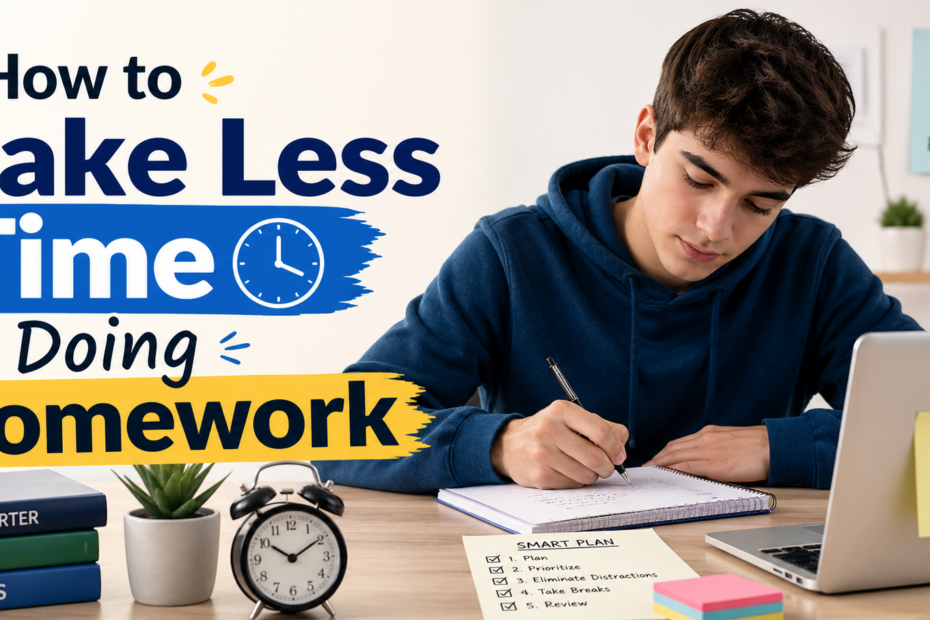
Many students find themselves spending countless hours on homework, often feeling stressed, exhausted, and unproductive. It’s easy to get overwhelmed when assignments pile up, leaving little time for relaxation or hobbies.
The good news is that finishing homework doesn’t have to take all day. With the right strategies, you can work smarter, not harder, and complete your tasks efficiently without sacrificing quality.
If you want to learn how to do homework faster, these tips will help you organize your tasks, manage your time, and stay focused from start to finish. By applying practical methods and simple productivity hacks, you can reduce homework stress, gain more free time, and still achieve excellent results in school.
Prioritize Tasks to Save Time Doing Homework
One of the most effective ways to finish homework faster is to plan and prioritize your tasks. Start by listing all your assignments in one place, noting their due dates and the estimated time each will take. This helps you visualize your workload and reduces the risk of forgetting important tasks.
Next, prioritize your assignments based on urgency and difficulty. For example, tackle tasks that are due soon or require more focus first, and leave easier or less critical work for later.
Tools like the Eisenhower Matrix, which separates tasks into urgent vs. important categories, can help you make these decisions quickly. By planning and prioritizing your homework, you save time, stay organized, and reduce stress while improving your overall productivity.
Create a Dedicated Study Environment
Creating the right environment can help you do homework faster and more efficiently. A clutter-free, organized workspace allows you to focus better and reduces the time wasted searching for materials or getting distracted by unnecessary items. Choose a quiet area with good lighting, a comfortable chair, and all the supplies you need within reach.
Minimize distractions by turning off phone notifications or putting your phone in another room. You can also use productivity apps like Forest or Focus To-Do to stay focused and track your study sessions. By setting up a dedicated study environment, you create the perfect space to concentrate, work efficiently, and complete homework in less time.
Time Management Tips to Finish Homework Faster
Effective time management is key to finishing homework faster without compromising quality. One popular method is the Pomodoro Technique, which involves working for 25 minutes with full focus, followed by a 5-minute break. This approach helps maintain concentration while preventing burnout.
Another useful strategy is time blocking, where you assign specific hours to each subject or assignment. By scheduling your tasks, you know exactly what to work on and when, reducing wasted time deciding where to start.
Additionally, tackle the most challenging assignments first when your energy and focus are at their peak. Combining these techniques ensures that you stay productive, organized, and efficient, allowing you to complete homework faster and more effectively.
Learn to Take Smart Notes and Study Efficiently
Taking smart notes can drastically reduce the time needed to complete homework. Instead of copying everything from textbooks or class notes, focus on summarizing key points in your own words.
Techniques like active recall, where you test yourself on the material, and mind mapping, which visually organizes information, help you understand and remember concepts faster.
Additionally, use online resources for quick explanations when you’re stuck. Educational websites, videos, and interactive tutorials can clarify difficult topics in minutes, saving you hours of confusion. By adopting these strategies, you not only complete homework faster but also retain information more effectively, making study sessions far more productive.
Focus on One Homework Task at a Time
Multitasking might seem like a way to get more done, but it often wastes time and increases mistakes. Switching between assignments breaks your concentration and can lead to errors that take longer to fix.
To work more efficiently, focus on one homework task at a time. Give each assignment your full attention until it’s completed before moving on to the next.
This approach not only speeds up your work but also improves accuracy and reduces stress. By concentrating on a single task, you make steady progress and finish your homework faster without compromising quality.
Use Tools and Resources Wisely
Leveraging the right tools can help you complete homework faster and more efficiently. For writing assignments, Grammarly can check grammar and spelling in seconds, saving time on revisions.
For studying or memorizing key concepts, Quizlet offers flashcards and practice tests, making learning quicker and more interactive. For research-based tasks, Google Scholar provides credible sources and references in just a few clicks.
Additionally, using templates or homework planners can save repetitive effort. Templates help streamline formatting for reports or essays, while planners let you organize assignments, deadlines, and priorities at a glance. By using these tools and resources wisely, you can work smarter, reduce time spent on each task, and stay organized throughout your homework.
Boost Productivity and Finish Homework Faster with Healthy Habits
Maintaining focus and energy is essential for completing homework efficiently. Taking short breaks between study sessions helps refresh your mind and prevents burnout, while staying hydrated keeps your brain functioning at its best. Adequate sleep is equally important, as a well-rested mind works faster, makes fewer mistakes, and retains information better.
Incorporating these healthy habits into your homework routine ensures that you remain productive throughout your study sessions. By taking care of your mind and body, you can finish homework faster, improve your overall efficiency, and feel less stressed while tackling assignments.
Conclusion
Finishing homework faster doesn’t have to be stressful. By planning and prioritizing tasks, creating a dedicated study environment, managing your time effectively, taking smart notes, focusing on one task at a time, using helpful tools and resources, and maintaining healthy habits, you can significantly reduce the time spent on assignments while improving quality.
By following these tips, you can learn how to do homework faster and spend more time on what you enjoy. Start implementing these strategies today, and watch your productivity soar while homework becomes more manageable and less overwhelming.
Frequently Asked Questions
How to spend less time on homework?
Spending less time on homework is not about rushing through tasks but about improving efficiency and focus. The first key strategy is eliminating distractions. Many students waste a lot of time checking their phones, switching apps, or multitasking while doing homework. Creating a distraction-free environment can instantly reduce the time spent.
Another important method is understanding before starting. When you fully understand the topic taught in class, homework becomes faster because you are not struggling to figure out instructions or concepts from scratch. Reviewing notes immediately after school helps a lot.
You should also use the “focus block” method, where you work for 25–50 minutes without interruption and then take a short break. This helps your brain stay sharp and prevents fatigue.
Planning is also important. Before starting, quickly go through all your assignments and complete the easiest ones first to build momentum. This reduces mental pressure and increases speed.
Finally, avoid perfectionism. Many students spend too much time trying to make homework “perfect” instead of just completing it correctly. Aim for accuracy, not unnecessary over-detailing.
With consistency, these habits help you finish homework faster while maintaining good quality.
How to be a 1% student?
Being a 1% student means becoming part of the small group of students who consistently perform at a high level through discipline, strategy, and focus. It begins with having a clear purpose. You must know why you are studying and what goals you want to achieve. This clarity guides every decision you make.
Next is deep learning instead of surface learning. A 1% student does not just memorize answers; they understand concepts so well that they can apply them anywhere. This makes exams and assignments easier.
Another key habit is time management mastery. High-performing students plan their day, avoid wasted time, and prioritize important tasks first. They treat time like a valuable resource.
They also practice consistency over motivation. Even when they are tired or not in the mood, they still complete their study tasks. Discipline, not feelings, drives their success.
Additionally, they remove distractions aggressively. Social media, unnecessary entertainment, and noise are minimized during study time.
Finally, they continuously improve through self-review and adjustment. They analyze their performance, identify weaknesses, and work on them.
Becoming a 1% student is not about talent—it is about building strong daily habits that most people ignore.
How to do homework in less time?
To complete homework in less time, you must improve both focus and preparation. The first step is preparation before starting. If you already reviewed the lesson in class or at home, homework becomes much easier and faster.
Second, use a structured approach. Instead of jumping randomly between subjects, organize your tasks. Start with simple or short assignments to gain momentum, then move to harder ones.
Third, apply focused study sessions. Work for 30–60 minutes without distractions, then take short breaks. This keeps your brain fresh and improves speed.
Fourth, avoid unnecessary rewriting or overthinking. Many students waste time trying to make answers too perfect. Focus on correctness and clarity instead.
Fifth, reduce distractions completely. Put your phone away or switch it to silent mode during homework time.
Lastly, practice regularly. The more familiar you become with subjects, the faster you complete assignments.
Efficiency improves with consistency, not rushing.
How do we finish our homework quickly?
Finishing homework quickly requires a combination of focus, planning, and discipline. First, you need to start immediately without delay. The longer you wait, the harder it becomes to begin. Use simple action techniques like counting down “3-2-1” and starting right away.
Second, create a clear plan before you begin. Quickly review all your assignments and estimate which ones are easy and which are difficult. Start with the easiest tasks to build confidence and speed.
Third, use time limits for each task. For example, give yourself 20–30 minutes per assignment. This prevents overthinking and encourages faster completion.
Fourth, remove distractions such as phones, TV, or unnecessary noise. A focused environment significantly reduces completion time.
Fifth, make sure you understand your lesson before doing homework. Confusion slows everything down.
Finally, practice doing homework daily at the same time. Routine builds speed naturally over time.
With these habits, homework becomes faster and less stressful.
How to be a top 1% student?
Becoming a top 1% student requires long-term discipline, strategy, and consistent self-improvement. The first step is developing a strong learning mindset. Instead of studying just to pass exams, focus on mastering knowledge deeply. Understanding concepts makes you stand out academically.
Second, you must build a structured daily routine. Top students plan their day carefully, balancing study time, rest, and revision. They avoid wasting time on unproductive activities.
Third, consistency is key. Studying a little every day is far more effective than cramming before exams. Top students never rely on last-minute preparation.
Fourth, they use active learning techniques such as practice questions, teaching others, and summarizing lessons. This improves understanding and retention.
Fifth, they eliminate distractions completely during study time. Social media and unnecessary entertainment are controlled or minimized.
Sixth, they focus on self-evaluation. They regularly check their progress, identify weak areas, and improve them.
Finally, they develop strong discipline and resilience. Even when things are difficult, they continue working steadily toward their goals.
Being a top 1% student is not about intelligence alone—it is about habits, discipline, and consistency practiced every day over time.
What can replace homework?
Homework is mainly used to help students practice what they learn in class, but in some cases, it can be reduced or replaced with more effective learning methods.
One possible replacement is project-based learning, where students apply knowledge to real-life tasks instead of repeating written exercises. For example, instead of solving math problems on paper, students can use math in budgeting a small project or analyzing real data.
Another alternative is interactive learning activities, such as group discussions, presentations, and classroom exercises. These methods improve understanding while reducing the need for long written assignments at home.
Flipped learning is also becoming popular. In this system, students watch lessons or study materials at home and use classroom time for practice, clarification, and problem-solving. This reduces traditional homework load.
Additionally, digital learning platforms can replace some homework by offering quizzes and interactive exercises that give instant feedback. This makes learning faster and more engaging.
However, homework still plays an important role in reinforcing learning. The best approach is not to completely eliminate it but to replace unnecessary or repetitive homework with more meaningful and practical learning activities that improve understanding and critical thinking.
How to finish homework when lazy?
Feeling lazy while doing homework is very common, but it can be managed with simple mental and physical tricks. The first step is to start small. Tell yourself you will only work for 5–10 minutes. Most of the time, once you begin, it becomes easier to continue.
Second, use the 3-2-1 rule: count down and start immediately without overthinking. This helps break procrastination.
Third, remove distractions such as your phone, TV, or social media. Laziness often increases when distractions are available.
Fourth, break your homework into smaller parts. Large tasks feel overwhelming, but smaller tasks feel easier and quicker to complete.
Fifth, change your environment. Sitting in a quiet, clean space can improve focus and reduce laziness.
Also, remind yourself of your goals. Thinking about your future success can increase motivation and push you to act even when you feel lazy.
Finally, reward yourself after completing tasks. Small rewards help train your brain to associate homework with positive outcomes.
How to learn fast in less time?
Learning faster is not about studying longer but about studying smarter. The first step is active learning, which means engaging with the material instead of just reading. You can summarize lessons, ask questions, or teach someone else.
Second, focus on understanding instead of memorizing. When you understand a concept deeply, you remember it longer and need less revision time.
Third, use spaced repetition, which means reviewing material at intervals instead of cramming everything at once. This improves memory retention.
Fourth, eliminate distractions completely during study sessions. Even small interruptions slow down learning.
Fifth, study in focused time blocks (25–50 minutes), followed by short breaks. This keeps your brain fresh and efficient.
Sixth, prioritize important topics instead of trying to study everything at once. Focus on high-value information first.
Lastly, ensure proper sleep and rest. A tired brain learns slowly, while a rested brain absorbs information faster.
How to get a 16 year old to do homework?
Getting a 16-year-old to do homework requires understanding, structure, and motivation rather than pressure alone. At this age, teenagers are developing independence, so strict control often leads to resistance. The first step is to create a routine. A consistent schedule helps them know exactly when homework should be done.
Second, reduce distractions such as phones, games, or social media during study time. A focused environment makes it easier to start and finish tasks.
Third, help them understand the purpose of homework. When students see how homework connects to their goals—such as exams, careers, or future opportunities—they are more likely to take it seriously.
Fourth, use positive reinforcement. Encouragement and rewards for completing tasks can improve consistency.
Fifth, break homework into smaller, manageable parts. Large tasks often feel overwhelming and lead to procrastination.
Finally, allow some independence. Instead of forcing, guide them to take responsibility for their own learning. When teenagers feel ownership, they are more likely to complete their work consistently.
What are the 4 types of students?
Students can generally be grouped into four main types based on their habits and learning behavior: passive students, average students, active students, and top-performing students.
The passive student does the bare minimum. They rarely prepare ahead and often rely on last-minute effort. Their learning is inconsistent, which leads to poor performance.
The average student completes required tasks but lacks strong consistency. They study mainly during exams and may perform well sometimes but not always.
The active student is more engaged. They participate in class, revise regularly, and try to understand concepts. They have better discipline and more consistent results.
The top-performing student goes beyond expectations. They are highly disciplined, organized, and consistent. They plan their studies, avoid distractions, and focus on deep understanding rather than memorization.
These categories are not fixed. With discipline and the right habits, any student can move from one level to a higher one over time.
How to get A+ grade?
Getting an A+ grade is not about studying harder only, but about studying smarter and consistently. The first step is understanding your syllabus clearly. Many students fail to score high grades because they do not fully know what topics will be tested. Break your subjects into small topics and study them step by step.
Next, focus on active learning instead of passive reading. This means solving past questions, summarizing lessons in your own words, and practicing regularly. Active learning improves understanding and memory retention, which is key for top grades.
Another important factor is consistent revision. Instead of waiting for exams, revise your notes weekly. This prevents forgetting and reduces stress during exams.
You should also manage your time well. Create a study timetable that includes all subjects, with more time given to difficult areas. Avoid cramming because it reduces long-term understanding.
Additionally, practice exam techniques, such as answering questions clearly, managing time during exams, and reading instructions carefully.
Finally, maintain discipline. Even when you feel lazy or distracted, continue studying small portions daily. A+ students are not necessarily the smartest—they are the most consistent and organized learners.
How to use 100% of your brain while studying?
The idea of using “100% of your brain” is actually a myth. In reality, humans already use all parts of their brain, but not all at the same time. However, you can improve your brain efficiency while studying.
First, use focused attention. Avoid multitasking and concentrate on one subject at a time. This helps your brain process information better.
Second, practice active recall, which means testing yourself instead of just reading. This strengthens memory and improves understanding.
Third, use spaced repetition, reviewing material over time instead of cramming. This helps your brain store information in long-term memory.
Fourth, ensure proper sleep and rest. A well-rested brain performs better in concentration, problem-solving, and memory.
Fifth, stay physically active. Exercise increases blood flow to the brain, improving focus and learning ability.
Lastly, reduce distractions like phones and noise while studying. A focused environment helps your brain work more efficiently.
So instead of trying to “use 100% of your brain,” the goal is to use your brain effectively through smart study habits.
What can a bored 12 year old do?
A bored 12-year-old has many productive and fun options that can help them learn and grow at the same time. One great option is reading books or comics, which improves imagination, vocabulary, and knowledge.
Another activity is creative hobbies such as drawing, painting, crafting, or writing stories. These activities help develop creativity and focus.
They can also try learning new skills online, such as basic coding, music, or simple science experiments. Many educational videos make learning fun and interactive.
Outdoor activities are also very important. Playing sports like football, cycling, or skipping helps improve physical health and reduces boredom.
Puzzle games, chess, and brain games are also great for improving thinking skills.
Additionally, helping at home with small tasks can build responsibility and discipline.
The key is to balance fun and learning. Instead of wasting time on boredom, a 12-year-old can use free time to develop useful skills and hobbies.
Can ChatGPT do my homework?
ChatGPT can help you with homework, but it should not fully replace your own effort. It is designed to assist learning, not do everything for you. For example, it can explain difficult topics, give examples, help you understand questions, and guide you on how to solve problems.
However, copying answers directly without understanding is not a good idea. Homework is meant to help you practice and learn. If ChatGPT does everything for you, you may miss important learning opportunities and struggle in exams.
The best way to use ChatGPT is as a study assistant. You can ask it to explain concepts in simple terms, help you brainstorm ideas, or check your understanding after you attempt a question.
Used correctly, it can improve your learning speed and understanding. But real success comes when you combine its help with your own thinking and practice.
What are the 10 disadvantages of homework?
While homework can help reinforce learning, it also has some disadvantages when it is excessive or poorly designed. One major disadvantage is stress and pressure, especially when students have too much workload from multiple subjects.
Second, it can lead to lack of free time, reducing opportunities for rest, hobbies, and family interaction.
Third, homework may cause sleep deprivation, especially when students stay up late to complete assignments.
Fourth, it can create inequality, because not all students have the same home environment, support, or resources.
Fifth, excessive homework may reduce interest in learning, making education feel like a burden instead of an engaging experience.
Sixth, it can lead to copying or cheating, especially when students feel overwhelmed.
Seventh, homework can increase mental fatigue, reducing focus and productivity.
Eighth, it may cause less physical activity, as students spend more time sitting and working.
Ninth, it sometimes leads to poor quality learning, where students rush just to complete tasks instead of truly understanding them.
Tenth, it can reduce creativity and independent thinking if it is repetitive and not meaningful.
Because of these disadvantages, many educators suggest balancing homework with meaningful, practical, and engaging learning activities.
What is a red flag for a teacher?
A “red flag” for a teacher refers to warning signs that may indicate unprofessional behavior, poor teaching practices, or actions that could negatively affect students’ learning or well-being. It does not mean every difficult situation is bad, but repeated patterns of behavior can be concerning.
One common red flag is lack of respect toward students. A good teacher should encourage learning in a supportive environment. If a teacher frequently humiliates students, uses insulting language, or shows favoritism, it can harm students’ confidence and motivation.
Another warning sign is poor communication and inconsistency. If instructions are unclear, lessons are disorganized, or grading is inconsistent without explanation, students may struggle to understand expectations.
Unfair treatment is also a serious red flag. This includes giving some students advantages without reason or being overly harsh on others. Fairness is essential in education.
A teacher who is frequently absent or unprepared can also negatively impact learning. Consistency is important because students rely on structured lessons to progress academically.
Another concern is ignoring student questions or struggles. A supportive teacher should be willing to explain concepts in different ways when students do not understand.
Finally, any behavior that creates an unsafe or uncomfortable environment for students should be taken seriously and addressed appropriately.
Overall, a good teacher should be respectful, organized, fair, and supportive, while helping students grow academically and emotionally.
Does homework mess with sleep?
Yes, homework can affect sleep, especially when it is excessive, poorly timed, or not well balanced with other responsibilities. One of the main ways homework impacts sleep is by causing late-night studying. Many students stay up late trying to finish assignments, which reduces the number of hours they sleep.
Sleep is very important for brain function, memory, and concentration. When students do not get enough rest, it becomes harder to focus in class, remember information, or perform well academically. Ironically, too much homework can reduce learning efficiency instead of improving it.
Another issue is stress and mental overload. When students have multiple assignments due at the same time, they may feel anxious. This stress can make it difficult to fall asleep even after finishing homework.
Using screens while doing homework at night can also interfere with sleep. Phones, laptops, and tablets expose the brain to blue light, which can delay sleepiness and disrupt sleep cycles.
However, homework does not always harm sleep. When managed properly, it can be completed earlier in the day with a structured routine. Time management plays a major role.
To avoid sleep problems, students should set a fixed homework schedule, avoid procrastination, and limit distractions. Schools and parents also play a role in ensuring homework is reasonable and does not overload students.
In summary, homework can affect sleep when it is not balanced, but with good planning and discipline, students can maintain both academic success and healthy rest.
What are the 7 classroom rules?
Classroom rules are important because they create a structured, respectful, and productive learning environment. The first rule is respect everyone. This means treating teachers and classmates politely, listening when others speak, and avoiding disrespectful behavior.
The second rule is be on time. Arriving late disrupts learning and shows a lack of discipline. Being punctual helps students stay organized and ready for lessons.
The third rule is listen carefully and follow instructions. Paying attention helps students understand lessons better and reduces mistakes during assignments and activities.
The fourth rule is participate actively. Asking questions, answering when called upon, and engaging in discussions improves learning and builds confidence.
The fifth rule is complete assignments on time. Homework and classwork are part of learning, and submitting them on time shows responsibility.
The sixth rule is keep the classroom clean and organized. A clean environment helps students focus better and creates a positive atmosphere for learning.
The seventh rule is no distractions during learning time. This includes avoiding unnecessary talking, mobile phone use, or anything that interrupts concentration.
These rules help maintain discipline and ensure that all students have a fair chance to learn effectively. When followed consistently, they create a positive classroom experience for everyone.
Is 90 an A or B+?
Whether a score of 90 is an A or B+ depends on the grading system used by a school or country. In many common grading systems, especially in the United States, a score of 90% is usually considered an A- or A. In some systems, it is classified as a solid A, while in more strict grading scales, it may be an A-.
Typically, grading ranges look like this:
- 90–100% = A or A-
- 80–89% = B or B+
- 70–79% = C
- Below 70% = D or F
However, not all schools use the same scale. Some institutions may adjust grading boundaries slightly depending on difficulty level, subject, or academic policy. For example, in more competitive schools, 90 might be closer to an A-, while in others it is a full A.
It is also important to understand that grades are not just about numbers. Some teachers include factors like participation, assignments, and behavior when calculating final grades.
In summary, a 90 is generally considered an excellent score and is most often an A or A-, but the exact classification depends on the specific grading system used.
Is a 67% a C?
A score of 67% is usually considered a C or C- grade, depending on the grading system used by a school or educational institution. In many standard grading scales, 60% to 69% falls within the C range, which is generally seen as an average or passing grade.
In some systems, 67% might be classified as a C+ or C, while in stricter grading systems, it could be closer to a C-. The exact classification varies from school to school, but it is commonly still considered a passing score.
A C grade means that the student has achieved basic understanding of the subject but may still have gaps in knowledge or skills. It shows that the student is passing but not performing at a high level.
While a 67% is not failing, it also indicates room for improvement. Students with this score may need to improve study habits, revise more consistently, or seek help in difficult topics to boost performance.
It is important to remember that grades are not the only measure of ability. A student with a C grade can still improve significantly with better discipline, practice, and study strategies.
In conclusion, yes, a 67% is generally a C in most grading systems, representing a basic but passing level of performance.
How to study for 3 hours straight?
Studying for 3 hours straight is possible, but it requires strategy, not just willpower. The biggest mistake students make is trying to sit for long hours without structure, which leads to distraction and fatigue. Instead, you should use a structured focus system.
Start by dividing the 3 hours into focused study blocks, such as 45 minutes of study followed by a 5–10 minute break. This helps your brain stay active and prevents mental exhaustion. During breaks, avoid your phone; instead, stretch, drink water, or walk briefly.
Before you begin, create a clear study plan. Know exactly what topics you will cover in those 3 hours. Uncertainty wastes time and reduces focus. When your brain knows the task, it enters “focus mode” faster.
Next, remove all distractions. Put your phone on silent or in another room. A quiet, organized environment increases concentration significantly.
Another important step is using active learning methods, such as solving questions, summarizing notes, or teaching the topic aloud. Passive reading makes long study sessions harder.
Also, start with easier topics first to build momentum, then move to more difficult ones when your focus is strongest.
Finally, take care of your body. Sit comfortably, stay hydrated, and avoid heavy meals before studying.
With consistency, your brain adapts, and 3-hour sessions become easier over time. The key is not forcing endurance but building structured focus habits.
What kills brain cells the most?
The idea of “killing brain cells” is often simplified, but certain habits and conditions can negatively affect brain health and cognitive performance over time. One of the most harmful factors is excessive alcohol consumption. Long-term heavy drinking can damage brain structure and impair memory, learning, and decision-making.
Another major factor is chronic sleep deprivation. When the brain does not get enough rest, it cannot properly repair itself or process memories. Over time, this affects concentration, emotional control, and learning ability.
Drug abuse is also highly damaging. Substances like hard drugs can interfere with brain communication systems and cause long-term cognitive decline.
Another important factor is poor diet, especially diets high in processed foods, sugar, and unhealthy fats. The brain needs proper nutrients to function effectively, and poor nutrition can reduce mental performance.
Chronic stress also affects brain health. Long-term stress increases cortisol levels, which can impair memory and reduce brain efficiency.
Finally, lack of mental stimulation can weaken cognitive abilities over time. The brain needs regular challenges like reading, problem-solving, and learning new skills to stay sharp.
In summary, while the brain is highly resilient, unhealthy lifestyle choices over time can significantly reduce its performance and efficiency.
What are the 7 signs of memory loss?
Memory loss can range from normal forgetfulness to more serious cognitive decline. One of the first signs is frequently forgetting recent events or conversations, such as what you just studied or discussed.
Another sign is difficulty remembering names, dates, or familiar information that you previously knew well.
A third sign is repeating questions or statements, not realizing you have already asked or said them.
Fourth, people may experience misplacing items often, such as keys, books, or phones in unusual places and being unable to retrace steps.
Fifth is difficulty following instructions or completing familiar tasks, which used to be easy before.
Sixth, there may be confusion about time or place, such as forgetting the day, date, or where you are.
Seventh is struggling to learn new information, where it becomes harder to remember lessons or instructions shortly after learning them.
Occasional forgetfulness is normal, especially during stress or fatigue. However, when these signs become frequent or interfere with daily life, it may indicate a deeper issue that needs attention. Good sleep, proper nutrition, mental exercise, and stress management can help support healthy memory function.
Is Gen Z more intelligent?
The question of whether Gen Z is more intelligent is complex and depends on how intelligence is defined. Gen Z refers to people born roughly between the late 1990s and early 2010s, and they have grown up in a highly digital and information-rich environment.
One advantage Gen Z has is access to information. With smartphones, the internet, and educational platforms, they can learn almost anything quickly. This has improved general knowledge and digital literacy compared to earlier generations.
Gen Z is also often more skilled in technology and multitasking, which are valuable modern skills. They are exposed to global ideas, cultures, and innovations from a young age.
However, intelligence is not only about access to information. It also includes focus, critical thinking, and deep learning ability. Some experts argue that constant exposure to short-form content and distractions may reduce attention span in some individuals.
In reality, intelligence varies within every generation. There are highly intelligent individuals in Gen Z just as in previous generations.
So instead of saying Gen Z is “more intelligent,” it is more accurate to say they are more digitally exposed, faster at accessing information, and differently skilled compared to older generations.
What makes a face look smart?
A “smart-looking face” is not about intelligence itself but about visual perception and expression. People often associate certain facial cues with intelligence, even though they are not always accurate indicators.
One factor is facial expression. Calm, focused, and confident expressions are often interpreted as intelligence. A blank or overly distracted expression may be perceived differently.
Another factor is eye contact and alertness. People who maintain steady eye contact and appear attentive are often seen as more thoughtful or intelligent.
Posture and grooming also play a role. Well-groomed appearance, clean style, and upright posture can create an impression of discipline and awareness.
Facial symmetry is another aspect often linked to attractiveness and perceived intelligence, although this is based on perception rather than actual ability.
Additionally, how someone communicates strongly influences perception. Clear speech, thoughtful responses, and calm behavior often make people appear more intelligent.
However, it is important to understand that appearance does not determine intelligence. A person’s thinking ability, problem-solving skills, and knowledge are what truly define intelligence, not facial features.
In conclusion, a “smart-looking face” is mainly a combination of expression, confidence, grooming, and behavior—not actual intelligence itself.